[VoltLog] got a hold of a prerelease unit of Joulescope — a DC energy analyzer that promises to make it easy to optimize power and energy usage of your electronic designs. You can find his review in the video below. The device is a very fast ammeter and voltmeter. Given that, it is easy to compute energy and, over time, power.
The device is set to retail for about $400 according to a letter in the video, although the website mentions closer to $800. Both of those seem to be a bit much for a piece of specialty gear that is really just a fast analog to digital converter and some software. To be fair, the device can read ranges between 18 microamps to 10 amps with resolutions as low as 1.5 nanoamps on the lower side of the range. Is it worth it? That will depend on your application and your price sensitivity.
We have covered enough of the work of [Ken Shirriff] on these pages to know that when he publishes something, it will be a fascinating read and work of the highest quality. And so it is with his latest, a very unusual op-amp on which he performs his usual reverse engineering. Not only does it lead us directly to some of the seminal figures in the early years of the semiconductor industry, it turns out to have been a component manufactured to a NASA specification and of which there is an example on the Moon.
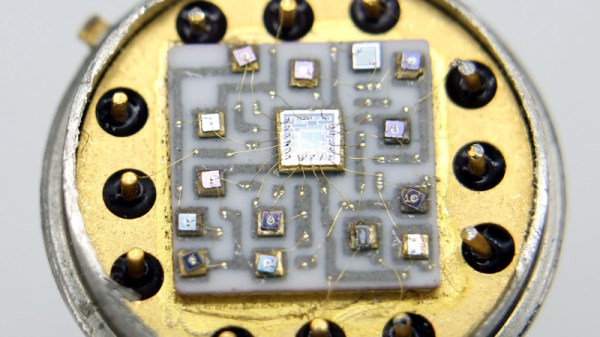
The metal can revealed a hybrid circuit when the lid was removed, one in which individual transistors were wired together with a single block containing a group of thin-film resistors. At the start of the 1960s the height of consumer electronics would have been your domestic TV which would have been an all-tube affair, so while it sounds archaic this would truly have been a space-age piece of technology. The designer is revealed as the legendary [Bob Pease], and the transistors take us back to the semiconductor physicist [Jean Hoerni], inventor of the planar transistor and one of the famous eight defectors from Shockley Semiconductor in the 1950s who kick-started the semiconductor boom.
The op-amp itself is a relatively simple design without the compensation capacitor you might expect in a modern device, but what makes it unusual for its time is the use of [Hoerni]’s planar JFETs at its input. [Ken]’s analysis is as usual extremely thorough, and the bit of Silicon Valley history it gives us is the icing on the cake.
High-capacity lithium batteries tend to make everything in life better. No longer must you interact with your fellow human beings if your car battery goes flat in the carpark. You can jump the car yourself, with a compact device that fits in your glovebox. [Big Clive] decided to pull one apart and peek inside, and it’s quite the illuminating experience.
The first thing to note is there is almost no protection at all for the lithium battery inside. The output leads connect the lithium pack inside directly to the car battery, save for some diodes in series to prevent the car’s alternator backcharging the pack. [Clive] demonstrates this by short circuiting the pack, using a copper pipe as a test load to measure the current output. The pack briefly delivers 500 amps before the battery gives up the ghost, with one of the cells swelling up and releasing the magic smoke.
The teardown then continues, with [Clive] gingerly peeling back the layers of insulation around the cells, getting right down to the conductive plates inside. It’s a tough watch, but thankfully nothing explodes and [Clive]’s person remains intact. If you’ve never seen inside a lithium cell before, this is a real treat. The opened pack is even connected to a multimeter and squeezed to show the effect of the physical structure on output.
It would be interesting to compare various brands of jump starter; we imagine some have more protection than others. Regardless, be aware that many on the market won’t save you from yourself. Be careful out there, and consider jumping your car with an even more dangerous method instead (but don’t). Video after the break.
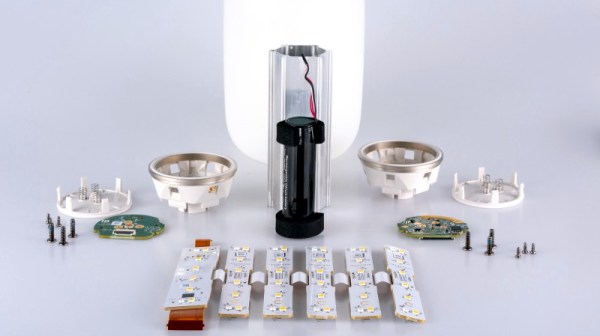
If you had asked us yesterday what peak nightlight technology looked like, we might have said one of those LED panels that you stick in the outlet. At least it beats one of those little wimpy light bulbs behind the seashell, anyway. But after looking at a detailed teardown of the “Glow Light” from Casper, we’ve learned a lot about the modern nightlight. Such as the fact that there are adults who not only sleep with nightlights, but are willing to pay $89 USD for one.
On the outside they might look like marshmallows, but the insides look far more like what you’d expect from an expensive piece of consumer gear. It’s based on the Nordic nRF52832 Bluetooth SoC which is becoming an increasingly common sight in consumer gadgets, and uses an inertial measurement unit (IMU) to detect when it’s moved or twisted and adjusts the light output accordingly. If you’ve got the disposable income for two of these things, they’ll even synchronize so that twisting one will dim its counterpart.
The teardown that [Tyler] did on the Glow Light is quite frankly one of the best we’ve ever seen, and while it might be a bit light on the gritty technical details, it more than makes up for that with the fantastic pictures that are about as close to actual hardware porn as you can get. The only question we have now is, how long until a hacker replicates this design with a 3D printed enclosure and an ESP?
Listen, it hurts to hear, but somebody needs to say it. It’s over, OK? You’ve got to admit it and move on. Sure, you could get away with it for a week or two in January, but now it’s just getting weird. No matter how hard you fight it, the facts are the facts: the holidays are over. It’s time to pack up all those lights and decorations before the neighbors really start talking.
Fun Fact: It can’t actually do this
But don’t worry, because there’s an upside. Retailers are now gearing up for their next big selling season, which means right now clearance racks the world over are likely to be playing home to holiday lights and decor. That wouldn’t have been very interesting to the average hacker or maker a few years ago, after all, there’s only so much you can do with a string of twinkle lights. But today, holiday decorations are dripping with the sort of high-tech features you’d expect from gadgets that are actively aiming to be obsolete within the next ten months or so.
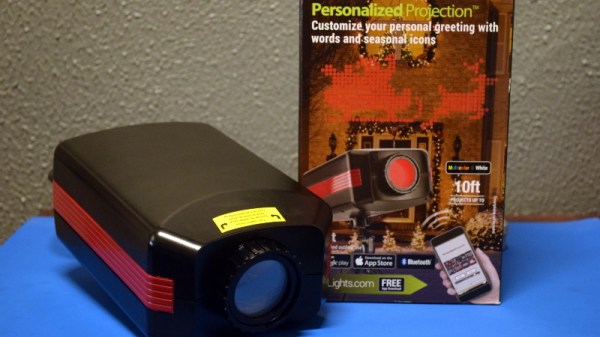
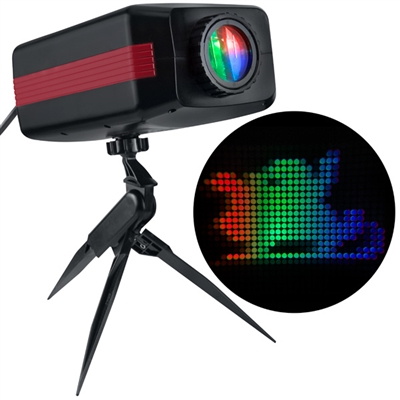
Case in point, the “AppLights Personalized Projection” which I found sulking around the clearance section of the Home Depot a couple weeks back. This device advertises the ability to project multi-color custom messages and animations on your wall, and is configured over Bluetooth with a companion application on your Android or iOS device. At a minimum we can assume the device must contain a fairly powerful RGB LED, an LCD to shine the light through, and some sort of Bluetooth-compatible microcontroller. For $20 USD, I thought it was worth taking a shot on.
Around this time last year, the regular Hackaday reader may recall I did a teardown for a Christmas laser projector. Inside we found red, green, and blue lasers of considerable power, as well as all the optics and support hardware to get them running. It was a veritable laser playground for $14. Let’s see if the AppLights projector turns out to be a similar electronic cornucopia, and whether or not we’ve got a new Hackaday Holiday tradition on our hands.
[Big Clive] picked up some chip-on-board (COB) LEDs meant for hydroponics that were very unusual and set out to examine them on video. Despite damaging the board almost right away, he managed to do some testing on these arrays and you can see the results in the video below. He also compares it to older LED modules.
The 144 LEDs produce a lot of light. In addition to powering the device up, he also looks at the construction of the LEDs under a magnification, comparing the older style that used tiny bond wires to make connections versus the new version soldered on the board directly.
There’s an old joke that all you need to fix TVs is a cheater, a heater, and a meter. If you don’t remember, a cheater was a cord to override the interlock on TVs so you could turn them on with the back removed. Of course, in real life, pro repair techs always had better equipment. In 1939 that might have meant the Supreme Vedolyzer which combined a meter, a ‘scope, and a wavemeter all in one device. [Mr Carlson] acquired one that was in fair shape and made a few videos (see below) of the teardown and restoration.
[Mr Carlson] wasn’t restoring this as an art project, by the way. He plans on using it, so he was less concerned with authenticity and more worried about usability. That led him to do things like remove the input jacks and replace them with BNCs. The video series is a bit of a time investment. Part one is about 82 minutes long! But if you are interested in old gear, this is a chance to peer inside an unusual specimen.