DIY WiFi Analyzer Sniffs Out Congestion And Coverage Issues, Suggests Fixes

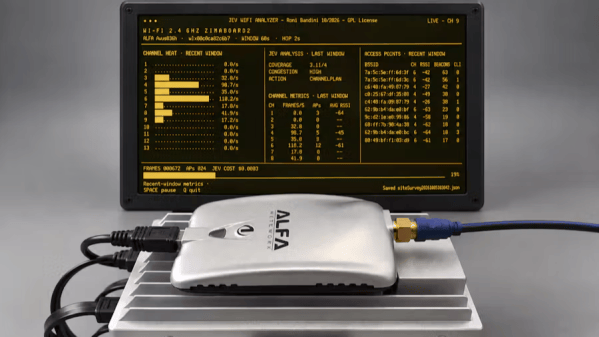
[Roni Bandini]’s JEV WiFi Analyzer is an interesting experiment that glues together a single-board Linux computer, a USB WiFi adapter, and a specialized AI model to create a new kind of automated tool that passively monitors WiFi activity to measure and profile coverage, congestion, and suggest possible optimizations.
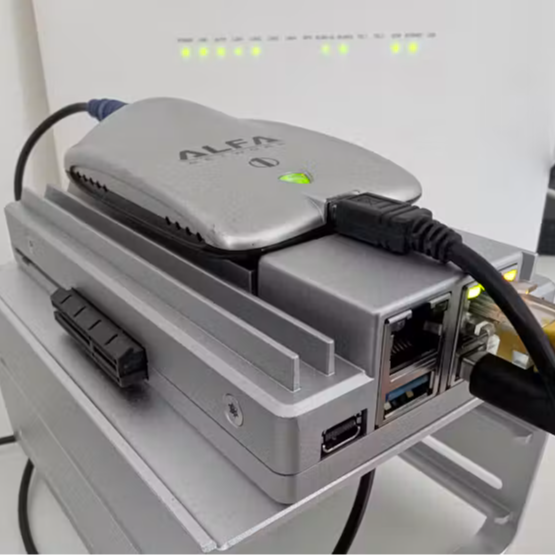
Here’s how it works: a Python program connects to WiFi, cycles through available channels, and uses scapy to gather details like signal strength, number of clients, WiFi frames per second, and similar data about each given channel. That data is fed to Jev, a highly efficient sort of decision-making AI model responsible for interpreting that data on an ongoing basis.

Briefly, Jev is a new kind of AI that is completely unable to generate text or images. It outputs only numbers representing bounded decisions. We covered these decision-making models earlier, including locally-installed versions. Jev is cheap enough to throw at a variety of problems, but it’s also practical to run your own model on your own hardware.

In [Roni]’s analyzer, Python gathers the raw numbers and Jev takes care of classifying the WiFi network’s coverage, congestion level, and basic remedial actions if applicable. There’s a brief video embedded below (Spanish only) that shows the Jev WiFi Analyzer in action.

The AI isn’t making particularly deep analyses, but it doesn’t take much to imagine Jev taking a more active role like deciding which channels to spend more (or less) time monitoring. Using a decision-making model in this way is interesting, and makes us wonder if similar models integrated with other kinds of hardware is a branch of projects waiting to happen.

Continue reading “DIY WiFi Analyzer Sniffs Out Congestion And Coverage Issues, Suggests Fixes” →

2026 Retrocomputing Challenge: Dollhouse Arcade Cabinet Runs Remote DOS Games

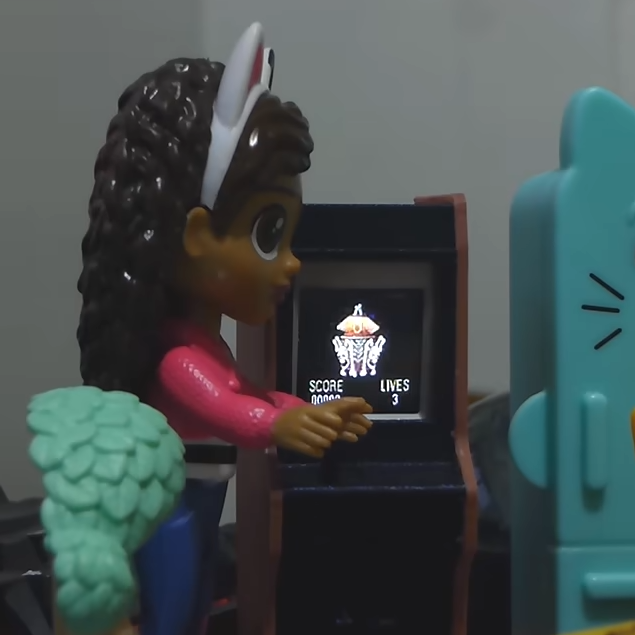
Classic DOS games never ran from within stand-up arcade cabinets in dollhouses, but [Juha Lilja] imagines a world in which they did. His Micro DOS arcade cabinet is described as a device that “runs nothing” because the tiny unit is actually streaming the games over Wi-Fi from a nearby PC. That doesn’t mean it’s just a glorified movie player, though — the cabinet is playable, if a bit awkward to do so.

An economical development board and a 3D-printed enclosure is all it takes to put classic DOS games into dollhouse-sized arcade cabinet.

The core of the micro arcade cabinet is a M5Stack AtomS3R running as an embedded remote terminal. One tilts the whole cabinet as if it were a virtual joystick to send up, down, left, and right. Button presses are done by pushing on the physical screen; it supports single, double, and long-clicks. While in theory one could install a micro joystick and buttons instead, [Juha] aimed to keep everything self-contained and use only what was already built into the AtomS3R. In this case, that’s a motion sensor and the single button which is activated by pressing the screen.

The games themselves run on a PC, with screen contents being streamed wirelessly to the little display and inputs being sent back. The firmware on the AtomS3R doesn’t know or care what game is being played; all it does is display what it’s told, and send back input events. The back end does the rest. This makes it pretty flexible, and a tiny arcade cabinet is a handy way to demonstrate the whole system. It’s a pretty slick addition to his daughter’s dollhouse, too.

If streaming DOS games (or whatever else) to economical endpoints is giving you some ideas, the GitHub repository holds code and a fuller explanation of how it works. There’s a deeper discussion on some of the finer technical points, as well. Watch it in action in the video embedded just below the page break.

Continue reading “2026 Retrocomputing Challenge: Dollhouse Arcade Cabinet Runs Remote DOS Games” →

ESP-SDR Can Now Transmit

Well, that was fast! Last week, we reported on two apparently simultaneous hacks using the 2.4 GHz radio inside many ESP32 variants that enabled raw access to the radio samples, turning it into a listen-only software defined radio (SDR) platform. Listen only? That’s only half of the SDR story.

Last weekend, [marble] got started fixing that, and released an early version of ESP32 firmware that can also transmit, and got receive working with gqrx. The demo communicates between an S3 and a C6 using a Hellschreiber mode, something that’s certainly out of the WiFi spec. And it didn’t stop there, either. [marble] is working on 802.15.4 modulation at the moment, which means that maybe soon your ESP32 will speak ZigBee.

This is all in the roughly 2.4 GHz band, but [marble] suggests that it might be good down to 1.8 GHz. (Editor’s note: previously, we said 100 MHz, but that was incorrect.) So there is still some uncharted terrain, and it’s clear that the boundaries on the ESP-SDR are just starting to get pushed.

If the early hacks on the RTL-SDR set off a wave of hacker SDR radio experimentation, and we can only hope that this is the beginning of the ESP-SDR era. Thanks then to [marble]– and the original hacks coming from the Espargos team for kicking this all off!

ESP32 As Your Raspberry Pi’s Linux Wireless Co-processor

A laptop with no wireless connectivity feels like a rarity – but when you shop for powerful Linux single-board computers (SBCs), it is pretty common to see one skimp on WiFi. At the same time, current wireless cards can leave much to be desired. A mess of proprietary firmware, ephemeral or even binary blob drivers, weird glitches never resolved, and sometimes entirely source-less blobs with an expiration date. Maybe the SBC doesn’t have a free USB port for a plug-and-play WiFi chip, or you don’t want to design for an obscure hard-to-source castellated module.

What if I told you there’s a unique solution to the problem, as long as the SBC has an SDIO or SPI to spare? There’s a wireless card we can all try to get behind, and it’s certainly not flawless but gives us way more room to grow – it’s got somewhat open-source firmware, it comes from a respectable company, and it’s nigh-guaranteed to be easy to source. I am, of course, talking about esp-hosted – using ESP32 modules as your WiFi/BT card, over SDIO or SPI.

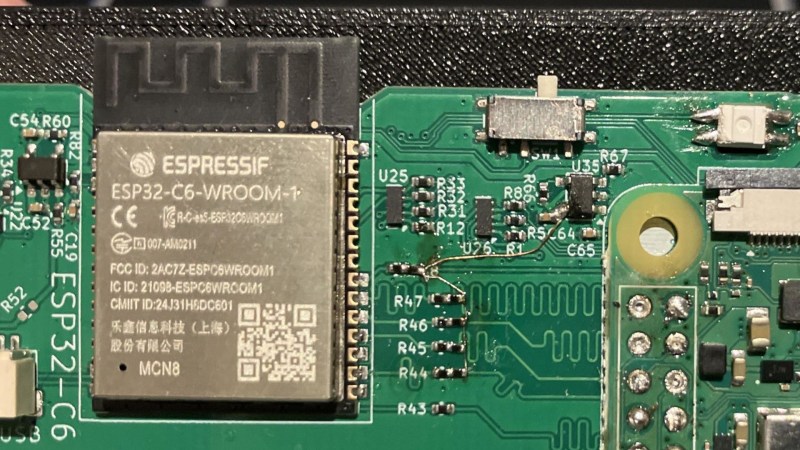
I’ve recently added an ESP32-C6 into my project, and setting up esp-hosted wasn’t ultra straightforward – so here’s a guide, and a discussion on what makes esp-hosted so cool and so incredibly promising. Spoilers: it works with privacy switches that cut out power, it could be hacked into a coprocessor for mesh protocols, and it could potentially help us build a fully open-source SDIO WiFi card.

Continue reading “ESP32 As Your Raspberry Pi’s Linux Wireless Co-processor” →

A Mechanical Radio, Sort Of

[The Mike Stuff] has an interesting proposition. He asserts that ancient people like the Greeks could have built a form of radio that was purely mechanical. We aren’t sure we agree, but even if it were possible, we are sure it would have sounded awful. You can see the details in the video below.

The idea is that you can compress air with a waterwheel, blow it through a rotating disk with slots in it, and a valve to amplitude modulate the airflow through the disk. Horns like an old gramophone speaker would amplify the signal at both ends. The demodulation is straightforward and doesn’t even require power, like compressed air.

Continue reading “A Mechanical Radio, Sort Of” →

An IR Blaster Project, In A Nutshell

The speed that computers have gotten smaller is a bit mind-bending. Most of us now walk around with computers in our pockets that would have rivaled the supercomputers from a few decades ago. And, although it seems like the speed at which things are getting smaller and faster has slowed a bit compared to the rapid pace of the 90s and 00s, some truly minuscule computers are accessible nowadays. So much so that it’s possible to do useful computing inside a walnut shell.

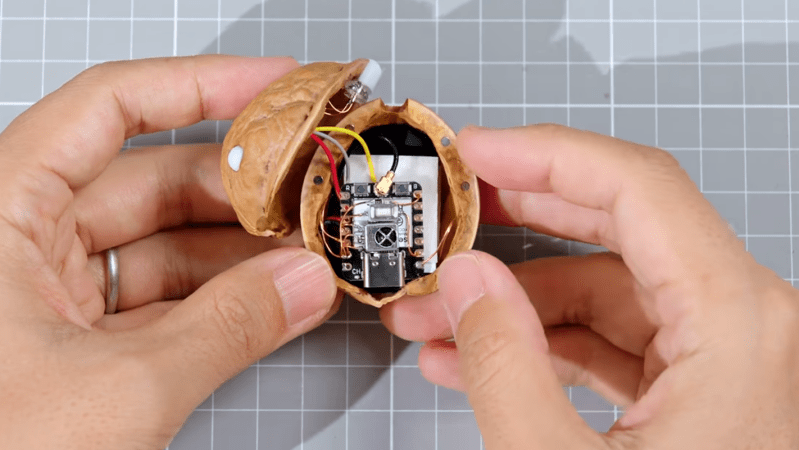
The first step in this build is to crack into a walnut. Most have a natural seam that separates two hemispheres, so splitting it open, enjoying a small snack, and then adding some small neodymium magnets on the inside of that seam to close up the shell is not too difficult. From there, some LEDs were installed at various points in the shell, with an ESP32-C3 installed in the middle to control everything and oriented so that its USB port is still accessible.

Although putting a small microcontroller in a nutshell might seem like a novelty, [JSK-koubou] is actually using the LEDs to perform a useful task. The walnut sits in his living room and connects to a home automation system through the ESP32, and when it receives a command it uses the LEDs to send infrared signals to non-connected devices. Hiding projects in unexpected places is a fun pastime, like this Meshtastic node hidden in a landscape light.

Continue reading “An IR Blaster Project, In A Nutshell” →

Building An Energy-Harvesting Business Card

The hope is always that a good business card will leave a good impression. For those in the electronics field, they also serve as an opportunity to showcase creative design skills. [Wilson Harper] demonstrates that ably with a rather nifty energy-harvesting build.

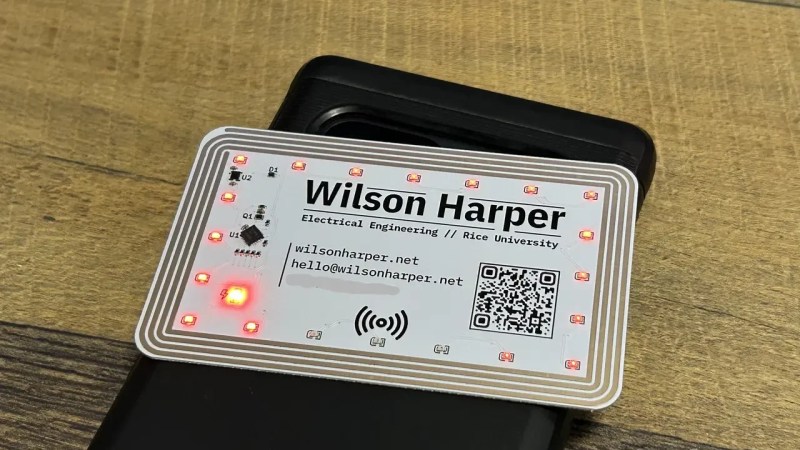
The card is based around a thin PCB in the typical business card size. It’s populated by 21 Charlieplexed LEDs, a small microcontroller, and some supporting components. Now, this is normally where you might expect the device to be powered by a small coin cell, maybe deftly integrated into the PCB thickness itself to make the card less cumbersome. But no—[Wilson] went a different route. The thing is that in 2026, most of us are carrying phones with NFC readers built in. Thus, the card was built to harvest this source of energy with a PCB trace antenna, designed with the aid of STM’s antenna inductance tools and an LLM script lobbed into KiCad. All one needs to do is to pop the card on the back of a phone and the LEDs animate joyfully.

Design files are on Github for the curious. You might also like to check out some of the fancy business cards we’ve featured in the past. Of course, if you’re working on just such a project yourself, you’re more than welcome to send it in to the tipsline!