Finding Your Motorbike Using Wi-Fi

An urban planner once told me that every car requires at least four times as much space as they actually occupy. Each needs a spot on the roads, and three available parking spaces: one at home, one at work, and one to shop. Motorcycles are much smaller, but they still spend most of their time parked.

Motorcycles are the primary means of transport in Southeast Asia, and learning to safely drive one is an essential part of adapting to life here. Assuming it’s not pouring rain and you’re not flooded past your ankles, it’s actually quite a pleasant experience… until you have to park.

Unlike the parking lots you may be familiar with, there’s no expectation that your bike won’t be moved. In fact, it might very well end up on another floor, in another parking lot, or behind hundreds of impassable parked bikes on the roof. In the latter case, the attendant will shrug and suggest you come back in a few hours. Eventually, this won’t even register as a frustration – you will simply reason that there are plenty of other things that are more convenient here, like the weather (recent typhoon aside) or unlimited symmetrical fiber to the home for USD 5 a month.

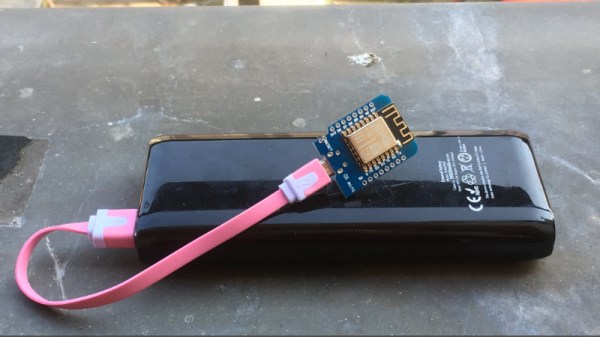
That being said, with a little technology the problem could be lessened a bit while waiting for automated parking lots to become commonplace. On rare occasions I see people with little radio emitters that make their headlights flash, but they’re not terribly common here and require carrying yet another thing on my already full key chain (homes here typically use several different locks). It seemed pretty easy to pull off something similar using my smart phone with an ESP8266 running NodeMCU. I had been meaning to try out the sleep modes to save battery power anyway, so off I went.

Continue reading “Finding Your Motorbike Using Wi-Fi”

Samy Kamkar: Reverse Engineering For A Secure Future

Show of hands: how many of you have parked your car in the driveway, walked up to your house, and pressed your car’s key fob button thinking it would open the front door? We’ve probably all done it and felt a little dopey as a result, but when you think about it, it would be tremendously convenient, especially with grocery bags dangling off each arm and the mail clenched between your teeth. After all, we’re living in the future —  shouldn’t your house be smart enough to know when you’re home?

Reverse engineer par excellence Samy Kamkar might think so, but given his recent experiences with cars smart enough to know when you’re standing outside them, he’d probably have some reservations. Samy dropped by the 2017 Hackaday Superconference in November to discuss the finer points of exploiting security flaws in passive car entry systems, and also sat down with our own Elliot Williams after his talk for a one-on-one interview. Samy has some interesting insights on vehicle cybersecurity, but the practical knowledge he’s gained while exploring the limits of these systems teach some powerful lessons about being a real-world reverse engineer.

Continue reading “Samy Kamkar: Reverse Engineering For A Secure Future”

Wireless Charger Truck Mod Keeps Juice Flowing On The Move

Wireless charging is great tech, but its relative novelty means it may not be everywhere you want it. When one of those places is your vehicle, well, you make like [Braxen McConnell] and crack it open to install a wireless charger!

After dismantling the centre console, [McConnell] had to make a few cuts behind the scenes to make room for the wireless charger — as well as cutting down the charger itself. He also took apart the charger and flipped the board and charging coil around inside its case; the reason for this is the closer the coil is to the phone, the better. The charger will already be hidden behind the plastic of the centre console, so it’s no good to be fighting through the extra distance of the charger’s internals. The charger was mounted with double-sided tape, since it’s relatively light and won’t be knocked about.

[McConnell] tapped into the accessory circuit on his truck so it would only be drawing current when the truck is on — nobody likes coming back to a dead battery! Power comes from a cigarette outlet connected to a USB car charger, which then powers the wireless charger — it’s a little hacky, but it works! Once the wireless charger is plugged in and the centre console is reinstalled, [McConnell] was set! Check out the build video after the break.

Continue reading “Wireless Charger Truck Mod Keeps Juice Flowing On The Move”

Hunting Rogue Access Points With The ESP8266

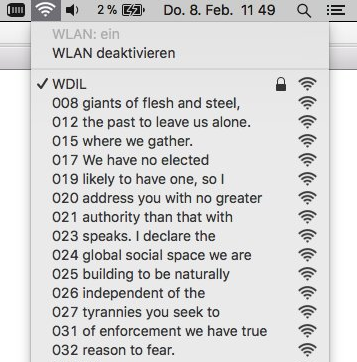
Cantennas outperform every consumer-grade Wi-Fi antenna I’ve had the bad luck of purchasing. Cantenna is a mashup of ‘can’ and ‘antenna’ creating the nickname for a directional waveguide antenna built from re-purposed steel cans. For anyone who has yet to build one, it makes an excellent afternoon project. Here are some build instructions and technical details. I went beyond that, and ended up catching a rogue WiFi access point in the process.

When I needed to extend the range of some ESP8266-based sensors, cantennas were right at the top of my list of things to try. It was easy enough to build one, attach it to a Wemos Mini D1 Pro, and call the job done… leaving me with plenty of time to over-engineer it, and I ended up down a bit of a rabbit hole.

The first thing I did was stop using cans. Canned goods are not only expensive in my corner of the world, but more importantly don’t lend themselves that well to making a standardized antenna in volume. I can also only eat so many beans! The latter reason alone is enough to consider an alternative design like a modular dish reflector.

Continue reading “Hunting Rogue Access Points With The ESP8266”

The WiFi Repeater You Probably Have On Your Bench

Few things are as frustrating as a WiFi signal that drops in and out. On a public network it is bad enough but at home? Even if you can live with it, your cohabitants will certainly impune your technical abilities if they don’t have solid WiFi.  One solution is a WiFi repeater. You can buy one, of course. But you can also make one out of an ESP8266 and some code from GitHub. There is also a video about the project, below.

[Martin Ger’s] code implements NAT, so it isn’t a true WiFi repeater, but more of a bridge or router. Of course, that means performance isn’t stellar, but tests show it can sustain about 5 Mbps, which isn’t bad for a little board that costs a couple of bucks. There is a limit of 8 clients, but that’s more than enough for a lot of cases. Even if you don’t want to use it as a router, it has a mesh mode that could be a basis for some interesting projects all by itself.

Continue reading “The WiFi Repeater You Probably Have On Your Bench”

Control A Quadcopter Over Websockets

The interface

Everyone’s favourite IOT module, the ESP8266, is often the go-to choice for any project that needs quick and cheap control over the web. [Andi23456] wanted to control his quadcopter using the luxury of his mobile phone and thought permanently tethering an ESP12-E module to the quadcopter was exactly what he required.

The ESP8266, really showcasing its all-round prowess, hosts both a web server for a HTML5 based joystick and a Websockets server so that a client, such as a phone, could interact with it over a fast, low latency connection. Once the ESP8266 receives the input, it uses interrupts to generate the corresponding PPM (Pule Position Modulation) code which the RC receiver on the quadcopter can understand. Very cool!

What really makes this realtime(ish) control viable is Websockets, a protocol that basically allows you to flexibly exchange data over an “upgraded” HTTP connection without having to lug around headers each time you communicate. If you haven’t heard of Websockets you really should look really check out this library or even watch this video to see what you can achieve.

Neural Network Learns SDR Ham Radio

Identifying ham radio signals used to be easy. Beeps were Morse code, voice was AM unless it sounded like Donald Duck in which case it was sideband. But there are dozens of modes in common use now including TV, digital data, digital voice, FM, and more coming on line every day. [Randaller] used CUDA to build a neural network that could interface with an RTL-SDR dongle and can classify the signals it hears. Since it is a neural network, it isn’t so much programmed to do it as it is trained. The proof of concept has training to distinguish FM, SECAM, and tetra. However, you can train it to recognize other modulation schemes if you want to invest the time into it.

Continue reading “Neural Network Learns SDR Ham Radio”