Dub Siren, a 555-powered synthesizer

Classic Chip Line-Up Powers This Fun Dub Siren Synth

There’s a certain elite set of chips that fall into the “cold, dead hands” category, and they tend to be parts that have proven their worth over decades, not years. Chief among these is the ubiquitous 555 timer chip, which nearly 50 years after its release still finds its way into the strangest places. Add in other silicon stalwarts like the 741 op-amp and the LM386 audio amp, and you’ve got a Hall of Fame lineup for almost any project.

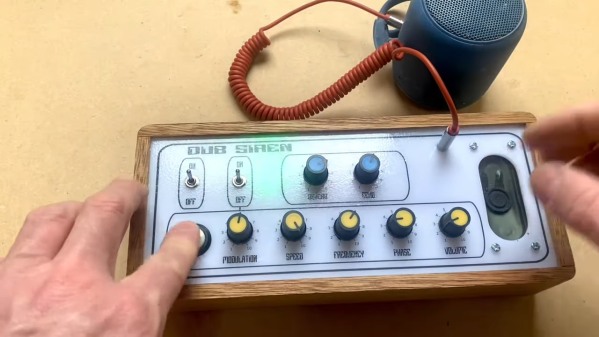
That’s exactly the complement of chips that powers this fun little dub siren. As [lonesoulsurfer] explains, dub sirens started out as actual sirens from police cars and the like that were used as part of musical performances. The ear-splitting versions were eventually replaced with sampled or synthesized siren effects for recording studio and DJ use, which leads us to the current project. The video below starts with a demo, and it’s hard to believe that the diversity of sounds this box produces comes from just a pair of 555s coupled by a 741 buffer. Five pots on the main PCB control the effects, while a second commercial reverb module — modified to support echo effects too — adds depth and presence. I built-in speaker and a nice-looking wood enclosure complete the build, which honestly sounds better than any 555-based synth has a right to.

Interested in more about the chips behind this build? We’ve talked about the 555 and how it came to be, taken a look inside the 741, and gotten a lesson in LM386 loyalty.

Continue reading “Classic Chip Line-Up Powers This Fun Dub Siren Synth”

The Most Important Device In The Universe on display at Modern Props

The Most Important Device In The Universe Is Powered By A 555 Timer

The Hackaday comments section has become infamous for a recurring theme that goes something like “I don’t know why they used an Arduino, they could have done it with a 555 timer!” If you’ve ever thought the same way, then this post is for you!

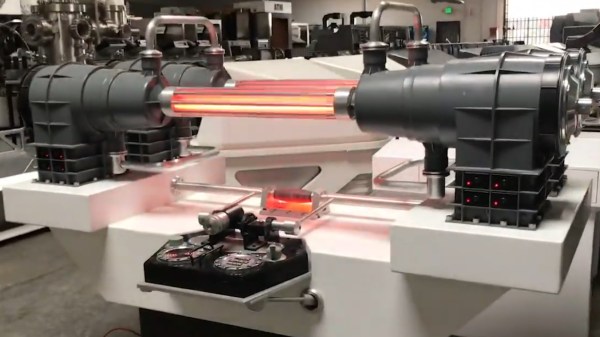
What is The Most Important Device In The Universe, then? It’s the Modern Props #195-290-1, a movie prop originally built in the 1970’s. It’s a product of the creative mind of [John Zabrucky] who founded Modern Props in 1977 to serve Sci-Fi television and movie productions that wanted to invent the future with their props. Known for their high quality and impeccable craftsmanship, Modern Props’ products were in demand until the day they closed the doors so that [John] could retire.

This particular piece is called The Most Important Device In The Universe due to its ubiquity in modern productions that we’ve all heard of: several Star Trek franchises, The Last Starfighter, Knight Rider, Airplane II, Austin Powers, and countless others. The next time you sit down to watch a Sci-Fi show, see if you can spot it! Be sure to check the video below the break to see several examples.

Nobody is sure what The Most Important Device does, aside from the fact that it has red lights that go back and forth. What we do know, thanks to a comment by the man who installed the electronics, [Gene Turnbow], is how it’s powered. [Gene] explained that 45w NPN power transistors drive the neon tubes through step up transformers. The transistors themselves are connected to a 74C4514 demultiplexer, which is itself driven by a 7493 binary counter. What’s the 7493 driven by? You guessed it: the venerable 555 Timer. And so it is that the 555 timer runs The Most Important Device In The Universe.

We did think that [Gene]’s final comment was rather indicative of how much things have changed since the prop was originally built. After explaining the device, he says “These days we would just use an Arduino to do the same job.” Indeed.

Don’t worry, 555 lovers. We’ve got you covered with this Vacuum Tube 555, and and the Trollduino, a 555 on an Arduino Shield. Thanks [Matt K] for the great tip. Don’t forget to submit your favorite hacks to our Tip Line!

Continue reading “The Most Important Device In The Universe Is Powered By A 555 Timer”

So You Can Solder Small SMD Devices. The Question Is, Just How Small?

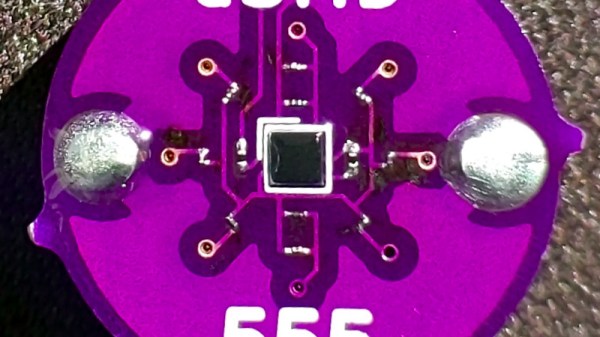
A highlight of last year’s Hackaday Remoticon was a soldering competition that had teams from around the world came together online and did the well-known MakersBox SMD Challenge kit in which a series of LED circuits of decreasing size must be soldered. The Hackaday crew acquitted themselves well, and though an 01005 resistor and LED certainly pushes a writer’s soldering skills to the limit it’s very satisfying to see it working. Lest that kit become too easy, [Arthur Benemann] has come up with something even more fiendish; his uSMD is a 555 LED flasher that uses a BGA 555 and a selection of 008004 small components.

The trick with an 01005 is to heat not the tinned and fluxed solder joint, but the trace leading up to it. If components of that size can be mastered then perhaps an 008004 isn’t that much smaller so maybe the same technique might work for them too. In his tip email to us he wrote “Soldering 008004 isn’t much worse than a 0201, you just need magnification“, and while we think he might be trolling us slightly we can see there’s no reason why it shouldn’t be do-able. Sadly he doesn’t seem to have made it available for us to buy and try so if you want to prove yourself with a soldering iron you’ll have to source the PCBs and parts yourself. Still, we suspect that if you are the type of person who can solder an 008004 then that will hardly be an onerous task for you.

Meanwhile this isn’t the first soldering challenge kit we’ve brought you, and of course if you’d like to hone your skills you can find the MakersBox one on Tindie.

Smallest Discrete Transistor 555 Timer

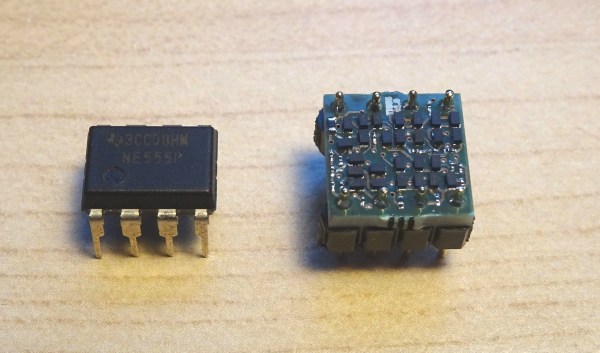
Over at Tiny Transistor labs, [Robo] took it upon himself to reproduce the classic 555 timer in discrete transistor form. For bonus points, he also managed to put it in a package that’s the same basic size, pin compatible with, and a plug-in replacement for the original. The first task was deciding which 555 circuit to implement. He examined a handful of different implementations — and by examined, we mean dissected them and studied the die circuitry under a microscope. In the end, he went with Hans Camenzind’s original circuit, both as a tribute and because it used the fewest transistors — a point which helped manage the final size, which is only a little bit bigger than the IC!

Speaking of sizes, have you ever soldered an EIA 01005 resistor? We agree with [mbedded.ninja] who wrote on a post about standard chip resistor sizes, the 01005 is a “ridiculously small chip package that can barely be seen by the naked eye.”  It is 16 thou x 8 thou (0.4 mm x 0.2 mm) in size, and despite its name and placement in the Imperial series, it is not half the size of an 0201. The transistors are your standard 2N3904 / 2N3906, but purchased in a not-so-standard DFN (Dual Flat Pack, No Leads). We might think a 1.0 x 0.6 mm component as small, but compared to its neighboring resistors in this circuit, it’s huge.

[Robo] has done this kind of project before, most recently making a discrete recreation of of the classic 741 op-amp. We covered a similar, but larger, discrete 555 timer project back in 2011. If you want to go really big-scale with your own reproduction project, check out the MOnSter 6502 from five years ago for further inspiration. Thanks to [Lucas] for the tip.

WiFive55: More Than A Smart 555 Replacement

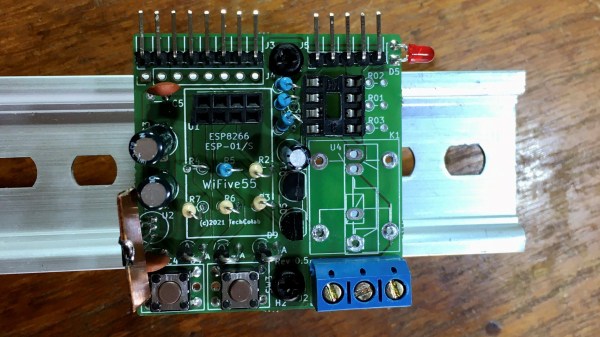
“You could’ve done that with a 555 timer.” But what if all you have on hand is an ESP8266? [TechColab] needed to control a solenoid valve with a short pulse via a solid-state relay (SSR) but found that the trusty 555 timer was tricky to set properly. Additionally, they wanted to add features, such as fixed pulse length, that were difficult to implement—even with multiple timers. Still wanting to keep things cheap and accessible, [TechColab] has created the WiFive55, a 555 replacement based on the ESP-01 ESP8266 board.

[TechColab] began by investigating existing ESP-01 solid-state relay boards but found that many of them momentarily enable the output on startup—a risk [TechColab] deemed unacceptable. This was resolved in the WiFive55 by adding an RC filter to the SSR output, eliminating the output glitches at the cost of slowing switching time to around 20 ms—an acceptable trade for many SSR applications.

Since they were going to design a new PCB to support this improved ESP-01 SSR controller, [TechColab] decided to go all-out. To support loads of widely varying sizes, the PCB supports an optoisolator that switches up to 1 A, a MOSFET that switches up to 2 A, and an on-board relay or SSR that can switch up to 3 A. For heavy loads, it includes connections for an off-board SSR, which allow it to switch whatever current the SSR can handle (easily over 50 A). Because the ESP-01 is slightly more capable than the 555, the WiFive55 supports control via WiFi, GPIO, serial, and push-button. Keeping with the WiFive55’s original role as a 555 replacement, it even includes a header exposing a 555-like trigger and output interface!

We always like seeing inexpensive boards like the ESP-01 being used to their full potential, and we can’t wait to see what software [TechColab] cooks up for this! If you’re interested in getting started with the ESP-01, you might consider starting with this guide to blinking an LED over WiFi.

Stepper Motors Quick And Simple

If you want a simple and easy introduction to stepper motors, check out the [IMSAI Guy]’s short video where he designs a very basic stepper motor controller and packs in a lot of quick lessons along the way. (Embedded below.)

He first goes over the fundamentals of a stepper motor in a practical, hands-on approach, and also shows us how to ring out the connections if the pinout is unknown. Next he demonstrates stepping the motor manually and then makes a simple FET driver circuit. Just when you’re expecting a small microcontroller to appear, the [IMSAI Guy] instead digs deep into his junk box and explains how to drive the motor with a 22V10 GAL (an electrically erasable PAL) and a 555 timer module. Based on a clearly-explained logic table for driving the coils, a sneaky way to introduce Karnaugh maps, he proceeds to write the output equations in WinCUPL.

Mature Readers will recall the “Happy PAL” Character

WinCUPL is the modern version of CUPL (Compiler for Universal Programmable Logic) originally written by a company called Assisted Technology, now owned by Altium. CUPL and peers like PALASM from Monolithic Memories, Inc. (MMI) and ABEL from Data I/O Corporation were basic Hardware Description Languages specifically designed for PALs, GALs, and CPLDs. PALs were small arrays of logic gates with fusible interconnections, and your design is “burned” into the fuses much like a (EE)PROM. When designing with PALs, you could clearly visualize the connections in your mind, something that has since been remedied by the advent of modern FPGAs.

Alas, he cuts out the part where the source code is compiled and the 22V10 is programmed, and jumps directly into testing the circuit on a breadboard. Spoiler alert — it does work. Zooming in close and squinting, the nifty 555 timer breadboard module that he points out is called a TP353, which you can find from your favorite online supplier.

There is a lot to learn in this tutorial, and the [IMSAI Guy] does a great job at making the subject approachable to hobbyists and novices. We also covered another of his tutorials a couple of weeks ago on image sensors. Thanks to [itsevilbert] for the tip.

Continue reading “Stepper Motors Quick And Simple”

Peek Into This Synth’s Great Design (And Abandoned Features)

[Tommy]’s POLY555 is an analog, 20-note polyphonic synthesizer that makes heavy use of 3D printing and shows off some clever design. The POLY555, as well as [Tommy]’s earlier synth designs, are based around the 555 timer. But one 555 is one oscillator, which means only one note can be played at a time. To make the POLY555 polyphonic, [Tommy] took things to their logical extreme and simply added multiple 555s, expanding the capabilities while keeping the classic 555 synth heritage.

The real gem here is [Tommy]’s writeup. In it, he explains the various design choices and improvements that went into the POLY555, not just as an instrument, but as a kit intended to be produced and easy to assemble. Good DFM (Design For Manufacturability) takes time and effort, but pays off big time even for things made in relatively small quantities. Anything that reduces complexity, eliminates steps, or improves reliability is a change worth investigating.

For example, the volume wheel is not a thumbwheel pot. It is actually a 3D-printed piece attached to the same potentiometer that the 555s use for tuning; meaning one less part to keep track of in the bill of materials. It’s all a gold mine of tips for anyone looking at making more than just a handful of something, and a peek into the hard work that goes into designing something to be produced. [Tommy] even has a short section dedicated to abandoned or rejected ideas that didn’t make the cut, which is educational in itself. Want more? Good news! This isn’t the first time we’ve been delighted with [Tommy]’s prototyping and design discussions.

POLY555’s design files (OpenSCAD for enclosure and parts, and KiCad for schematic and PCB) as well as assembly guide are all available on GitHub, and STL files can be found on Thingiverse. [Tommy] sells partial and complete kits as well, so there’s something for everyone’s comfort level. Watch the POLY555 in action in the video, embedded below.

Continue reading “Peek Into This Synth’s Great Design (And Abandoned Features)”