Cool Off With A Piezo And A Glass Of Water

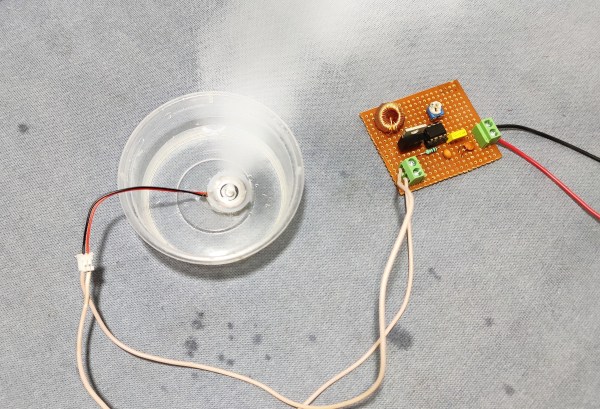
Some cool-mist humidifiers work by flinging water at a vaporizer, but our favorite kind uses a piezoelectric transducer. These work by using high-frequency sound waves to pound the surface of the water with mechanical energy. That energy introduces standing waves that force the water to break apart into a fine mist on the surface of the piezo disk.

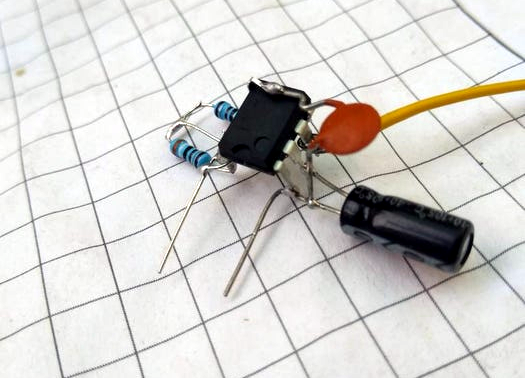
The driving circuit for this DIY mist maker uses a 555 to generate 113 KHz, a trimmer potentiometer to fine-tune it, and a MOSFET to amplify the signal. You don’t need much more than that and a handful of passives to recreate this cool junk box experiment, but the spec of the piezo disk is quite important. The circuit is designed for atomizing transducers, which have a resonant frequency of 113 KHz — much higher than your average junk box piezo. Check out the demo and build video after the break.

Atomizing transducers can do way more than than moisten the air for our comfort. They’re not picky about where the water comes from, so if you have enough of them, you can dry a load of laundry in a few minutes.

Continue reading “Cool Off With A Piezo And A Glass Of Water”

Tiny Circuit Sculpture Keeps The Night Watch

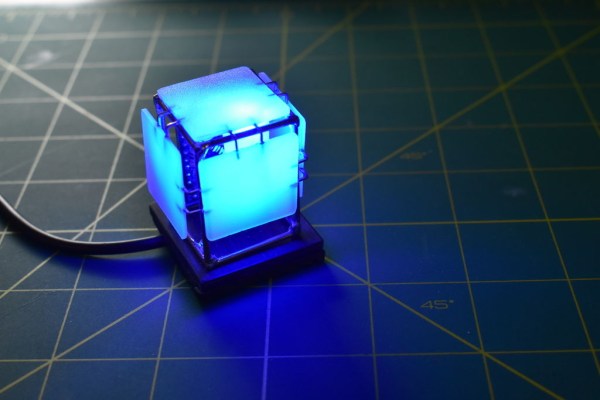
If you’re planning to get into circuit sculpture one of these days, it would probably be best to start with something small and simple, instead of trying to make a crazy light-up spaceship or something with a lot of curves on the first go. A small form factor doesn’t necessarily mean it can’t also be useful. Why not start by making a small automatic night light?

The circuit itself is quite simple, especially because it uses an Arduino. You could accomplish the same thing with a 555, but that’s going to complicate the circuit sculpture part of things a bit. As long as the ambient light level coming in from the light-dependent resistor is low enough, then the two LEDs will be lit.

We love the frosted acrylic panels that [akshar1101] connected together with what looks like right angle header pins. If you wanted to expose the electronics, localize the light diffusion with a little acrylic cover that slips over the LEDs. Check it out in the demo after the break.

There’s more than one way to build a glowing cuboid night light. The Rubik’s way, for instance.

Continue reading “Tiny Circuit Sculpture Keeps The Night Watch”

A Shrine For All The 555 Lovers

For many of our readers, the classic 555 timer holds a special place in their heart, and cursed be the fool who dares to use an Arduino in its place. For the seriously devoted ones, or those who simply like a novelty decorative item, [acerlaguinto7] built just the right thing: a giant, actually functional, cardboard 555 timer IC.

Taking all the measurements of the original IC, [acerlaguinto7] scaled it up by factor 22 and started cutting out pieces of cardboard — also considering the orientation notch — and added the markings to emulate TI’s NE555P. Next he took a bunch of aluminum cans apart and shaped them into the pins, again staying as close as possible to the original. To top it all off, he put an actual NE555 inside the giant counterpart, and hooked it up to the soda can pins, turning it into a fully operational, oversized timer IC.

Obviously, giant conductive pins like that scream for some dead bug blinky light that even the shakiest of hands could manage to solder, and [acerlaguinto7] certainly delivers, as you can see in the video after the break. One nifty way we could see this taken further would be integrating this breadboard implementation as replacement for the 555 inside — or then just connect it to the giant Raspberry Pi.

Continue reading “A Shrine For All The 555 Lovers”

What Does The Bat Say? Tune In With This Heterodyne Detector

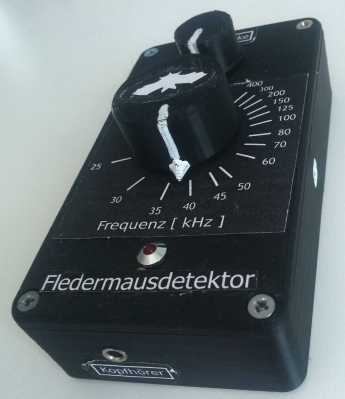
Bats are fascinating animals, and despite all the myth and creepiness surrounding them, they really remind one more of a drunk bird lost in the night sky than the blood-sucking creature they’re often made out to be. Of course, some really fall into that category, and unlike actual birds, bats don’t tend to grace us with their singsong — at least not in ways audible for us humans. But thanks to bat detectors, we can still pick up on it, and [Marcel] recently built a heterodyne bat detector himself.

Bat Detector in its enclosure
The bat detector (and an insight to the beauty of German language, where a bat is a flutter mouse)

The detector is made with a 555, an MCP6004 op amp, and a 4066 analog switch — along with a bunch of passives — and is neatly packed into a 3D-printed case with a potentiometer to set the volume and center frequency for the detection. The bat signal itself is picked up by a MEMS microphone with a frequency range [Marcel] found suitable for the task. His write-up also goes in all the mathematics details regarding heterodyning, and how each component plays into that. The resulting audio can be listened to through a headphone output, and after putting together an adapter, can also be recorded from his smartphone. A sample of how that sounds is added in his write-up, which you can also check out after the break.

In case you want to give it a try yourself, [Marcel] put all the design files and some LTSpice simulations on the project’s GitHub page. If you are curious about bat detectors in general and want to read more about them, follow [Pat Whetman] down that rabbit hole, or have a look at this one made in Python for something more software-focused.

Continue reading “What Does The Bat Say? Tune In With This Heterodyne Detector”

Repurposed UV Curer Makes Your Prints Hard As Nails

The price of resin printers has dropped significantly in the last couple of years, and it’s down to the point where you can pick up a fairly decent DLP machine for less than $500. While this is great news, you still need several things beyond resin for successful prints, like a way to do post-process UV curing.

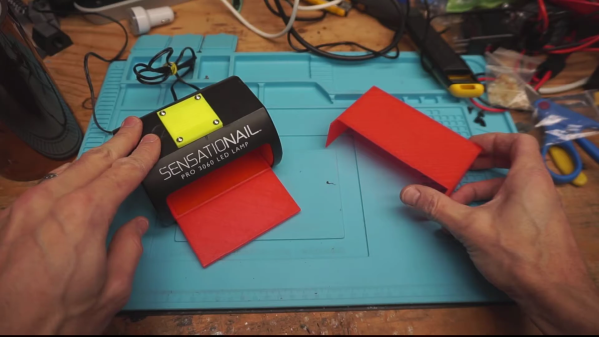
[Inhibit] picked up the formidably-priced Wanhao D7 awhile back. Rather than spending another printer’s worth of paper on a UV curing box, he rescued and repurposed a small commercial curing device meant for gel-based nail polish. You stick your fingertips in, switch it on, and it runs for 60 seconds and then shuts off.

It’s a great idea, but unfortunately prints don’t cure as fast as fingernails. So the first order of business was to bypass the dual 555-based timing system by wiring the UV LEDs directly to power. The manufacturer never intended for the lights to run continuously, so to keep the board from melting, [Inhibit] added in a small 12 V computer fan for cooling. There’s even a little printed grille with angled fins to keep UV light from leaking out and burning nearby retinas.

[Inhibit] also designed and printed a tray for the prints to sit on, and a front enclosure piece to focus as much light on the parts as possible. Files for both parts are floating around the Thingiverse, and we’ve got the build video all cured queued up after the break.

These little commercial boxes don’t cost all that much, but you could always just build your own.

Continue reading “Repurposed UV Curer Makes Your Prints Hard As Nails”

Dog-Harnessing The Power Of Walkie Talkies

[javier.borquez] likes to take his dog to the hang out at the dog park around dusk. But once the sun goes down and [Rusio]’s off the leash, running amok with the other dogs, it’s almost impossible to keep track of him.

Sure, there are probably glow-in-the-dark or lighted collars out there, but if you go commercial, chances are good that someone else’s dog will be wearing the same thing. Besides, what’s the fun in buying something that you can do a better job making yourself? With this dog distance indicator harness, you don’t even have to program anything. Instead, it uses a cheap pair of modified walkie talkies to show green LEDs on the harness while the dog is in range, and red when it isn’t.

Although [javier]’s pupper is the best pupper yes he is, [Rusio] can’t be expected to hold down the button and bark his location. His walkie talkie uses a 555-based frequency generator and a glued-down button to speak at 1 kHz.

Over in [javier]’s walkie, there’s a resistor in place of the speaker to keep the talkie parts working. There’s also a half-wave bridge rectifier that charges a capacitor when [Rusio] is within range, and a resistor that drains it when he’s outside the 6-8 meter range. The rectifier’s output goes to a second 555 set up as a Schmitt trigger, which tells a transistor to turn the red LEDs on instead.

If you got stuck on the idea of hearing your dog talk to you over distances, here’s a Bluetooth Babelfish collar.

Random Numbers From Outer Space

Need a random number? Sure, you could just roll a die, but if you do, you might invite laughter from nearby quantum enthusiasts. If it’s truly, unpredictably random numbers you need, look no farther than the background radiation constantly bombarding us from the safety of its celestial hideout.

In a rare but much appreciated break from the Nixie tube norm of clock making, [Alpha-Phoenix] has designed a muon-powered random number generator around that warm, vintage glow. Muons are subatomic particles that are like electrons, but much heavier, and are created when pions enter the atmosphere and undergo radioactive decay. The Geiger-Müller tube, mainstay of Geiger counters the world over, detects these incoming muons and uses them to generate the number.

Inside the box, a 555 in astable mode drives a decade counter, which outputs the numbers 0-9 sequentially on the Nixie via beefy transistors. While the G-M tube waits for muons, the numbers just cycle through repeatedly, looking pretty. When a muon hits the tube, a second 555 tells the decade counter to stop immediately. Bingo, you have your random number! The only trouble we can see with this method is that if you need a number right away, you might have to go get a banana and wave it near the G-M tube.

Whether this all makes sense or not, you should check out [Alpha-Phoenix]’s project video, which is as entertaining as it is informative. He’s planning a follow-up video focused on the randomness of the G-M tube, so look out for that.

Looking for a cheaper way to catch your random numbers? You can do it with a fish tank, some air pumps, and a sprinkle of OpenCV.

Continue reading “Random Numbers From Outer Space”