Silicone And AI Power This Prayerful Robotic Intercessor

Even in a world that is as currently far off the rails as this one is, we’re going to go out on a limb and say that this machine learning, servo-powered prayer bot is going to be the strangest thing you see today. We’re happy to be wrong about that, though, and if we are, please send links.

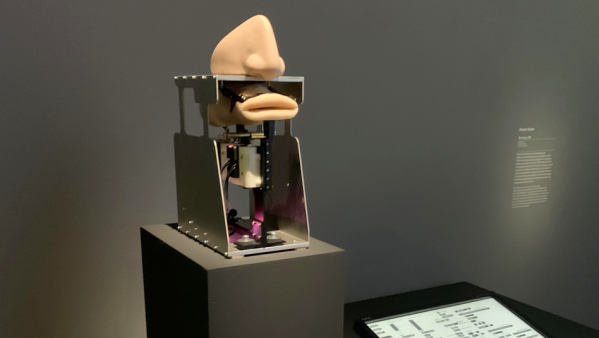
“The Prayer,” as [Diemut Strebe]’s work is called, may look strange, but it’s another in a string of pieces by various artists that explores just what it means to be human at a time when machines are blurring the line between them and us. The hardware is straightforward: a silicone rubber representation of a human nasopharyngeal cavity, servos for moving the lips, and a speaker to create the vocals. Those are generated by a machine-learning algorithm that was trained against the sacred texts of many of the world’s major religions, including the Christian Bible, the Koran, the Baghavad Gita, Taoist texts, and the Book of Mormon. The algorithm analyzes the structure of sacred verses and recreates random prayers and hymns using Amazon Polly that sound a lot like the real thing. That the lips move in synchrony with the ersatz devotions only adds to the otherworldliness of the piece. Watch it in action below.

We’ve featured several AI-based projects that poke at some interesting questions. This kinetic sculpture that uses machine learning to achieve balance comes to mind, while AI has even been employed in the search for spirits from the other side.

Continue reading “Silicone And AI Power This Prayerful Robotic Intercessor”

Watchman Watches You Watching Him Watch You

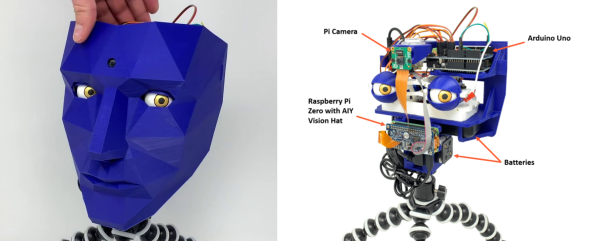
At this point, society has had over three decades to get used to the Blue Man Group. Maybe that’s why we’re less disturbed by [Graham Jessup]’s face-tracking Watchman than we should be. Either that, or it’s because it reminds us of Data from Star Trek: The Next Generation. Frankly, this is just way too cool to be dismissed out of hand as creepy.

The Watchman finds faces via video feed from a camera module positioned in his forehead as a third eye. The camera is connected to a Pi Zero that’s wearing a Google AIY vision bonnet. The Pi translates the face locations into servo positions and feeds them to an Arduino UNO located in the frontal lobe region to move the eyeballs and lids accordingly.

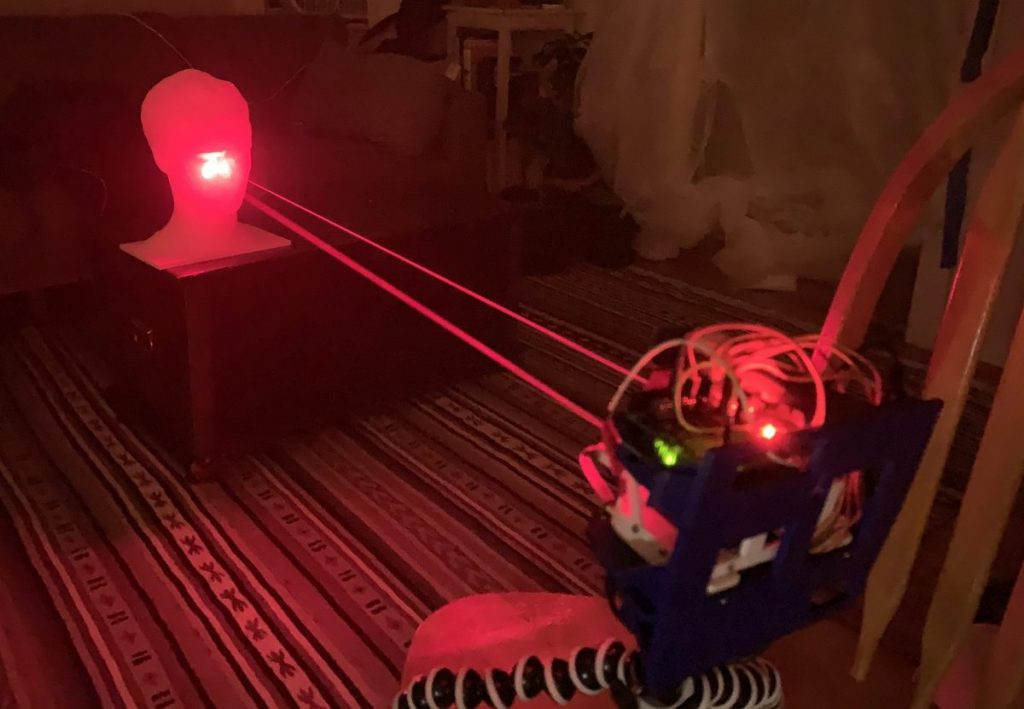
[Graham] had a bit of trouble with tracking accuracy at first, so he temporarily replaced the pupils with 5 mW lasers and calibrated them by tracking a printed stand-in of his head to avoid burning out his retinas.

This project builds on previous work by [Tjahzi] and the animatronic eye movements of [Will Cogley]. We can only imagine how awesome the Watchman would look with a pair of [Will]’s incredibly realistic eyeballs. Either way, we would totally trust the Watchman to defend our modest supply of toilet paper in the coming weeks. Check out a brief demo after the break, and a whole lot more clips on [Graham]’s site.

Continue reading “Watchman Watches You Watching Him Watch You”

Be Still, My Animatronic Heart

Fair warning for the squeamish: some versions of [Will Cogley]’s animatronic heart are realistic enough that you might not want to watch the video below. That’d be a shame though, because he really put a lot of effort into the build, and the results have a lot to teach about mimicking the movements of living things.

As for why one would need an animatronic heart, we’re not sure. [Will] mentions no specific use case for it, although we can think of a few. With the Day of Compulsory Romance fast approaching, the fabric-wrapped version would make a great gift for the one who stole your heart, while the silicone-enrobed one could be used as a movie prop or an awesome prank. Whatever the reason, [Will]’s build is a case study in incremental development. He started with a design using a single continuous-rotation servo, which powered four 3D-printed paddles from a common crank. The four paddles somewhat mimicked the movements of the four chambers of the heart, but the effect wasn’t quite convincing. The next design used two servos and complex parallelogram linkages to expand each side of the heart in turn. It was closer, but still not quite right.

After carefully watching footage of a beating heart, [Will] decided that his mechanism needed to imitate the rapid systolic contraction and slow diastolic expansion characteristic of a real heart. To achieve this, his final design has three servos plus an Arduino for motion control. Slipped into a detailed silicone jacket, the look is very realistic. Check out the video below if you dare.

We’ve seen plenty of animatronic body parts before, from eyes to hands to entire faces. This might be the first time we’ve seen an animatronic version of an internal organ, though.

Continue reading “Be Still, My Animatronic Heart”

This Arduino Keeps Its Eyes On You

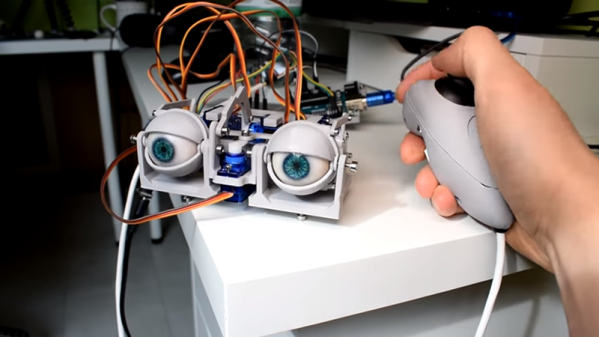
[Will] wanted to build some animatronic eyes that didn’t require high-precision 3D printing. He wound up with a forgiving design that uses an Arduino and six servo motors. You can see the video of the eyes moving around in the video below.

The bill of materials is pretty simple and features an Arduino, a driver board, and a joystick. The 3D printing parts are easy to print with no supports, and will work with PLA. Other than opening up holes there wasn’t much post-processing required, though he did sand the actual eyeballs which sounds painful.

Continue reading “This Arduino Keeps Its Eyes On You”

Use Movie Tools To Make Your Robot Move Like Movie Robots

Robots of the entertainment industry are given life by character animation, where the goal is to emotionally connect with the audience to tell a story. In comparison, real-world robot movement design focus more on managing physical limitations like sensor accuracy and power management. Tools for robot control are thus more likely to resemble engineering control consoles and not artistic character animation tools. When the goal is to build expressive physical robots, we’ll need tools like ROBiTS project to bridge the two worlds.

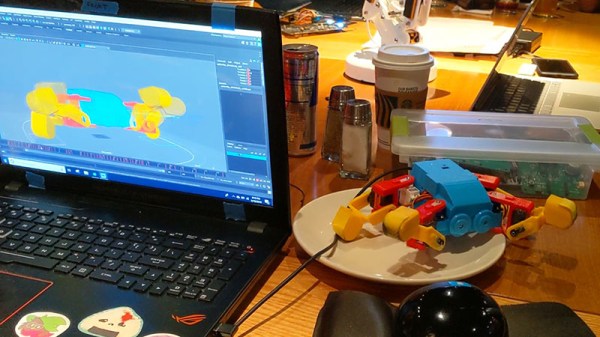
As an exhibitor at Maker Faire Bay Area 2019, this group showed off their first demo: a plugin to Autodesk Maya that translate joint movements into digital pulses controlling standard RC servos. Maya can import the same STL files fed to 3D printers, easily creating a digital representation of a robot. Animators skilled in Maya can then use all the tools they are familiar with, working in full context of a robot’s structure in the digital world. This will be a far more productive workflow for animation artists versus manipulating a long flat list of unintuitive slider controls or writing code by hand.

Of course, a virtual world offers some freedoms that are not available in the physical world. Real parts are not allowed to intersect, for one, and then there are other pesky physical limitations like momentum and center of gravity. Forgetting to account for them results in a robot that falls over! One of the follow-up projects on their to-do list is a bridge in the other direction: bringing physical world sensor like an IMU into digital representations in Maya.

We look forward to seeing more results on their YouTube channel. They join the ranks of other animated robots at Maker Faire and a promising addition to the toolbox for robot animation from Disney Research’s kinetic wires to Billy Whiskers who linked servos to Adobe Animate.

Continue reading “Use Movie Tools To Make Your Robot Move Like Movie Robots”

Lifelike Dinosaur Emerges From The Plumbing Aisle

Despite the incredible advancements in special effects technology since the film’s release, the dinosaurs in 1993’s Jurassic Park still look just as terrifying today as they did nearly 30 years ago. This has largely been attributed to the fact that the filmmakers wisely decided to use physical models in many of the close-up shots, allowing them to capture the nuances of movement which really helps sell the idea you’re looking at living creatures.

[Esmée Kramer] puts that same principle to work in her incredible articulated dinosaur costume, and by the looks of it, Steven Spielberg could have saved some money if he had his special effects team get their supplies at the Home Depot. Built out of PVC pipes and sheets of foam, her skeletal raptor moves with an unnerving level of realism. In fact, we’re almost relieved to hear she doesn’t currently have plans on skinning the creature; some things are better left to the imagination.

In her write-up on LinkedIn (apparently that’s a thing), [Esmée] explains some of the construction tricks she used to help bring her dinosaur to life, such as heating the pipes and folding them to create rotatable joints. Everything is controlled by way of thin ropes, with all the articulation points of the head mirrored on the “steering wheel” in front of her.

Now to be fair, it takes more than a bundle of PVC pipes to create a convincing dinosaur. Obviously a large part of why this project works so well is the artistry that [Esmée] demonstrates at the controls of her creation. Judging by her performance in the video after the break, we’re going to assume she’s spent a not inconsiderable amount of time stomping around the neighborhood in this contraption to perfect her moves.

In the past we’ve seen the Raspberry Pi used to upgrade life-sized animatronic dinosaurs, but even with the added processing power, those dinos don’t hold a candle to the smooth and organic motion that [Esmée] has achieved here. Just goes to show that sometimes low-tech methods can outperform the latest technological wizardry.

Continue reading “Lifelike Dinosaur Emerges From The Plumbing Aisle”

State Of The Art Big Mouth Alexa Bass

Hackers seem intent on making sure the world doesn’t forget that, for a brief shining moment, everyone thought Big Mouth Billy Bass was a pretty neat idea. Every so often we see a project that takes this classic piece of home decor and manages to shoehorn in some new features or capabilities, and with the rise of voice controlled home automation products from the likes of Amazon and Google, they’ve found a new ingredient du jour when preparing stuffed bass.

[Ben Eagan] has recently completed his entry into the Pantheon of animatronic fish projects, and while we’ll stop short of saying the world needed another Alexa-enabled fish on the wall, we’ve got to admit that he’s done a slick job of it. Rather than trying to convince Billy’s original electronics to play nice with others, he decided to just rip it all out and start from scratch. The end result is arguably one of the most capable Billy Bass updates we’ve come across, if you’re willing to consider flapping around on the wall an actual capability in the first place.

The build process is well detailed in the write-up, and [Ben] provides many pictures so the reader can easily follow along with the modification. The short version of the story is that he cuts out the original control board and wires the three motors up to an Arduino Motor Driver Shield, and when combined with the appropriate code, this gives him full control over Billy’s mouth and body movements. This saved him the trouble of figuring out how to interface with the original electronics, which is probably for the better since they looked rather crusty anyway.

From there, he just needed to give the fish something to get excited about. [Ben] decided to connect the 3.5 mm audio jack of an second generation Echo Dot to one of the analog pins of the Arduino, and wrote some code that can tell him if Amazon’s illuminated hockey puck is currently yammering on about something or not. He even added a LM386 audio amplifier module in there to help drive Billy’s original speaker, since that will now be the audio output of the Dot.

A decade ago we saw Billy reading out Tweets, and last year we presented a different take on adding an Alexa “brain” to everyone’s favorite battery powered fish. What will Billy be up to in 2029? We’re almost too scared to think about it. Continue reading “State Of The Art Big Mouth Alexa Bass”