Hackaday Links Column Banner

Hackaday Links: November 29, 2020

While concerns over COVID-19 probably kept many a guest room empty this Thanksgiving, things were a little different aboard the International Space Station. The four-seat SpaceX Crew Dragon is able to carry one more occupant to the orbiting outpost than the Russian Soyuz, which has lead to a somewhat awkward sleeping arrangement: there are currently seven people aboard a Station that only has six crew cabins. To remedy the situation, Commander Michael Hopkins has decided to sleep inside the Crew Dragon itself, technically giving himself the most spacious personal accommodations on the Station. This might seem a little hokey, but it’s actually not without precedent; when the Shuttle used to dock with the ISS, the Commander would customarily sleep in the cockpit so they would be ready to handle any potential emergency.

Speaking of off-world visitation, the Hayabusa2 spacecraft is nearly home after six years in space. It won’t be staying long though, the deep-space probe is only in the neighborhood to drop off a sample of material collected from the asteroid Ryugu. If all goes according to plan, the small capsule carrying the samples will renter the atmosphere and land in the South Australian desert on December 6th, while Hayabusa2 heads back into the black for an extended mission that would have it chasing down new asteroids into the 2030s.

Moving on to a story that almost certainly didn’t come from space, a crew from the Utah Division of Wildlife Resources recently discovered a strange metal monolith hidden in the desert. While authorities were careful not to disclose the exact coordinates of the object, it didn’t take Internet sleuths long to determine its location, in part thanks to radar data that allowed them to plot the flight path of a government helicopters. Up close inspections that popped up on social media revealed that the object seemed to be hollow, was held together with rivets, and was likely made of aluminum. It’s almost certainly a guerrilla art piece, though there are also theories that it could have been a movie or TV prop (several productions are known to have filmed nearby) or even some kind of military IR/radar target. We may never know for sure though, as the object disappeared soon after.

Even if you’re not a fan of Apple, it’s hard not to be interested in the company’s new M1 chip. Hackers have been clamoring for more ARM laptops and desktops for years, and with such a major player getting in the game, it’s only a matter of time before we start seeing less luxurious brands taking the idea seriously. After the recent discovery that the ARM version of Ubuntu can run on the new M1 Macs with a simple virtualization layer, it looks like we won’t have to wait too long before folks start chipping away at the Walled Garden.

In the market for a three phase servo controller? A reader who’s working on a robotics project worth as much as a nice house recently wrote in to tell us about an imported driver that goes for just $35. Technically it’s designed for driving stepper motors, but it can also (somewhat inefficiently) run servos. Our informant tells us that you’d pay at least $2,000 for a similar servo driver from Allen-Bradley, so the price difference certainly seems to make up for the hit in performance.

Finally, some bittersweet news as we’ve recently learned that Universal Radio is closing. After nearly 40 years, proprietors Fred and Barbara Osterman have decided it’s time to start winding things down. The physical store in Worthington, Ohio will be shuttered on Monday, but the online site will remain up for awhile longer to sell off the remaining stock. The Ostermans have generously supported many radio clubs and organizations over the years, and they’ll certainly be missed. Still, it’s a well-deserved retirement and the community wishes them the best.

The Art Of Nixies Hack Chat

Join us on Wednesday, October 28th at noon Pacific for The Art of Nixies Hack Chat with Dalibor Farný!

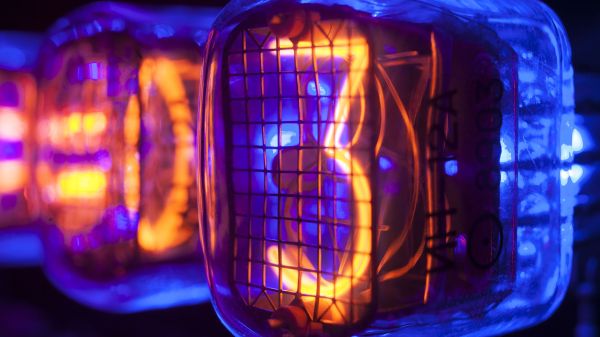
When they were invented in the 1950s, Nixie tubes were a huge leap forward in display technology. In the days before affordable LEDs made seven-segment displays a commodity, there were few alternatives to the charming glow of the clear and legible characters inside Nixies. Sturdy and reliable, the cold-cathode displays found their way into everything from scientific instruments to test equipment, and even some of the earliest computers and the equipment that formed the foundation of the Space Race sported the venerable tubes.

But time marches on, and a display that requires high voltage and special driver circuits isn’t long for a world where LEDs are cheap and easy to design with. Nixies fell from favor through the late 1960s and 1970s, to the point where new tubes were only being made by the Russians, until that supply dried up as well. Rediscovered by hobbyists for use in quirky clocks and other displays, any stock left over from the Nixie’s heyday are quickly being snapped up, putting the tubes on the fast track to unobtainium status.

That’s not to say that you can’t get brand new Nixie tubes, of course. Artisanal manufacturers like Dalibor Farný have taken the Nixie to a whole new level, with big, beautiful tubes that are handcrafted from the best materials. Reviving the somewhat lost art of Nixie manufacturing wasn’t easy, but the tubes that Dalibor makes in a castle in the Czech Republic now find their way into cool clocks and other builds around the world. He’ll join us on the Hack Chat to dive into the art and science of Nixies, and what’s going on with his mysterious “Project H”.

join-hack-chatOur Hack Chats are live community events in the Hackaday.io Hack Chat group messaging. This week we’ll be sitting down on Wednesday, October 28 at 12:00 PM Pacific time. If time zones baffle you as much as us, we have a handy time zone converter.

Click that speech bubble to the right, and you’ll be taken directly to the Hack Chat group on Hackaday.io. You don’t have to wait until Wednesday; join whenever you want and you can see what the community is talking about.

Continue reading “The Art Of Nixies Hack Chat”

Receipt Printers End It All In Moving Art Piece

Art is something that is always hard to classify, but by and large is most celebrated when it stimulates an emotional response for the intended audience. We’d say [Alexander Miller] achieved that in spades, with his elegant piece The Emergence and Decay of Computation.

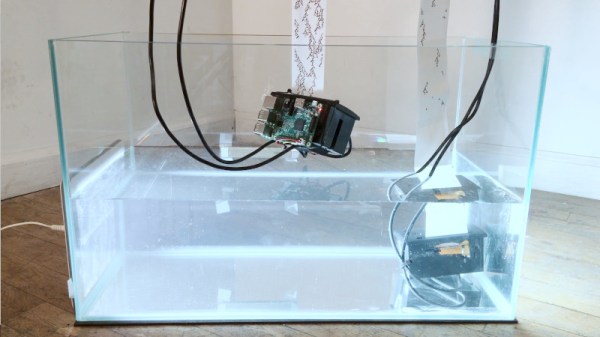
An installation piece done for The School for Poetic Computation’s 2019 spring showcase, it consists of a series of receipt printers suspended from a height by their own paper. The thermal printers output a pattern from a cellular automata — a mathematical simulation that generates patterns that emerge from initial conditions, of which Conway’s Game of Life is perhaps the most popular. Fed data by an attached Raspberry Pi, as printing continues, the printers gradually lower themselves into a tank of water, permanently killing the hardware.

Watching a proud, brave printer slowly work itself into a watery grave is a sobering experience to any lover of stout commercial hardware, and one we won’t soon forget. What a shame to see them sacrificed so. We love a good art piece around these parts, after all. Especially when the hardware can be used in another project once the excitement of this one has waned. Video after the break. Continue reading “Receipt Printers End It All In Moving Art Piece”

Cerebral Palsy Tool Assistant

We all deserve to create. Some people seem to have the muses hidden in their pocket, but everyone benefits when they express themselves in their chose art form. Each of us has tools, from Dremels to paintbrushes, and many folks here build their own implements. Even if we don’t have our macro-enabled mechanical keyboard or a dual-extrusion printer, we can make due. But what if you couldn’t operate your drill, or mouse, or even a pencil? To us, that would be excruciating and is the reality for some. [Laura Roth] and [Christopher Sweeney] are art teachers designing a tool holder for their students with cerebral palsy so that they can express themselves independently.

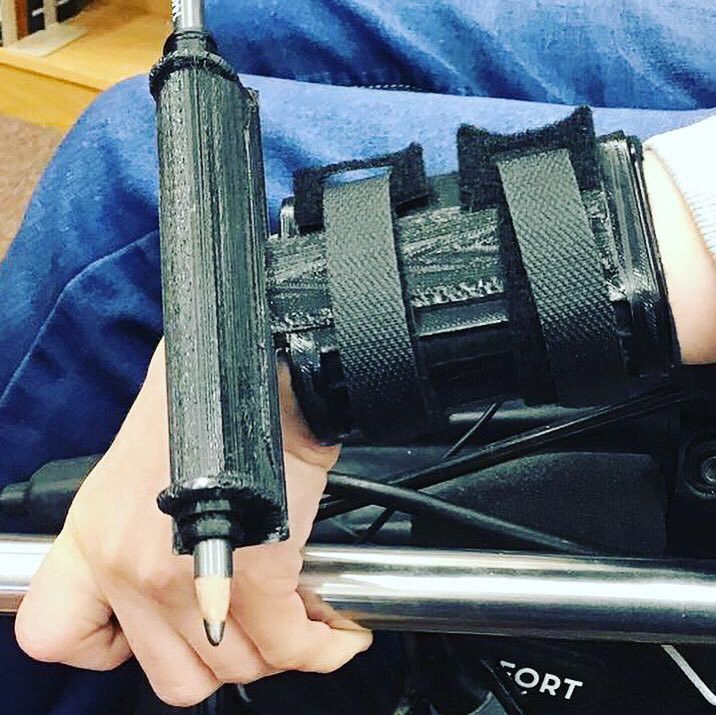
On either side of this banner image, you can see pencil drawings from [Sara], who has spastic cerebral palsy. She made these drawings while wearing the tool holder modeled after her hand. Now, that design serves other students and is part of the 2020 Hackaday Prize. The tool holder wraps around the wrist like a wide bracelet. Ribbing keeps its shape, and a tube accepts cylindrical objects, like pencils, styluses, and paintbrushes.The result is that the tip of the pencil is not far from where it would have been if held in the hand, but this sidesteps issues with grip and fine control in hands and fingers.

The print is available as an STL and should be printed with flexible filament to ensure it’s comfortable to wear. Be mindful of digital styluses which may need something conductive between the barrel and user.

Hackers are familiar with the challenges of cerebral palsy, and we’ve enjoyed seeing a variety of solutions over the years like door openers, camera gimbals, and just being altogether supportive.

Art Piece Builds Up Images With Dots On Thread

Hackers being as a rule practical people, we sometimes get a little guff when we run a story on an art installation, on the grounds of not being sufficiently hacky. We understand that, but sometimes the way an artist weaves technology into their pieces is just too cool to pass us, as with this thread-printing art piece entitled On Framing Textile Ambiguities.

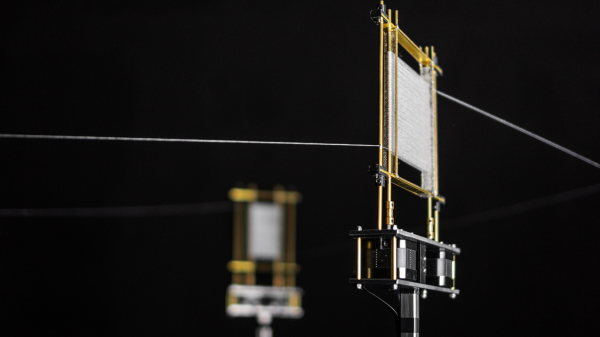
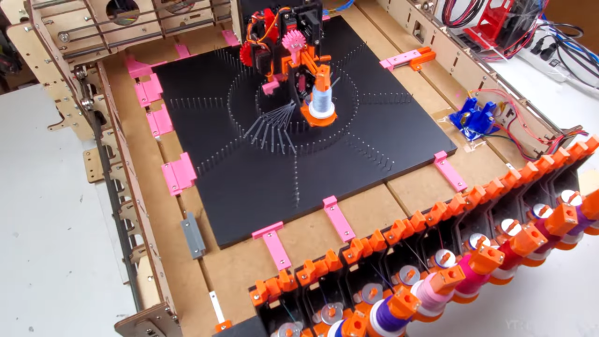
We’ll leave criticism of the artistic statement that [Nathalie Gebert]’s installation makes to others more qualified, and instead concentrate on its technical aspects. The piece has four frames made mainly from brass rods. Three of the frames have vertical rods that are connected to stepper motors and around which is wrapped a single thread. The thread weaves back and forth over the rods on one frame, forming a flat surface that constantly changes as the rods rotate, before heading off to do the same on the others. The fourth frame has a platen that the thread passes over with a pen positioned right above it. As the thread pauses in its endless loop, the pen clicks down onto it, making a dot of color. The dots then wend their way through the frame, occasionally making patterns that are just shy of recognizable before morphing into something new. The video below shows it better than it can be easily described.

Love it or hate it, you’ve got to admit that it has some interesting potential as a display. And it sort of reminds us of this thread-art polar robot, although this one has the advantage of being far simpler.

Continue reading “Art Piece Builds Up Images With Dots On Thread”

Playing The Pixelflut

Every hacker gathering needs as many pixels as its hackers can get their hands on. Get a group together and you’ll be blinded by the amount of light on display. (We propose “a blinkenlights” as the taxonomic name for such a group.) At a large gathering, what better way to show of your elite hacking ability than a “competition” over who can paint an LED canvas the best? Enter Pixelflut, the multiplayer drawing canvas.

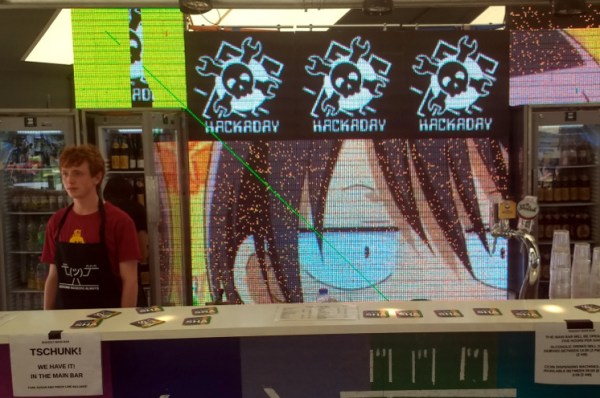
Pixelflut has been around since at least 2012, but it came to this author’s attention after editor [Jenny List] noted it in her review of SHA 2017. What was that beguiling display behind the central bar? It turns out it was a display driven by a server running Pixelflut. A Pixelflut server exposes a display which can be drawn on by sending commands over the network in an extremely simple protocol. There are just four ASCII commands supported by every server — essentially get pixel, set pixel, screen size, and help — so implementing either a client or server is a snap, and that’s sort of the point.

While the original implementations appear to be written by [defnull] at the link at the top, in some sense Pixelflut is more of a common protocol than an implementation. In a sense, one “plays” one of a variety of Pixelflut minigames. When there is a display in a shared space the game is who can control the most area by drawing the fastest, either by being clever or by consuming as much bandwidth as possible.

Then there is the game of who can write the fastest more battle-hardened server possible in order to handle all that traffic without collapsing. To give a sense of scale, one installation at 36c3 reported that a truly gargantuan 0.5 petabytes of data were spent at a peak of rate of more than 30 gigabits/second, just painting pixels! That’s bound to bog down all but the most lithe server implementation. (“Flut” is “flood” in German.)

While hacker camps may be on pause for the foreseeable future, writing a performant Pixelflut client or server seems like an excellent way to sharpen one’s skills while we wait for their return. For a video example check out the embed after the break. Have a favorite implementation? Tell us about it in the comments!

Continue reading “Playing The Pixelflut”

How Many Of You Are There, Really?

We’re now accustomed to hearing, “We’re all special in our own unique ways.” But what if we weren’t really aren’t all that unique? Many people think there are no more than two political opinions, maybe a handful of religious beliefs, and certainly no more than one way to characterize a hack. But despite this controversy in other aspects as life, at least we can all rely on the uniqueness of our individual names. Or can you?

You ever thought there were too many people named [insert name here]? Well, [Nicole] thought there were too many people who shared her name in her home country of Belgium and decided to make an art piece out of it.

She was able to find data on the first names of people in Belgium and wrote a Python script…er…used Excel to find the number of Nicoles in each zip code. She then created a 3D map of Belgium divided into each province with the height of each province proportional to the number of Nicoles in that area. A pretty simple print job that any standard 3D printer can probably do these days.

Not much of a “do something” hack, but could make for a cool demotivational ornament that will constantly remind us just how unique we really are.

Happy hacking!

Continue reading “How Many Of You Are There, Really?”