That Time Atari Cracked The Nintendo Entertainment System

It was darkest hour for the video game industry following the holiday shopping season of 1982. The torrent of third party developed titles had flooded the home video game console market to the point of saturation. It incited a price war amongst retailers where new releases were dropped to 85% off MSRP after less than a month on the shelves. Mountains of warehouse inventory went unsold leaving a company like Atari choosing to dump the merchandise into the Chihuahuan desert rather than face the looming tax bill. As a result, the whole home video game industry receded seemingly overnight.

One company single-handedly revived video games to mainstream prominence. That company was Nintendo. They’re ostensibly seen as the “savior” of the video games industry, despite the fact that microcomputer games were still thriving (history tends to be written by the victors). Nevertheless their Nintendo Entertainment System (NES) was an innovative console featuring games with scrolling screens, arcade-like sprites. But the tactic they used to avoid repeating the 1983 collapse was to tightly control their market using the Nintendo Seal of Quality.

From the third party developer perspective, Nintendo’s Seal of Quality represented more than just another logo to throw on the box art. It represented what you could and couldn’t do with your business. Those third party licensing agreements dictated the types of games that could be made, the way the games were manufactured, the schedule on which the games shipped to retail, and even the number of games your company could make. From the customer side of things that seal stood for confidence in the product, and Nintendo would go to great lengths to ensure it did just that.

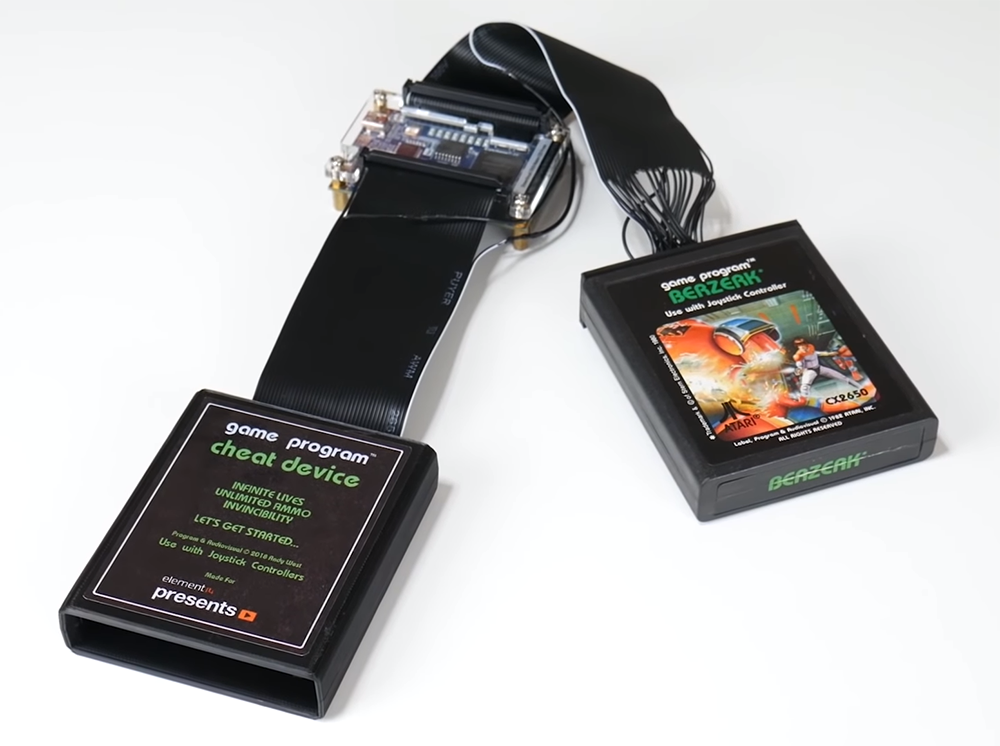
This is the story of how an Atari subsidiary company cracked the hardware security of the original Nintendo and started putting it into their unofficial cartridges.

Continue reading “That Time Atari Cracked The Nintendo Entertainment System”

New Controller For Retro Console

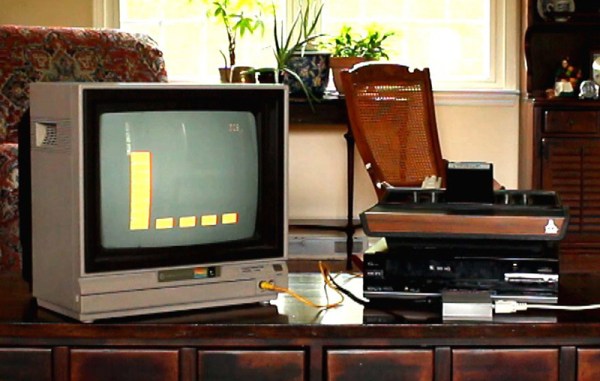
In the world of retro gaming, when using emulators and non-native hardware it’s pretty common to use whatever USB controller happens to be available. This allows us to get a nostalgic look while using a  configurable controller. One thing that isn’t as common is using the original hardware while still finding a way to adapt a modern controller to an old console. This is exactly what you need though, when you’re retro gaming on a platform with notoriously terrible controllers.

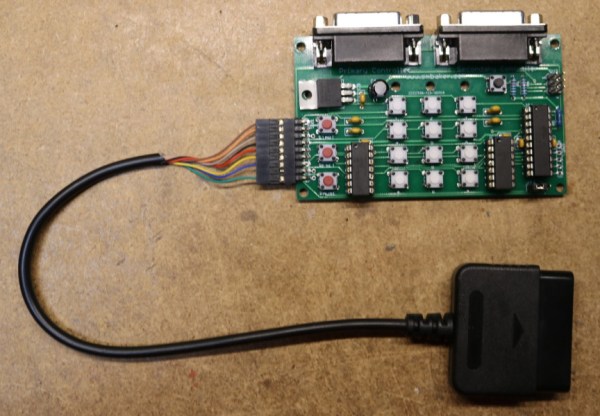
[Scott] enjoys his Atari 5200 but the non-centering and generically terrible joystick wasn’t well received even in the early 80s when the console was in its prime. He decided that using a Dual Shock controller from a Playstation 2 would provide a much better gaming experience, and set about building an adapter. He found that in a way the Dual Shock controller was an almost perfect pairing for the Atari because it has two analog control sticks built-in already. There’s also an array of information on pairing the Dual Shock controller with AVR microcontrollers, so he wouldn’t have to reinvent the wheel. From there, it was just a matter of pairing communications protocols between the two pieces of hardware.

The project page goes into quite a bit of detail on SPI communication protocols and the needs of both the Atari and the Playstation controller. If you’re a retro gaming fan, really into communication protocols, or have always had a love-hate relationship with your Atari because the controllers were just that bad, it’s worth checking out. If this is too much, though, there are other ways to get that Atari nostalgia.

Thanks to [Baldpower] for the tip!

Continue reading “New Controller For Retro Console”

Atari Lynx 2600 Console Mod

Atari Lynx Becomes Modern 2600 Console Homage

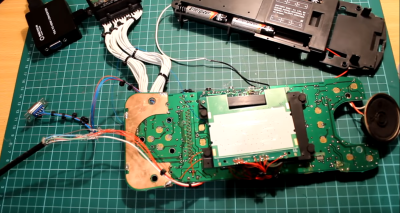
With its introduction in 1989, the Atari Lynx was the first handheld videogame system to include a color LCD. The gigantic size and equally gigantic price tag did not win-over a massive audience, but that doesn’t mean the Lynx was without its fans. Over the past few months a modder named [Jared] has been toiling away with his project to transform an Atari Lynx into a home console.

Atari Lynx 2600 Console Mod Motherboard

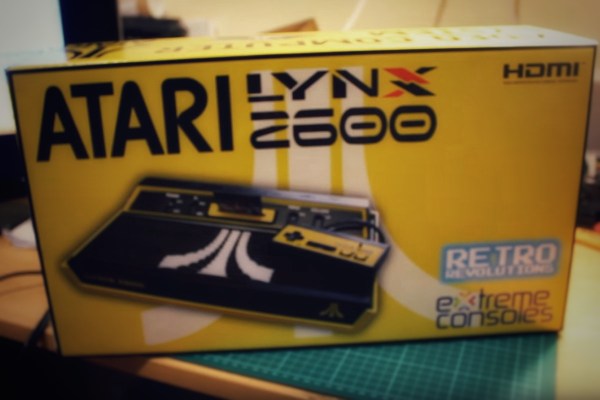
The inspiration behind the mod was the original Atari console, the Atari 2600. [Jared’s] console mod, called the Atari Lynx 2600, utilizes a four-switch 2600 case as an enclosure. However, since the Atari 2600 joystick did not offer enough button real estate an NES controller was used instead. A male-male serial cable serves as the new controller cord, while all the buttons on the face of the Lynx are hardwired to a female DB9 port. As an added touch a custom 3D printed cartridge adapter was incorporated into the original 2600 cartridge slot.

Since the Lynx did not natively support video out, and intermediary device known as the McWill LCD mod kit was used. The McWill LCD mod is typically done in order to modernize the Atari Lynx’s screen with hardware from this decade, but [Jared] used the kit in order to get VGA video output from the Lynx. Not satisfied with just VGA [Jared] also included a VGA to HDMI scaler inside to ensure a wider compatibility with current displays. Fittingly the HDMI port was placed on the back of the 2600 enclosure where the RF video used to come from.

Bonus points should go to [Jared] for going the extra mile and creating a custom console box to accompany the console mod. The entirety of the project was detailed in a three-part video series, but you can watch the console in action in part 2 below:

Continue reading “Atari Lynx Becomes Modern 2600 Console Homage”

Detective Work Recovers Atari ST ASIC Designs

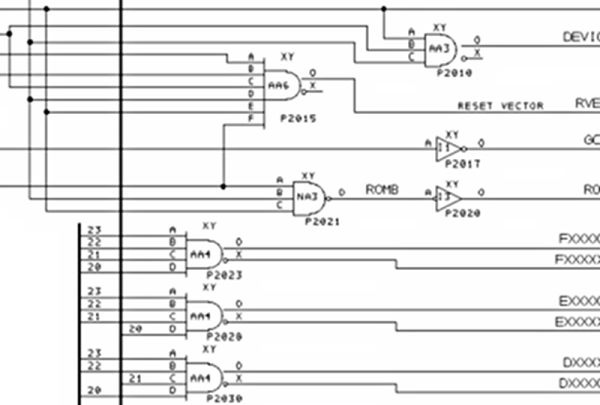
[Christian Zietz] wanted to know more about the Atari ST. He found information online from newer Atari machines like the Falcon030 and the Jaguar, but couldn’t find much else. While looking through some archives of old disk images from the Atari headquarters, he found a folder marked “Drawings\4118.” With some detective work and emulation of an old operating system, he was able to recover the schematics for the ST-4118 video shifter ASIC (Application-Specific Integrated Circuit).

Unfortunately, this appeared to be a chip for the unreleased Atari Panther video game console. However, it did show the way to how these older schematics were readable. [Christian] continued searching and found some floppy disk images that were a bit unusual. They didn’t have a proper file system but had been created by a backup program called FastBack for MS-DOS.

Continue reading “Detective Work Recovers Atari ST ASIC Designs”

Retro Console Upgrade Gives Atari Flair

If you’re desperate for a sense of nostalgia for video games of yore but don’t want to shell out the big bucks for an NES classic, you can always grab a single arcade-style game that’ll plug straight into your TV. Of course it’s no longer 1980, and playing Space Invaders or Asteroids can get old after a while. When that happens, just replace the internals for an upgraded retro Atari 2600 with all the games from that system instead of just one.

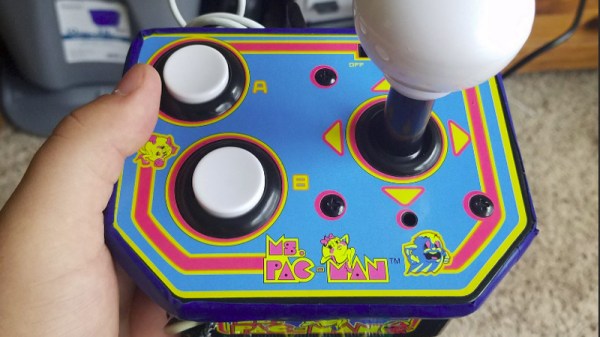
As expected for something that has to fit in such a tiny package, this upgrade is based on a Raspberry Pi Zero. It’s not quite as simple as throwing RetroPi on it and calling it a day, though. For one, [Blue Okiris] is still using the original two-button controller/joystick that came with the Ms. Pac-Man game this build is based on, and that added its own set of challenges. For another, RetroPi didn’t have everything he needed so he switched to another OS called Recalbox. It also includes Kodi so it could be used as a media center as well.

The build looks like a hack in the truest sense of the word. The circuit board sticks out the bottom a little bit, but this is more of a feature than a bug because that’s where some extra buttons and the power switch are. Overall, it’s a great Retro Atari system that has all the true classics that should keep [Blue Okiris] entertained until Atari releases an official system one day. If you’d like to go a little deeper in the Atari world, though, you could always restore one instead.

Continue reading “Retro Console Upgrade Gives Atari Flair”

Thumbs Up For This Custom Atari 5200 Controller

It may be nearly 40 years old, but the Atari 5200 still inspires legions of fans to relive the 8-bit glory days of their youth. There was much to love about the game console, but the joystick-and-keypad controllers were not among its many charms. The joystick didn’t auto-center, the buttons were mushy, and the ergonomics were nonexistent.

Retro-aficionados need not suffer in silence, though, thanks to this replacement controller for the Atari 5200. [Scott Baker] didn’t want to settle for one of the commercial replacements or, horrors, an adapter for the old PC-style joystick, so he rolled his own. Working from the original Atari schematics, [Scott] devised a plan for using a readily available thumbstick controller as the basis for his build. The essential problem was how to adapt the 10k pots on the new joystick to work in an environment expecting 500k pots, which he solved using an analog to digital and back to analog approach. The ADCs on an ATtiny85 convert each joystick pot’s voltage to a digital value between 0 and 255, which is sent to a 100K digital potentiometer. A little fiddling with RC constants brings it back in line with what the console expects. The thumbstick and buttons live on a custom PCB – kudos to [Scott] for designing an ambidextrous board. The video below shows the design and the finished product in action.

[Scott] is on a bit of a 5200 kick these days; he just finished up a Raspberry Pi multi-cartridge for the venerable console. His controller should make retro-gameplay on the console a little easier on the hands.

Continue reading “Thumbs Up For This Custom Atari 5200 Controller”

Ted Dabney, Atari, And The Video Game Revolution

It may be hard for those raised on cinematic video games to conceive of the wonder of watching a plain white dot tracing across a black screen, reflecting off walls and bounced by a little paddle that responded instantly to the twist of a wrist. But there was a time when Pong was all we had, and it was fascinating. People lined up for hours for the privilege of exchanging a quarter for a few minutes of monochrome distraction. In an arcade stuffed with noisy pinball machines with garish artwork and flashing lights, Pong seemed like a calm oasis, and you could almost feel your brain doing the geometry to figure out where to place the paddle so as not to miss the shot.

As primitive as it now seems, Pong was at the forefront of the video game revolution, and that little game spawned an industry that raked in $108 billion last year alone. It also spawned one of the early success stories of the industry, Atari, a company founded in 1972. Just last week, Ted Dabney, one of the co-founders of Atari, died at the age of 81. It’s sad that we’re getting to the point where we’re losing some of the pioneers of the industry, but it’s the way of things. All we can do is reflect on Dabney’s life and legacy, and examine the improbable path that led him to be one of the fathers of the video game industry.

Continue reading “Ted Dabney, Atari, And The Video Game Revolution”