A More Conspicuous Computer Assistant

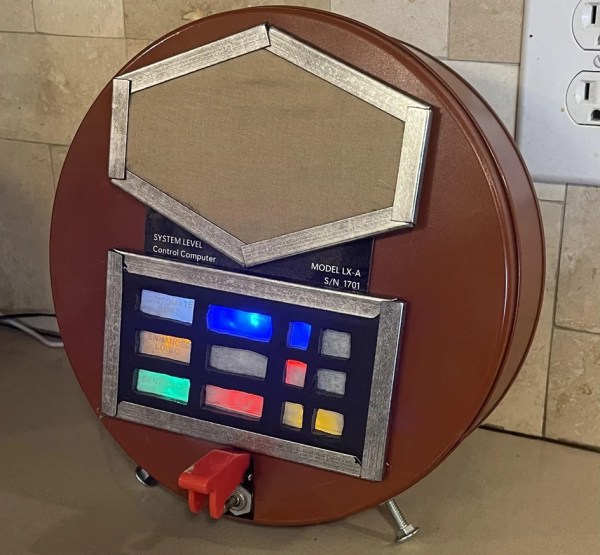
Back in the last century, especially in the ’40s to the ’60s, one of the major home decor trends was to install various home appliances, like the television or stereo, into its own piece of furniture. These were usually bulky, awkward, and incredibly heavy. And, since real life inspires art, most of the futuristic sci-fi technology we saw in movies and TV of the time was similarly conspicuous and physical. Not so with modern technology, though, where the trend now is to hide it out of the way and forget it exists. But [dermbrian] wanted some of his modern technology to have some of the mid-century visibility aesthetic so he made some modifications to his Amazon Echo.

The Echo itself remains largely unmodified, other than placing it inside a much larger cookie tin with some supporting electronics. For that, [dermbrian] found a relay board with a built-in microphone which switches the relay off when it detects sound so that when the Echo is activated, the sound from its speaker activates the module. From there it drives a series of blinkenlights which mimic the 60s computer aesthetic. Some custom fabrication and light diffusion methods were needed to get it to look just right, and a switch on the outside can disable the mechanism if it is getting triggered by background noise like music from his stereo.

While the appeal of this style may be lost on anyone who wasn’t a fan of the original Lost in Space, Star Trek, or Jetsons, it certainly holds a special significance for those who grew up in that era. It’s certainly not the first project we’ve seen to take a look back at the aesthetics of bygone eras, either. Take a look at this project which adds lenses to modern displays to give them the impression of antiquated CRT displays.
Continue reading “A More Conspicuous Computer Assistant”

Woodworking, Blinkenlites, And FFT’s Dance To The Music

We all have that one project on our minds that we’d love to build if we could just find the right combination of time, energy, and knowledge to dive right in. For [Jonathan], that project was a sound sculpture that’s finally made it from concept to complete. [Jonathan] describes the sound sculpture as the culmination of a decade of learning, and in a moment you’ll understand why.

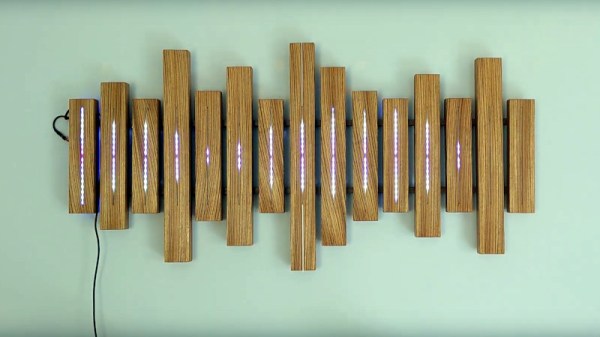
The sculpture itself is a beautiful display of woodwork mixed with what appear to be individually addressable LED’s. The varying length of the individual enclosures evokes the idea that the sculpture is somehow involved in the sound production, which is a nice touch.

An Adafruit microphone module feeds detected audio into a PSoC 5 microcontroller. You’d expect that [Jonathan] just used one of the FFT libraries that are available. But you’ll recall that this was the culmination of a decade of learning- why so? Because [Jonathan] went through the process of procuring his own grey hairs by writing his own FFT function. A homebrew FFT function and blinkenlites? What’s not to love!

You may also enjoy this discussion of Sine Waves, Square Waves, and FFT’s with our own Bil Herd.

Continue reading “Woodworking, Blinkenlites, And FFT’s Dance To The Music”

Need A Small, Cheap Ammeter? Blinkenlights To The Rescue!

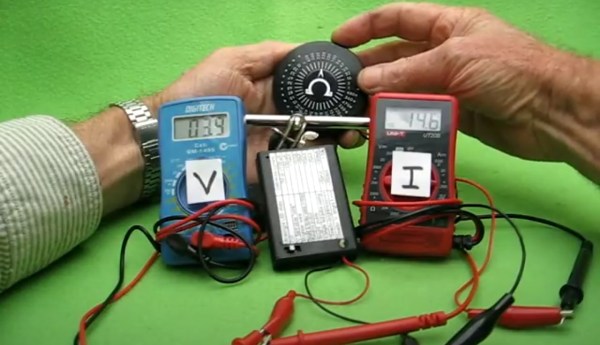
You know how it is. You’ve got that new project running, and while it doesn’t consume much power, it also doesn’t give much indication of whether it’s functioning or just sitting there with a dead battery. What you need is an ammeter to check power consumption, even from across the room. And it just so happens that [Manuka] has Just The Circuit You Need, complete with a demonstration in the video after the break!

Oh sure, you could grab a cheap ammeter at your favorite tool import store or site, but those are bulky and take batteries. You could put in an LED that gets dimmer as voltage drops. But wait- is that the sun shining on it? or is it on? Or has something gone awry and it’s consuming too much power?

What [Manuka] gives us is a circuit that is designed to be built into your project or project’s power supply. Using only an ultra-bright white LED, red blinking LED, PNP transistor, and a diode, the circuit gives a strong visual indication of current consumption by blinking brighter and more frequently as current increases. With a bit of calibration, accurate measurements can be obtained. All of this is made possible by using the Flashing LED as a driver for the ultra-bright LED, which is a pretty slick hack!

Flashing LEDs have a great number of uses, like protecting your family from lions. Yes, really. Got a cool tip for flashing LEDs, blinkenlights, 555’s, or any odd thing that strikes your hackers fancy? Let the tip line know!

Continue reading “Need A Small, Cheap Ammeter? Blinkenlights To The Rescue!”

The Most Important Device In The Universe on display at Modern Props

The Most Important Device In The Universe Is Powered By A 555 Timer

The Hackaday comments section has become infamous for a recurring theme that goes something like “I don’t know why they used an Arduino, they could have done it with a 555 timer!” If you’ve ever thought the same way, then this post is for you!

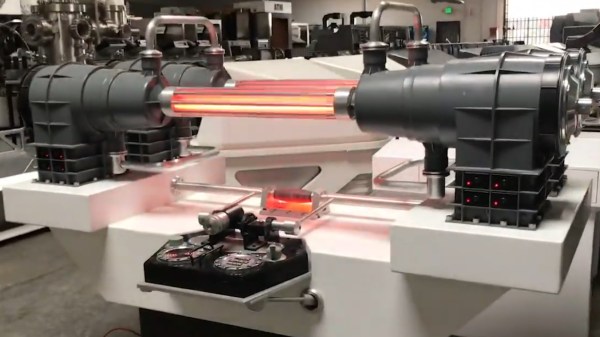
What is The Most Important Device In The Universe, then? It’s the Modern Props #195-290-1, a movie prop originally built in the 1970’s. It’s a product of the creative mind of [John Zabrucky] who founded Modern Props in 1977 to serve Sci-Fi television and movie productions that wanted to invent the future with their props. Known for their high quality and impeccable craftsmanship, Modern Props’ products were in demand until the day they closed the doors so that [John] could retire.

This particular piece is called The Most Important Device In The Universe due to its ubiquity in modern productions that we’ve all heard of: several Star Trek franchises, The Last Starfighter, Knight Rider, Airplane II, Austin Powers, and countless others. The next time you sit down to watch a Sci-Fi show, see if you can spot it! Be sure to check the video below the break to see several examples.

Nobody is sure what The Most Important Device does, aside from the fact that it has red lights that go back and forth. What we do know, thanks to a comment by the man who installed the electronics, [Gene Turnbow], is how it’s powered. [Gene] explained that 45w NPN power transistors drive the neon tubes through step up transformers. The transistors themselves are connected to a 74C4514 demultiplexer, which is itself driven by a 7493 binary counter. What’s the 7493 driven by? You guessed it: the venerable 555 Timer. And so it is that the 555 timer runs The Most Important Device In The Universe.

We did think that [Gene]’s final comment was rather indicative of how much things have changed since the prop was originally built. After explaining the device, he says “These days we would just use an Arduino to do the same job.” Indeed.

Don’t worry, 555 lovers. We’ve got you covered with this Vacuum Tube 555, and and the Trollduino, a 555 on an Arduino Shield. Thanks [Matt K] for the great tip. Don’t forget to submit your favorite hacks to our Tip Line!

Continue reading “The Most Important Device In The Universe Is Powered By A 555 Timer”

The Retro Shield, an Arduino Proto Shield for making many different circuits.

Retro Shield Replaces Springs With Jumpers, Includes Blinkenlights!

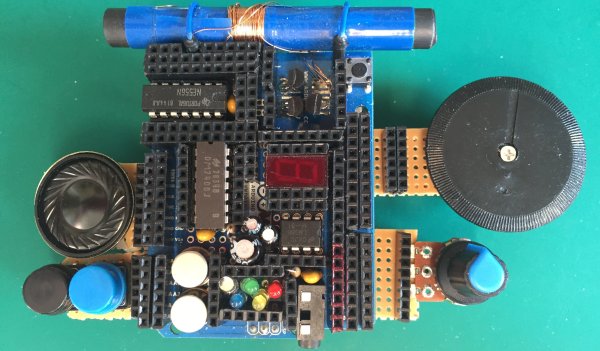
Is it an AM radio? Yes. It is a 555 LED flashing circuit? Yep. How about a hex counter with a 7 segment display? That too. Five different colored LED’s to satisfy your need for blinkenlights? Even that! What is this magical contraption? Is it one of those old school 30-in-1 or 50-in-1 “Science Fair” kits with the jumper wires and the springs? Almost!

When [grandalf]’s friend showed them a project where a 555 timer was installed on an Arduino shield, they realized two things: This whole “could have done that with a 555 timer” meme is a lot of fun, and “I’ve got an old 556 chip, I wonder if I can build one?” The answer is yes, and so much more.

Starting with the 556 timer, and inspired by the old spring-and-jumper kits of the past, [grandalf]’s “556 on a Proto Shield” project evolved into a creation they call the Retro Shield. Snowballing like so many hacker projects, it now includes several built in circuits and components. Breadboard jumpers are used to connect components through strategically placed pin headers, of which there are quite a few!

To make it all fit, some parts were substituted with more compact pieces such as an LM386 instead of an LM380.  The AM radio portion is supplied by an all-in-one radio chip, the ZN414. With the scope creep picking up steam, [grandalf] eventually added so called sidecars- bits of board that contain controls and a speaker hanging off the side of the Proto Shield.

It is not mentioned if the Retro Shield integrates with the Arduino or not. All the same, the Retro Shield has been used to pick up local AM stations, blink LED’s and amplify audio with the LM386. Like [grandalf] we’re sure that the Retro Shield can be used for much more. We hope that [grandalf] expands on the concept and inspires future hackers to answer the question “I wonder what happens if I try this.” 

If you haven’t set eyes on one of the all-in-one kits, check out this 200-in-1 kit teardown and review. And of course, if you have your own hacked up projects to share, be sure to let us know through the Tip Line!

Head Lamp Gives Glowing Creature Comforts

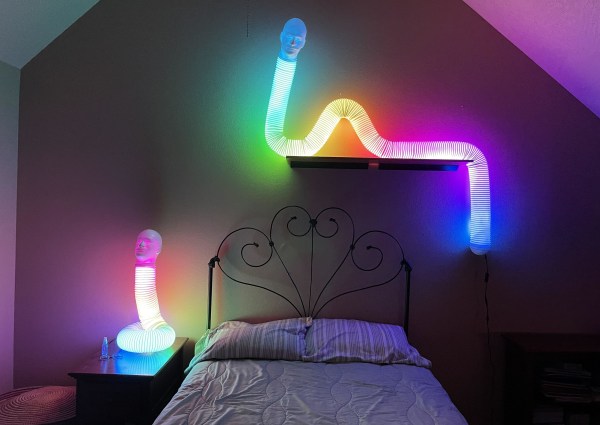
What can we say? It’s 2021, and we could probably all use a psychotic glow worm lamp in our lives about now to lighten the mood and/or provide a new focal point for sitting and staring. Tired of dragging out that creepy little Elf on the Shelf every holiday season? [LiabilityLabs]’ Head Lamp is slightly less terrifying and far more functional. Really, the options are limitless.

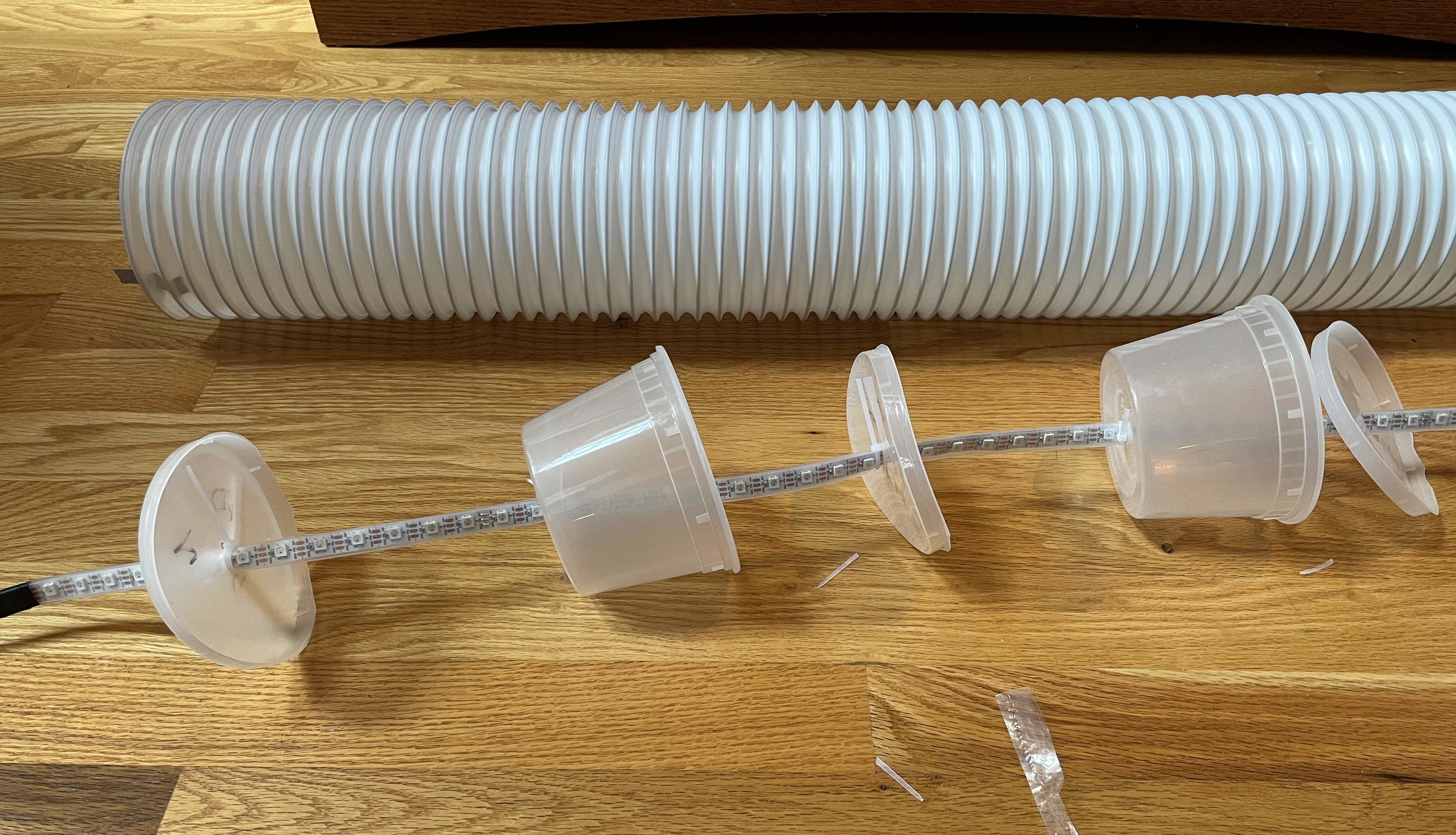
The brain of this scare snake is an Electromage Pixelblaze LED controller, a powerful Wi-Fi enabled little board with a live web editor. [LiabilityLabs] recycled 20 milky plastic containers and their lids to help diffuse the light and avoid hot spots by holding the LED strip in the center of the tube. There’s a momentary button on the glowy guy’s tail that lets [LiabilityLabs] cycle through different color patterns with ease.

Whether you need a mascot for your stream channel, a confidant, or a refreshing rainbow rubber ducky of problem solving, Head Lamp is flexible. Feast your eyes on some brief animations after the break.

Want the glowies without the willies? This mesmerizing fiber optic lamp is an easy build.

Continue reading “Head Lamp Gives Glowing Creature Comforts”

The Bright Side Of The Moon Lamp: It’s Any Colour You Like

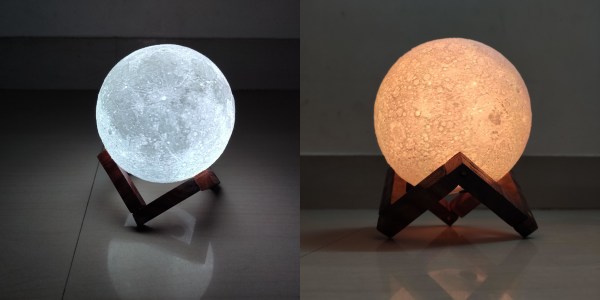
One of the easiest ways to get into hardware hacking is by piecing together a few modules and shoehorning them into a really cool home. For example, why buy a commercial moon lamp when you can spend 30+ hours printing your own, and a few more hours hacking the guts together?

[Amit_Jain] was inspired by a project that combined a color map and bump map of the moon into a highly-detailed printable model. Displeased with the lack of features like portability and pretty colors, [Amit] took it to the next level by designing a threaded cap that unscrews to show the streamlined guts of an off-the-shelf RGB LED controller.

[Amit] freed the controller board from its plastic box and soldered the LED strip’s wires directly to it. For power, [Amit] taped the board to the battery from an old cell phone and stepped it up to 12 V with a boost converter. We think this looks quite nice and professional, especially with the stand. A brief demo is on the rise after the break.

If you’ve got the room for a much, much larger light-up moon, you should go for it.

Continue reading “The Bright Side Of The Moon Lamp: It’s Any Colour You Like”