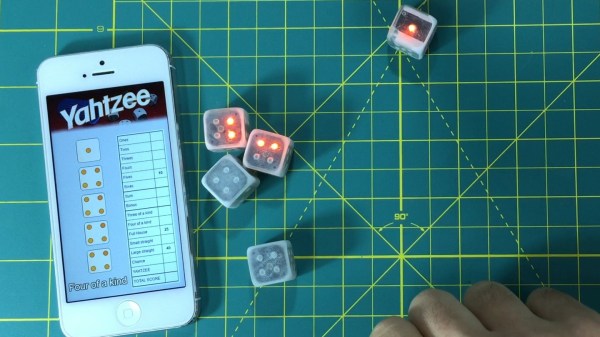
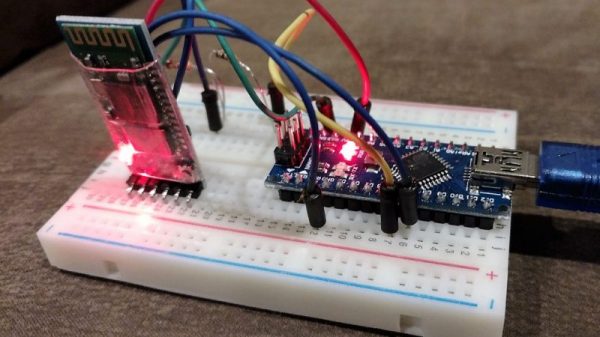
NodeConf EU Hackable Badge

During conferences, a name-tag is one of the first things people look at when bumping in to others – mentally trying to keep track of faces and names. But gone are the days when your name tag was a post-it stuck on your arm. Over the years, conference badges have become increasingly interesting and complex. Hackable electronic badges are becoming the norm, and not just at hardware cons. For the recently concluded NodeConfEU conference in Ireland, [Gordon Williams], of Espruino fame, designed a JavaScript centric hackable badge.

NodeConf EU is the key Node.js event in Europe, providing a forum for the Node.js community. So when they brain-stormed ideas for a conference badge, they obviously gravitated towards a design that could run JS. [Gordon]’s Puck.js fit the requirements perfectly, and he was tasked with creating a new design based on the Puck.js. The feature list included BlueTooth Low Energy, low power consumption so it could run off a CR2032 battery, a high contrast LCD, some buttons, NFC, and a prototyping area – all packaged in a beautiful hexagonal shaped PCB (obviously) to resemble the Node.js logo. The badges were programmed with attendee names, but the fun, juicy part could be accessed by pressing buttons in the Konami code sequence.

Easy to follow, detailed documentation helped hackers quickly get started with code examples. They were also presented several challenges to work through allowing them to get familiar with the badge. Hacked badges were entered for a Grand Challenge with a chance to win a free ticket to next years conference. The badge hardware and firmware are open source and source files are hosted in a Github repository. Check out a short overview of the badge in the video after the break.

Thanks to [Conor] from nearForm for letting us know about this awesome badge.

Continue reading “NodeConf EU Hackable Badge”

Bluetooth Bedroom Clock!

When [decino]’s old bedroom clock finally bit the dust, he built himself a new one from scratch for fun and functionality.

Initially, he wanted to solder Adafruit NeoPixel lights onto four prototype boards, using a mini-USB for power and a DS1307 to keep the time. However, after soldering the board for the first digit and realizing that carrying on with the other three would be a huge pain, he switched to etching the boards instead — a far more efficient solution. In keeping with this time-saving mindset, he added a Bluetooth module that would allow him to update the clock from his phone whenever the DS1307 started dropping minutes or whenever daylight savings time is in effect.

Continue reading “Bluetooth Bedroom Clock!”

Hackaday Prize Entry: OrthoSense, A Smart Knee Brace For Physical Therapy

If you have knee surgery, you can probably count on some physical therapy to go with it. But one thing you might not be able to count on is getting enough attention from your therapist. This was the case with [Vignesh]’s mother, who suffers from osteoarthritis (OA). Her physiotherapist kept a busy schedule and couldn’t see her very often, leaving her to wonder at her rehabilitation progress.

[Vignesh] already had a longstanding interest in bio-engineering and wearables. His mother’s experience led him down a rabbit hole of research about the particulars of OA rehabilitation. He found that less than 35% of patients adhere to the home regimen they were given. While there are a lot of factors at play, the lack of feedback and reinforcement are key components. [Vignesh] sought to develop a simple system for patients and therapists to share information.

The fruit of this labor is Orthosense, an intelligent knee brace system that measures gait angle, joint acoustics, and joint strain.  The user puts on the brace, pairs it with a device, and goes through their therapy routine. Sensors embedded in the brace upload their data to the cloud over Bluetooth.

Joint strain is measured by a narrow strip of conductive fabric running down the length of the knee. As the user does their exercises, the fabric stretches and relaxes, changing resistances all the while. The changes are measured against a Wheatstone bridge voltage divider. The knee’s gait angle is measured with an IMU and is calculated relative to the hip angle—this gives a reference point for the data collected by the strain sensor. An electret mic and a sensitive contact mic built for body sounds picks up all the pops and squeaks emitted by the knee. Analysis of this data provides insight into the condition of the cartilage and bones that make up the joint. As you might imagine, unhealthy cartilage is noisier than healthy cartilage.

[Vignesh]’s prototype is based the tinyTILE because of the onboard IMU, ADC, and Bluetooth. Since all things Curie are being discontinued, the next version will either use something nRF52832 or a BC127 module and a la carte sensors. [Vignesh] envisions a lot for this system, and we are nodding our heads to all of it.

Fidget Spinner Gets Useful As MIDI Controller

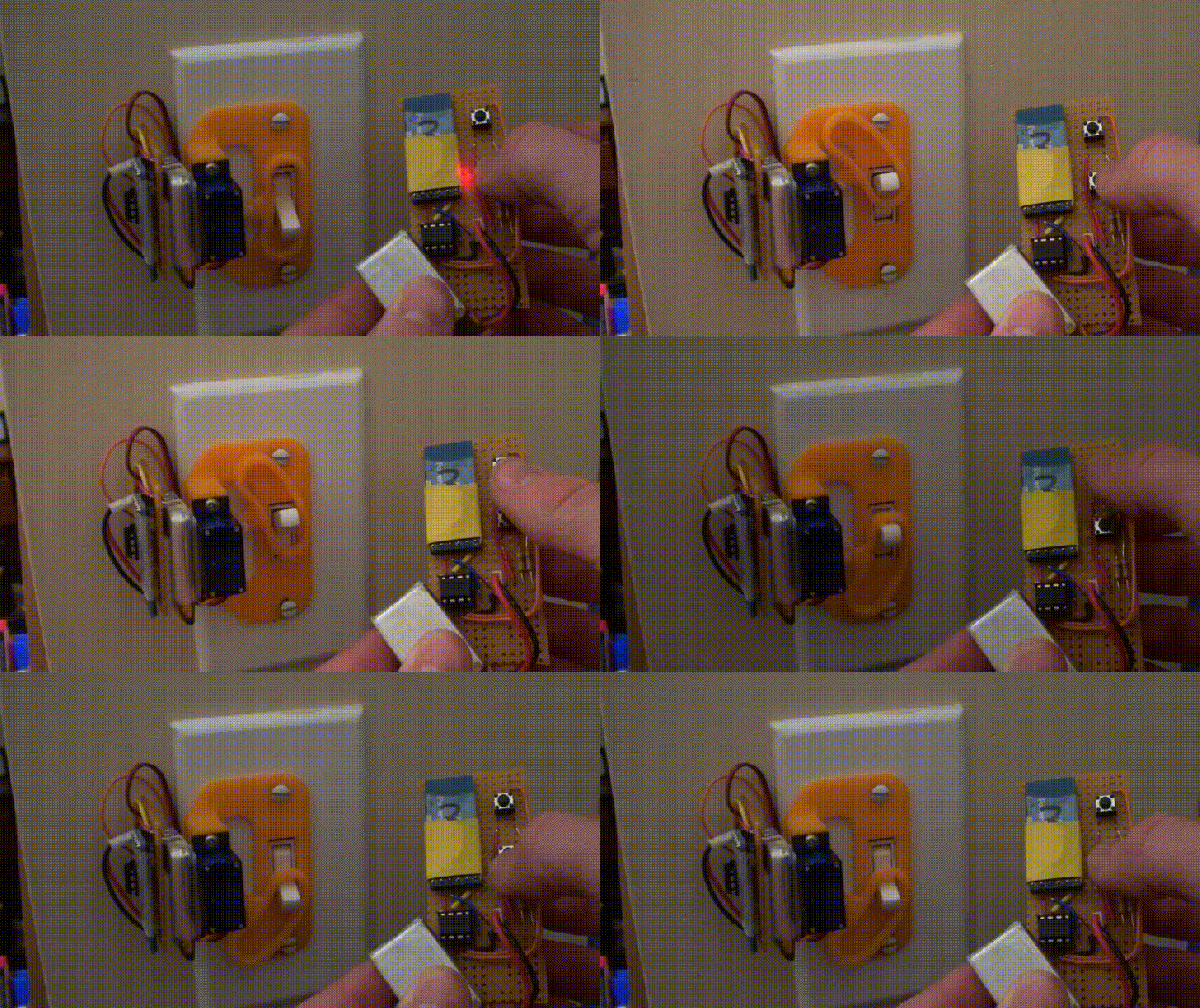
Fidget spinners are not only a fad, but pretty much useless. Sounds like a job for hacking to make the toys have some actual purpose. [D777k] took up the challenge and created a MIDI controller from a common spinner. You can see a video of the results, below.

The device uses a LightBlue Bean controller and Garage Band as the MIDI software. Granted, it might not be super useful, but it is better than just a plain old spinner. [D777k] calls it a “whirling dervish of sound making!

The Arduino code that drives the thing is very simple. It reads three axes of acceleration and uses that to drive the MIDI software. When the acceleration exceeds a threshold, the software creates a new note based on the sums and differences of the accelerations.

The Lightblue Bean isn’t anything new, but it is well suited for this kind of service. Certainly, making a toy into a MIDI controller isn’t an original idea, either. But it sure is fun.

Continue reading “Fidget Spinner Gets Useful As MIDI Controller”

Bluetooth Vulnerability Affects All Major OS

Security researchers from Armis Labs recently published a whitepaper unveiling eight critical 0-day Bluetooth-related vulnerabilities, affecting Linux, Windows, Android and iOS operating systems. These vulnerabilities alone or combined can lead to privileged code execution on a target device. The only requirement is: Bluetooth turned on. No user interaction is necessary to successfully exploit the flaws, the attacker does not need to pair with a target device nor the target device must be paired with some other device.

The research paper, dubbed BlueBorne (what’s a vulnerability, or a bunch, without a cool name nowadays?), details each vulnerability and how it was exploited. BlueBorne is estimated to affect over five billion devices. Some vendors, like Microsoft, have already issued a patch while others, like Samsung, remain silent. Despite the patches, some devices will never receive a BlueBorne patch since they are outside of their support window. Armis estimates this accounts for around 40% of all Bluetooth enabled devices.

A self-replicating worm that would spread and hop from a device to other nearby devices with Bluetooth turned on was mentioned by the researchers as something that could be done with some more work. That immediately reminds us of the BroadPwn vulnerability, in which the researchers implemented what is most likely the first WiFi only worm. Although it is definitely a fun security exercise to code such worm, it’s really a bad, bad idea… Right?…

So who’s affected?

Continue reading “Bluetooth Vulnerability Affects All Major OS”

Turning On Your Amplifier With A Raspberry Pi

Life is good if you are a couch potato music enthusiast. Bluetooth audio allows the playing of all your music from your smartphone, and apps to control your hi-fi give you complete control over your listening experience.

Not quite so for [Daniel Landau] though. His Cambridge Audio amplifier isn’t quite the latest generation, and he didn’t possess a handy way to turn it on and off without resorting to its infrared remote control. It has a proprietary interface of some kind, but nothing wireless to which he could talk from his mobile device.

His solution is fairly straightforward, which in itself says something about the technology available to us in the hardware world these days. He took a Raspberry Pi with the Home Assistant home automation package and the LIRC infrared subsystem installed, and had it drive an infrared LED within range of the amplifier’s receiver. Coupled with the Home Assistant app, he was then able to turn the amplifier on and off as desired. It’s a fairly simple use of the software in question, but this is the type of project upon which so much more can later be built.

Not so many years ago this comparatively easy project would have required a significant amount more hardware and effort. A few weeks ago [John Baichtal] took a look at the evolution of home automation technology, through the lens of the language surrounding the term itself.

Via Hacker News.

Hackaday Links Column Banner

Hackaday Links: August 13, 2017

We found the most boring man on the Internet! HTTP Status Code 418 — “I’m a teapot” — was introduced as an April Fools Joke in 1998. Everyone had a good laugh, and some frameworks even implemented it. Now, the most boring man on the Internet and chairman of the IETF HTTP working group is trying to get 418 removed from Node and Go. There is an argument to removing code 418 from pieces of software — it gums up the works, and given only 100 code points for a client error, with 30 of them already used, we don’t really have space for a joke. There’s a solution, though: someone has submitted a request to register 418 as ‘I’m a teapot’.

The Travelling Hacker box is a migratory box of random electronic junk. The box has traveled across the United States several times, and earlier this year it started across Canada — from Vancouver to St. Johns — to begin an International journey. The box is now missing, and I’m out. I’m turning this one over to the community. There are now several rogue boxes traveling the world, the first of which was sent from [Sophi] to [jlbrian7] and is now in Latvia with [Arsenijs]. The idea of the Travelling Hacker Box is now up to you — organize your own, and share random electronic crap.

Bluetooth 5 is here, or at least the spec is. It has longer range, more bandwidth, and advertising extensions.

Guess what’s on the review desk? The Monoprice Mini Delta! If you have any questions you’d like answered about this tiny, very inexpensive printer, put them in the comments. I only have some first impressions, but so far, it looks like extending the rails (to make a taller printer) is more difficult than it’s worth. That’s not to say it’s impossible, but with the effort required, I could just print another printer.

Interested in PCB art? [Drew] found someone doing halftone art with PCBs. This is a step up from nickels.

Indiana University is getting rid of some very, very cool stuff in a government auction. This device is listed as a ‘gantry’, but that’s certainly not what it is. There have been suggestions that these devices are a flight sim, but that doesn’t sit quite right either. It’s several thousand pounds of metal, with the minimum bid of $2.00 at the time of this writing. Any guesses on what this actually is?