Hackaday Prize Entry: DIY Automatic Tool Changer

Choosing between manually changing endmill bits on a CNC machine and investing in an expensive automated solution? Not for [Frank Herrmann], who invented the XATC, an eXtremely simple Automated Tool Changer. [Frank’s] ingenious hack achieves the same functionality as an industrial tool changer using only cheap standard hardware you might have lying around the workshop.

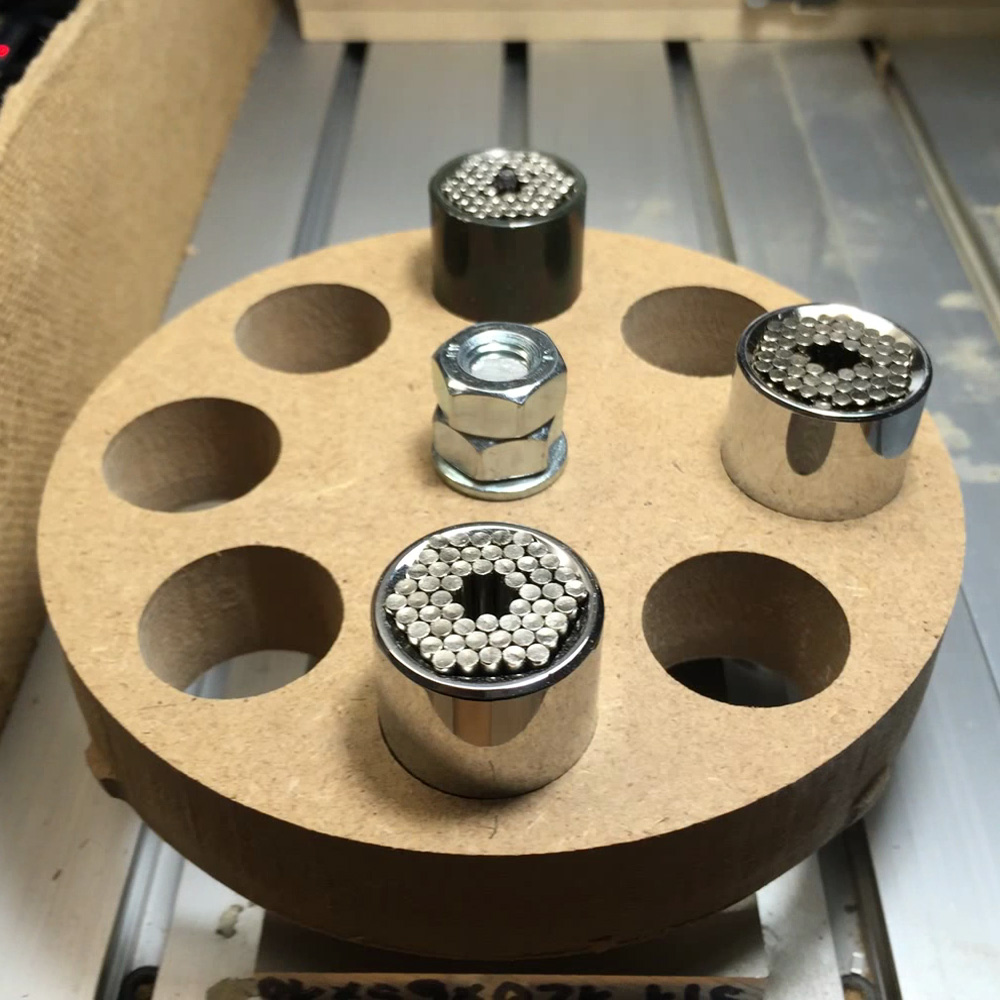
xatc_carouselLike many ATCs, this one features a tool carousel. The carousel, which is not motorized, stores each milling bit in the center bore of a Gator Grip wrench tool. To change a tool, a fork wrench, actuated by an RC servo, blocks the spindle shaft, just like you would do it to manually change a tool. The machine then positions the current bit in an empty Gator Grip on the carousel and loosens the collet by performing a circular “magic move” around the carousel. This move utilizes the carousel as a wrench to unscrew the collet. A short reverse spin of the spindle takes care of the rest. It then picks another tool from the carousel and does the whole trick in reverse.

The servo is controlled via a WiFi connected NodeMCU board, which accepts commands from his CNC controller over HTTP. The custom tool change sequences are provided by a few JavaScript macros written for the TinyG workspace on chilipeppr.com, a browser-based G-code host. Enjoy the video of [Frank Herrmann] explaining his build!

Thanks to Smoothieboard creator [Arthur Wolf], who is currently working on a similar project, for the tip!

The HackadayPrize2016 is Sponsored by:

[HomoFaciens] Shows Off With DIY Paper Printer

[HomoFaciens] is always making us feel silly about our purchases. Did we really need to buy a nice set of stepper motors for that automation project? Couldn’t we have just used some epoxy and a threaded rod to make an encoder? Did we need to spend hours reading through the documentation for an industrial inkjet head? Couldn’t we just have asked ourselves, “What would [HomoFaciens] do?” and then made a jailhouse tattoo gun attached to a broken printer carriage and some other household tech trash?

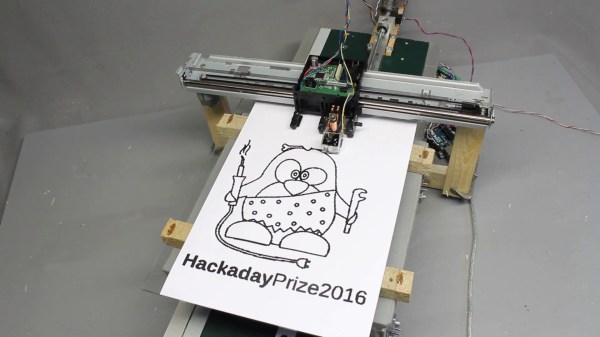
In his continuing work for his Hackaday prize entry, which we have covered before, his latest is a ink (…drop? ) printer. We think the goal is a Gingery book for CNC.  He begins to combine all his previous work into a complete assembly. The video, viewable after the break, starts by explaining the function of a salvaged printer carriage. A motor attached to a belt moves the carriage back and forth; the original linear encoder from the printer is used for positional feedback.

The base of the printer is a homemade y-carriage with another salvaged printer motor and encoder driving a threaded rod. The positional feedback for this axis is provided by a optical mouse gliding on a sheet of graph paper.  The printer nozzle is a cup of ink with a solenoid actuated needle in it. When the needle moves in a hole at the bottom, it dispenses ink.

As always, [HomoFaciens] makes something that is the very definition of a hack. Commenters will have to go elsewhere to leave their favorite debasement.

Continue reading “[HomoFaciens] Shows Off With DIY Paper Printer”

New CNC Machine? DIY Machinable Wax!

The folks at Leeds Hackspace have built themselves a shiny new C-beam based CNC mill. As you might expect everyone wants to try the machine out, but there’s a problem. A CNC machine presents a steep learning curve, and a lot of raw materials (not to mention cutting bits) can be used in a very short time. Their solution is simple: mix themselves some machinable wax from LDPE pellets and paraffin wax, then easily recycle their swarf and failed objects back into fresh machinable wax stock.

Making the wax recipe is not for the faint-hearted, and involves melting the LDPE pellets and wax to 130 degrees Celcius in a cheap deep-fat fryer. They bought the cheapest fryer they could find at the British catalogue retailer Argos, you really wouldn’t want to risk an appliance you cared about in this exercise.

Colouring came from an orange wax crayon, though they note recycling of mixed colours will inevitably result in a muddy brown. The finished mixture was poured into Tupperware lunchboxes to set, and the resulting blocks were trimmed to square on a bandsaw. The Tupperware proved not to have a flat bottom, so later batches were cast in a loaf tin which proved much more suitable.

We’ve mentioned the machinable wax recipe before here at Hackaday, but it’s worth returning to the topic here with a description of it being used in the wild. Having watched other environments get through learning materials at an alarming rate with very little to show for their effort, we can see it makes a lot of sense as a training material.

Pen-Plotter Firmware Written Completely In Ada

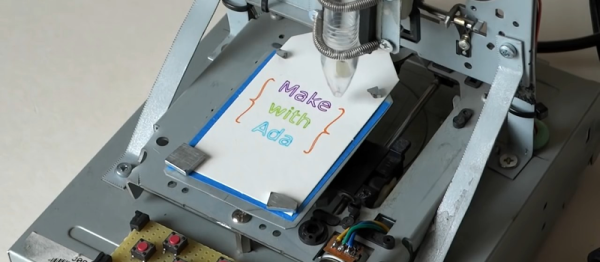
[Fabian Chouteau] built a plotter out of CD-ROM parts. Yawn, you say? Besides being a beautiful physical build, this one has a twist. He wrote the software and firmware for the entire project himself, in Ada.

Ada is currently number two on our list of oddball programming languages that should be useful for embedded programming. It’s vaguely Pascal-y, but with some modern object-oriented twists. It was developed for safety-critical, real-time embedded systems (by the US Department of Defense), and is used in things like airplanes, rockets, and the French TGV trains. If that sounds like overkill for your projects, [Fabian]’s project shows that it’s still very tractable.

In his GitHub, he re-implements the GRBL G-code generator and then writes a GUI front-end for it. In his writeup, he mentions that the firmware and its simulator for the front-end use exactly the same code which is quite a nice trick, and guarantees no (firmware) surprises when moving from the modelled device to the real thing.

We looked quickly around for Ada resources and came up with: GNAT, the GNU Ada compiler, and its derivatives: GNAT for ARM (STM32-flavor), ARM-Ada (LPC21xx flavor), AVR-Ada, and MSP430-Ada.

Any of you out there use Ada in embedded work? We’d love to hear your thoughts.

Continue reading “Pen-Plotter Firmware Written Completely In Ada”

How Did Pocket NC Survive And Thrive?

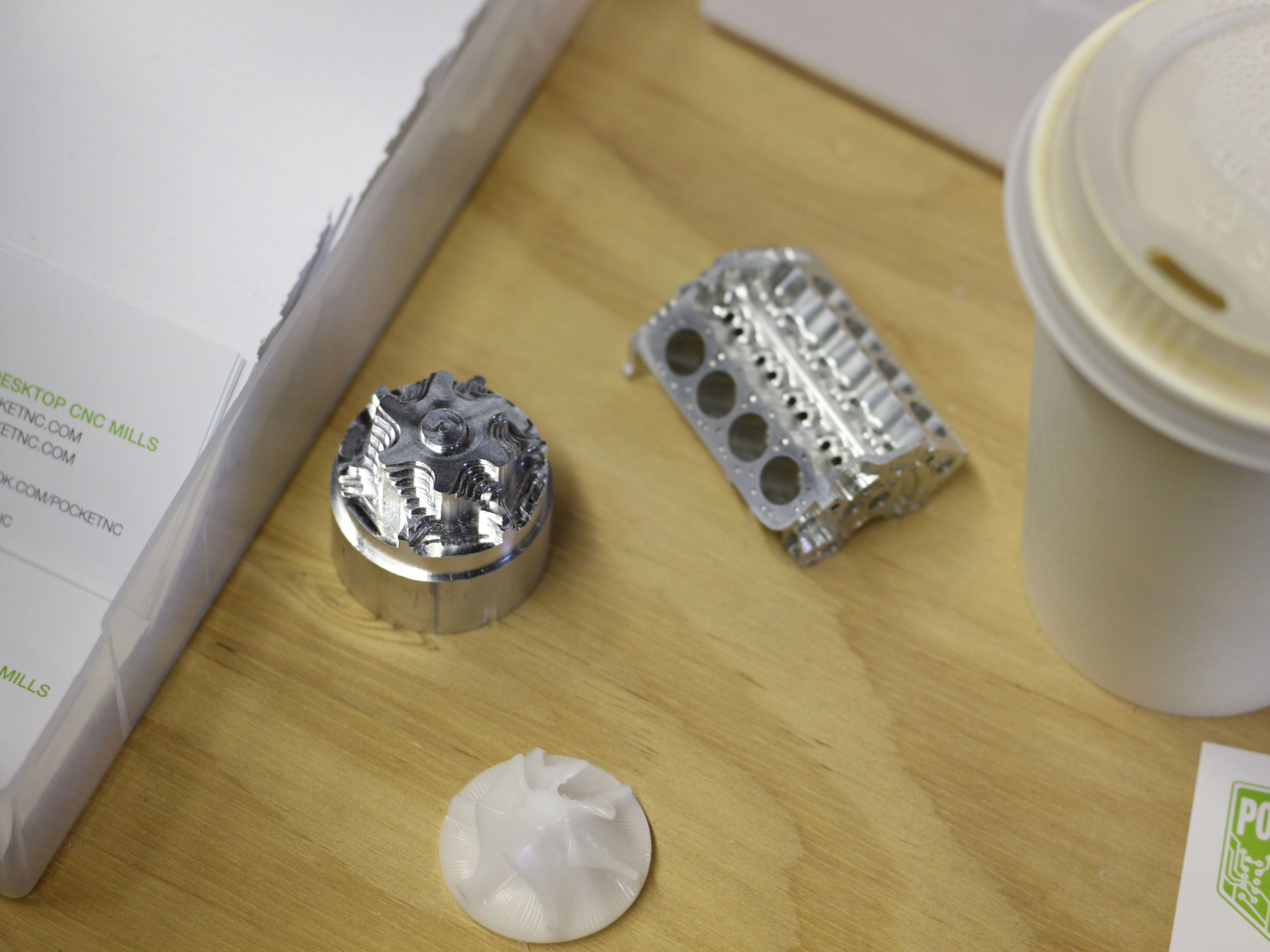
We had a chance to talk to Matthew Hertel of PocketNC at the Bay Area Maker Faire this year. During the conversation, he answered some questions I’d had about the project since I saw it on Kickstarter, and told a cool story while he was at it.

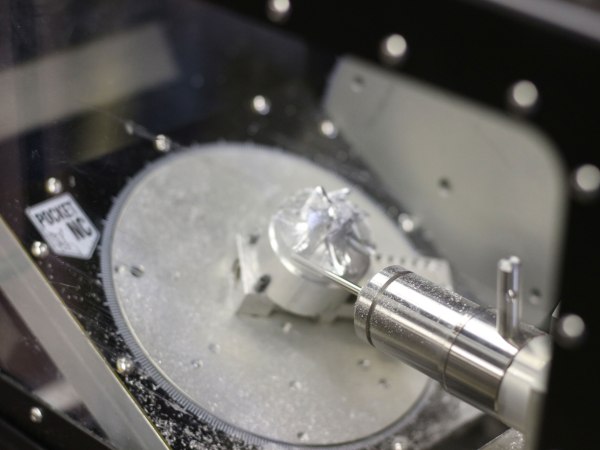
When the Pocket NC 5-axis Tabletop CNC Mill KickStarter came out, I immediately chocked it up as a failure out of the gate. I figured that there would never be a single delivered unit. It just seemed too impossible. The price was too low for a machine with that many large machined aluminum pieces. It had real linear guides. It had a real spindle and housed a beagle bone black running linuxCNC. It just couldn’t be that cheap. Ends up, I’m quite happy to be wrong. Pocket NC is doing well, delivering their first units, and taking new orders.

The CNC equivalent of a brag track on a hip-hop record.

It’s easy to get jaded with the Kickstarter and IndieGoGo scams that are out there. Or even the disappointing behavior of projects that could be legitimate. People often do failure analysis of companies, but it is also worth investigating what people did right when they are successful.

Continue reading “How Did Pocket NC Survive And Thrive?”

CNC Clock Mills Itself, Displays The Time

[Christian] wrote and sells some CAM/CNC controller software. We’re kinda sticklers for open source, and this software doesn’t seem to be, so “meh”. But what we do like is the Easter egg that comes included: the paths to mill out the base for a clock, and then the codes to move steel ball-bearings around to display the time.

Of course we’d like to see more info (more, MORE, MOAR!) but it looks easy enough to recreate. We could see redesigning this with marbles and a vacuum system, for instance. The seats for the ball bearings don’t even need to be milled out spheres. You could do this part with a drill press. Who’s going to rebuild this for their 3D printer? You just have to make sure that the machine is fast enough to move the balls around within one minute.

Continue reading “CNC Clock Mills Itself, Displays The Time”

Hackaday Prize Entry: Industrial Servo Control On The Cheap

[Oscar] wonders why hobby projects ignore all the powerful brushless motors available for far less than the equivalent stepper motors, especially with advanced techniques available to overcome their deficiencies.  He decided it must be because there is simply not a good, cheap, open source motor controller out there to drive them precisely. So, he made one.

Stepper motors are good for what they do, open-loop positioning along a grid, but as far as industrial motors go they’re really not the best technology available. Steppers win on the cost curve for being uncomplicated to manufacture and easy to control, but when it comes to higher-end automation it’s servo control all the way. The motors are more powerful and the closed-loop control can be more precise, but they require more control logic. [Oscar]’s board is designed to fill in this gap and take full advantage of this motor control technology.

The board can do some pretty impressive things for something with a price goal under $50 US dollars. It supports two motors at 24 volts with up to 150 amps peak current. It can take an encoder input for full closed loop control. It supports battery regeneration for braking. You can even augment a more modest power supply to allow for the occasional 1 KW peak movement with  the addition of a lithium battery. You can see the board showing off some of its features in the video after the break.

Continue reading “Hackaday Prize Entry: Industrial Servo Control On The Cheap”