Modular Keyboard And Custom Game Controller

Most video games, whether on console or PC, have standardized around either a keyboard and mouse or an analog controller of some sort, with very little differences between various offerings from the likes of Sony, Microsoft, Nintendo, or even Valve. This will get most of us through almost all video games, but for those looking to take their gameplay up a notch or who are playing much more complex games, certain specialized controllers are available, but they might not meet everyone’s specific needs. Thanks to this custom, modular keyboard anyone should be able to make exactly the controller they need.

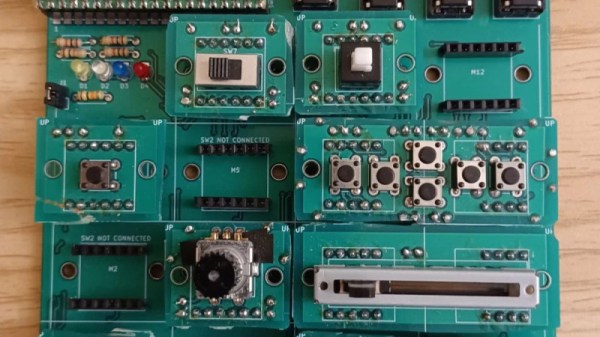
The device features a grid of 15 interfaces where modules like buttons, potentiometers, encoders, and joysticks can be placed. Each module can be customized to a significant extent on their own, and they can be placed anywhere on the grid. The modules themselves can be assigned to trigger keyboard presses or gamepad motions depending on the needs of the user. A Raspberry Pi handles the inputs and translates them to the computer, so in that regard it functions no differently than a standard keyboard or gamepad would. Programming is done by sending commands via a USB serial port, with the ability to save various configurations as well.

The modular controller is open-source in terms of hardware and software, with easy assembly using through-hole components and a customizable 3D printed cover for anyone looking to make their own. The project’s creator [Daniel] had flight simulators in mind when designing the device, which often benefit from having more specialized controllers, but any game with lots of specific inputs from Starcraft to League of Legends could benefit from a custom controller or keyboard like this. Flight simulators are more often the targets of specialized and unique controls, though, like this custom yoke or this physical control panel.

Well Documented Code Helps Revive Decades-Old Commodore Project

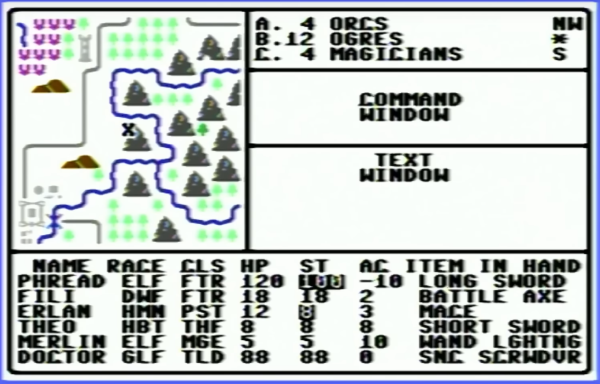
In the 1980s, [Mike] was working on his own RPG for the Commodore 64, inspired by dungeon crawlers of the era like Ultima IV and Telengard, both some of his favorites. The mechanics and gameplay were fairly revolutionary for the time, and [Mike] wanted to develop some of these ideas, especially the idea of line-of-sight, even further with his own game. But an illness, a stint in the military, and the rest of life since the 80s got in the way of finishing this project. This always nagged at him, so he finally dug out his decades-old project, dusted out his old Commodore and other antique equipment, and is hoping to finish it by 2024.

Luckily [Mike’s] younger self went to some extremes documenting the project, starting with a map he created which was inspired by Dungeons and Dragons. There are printed notes from a Commodore 64 printer, including all of the assembly instructions, augmented with his handwritten notes to explain how everything worked. He also has handwritten notes, including character set plans, disk sector use plans, menus, player commands, character stats, and equipment, all saved on paper. The early code was written using a machine language monitor since [Mike] didn’t know about the existence of assemblers at the time. Eventually, he discovered them and attempted to rebuild the code on a Commodore 128 and then an Amiga, but never got everything working together. There is some working code still on a floppy disk, but a lot of it doesn’t work together either.

While not quite finished yet, [Mike] has a well-thought-out plan for completing the build, involving aggregating all of the commented source code and doing quarterly sprints from here on out to attempt to get the project finished. We’re all excited to see how this project fares in the future. Beyond the huge scope of this pet project, we’d also suggest that this is an excellent example of thoroughly commenting one’s code to avoid having to solve mysteries or reinvent wheels when revisiting projects months (or decades) later. After all, self-documenting code doesn’t exist.

Continue reading “Well Documented Code Helps Revive Decades-Old Commodore Project”

Autopsy Of A Drifting Thumbstick Reveals All

Analog sticks have become a core part of modern video game controllers. They also routinely fail or end up drifting, consigning expensive controllers to the garbage. [sjm4306] recently did a repair job on an Oculus VR gaming controller with drifting analog sticks, and decided to do an autopsy to figure out what actually went wrong.

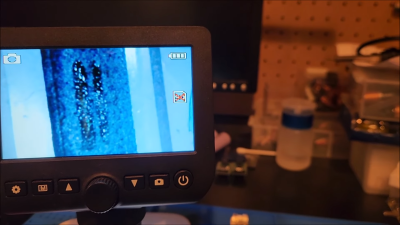
A microscope reveals gouges in the resistive material, caused by the metal contacts inside the analog stick. This happened via regular use.

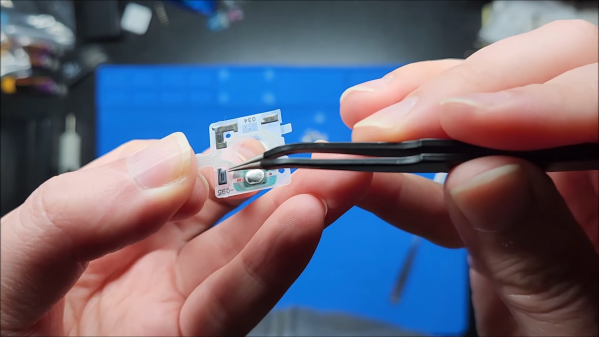
The video starts by taking apart the analog joystick itself by prying off the metal case. Inside, we get a look at the many tiny individual components that make up a modern thumbstick. Of most interest, though, are the components that make up the potentiometers within the stick. Investigation revealed that the metal contacts that move with the stick had worn through the resistive coating on the thin plastic membrane in the base of the joystick, creating the frustrating drift problem.

It doesn’t have to be this way. Analog sticks in modern controllers could be manufactured with higher-quality components that don’t wear so easily. After all, it’s hard to imagine a 90s video game controller wearing out as fast as this modern Oculus unit. But everything is built to a price, at the end of the day, and that’s just how it goes. Video after the break.

Continue reading “Autopsy Of A Drifting Thumbstick Reveals All”

Building An Energy Sword Replica From Halo

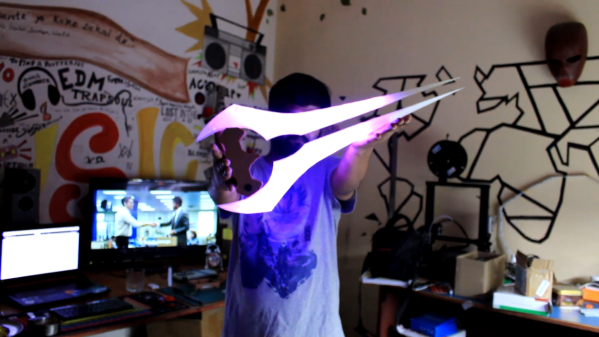
A good many of us whiled away the hours of our youths playing Swords Only deathmatch in Halo 2. The Energy Sword, aka the Plasma Sword, was the star of the show, with its devastating glowing blades granting us scoreboard domination. [Arnov Sharma] has now built a quality replica of this science-fiction weapon.

The build starts with a 3D design drawn up in Fusion 360. The parts are then 3D printed, with opaque filament used for the handle and translucent PLA filament for the “blade”. Inside the blade elements are twenty WS2812B LEDs, creating the characteristic glow that made the Energy Sword so tantalizing to find in game. An ATtiny85 is charged with running the LEDs, with the aid of an IP5306 chip to act as a boost converter for the lithium-ion battery supplying the juice.

[Anton] admits that the sword was built for the sole purpose of beautifying his maker space. That’s something we can respect, because we’d love to have one hanging on the wall at home. We’ve featured some other fun gaming replicas before, too.

Continue reading “Building An Energy Sword Replica From Halo

Long-Distance Gaming Over Packet Radio

The amateur radio community often gets stereotyped as a hobby with a minimum age requirement around 70, gatekeeping airwaves from those with less experience or simply ignoring unfamiliar beginners. While there is a small amount of truth to this on some local repeaters or specific frequencies, the spectrum is big enough to easily ignore those types and explore the hobby without worry (provided you are properly licensed). One of the best examples of this we’ve seen recently of esoteric radio use is this method of using packet radio to play a game of Colossal Cave Adventure.

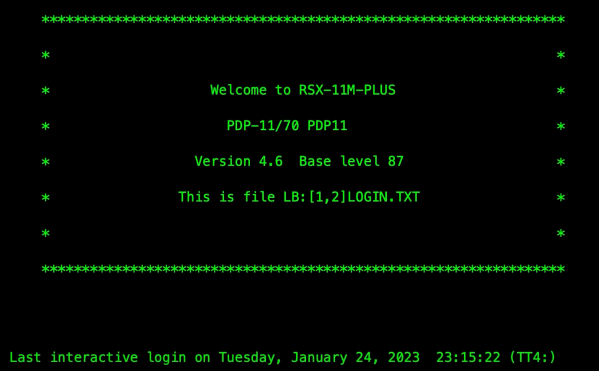
Packet radio is a method by which digital information can be sent out over the air to nodes, which are programmed to receive these transmissions and act on them. Typically this involves something like email or SMS messaging, so playing a text-based game over the air is not too much different than its intended use. For this build, [GlassTTY] aka [G6AML] is using a Kenwood TH-D72 which receives the packets from a Mac computer. It broadcasts these packets to his node, which receives these packets and sends them to a PDP-11 running the game. Information is then sent back to the Kenwood and attached Mac in much the same way as a standard Internet connection.

The unique features of packet radio make it both an interesting and useful niche within the ham radio community, allowing for all kinds of uses where data transmission might otherwise be infeasible or impossible. A common use case is APRS, which is often used on VHF bands to send weather and position information out, but there are plenty of other uses for it as well.

Continue reading “Long-Distance Gaming Over Packet Radio”

Classic Gaming With FPGA And ATX

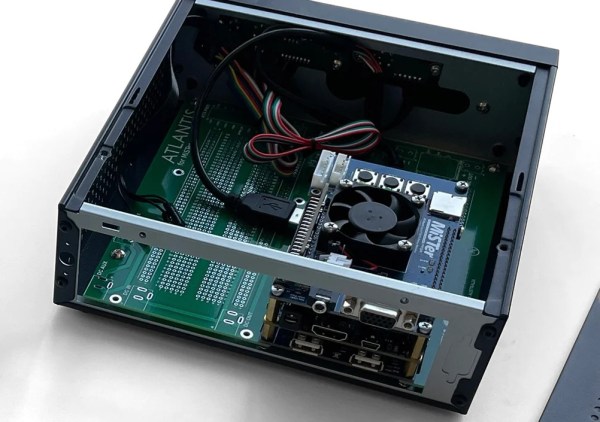
Playing classic games, whether they are games from the golden age of arcades or simply games from consoles that are long out of production, tends to exist on a spectrum. At one end is grabbing a game’s ROM file, finding an emulator, and kludging together some controls on a keyboard and mouse with your average PC. At the other is meticulously restoring classic hardware for the “true” feel of what the game would have felt like when it was new. Towards the latter end is emulating the hardware with an FPGA which the open-source MiSTer project attempts to do. This build, though, adds ATX capabilities for the retrocomputing platform. Continue reading “Classic Gaming With FPGA And ATX”

Playdate Handheld Turned Typewriter

The Playdate is an interesting gaming system. It’s a handheld, has a black and white screen, and superficially reminds us a little bit of the original Game Boy, right down to the button layout. But the fact that it has a second controller that pops out of the side, that this controller is a crank, and that the whole system was made by the same people that made Untitled Goose Game, makes us quite intrigued. Apparently it has made an impact on others, too, because this project turns the gaming system into a typewriter.

The Playdate doesn’t have native support for USB accessories unless it’s plugged into this custom 3D printed dock. Inside of the dock is a Teensy 4.1 which handles some translation between the keyboard and the console. Once the dock is taken care of the text editor needs to be side-loaded to the device as well. The word processor has the ability to move the cursor around, insert and delete text, and the project’s creator, [t0mg], plans to add more features in future versions like support for multiple files, changing the font, and a few other things as well.

For anyone interested in recreating this project, all of the printable files, the text editor, and the schematics are all available in the GitHub repo. It’s an impressive project for a less well-known console that we haven’t seen many other hacks for, unless you count this one-off Arduboy project which took some major inspiration from the Playdate’s crank controller.