A Holographic Seven-Segment Clock

Seven-segment displays are one of the most ho-hum ways to display the time. They were cool for a little bit in the 70s, but by now, they’re a little bit old hat. That is, unless you get weird with it. This holographic seven-segment clock from [mosivers] qualifies neatly in that category.

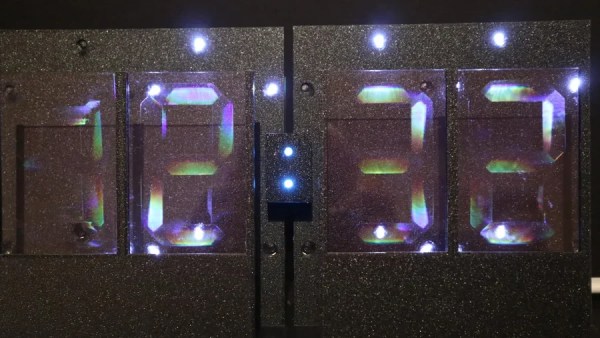
The first step was to make the holographic segment displays, because they’re not really something you can just buy off the shelf. [mosivers] achieved this by using a kit from LitiHolo, which enables you to create holograms by shooting a laser at special holographic film. Only, a few upgrades were made to use the kit with a nicer red diode laser that [mosivers] had on hand for better performance. The seven-segment layouts were carefully recorded on to the film to form the basic numerals of the clock, such that illuminating the films from different angles would light different segments of the numeral. It’s quite involved, but it’s explained well in the build video.

As for the timekeeping side of things, an ESP32 was used, setup to query a network time server to stay accurate. The microcontroller then commands a series of LEDs to light up as needed to illuminate the relevant segments of the holographic film to show the time.

Ultimately, [mosivers] built a cool clock with a look you won’t find anywhere else. It’s a lot more work than just wiring up some classic seven-segment LEDs, but we think the result is worth it. If you fancy other weird seven-segment builds, though, we’ve got plenty of others in the till.
Continue reading “A Holographic Seven-Segment Clock”

A frame from the two billion frames per second camera

Filming At The Speed Of Light, About One Foot Per Nanosecond

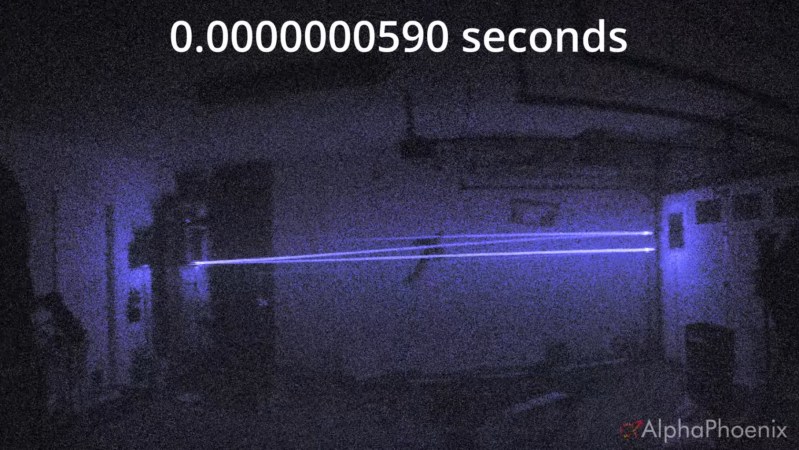
[Brian Haidet] published on his AlphaPhoenix channel a laser beam recorded at 2 billion frames per second. Well, sort of. The catch? It’s only a one pixel by one pixel video, but he repeats it over and over to build up the full rendering. It’s a fascinating experiment and a delightful result.

For this project [Brian] went back to the drawing board and rebuilt his entire apparatus from scratch. You see in December last year he had already made a video camera that ran at 1,000,000,000 fps. This time around, in order to hit 2,000,000,000 fps at significantly improved resolution, [Brian] updated the motors, the hardware, the oscilloscope, the signalling, the recording software, and the processing software. Basically, everything.

One of the coolest effects to come out of this new setup is how light appears to travel noticeably faster when coming towards the camera than when moving away from it. It’s an artifact of the setup: laser beams that reflect off of fog particles closer to the camera arrive sooner than ones that bounce back from further away. Or, put another way, it’s special relativity visualized in an experiment in [Brian]’s garage. Pretty cool.

If you found all this intriguing and would like to know more, there’s some bonus material that goes into much more depth.

Engrave A Cylinder Without A Rotary Attachment? No Problem!

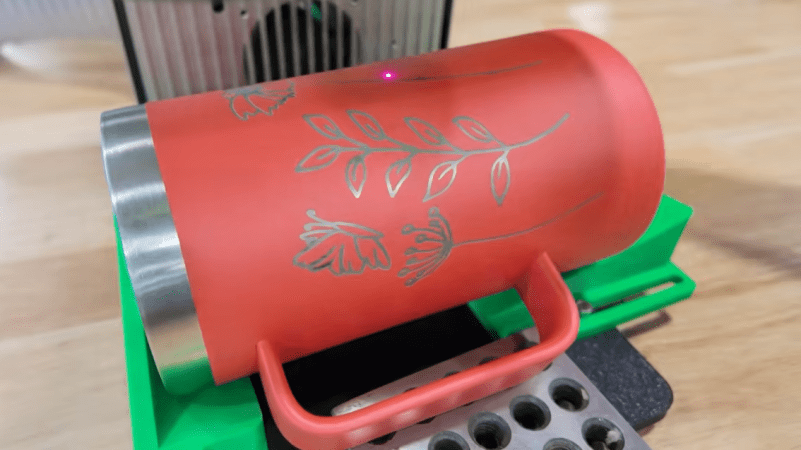
Laser-engraving a cylindrical object usually requires a rotary attachment, which is a motorized holder that rotates a cylindrical object in sync with the engraver. But [Samcraft] shows that engraving all around a mug can be done without a motorized rotary holder.

Separating a design into elements thin enough to engrave individually without losing focus is the key.

The basic idea is to split the design into a number of separate engraving jobs, each containing one element of the overall design, then setting the mug into a 3D printed jig and manually rotating it between jobs. To demonstrate, [Samcraft] selects a series of line-art flowers and plants which are ideal for this approach because there’s no need to minutely register the individual engravings with one another.

What about focus? [Samcraft] found that a design up to 45 mm wide could be engraved onto the curved surface of his mug before focus suffers too much. It’s true that this technique only works with certain types of designs — specifically those with individual elements that can be separated into tall and thin segments — but the results are pretty nice.

Laser engravers are a very serious potential eye hazard, and we are not delighted to see the way the shield around [Samcraft]’s engraver cannot close completely to accommodate the mug while the laser is active. But we’re going to assume [Samcraft] has appropriate precautions and eye protection in place off-camera, because laser radiation and eyeballs absolutely do not belong together, even indirectly.

Continue reading “Engrave A Cylinder Without A Rotary Attachment? No Problem!”

Hackaday Links Column Banner

Hackaday Links: June 29, 2025

In today’s episode of “AI Is Why We Can’t Have Nice Things,” we feature the Hertz Corporation and its new AI-powered rental car damage scanners. Gone are the days when an overworked human in a snappy windbreaker would give your rental return a once-over with the old Mark Ones to make sure you hadn’t messed the car up too badly. Instead, Hertz is fielding up to 100 of these “MRI scanners for cars.” The “damage discovery tool” uses cameras to capture images of the car and compares them to a model that’s apparently been trained on nothing but showroom cars. Redditors who’ve had the displeasure of being subjected to this thing report being charged egregiously high damage fees for non-existent damage. To add insult to injury, if renters want to appeal those charges, they have to argue with a chatbot first, one that offers no path to speaking with a human. While this is likely to be quite a tidy profit center for Hertz, their customers still have a vote here, and backlash will likely lead the company to adjust the model to be a bit more lenient, if not outright scrapping the system.

Continue reading “Hackaday Links: June 29, 2025”

Homebrew Pockels Cell Is Worth The Wait

We haven’t seen any projects from serial experimenter [Les Wright] for quite a while, and honestly, we were getting a little worried about that. Turns out we needn’t have fretted, as [Les] was deep into this exploration of the Pockels Effect, with pretty cool results.

If you’ll recall, [Les]’s last appearance on these pages concerned the automated creation of huge, perfect crystals of KDP, or potassium dihydrogen phosphate. KDP crystals have many interesting properties, but the focus here is on their ability to modulate light when an electrical charge is applied to the crystal. That’s the Pockels Effect, and while there are commercially available Pockels cells available for use mainly as optical switches, where’s the sport in buying when you can build?

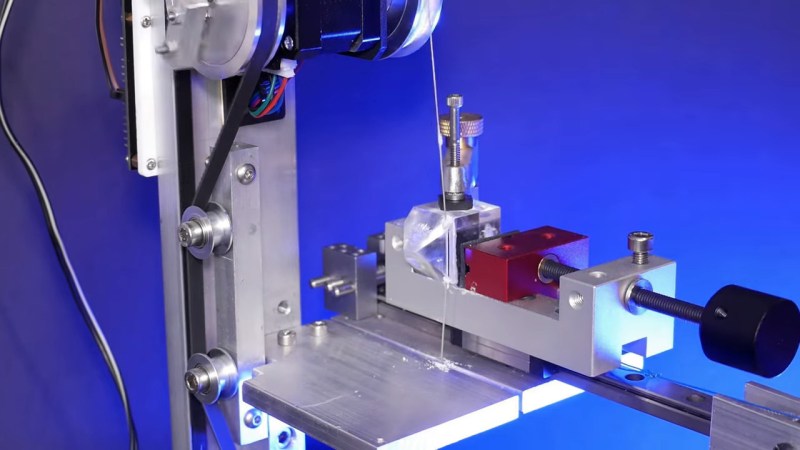
As with most of [Les]’s projects, there are hacks galore here, but the hackiest is probably the homemade diamond wire saw. The fragile KDP crystals need to be cut before use, and rather than risk his beauties to a bandsaw or angle grinder, [Les] threw together a rig using a stepper motor and some cheap diamond-encrusted wire. The motor moves the diamond wire up and down while a weight forces the crystal against it on a moving sled. Brilliant!

The cut crystals are then polished before being mounted between conductive ITO glass and connected to a high-voltage supply. The video below shows the beautiful polarization changes induced by the electric field, as well as demonstrating how well the Pockels cell acts as an optical switch. It’s kind of neat to see a clear crystal completely block a laser just by flipping a switch.

Nice work, [Les], and great to have you back.

Continue reading “Homebrew Pockels Cell Is Worth The Wait”

A 100-Year-Old Electronic Musical Instrument Brought Back To Life

In the early years of electrification, when electricity was beginning to shape the modern world, this new technology was being put to use in many more places than turning motors and providing lighting. Some things we can see as obvious missteps like electrified corsets marketed as health tonics or x-ray treatments for eye strain, but others ended up being fascinating bits of technology with interesting uses, many of which have been largely forgotten since. This 100-year-old musical instrument is squarely in the latter category, and this build brings the sound of it back to life.

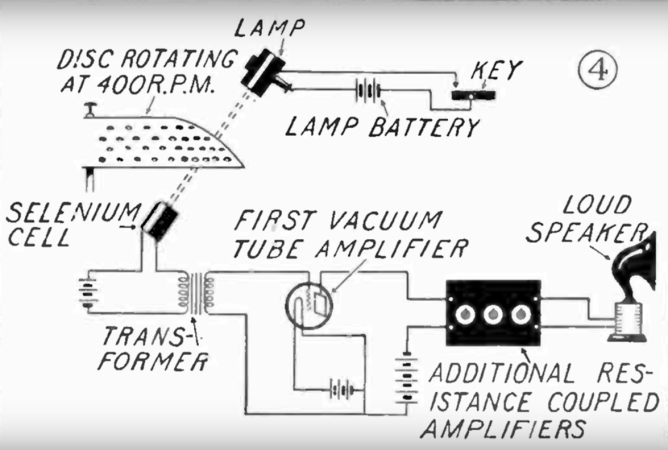
The instrument was called the Luminaphone and was originally built by [Harry Grindell Matthews]. Of course, this was an age before transistors and many other things we take for grated, so it has some quirks that we might not otherwise expect from a musical instrument. The device generated sound by shining a series of lights through a perforated rotating disc at a selenium cell. The selenium cell was an early photoresistor, generating current corresponding to the amount of light falling on it. A keyboard activated different lights, shining on areas of the disc with different numbers of holes, causing differing sounds to be produced by the instrument.

The recreation was built by [Nick Bild] and uses a laser diode as a stand-in for the rotating disc, but since it can be modulated in a similar way the idea is that the photodiode used as a receiver would generate a similar sound. The recreation sounds a bit like a video game from the 8-bit era, but with no recordings or original Luminaphones surviving to the present day we may never know how accurate it is. There are some other electronic instruments still around today, though, and plenty of ways of DIY-ing their sound like this project which recreates the tonewheels of the classic Hammond organ.

Continue reading “A 100-Year-Old Electronic Musical Instrument Brought Back To Life”

NES Zapper Becomes Telephone

Although there was a time in the 80s (and early 90s for fans of the SuperScope) where light guns were immensely popular, with games like DuckHunt cultural touchstones, their time in the video game world has largely come to an end. We might occasionally pick up a Zapper for the NES and play this classic out of nostalgia, but plenty of people are looking for other things that these unique video game controllers can do instead. [Nick] has turned one of his old NES peripherals into a wireless phone.

The way the original Zapper worked was by looking for a certain pattern of pixels that displayed for a fraction of a second whenever the trigger was pulled. Bypassing the anti-cheat mechanism that looks only for qualities of light coming from CRT screens of the day effectively turns the light gun into an analog light sensor which is used for receiving the audio from the phone’s base station via a laser. Of course there were no microphones present within the original hardware so one is added, wiring its output to another laser that communicates to the base station. With the light gun pointed directly at this base station, audio is communicated back and forth by varying the strengths of these small lasers and listening to them on the other end with photodiodes.

[Nick] does point out that this isn’t a great phone, largely because it needs to be pointed exactly at the right spot to work at all, although we do agree that it’s an interesting project that demonstrates what the original hardware could do with a few of its limitations removed. There are a few other ways of bringing these devices into the modern world, with one of our favorites being this laser pointer with additional hardware from a Wiimote that could also function as a mouse.

Continue reading “NES Zapper Becomes Telephone”