InSight Brings New Tech To Mars

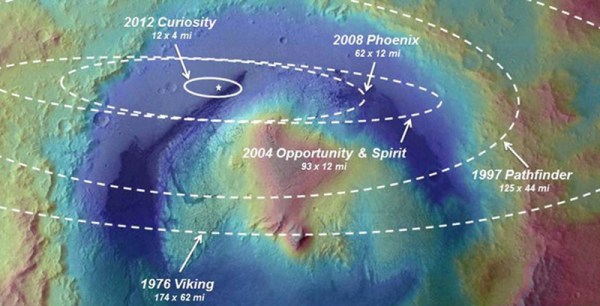
Unless you’ve got your ear on the launch pad so to speak, you might not be aware that humanity just launched a new envoy towards the Red Planet. Estimated to touch down in Elysium Planitia on November 26th, the InSight lander is relatively low-key as far as interplanetary missions go. Part of the NASA’s “Discovery Program”, it operates on a considerably lower budget than Flagship missions such as the Curiosity rover; meaning niceties like a big advertising and social media campaign to get the public excited doesn’t get a line item.

Which is a shame, because not only are there much worse things to do with tax money than increase public awareness of scientific endeavours, but because InSight frankly deserves a bit more respect than that. Featuring a number of firsts, the engineers and scientists behind InSight might have been short on dollars, but ambition was in ample supply.

So in honor of the successful launch, let’s take a look at the InSight mission, the unique technology onboard, and the answers scientists hope it will be able to find out there in the black.

Continue reading “InSight Brings New Tech To Mars”

Extraterrestrial Autonomous Lander Systems To Touch Down On Mars

The future of humans is on Mars. Between SpaceX, Boeing, NASA, and every other national space program, we’re going to Mars. With this comes a problem: flying to Mars is relatively easy, but landing a large payload on the surface of another planet is orders of magnitude more difficult. Mars, in particular, is tricky: it has just enough atmosphere that you need to design around it, but not enough where we can use only parachutes to bring several tons down to the surface. On top of this, we’ll need to land our habitats and Tesla Roadsters inside a very small landing ellipse. Landing on Mars is hard and the brightest minds are working on it.

At this year’s Hackaday Superconference, we learned how hard landing on Mars is from Ara Kourchians (you may know him as [Arko]) and Steve Collins, engineers at the Jet Propulsion Laboratory in beautiful Pasadena. For the last few years, they’ve been working on COBALT, a technology demonstrator on how to use machine vision, fancy IMUs, and a host of sensors to land autonomously on alien worlds. You can check out the video of their Supercon talk below.

Continue reading “Extraterrestrial Autonomous Lander Systems To Touch Down On Mars”

Earth Rovers Explore Our Own Planet

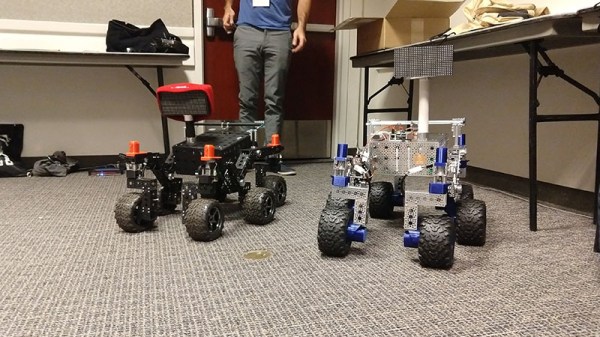
While Mars is currently under close scrutiny by NASA and other space agencies, there is still a lot of exploring to do here on Earth. But if you would like to explore a corner of our own planet in the same way NASA that explores Mars, it’s possible to send your own rover to a place and have it send back pictures and data for you, rather than go there yourself. This is what [Norbert Heinz]’s Earth Explorer robots do, and anyone can drive any of the robots to explore whatever locations they happen to be in.

A major goal of the Earth Explorer robot is to be easy to ship. This is a smaller version of the same problem the Mars rovers have: how to get the most into a robot while having as little mass as possible. The weight is kept to under 500g, and the length, width, and height to no more than 90cm combined. This is easy to do with some toy cars modified to carry a Raspberry Pi, a camera, and some radios and sensors. After that, the robots only need an interesting place to go and an Internet connection to communicate with Mission Control.

[Norbert] is currently looking for volunteers to host some of these robots, so if you’re interested head on over to the project page and get started. If you’d just like to drive the robots, though, you can also get your rover fix there as well. It’s an interesting project that will both get people interested in exploring Earth and in robotics all at the same time. And, if you’d like to take the rover concept beyond simple exploration, there are other machines that can take care of the same planet they explore.

Continue reading “Earth Rovers Explore Our Own Planet”

Living On Mars: The Stuff You Never Thought About

In The Martian we saw what kind of hacking was needed to stay alive for a relatively short while on Mars, but what if you were trying to live there permanently? Mars’ hostile environment would affect your house, your transportation, even how you communicate. So here’s a fun thought experiment about how you’d live on Mars as part of a larger community.

Not Your Normal House

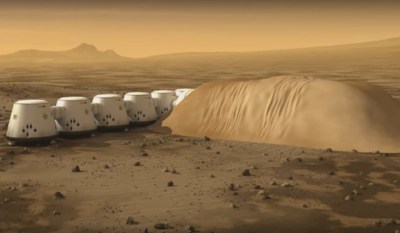
Mars One living units under regolith
Mars One living units under regolith, Source video

Radiation on Mars comes from solar particle events (SPE) and galactic cosmic radiation (GCR). Mars One, the organization planning one-way trips to Mars talks about covering their habitats in several meters of regolith, a fancy word for the miscellaneous rocky material covering the bedrock. Five meters provides the same protection as the Earth’s atmosphere — around 1,000 g/cm2 of shielding. A paper from the NASA Langley Research Center says that the largest reduction comes from the top 15 to 20 cm of regolith. And so our Mars house will have an underlying structure but the radiation protection will come from somewhere between 20 cm to a few meters of regolith. Effectively, people will be living underground.

On Earth, producing water and air for your house is not something you think of doing, let alone disposing of exhaled CO2. But Mars houses will need systems for this and more.

Continue reading “Living On Mars: The Stuff You Never Thought About”

Hacking On Mars In “The Martian”

It’s been 6 years since the hacker’s treat of a book, “The Martian” by Andy Weir, was self-published, and 2 years since the movie came out. We’ve talked about it briefly before, but enough time has passed that we can now write-up the book’s juicier hacks while being careful to not give away any plot spoilers. The book has more hacks than the movie so we’re using the book as the source.

For anyone unfamiliar with the story, Mark Watney is an astronaut who’s left for dead, by himself, on Mars. To survive, he has a habitat designed for six, called the Hab, two rovers, the Mars Descent Vehicle (MDV) they arrived in, and the bottom portion of the Mars Ascent Vehicle (MAV), the top portion of which was the rocket that his five crewmates departed in when they left him alone on the inhospitable desert planet. If you haven’t read it yet, it’s easy to finish over a long weekend. Do yourself a favor and pick it up after work today.

Making Water

Watney’s major concern is food. They sent up some potatoes with the mission which will sprout roots from their eyes. To grow potatoes he needs water.

One component of the precious H2O molecule is of course the O, oxygen. The bottom portion of the MAV doesn’t produce oxygen, but it does collect CO2 from the Martian atmosphere and stores it in liquid form. It does this as one step in producing rocket fuel used later to blast off from the surface.

Continue reading “Hacking On Mars In “The Martian””

PUFFER: A Smartphone-Sized Planetary Explorer

Is there room on Mars and Europa for cute robots? [NASA] — collaborating with [UC Berkley] and [Distant Focus Corporation] — have the answer: PUFFER, a robot inspired by origami.

PUFFER — which stands for Pop-Up Flat-Folding Explorer Robot — is able to sense objects and adjust its profile accordingly by ‘folding’ itself into a smaller size to fit itself into nooks and crannies. It was designed so multiple PUFFERs could reside inside a larger craft and then be deployed to scout otherwise inaccessible terrain. Caves, lava tubes and shaded rock overhangs that could shelter organic material are prime candidates for exploration. The groups of PUFFERs will send the collected info back to the mother ship to be relayed to mother Earth.

We’ve embedded the video of the bot folding it’s wheels down to pass a low-bridge. You can get a view of the wider scope of functionality for the collection of demos on the project page.

Continue reading “PUFFER: A Smartphone-Sized Planetary Explorer”

Growing Plants On Mars… On Earth

One of the biggest challenges of traveling to Mars is that it’s far away. That might seem obvious, but that comes with its own set of problems when compared to traveling to something relatively close like the Moon. The core issue is weight, and this becomes a big deal when you have to feed several astronauts for months or years. If food could be grown on Mars, however, this would make the trip easier to make. This is exactly the problem that [Clinton] is working on with his Martian terrarium, or “marsarium”.

The first task was to obtain some soil that would be a good analog of Martian soil. Obtaining the real thing was out of the question, as was getting similar dirt from Hawaii. [Clinton] decided to make his own by mixing various compounds from the hardware store in the appropriate amounts. From there he turned to creating the enclosure and filling it with the appropriate atmosphere. Various gas canisters controlled by gas solenoid valves mixed up the analog to Martian atmosphere: 96% dioxide, 2% argon, and 2% nitrogen. The entire experiment was controlled by an Intel Edison with custom circuits for all of the sensors and regulating equipment. Check out the appropriately dramatic video of the process after the break.

While the fern that [Clinton] planted did survive the 30-day experiment in the marsarium, it wasn’t doing too well. There’s an apparent lack of nitrogen in Martian soil which is crucial for plants to survive. Normally this is accomplished when another life form “fixes” nitrogen to the soil, but Mars probably doesn’t have any of that. Future experiments would need something that could do this for the other plants, but [Clinton] notes that he’ll need a larger marsarium for that. And, if you’re not interested in plants or Mars, there are some other interesting ramifications of nitrogen-fixing as well.

Continue reading “Growing Plants On Mars… On Earth”