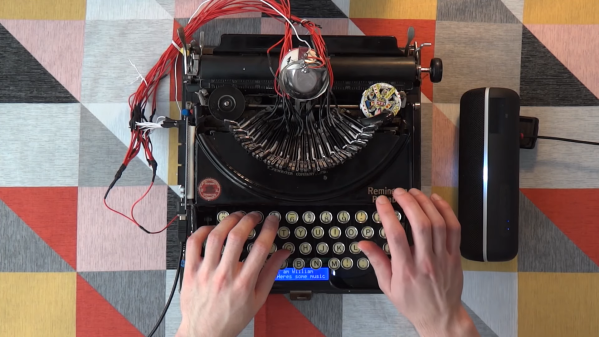
Brute-Forced Copyrighting: Liberating All The Melodies

Bluntly stated, music is in the end just applied physics. Harmony follows — depending on the genre — a more or less fixed set of rules, and there  are a limited amount of variation possible within the space of music itself. So there are technically only so many melodies possible, making it essentially a question of time until a songwriter or composer would come up with a certain sequence of notes without knowing that they’re not the first one to do so until the cease and desist letters start rolling in.

You might well argue that there is more to a song than just the melody — and you are absolutely right. However, current copyright laws and past court rulings may not care much about that. Aiming to point out these flaws in the laws, musician tech guy with a law degree [Damien Riehl] and musician software developer [Noah Rubin] got together to simply create every possible melody as MIDI files, releasing them under the Creative Commons Zero license. While their current list is limited to a few scales of fixed length, with the code available on GitHub, it’s really just a matter of brute-forcing literally every single possible melody.

Admittedly, such a list of melodies might not have too much practical use, but for [Damien] and [Noah] it’s anyway more about the legal and philosophical aspects: musicians shouldn’t worry about getting sued over a few overlapping notes. So while the list serves as a “safe set of melodies” they put in the public domain, their bigger goal is to mathematically point out the finite space of music that shouldn’t be copyrightable in the first place. And they definitely have a point — just imagine where music would be today if you could copyright and sue over chord progressions.
Continue reading “Brute-Forced Copyrighting: Liberating All The Melodies”

Harmonicade Is A High-Scoring MIDI Controller

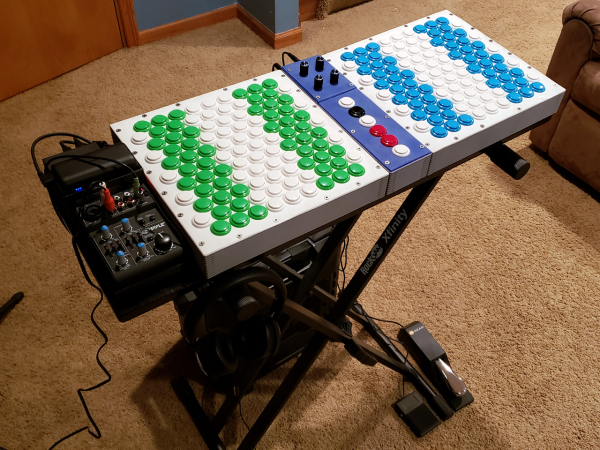
When [KOOP Instruments] started learning the piano, he wasn’t prepared for the tedium of learning chords and their relationships on the standard keyboard layout. But instead of killing his desire to tickle the ivories, it inspired him to explore alternative layouts that are easier to play. He converted to Isomorphism, started building MIDI controllers, and hasn’t looked back.

The latest incantation is Harmonicade, a dual-decked number arranged Wicki-Hayden style. Both decks have 5½ octaves, are (electrically) identical, and run off a single Teensy 3.6. We admire [KOOP]’s use of DB25 connectors to wrangle the wiring between the decks and the Teensy — quite a neat solution. Almost as neat as his beautifully-commented code.

Although the button decks and control boxes are all printed and open source, they are designed to be easily made from acrylic or plywood instead. [KOOP] is going to keep iterating until he’s totally happy with the control locations and layout, and the ease of breakdown and reassembly. We’ve got a double shot of videos for you after the break — one of [KOOP] playing Harmonicade, and a longer one exploring and playing its precursor, the Melodicade.

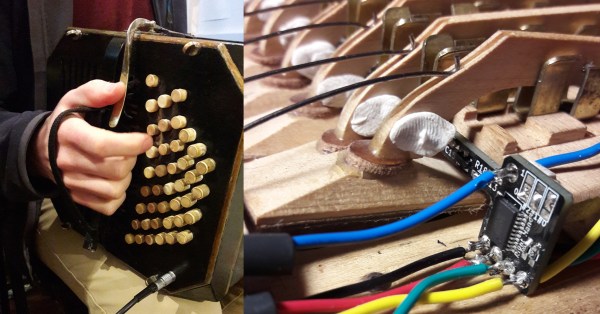
Tired of conventional-looking MIDI controllers? We hear your bellows and offer this MIDI controller in a concertina.

Continue reading “Harmonicade Is A High-Scoring MIDI Controller”

Play That Funky 3D Printer…

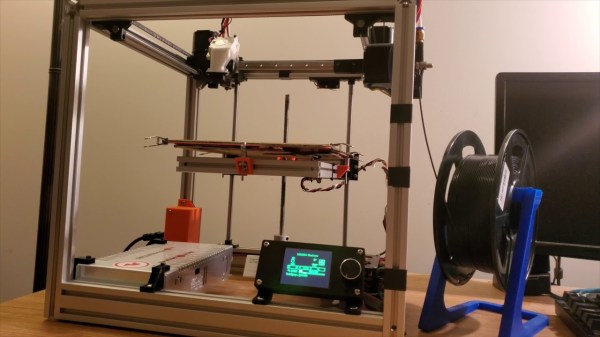
Human brains are wired for music. Scientists think the oldest musical instruments were flutes that date back somewhere between 67,000 and 37,000 years ago. We assume though that people were banging on wood or their thighs, or knocking two rocks together long before that. Almost anything can be a musical instrument. A case in point: [elifer5000] walked into a room containing a lot of running 3D printers, and thought it seemed musical. Next thing you know, he harnessed 3D printers as a MIDI instrument.

At a hackathon, he found some software that converts a MIDI file to GCode. The only problem is a common printer has three axes and, therefore, can only produce (at most) three notes at once. The obvious answer to this problem is to use more printers, and that’s what he did, as you can see below.

Continue reading “Play That Funky 3D Printer…”

Fabric(ated) Drum Machine

Some folks bring out an heirloom table runner when they have company, but what if you sewed your own and made it musical? We’d never put it away! [kAi CHENG] has an Instructable about how to recreate his melodic material, and there is a link to his website, which describes his design process, not just the finished product. We have a video below showing a jam session where he exercises a basic function set.

GarageBand is his DAW of choice, which receives translated MIDI from a Lilypad. If you don’t have a Lilypad, any Arduino based on the ATmega328P chip should work seamlessly. Testing shows that conductive threads in the soft circuit results in an occasional short circuit, but copper tape makes a good conductor  at the intersections. Wide metallic strips make for tolerant landing pads beneath modular potentiometers fitted with inviting foam knobs. Each twist controls a loop in GarageBand, and there is a pressure-sensitive pad to change the soundset. Of course, since this is all over MIDI, you can customize to your heart’s content.

MIDI drums come in all shapes and sizes, from a familiar game controller to hand rakes.

Continue reading “Fabric(ated) Drum Machine”

A STM32 Tonewheel Organ Without A Single Tonewheel

The one thing you might be surprised not to find in [Laurent]’s beautiful tonewheel organ build is any tonewheels at all.

Tonewheels were an early way to produce electronic organ sounds: by spinning a toothed wheel at different frequencies and transcending the signal one way or another it was possible to synthesize quite an array of sounds. We like to imagine that they’re all still there in [Laruent]’s organ, albeit very tiny, but the truth is that they’re being synthesized entirely on an STM32 micro controller.

The build itself is beautiful and extremely professional looking. We were unaware that it was possible to buy keybeds for a custom synthesizer, but a model from FATAR sits at the center of the show. There’s a MIDI encoder board and a Nucleo development board inside, tied together with a custom PCB. The UI is an momentary encoder wheel and a display from Mikroelektronika.

You can see and hear this beautiful instrument in the video after the break.

Continue reading “A STM32 Tonewheel Organ Without A Single Tonewheel”

Sara Adkins Is Jamming Out With Machines

Asking machines to make music by themselves is kind of a strange notion. They’re machines, after all. They don’t feel happy or hurt, and as far as we know, they don’t long for the affections of other machines. Humans like to think of music as being a strictly human thing, a passionate undertaking so nuanced and emotion-based that a machine could never begin to understand the feeling that goes into the process of making music, or even the simple enjoyment of it.

The idea of humans and machines having a jam session together is even stranger. But oddly enough, the principles of the jam session may be exactly what machines need to begin to understand musical expression. As Sara Adkins explains in her enlightening 2019 Hackaday Superconference talk, Creating with the Machine, humans and machines have a lot to learn from each other.

To a human musician, a machine’s speed and accuracy are enviable. So is its ability to make instant transitions between notes and chords. Humans are slow to learn these transitions and have to practice going back and forth repeatedly to build muscle memory. If the machine were capable, it would likely envy the human in terms of passionate performance and musical expression.

Continue reading “Sara Adkins Is Jamming Out With Machines”

World’s Smallest MIDI Synth, Now Even Better

We’re pretty sure there’s no internationally recognized arbiter of records like “World’s smallest full-featured polyphonic stereo MIDI synthesizer that fits in a DIN shell”. If there isn’t, there sure should be, and we’re pretty sure [mitxela]’s Flash-Synth would hold that particular record.

This is one of those lessons that some people just can’t leave a challenge alone. First [mitxela] built a MIDI synthesizer into a DIN connector, then a couple of months later he made a somewhat more streamlined version. While both were feats of engineering derring-do, neither was entirely satisfactory. With only square wave synthesis and a limit of eight voices, plus some unpleasant audio issues and a total lack of manufacturability, the next challenge was clear.

We won’t pretend to follow all the audio arcana, of which the video below and the build log have plenty, but the technical achievement is obvious enough. The Flash-Synth has an STM32, a tantalum SMD filter capacitor that dwarfs it, and a few support components on a flexible PCB that folds back on itself twice. This bit of circuit origami is connected to a 5-pin DIN plug and stuffed into the connector’s shell, which in turn mates to a custom-machined metal housing. A stereo audio jack lives at the other end of the assembly, and the whole synth is powered parasitically off the MIDI port.

The first half of the video below is mostly a demo that proves the synth sounds great and can do just about anything; skip to the 22-minute mark for the gory build details. Suffice it to say that [mitxela]’s past experience with ludicrous scale soldering served him well here.

Continue reading “World’s Smallest MIDI Synth, Now Even Better”