World’s Smallest MIDI Synth, Now Even Better

We’re pretty sure there’s no internationally recognized arbiter of records like “World’s smallest full-featured polyphonic stereo MIDI synthesizer that fits in a DIN shell”. If there isn’t, there sure should be, and we’re pretty sure [mitxela]’s Flash-Synth would hold that particular record.

This is one of those lessons that some people just can’t leave a challenge alone. First [mitxela] built a MIDI synthesizer into a DIN connector, then a couple of months later he made a somewhat more streamlined version. While both were feats of engineering derring-do, neither was entirely satisfactory. With only square wave synthesis and a limit of eight voices, plus some unpleasant audio issues and a total lack of manufacturability, the next challenge was clear.

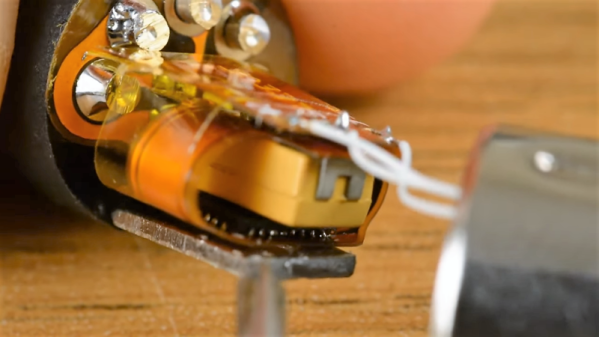
We won’t pretend to follow all the audio arcana, of which the video below and the build log have plenty, but the technical achievement is obvious enough. The Flash-Synth has an STM32, a tantalum SMD filter capacitor that dwarfs it, and a few support components on a flexible PCB that folds back on itself twice. This bit of circuit origami is connected to a 5-pin DIN plug and stuffed into the connector’s shell, which in turn mates to a custom-machined metal housing. A stereo audio jack lives at the other end of the assembly, and the whole synth is powered parasitically off the MIDI port.

The first half of the video below is mostly a demo that proves the synth sounds great and can do just about anything; skip to the 22-minute mark for the gory build details. Suffice it to say that [mitxela]’s past experience with ludicrous scale soldering served him well here.

Continue reading “World’s Smallest MIDI Synth, Now Even Better”

Turntable Spins Color And Sound Together

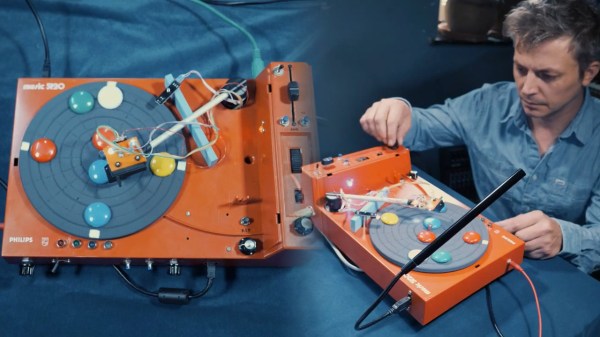
If you can’t grow your own synesthesia, buying electronics to do it for you is fine. Such is the case with the CHROMATIC by [Xavier Gazon], an artist who turns all kinds of electronics into circuit-bent musical art pieces. His project turns an old Philips Music 5120 turntable into a colorful MIDI sequencer, inspired by older 20th century instruments such as the Optophonic Piano and the Luminaphone.

The CHROMATIC uses colored pucks placed on a converted turntable to perform a looping sequence of chords in a given musical scale, generating MIDI data as output. Where its inspirations used primitive optics as their medium, this project employs a Teensy microcontroller and two modern optical sensors to do the work. One of these is a simple infrared sensor which tracks a white spot on the edge of the turntable, generating a MIDI clock signal to keep everything quantized and in sync. The other is a color sensor mounted on the tone arm, which can tell what color it sees and the height of the arm from the turntable.

While the instrument is still in beta testing phase details on how notes are generated aren’t yet given, though the general idea is that they are dictated by the color the tone arm sees and its position above the platter. Moving the tone arm changes which pucks it tracks, and the speed of the turntable can also be adjusted, changing how the melody sounds.​

The CHROMATIC is a very interesting project, but it’s not the first optical-based turntable hack we’ve seen here. We’ve also seen a much weirder use for a color sensor, too. Check out the video of this one in action after the break.

Continue reading “Turntable Spins Color And Sound Together”

DIY MIDI Looper Controller Looks Fantastic!

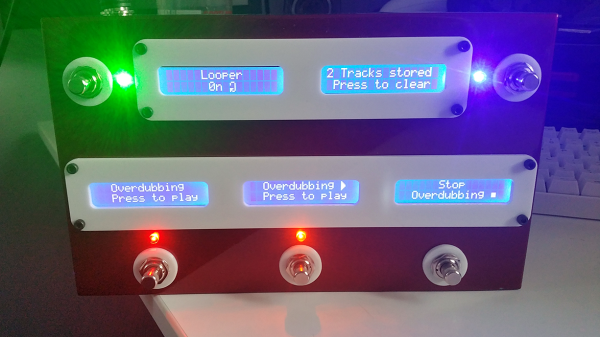
Due to pedalboard size, complicated guitar pedals sometimes reduce the number of buttons to the bare minimum. Many of these pedals are capable of being controlled with an external MIDI controller, however, and necessity being the mother of invention and all, this is a great opportunity to build something and learn some new skills at the same time. In need of a MIDI controller, Reddit user [Earthwin] built an Arduino powered one to control his Boss DD500 Looper pedal and the result is great looking.

Five 16×2 LCD screens, one for each button, show the functionality that that button currently has. They are attached (through some neat wiring) to a custom-built PCB which holds the Arduino that controls everything. The screens are mounted to an acrylic backplate which holds the screens in place while the laser-cut acrylic covers are mounted to the same plate through the chassis. The chassis is a standard Hammond aluminum box that was sanded down, primed and then filler was used to make the corners nice and smooth. Flat-top LEDs and custom 3D printed washers finish off the project.

[Earthwin] admits that this build might be overkill for the looper that he’s using, but he had fun building the controller and learning to use an Arduino. He’s already well on his way to building another, using the lessons learned in this build. If you want to build your own MIDI controller, this article should help you out. And then you’re ready to build your controller into a guitar if you want to.

[Via Reddit]

Upgrading A MIDI Controller With An FPGA

While the “M” in MIDI stands for “musical”, it’s possible to use this standard for other things as well. [s-ol] has been working on a VJ setup (mixing video instead of music) using various potentiometer-based hardware and MIDI to interface everything together. After becoming frustrated with drift in the potentiometers, he set out to outfit the entire rig with custom-built encoders.

[s-ol] designed the rotary-encoder based boards around an FPGA. It monitors the encoder for changes, controls eight RGB LEDs per knob, and even does capacitive touch sensing on the aluminum knob itself. The FPGA communicates via SPI with an Arduino master controller which communicates to a PC using a serial interface. This is [s-ol]’s first time diving into an FPGA project and it looks like he hit it out of the park!.

Even if you’re not mixing video or music, these encoders might be useful to any project where a standard analog potentiometer isn’t accurate or precise enough, or if you just need something that can dial into a specific value quickly. Potentiometers fall short in many different ways, but if you don’t want to replace them you might modify potentiometers to suit your purposes.

Continue reading “Upgrading A MIDI Controller With An FPGA”

Because Conventional Laser Harps Aren’t Dangerous Enough

In the late 1980s, the French musician [Jean-Michel Jarre] famously toured with a laser harp. The word among teenage fans was that he had to wear special gloves to stop his hands getting burned, because 1980s teens were both impressionable and didn’t know much about lasers. In fact we’re told by a member of our community who was part of his road crew that the glove was a matter of reflectivity, so laser harps remain relatively harmless and French harpists retain their fingers. To add a bit of spice to the laser harp experience, [James Cochrane] hooked up a laser rangefinder to a Tesla coil to make an instrument with a bit more crackling energy in its performance than the [Jarre] model.

It starts with a laser tape measure modified to serve as an Arduino rangefinder, coupled to custom MIDI code to make a laser harp MIDI controller. The Tesla coil in question happens also to be a MIDI instrument, so the one can control the other with ease. The addition of an earthed chain mail glove allows it to be played in close proximity to the coil, and he rewards us with a rendition of the Star Trek theme. Tesla fun and games behind us, he then gives us a demonstration with a more conventional MIDI instrument.

We’ve had innumerable Tesla coil projects here over the years, if you’re hungry for more we suggest starting with this unusual planar PCB coil design. Meanwhile you can see the laser harp coil in the video below the break.

Continue reading “Because Conventional Laser Harps Aren’t Dangerous Enough”

MIDI Controller In A Concertina Looks Sea Shanty-Ready

Did you know that the English concertina, that hand-pumped bellows instrument favored by sailors both legitimate and piratical in the Age of Sail, was invented by none other than [Sir Charles Wheatstone]? We didn’t, but [Dave Ehnebuske] knew that the venerable English gentleman was tickling the keys of his instrument nearly two decades before experimenting with the bridge circuit that would bear his name.

This, however, is not the reason [Dave] built a MIDI controller in the form of an English concertina. That has more to do with the fact that he already knows how to play one, they’re relatively easy to build, and it’s a great form factor for a MIDI controller. A real concertina has a series of reeds that vibrate as air from the hand bellows is directed over them by valves controlled by a forest of keys. [Dave]’s controller apes that form, with two wind boxes made from laser-cut plywood connected by a bellows made from cardboard, Tyvek, and nylon fabric. The keys are non-clicky Cherry MX-types that are scanned by a Bluefeather microcontroller. To provide some control over expression, [Dave] included a pressure sensor, which alters the volume of the notes played depending on how hard he pushes the bellows. The controller talks MIDI over Bluetooth, and you can hear it in action below.

We’ve seen MIDI controllers in just about everything, from a pair of skate shoes to a fidget spinner. But this is the first time we’ve seen one done up like this. Great job, [Dave]!

Continue reading “MIDI Controller In A Concertina Looks Sea Shanty-Ready”

Square Laser Harp Is Hip

You know, we hadn’t realized how tired we were of vertical laser harps until we saw [Jonathan Bumstead]’s entry into the 2019 Hackaday Prize. It’s all well and good to imitate the design of the inspiring instrument. But the neat thing about synths is that they aren’t confined to the physics of the acoustic instruments they mimic. This project elevates the laser harp into functional sculpture territory. It’s a piece of art that produces art.

And this art harp is entirely self-contained, with built-in MIDI, amplifier, and speakers. The brains of this beauty are an Arduino Mega and an Adafruit music maker shield, which give it twenty different instrument voices. Each of the six layers has two lasers, two mirrors, and two photo-resistors mounted in the corners of the plywood skeleton. The lasers and photo-resistors are mounted back to back in opposite corners, with mirrors in the other two corners to complete the paths. [Jonathan] cleverly diffused the laser light with milky slivers of film canister plastic.

This isn’t [Jonathan]’s first optical rodeo. Previous experience taught him the importance of being able to readjust the lasers on the fly, because every time he moved it, the laser modules would go out of alignment. This time, he built kinematic mounts that let him reposition the lasers using four screws that each push a corner.

There are a lot of nice touches here, especially the instrument selector wheel. [Jonathan] explains it and the rest of the harp in a fantastic demo/build video that’s just burning a hole in the space after the break.

Continue reading “Square Laser Harp Is Hip”