Hack A Folding Bike To Help You Catch Some Pike

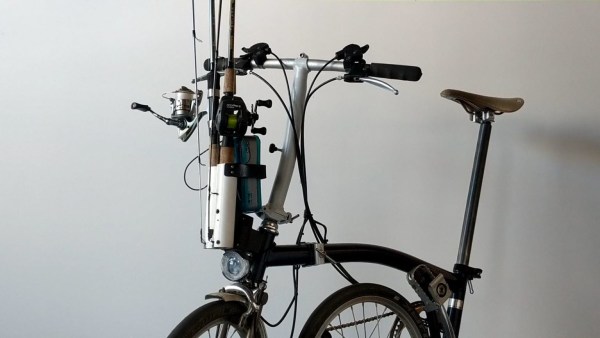
For many of us, this whole pandemic thing has produced some unexpected upsides. One of [George Turvey]’s was finding a nice new scenic route to work that goes by a lake with bike trails. [George] thought it might be nice to go fishing after work, and use a folding bike to cover a lot of ground while looking for good spots on the shore. There was just one problem — riding a bike while transporting tackle is awkward.

The bike comes with a front mount that’s meant to hold the special bags they make, so that became square one for designing a rod and tackle holder. Then [George] had to weigh the pros and cons of additive vs. subtractive methods for prototyping the holder, or at least the connection between it and the mount on the bike.

Milling won out, at least for the initial proof of concept, and result is a modular mock-up that combines a milled Kydex connector and tackle box holder with a double-barrel PVC rod holder. This way, [George] had a prototype in a fraction of the time it would have taken to design and print it. Cast your line past the break to see how fast [George] can switch gears into fishing mode.

3D printing definitely has a place in the fishing world. How else are you gonna design your own lures?

Continue reading “Hack A Folding Bike To Help You Catch Some Pike”
Converted Car Lets Toddlers Tool Around

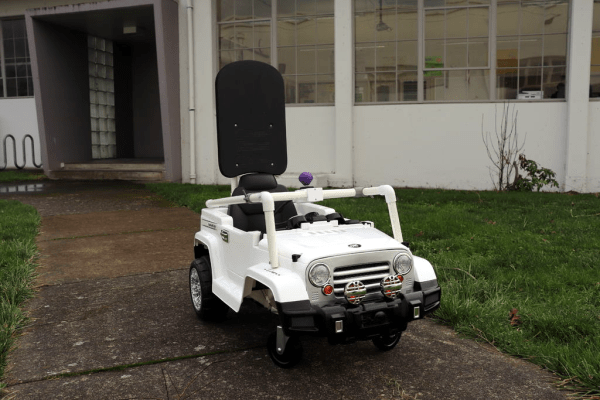
A few years ago, a professor at the University of Delaware started a project called Go Baby Go. It’s designed to bring fun and affordable mobility to small children with disabilities. The idea is to modify Power Wheels cars to make them easier for disabled kids to operate, and to teach as many people as possible how to do it in the process. The [South Eugene Robotics Team] is taking this a step further by replacing the steering wheel with a joystick that controls two motors with an Arduino Nano.

In the first instance you replace the foot pedal with a push button. The plans also call for a PVC frame, a high-backed seat, and a seat belt to make it safer. The end result is a fun ride the kid can control themselves that functions a lot like a power wheelchair, but is much more affordable. It has the added bonus of being a fun conversation piece for the other kids instead of a weird scary thing.

They also replace the front wheels with 5″ casters, because being able to spin around in circles is awesome. Their project shows how to do the entire conversion in great detail, starting with a standard ride-on car that comes with some assembly required. Motor past the break to check out a short demo with an extremely happy child tooling around in a fire truck.

If these kids get too wild, they’re gonna need traction control for these things.

Continue reading “Converted Car Lets Toddlers Tool Around”

PVC Pipe Turned Portable Bluetooth Speaker

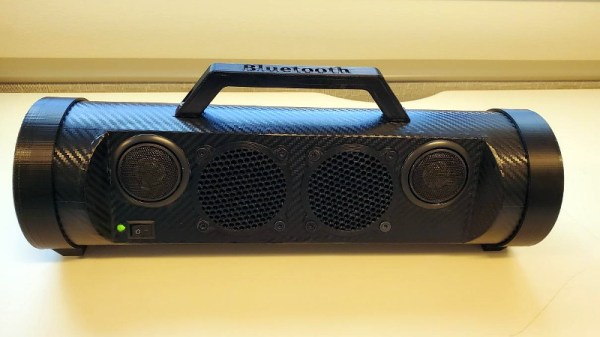
We’ve always felt that sections of PVC pipe from the home improvement store are a criminally underutilized construction material, and it looks like [Troy Proffitt] feels the same way. Rather than trying to entirely 3D print the enclosure for his recently completed portable Bluetooth speaker, he combined printed parts with a piece of four inch pipe from the Home Depot.

While using PVC pipe naturally means your final hardware will have a distinctly cylindrical look, it does provide compelling advantages over trying to print the entire thing. For one, printing an enclosure this large would have taken hours or potentially even days. But by limiting the printed parts to accessories like the face plate, handle, and caps, [Troy] reduced that time considerably. Of course, even if you’re not in a rush, it’s worth mentioning that a PVC pipe will be far stronger than anything your desktop FDM printer is likely to squirt out.

[Troy] provides links for all the hardware he used, such as the speakers, tweeters, and the Bluetooth audio board itself. The system is powered by an 1800 mAh 3S RC-style battery pack that he says lasts for hours, though he also links to a wall adapter that can be used if you don’t mind being tethered. Unfortunately it doesn’t look like he has any internal shots of the build, but given the relatively short parts list, we imagine it’s all fairly straightforward inside.

While this is certainly a respectable looking build considering it started life in the plumbing aisle, we have to admit that we’ve seen some portable Bluetooth speakers with fully 3D printed enclosures in the past that looked absolutely phenomenal. The tradeoff seems pretty clear: reuse existing materials to save time, print them if you don’t mind reinventing the wheel occasionally.

CNC Machine Rolls Up An Axis To Machine PVC Pipe

Whether it’s wood, metal, plastic, or otherwise, when it comes to obtaining materials for your builds, you have two choices: buy new stock, or scrounge what you can. Fresh virgin materials are often easier to work with, but it’s satisfying to get useful stock from unexpected sources.

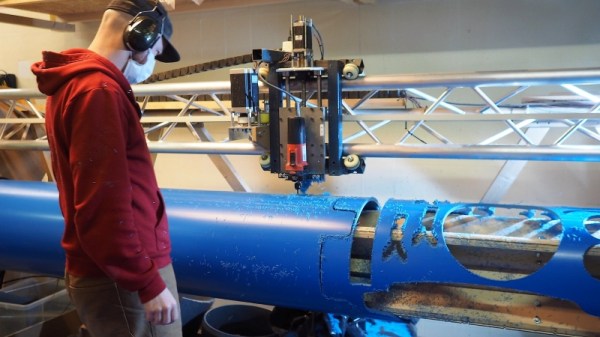
This CNC router for PVC pipe is a great example of harvesting materials from an unusual source. [Christophe Machet] undertook his “Pipeline Project” specifically to explore what can be made from large-diameter PVC pipe, of the type commonly used for sewers and other drains. It’s basically a standard – albeit large-format – three-axis CNC router with one axis wrapped into a cylinder. The pipe is slipped around a sacrificial mandrel and loaded into the machine, where it rotates under what looks like a piece of truss from an antenna tower. The spindle seems a bit small, but it obviously gets the job done; luckily the truss has the strength and stiffness to carry a much bigger spindle if that becomes necessary in the future.

The video below shows the machine carving up parts for some lovely chairs. [Christophe] tells us that some manual post-forming with a heat gun is required for features like the arms of the chairs, but we could see automating that step too. We like the look of the pieces that come off this machine, and how [Christophe] saw a way to adapt one axis for cylindrical work. He submitted this project for the 2019 Hackaday Prize; have you submitted your entry yet?

Continue reading “CNC Machine Rolls Up An Axis To Machine PVC Pipe”

Forming Fipples And Accompanying Accoutrements

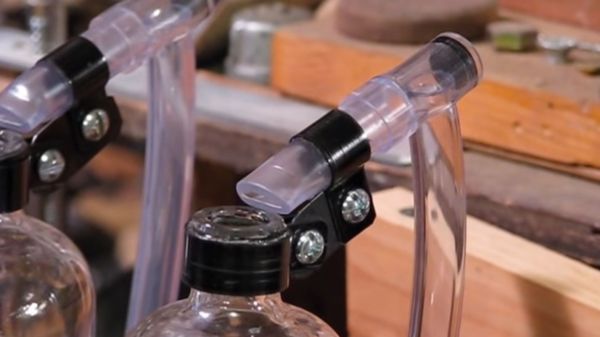
[Dr. Suess] created memorable books with minimal words and bright artwork. He inspired children and adults alike, and one of them, [Len], grew up to create wind instruments for the Bellowphone channel on YouTube. Behind the whimsy of his creations is significant engineering, and this time, we get to see the construction of a fipple. The video is also shown after the break. Even though fipple sounds like a word [Dr. Suess] would have coined, it is a legitimate musical term that means a whistle-like mouthpiece. In this case, it blows air across glass jars to create the sound for [Len]’s bottle organ. Check out the second video below for a performance from The Magic Flute.

[Len] uses clear rigid PVC for the fipples and a custom forming die to shape them while they are soft. The rest is precision hand-tool work with a razor saw, hand file, and wet-dry sandpaper. Once complete, the fipple looks like any musical instrument part produced by exacting construction techniques. Making a mouthpiece is one thing, but if it is not directed correctly it will not make any sound, so we also learn how to turn steel strapping into an organ bottle assembly. If you add some tubing and rubber squeeze balls, you can make your own instrument.

Part of the reason the Bellowphone channel exists is that [Len] found a lot of support in the pipe organ community that showed him the secret inner workings of their livelihood and now is his chance to share that enthusiasm with the maker community.

Continue reading “Forming Fipples And Accompanying Accoutrements”

Hold 3500 Volts Up To Your Eye

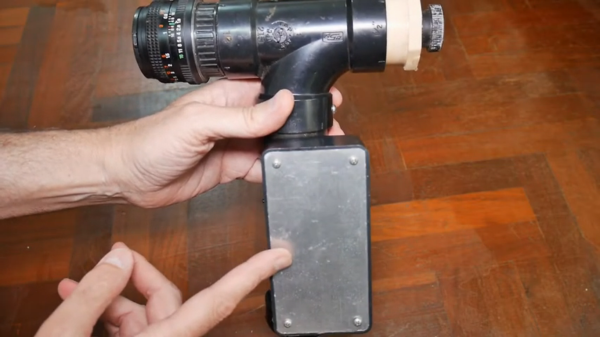
Old military equipment can sometimes be found in places like flea markets and eBay for pennies, often because people don’t always know what they have. While [tsbrownie] knew exactly what he was getting when he ordered this mystery device, we’re not sure we could say the same thing if we stumbled upon it ourselves. What looks like a vacuum tube of some sort turns out to be an infrared sensor from an old submarine periscope that was repurposed as a night vision device. (Video, embedded below.)

Of course, getting a tube like this to work requires high voltage. This one specifically needs 3500V in order to work properly, but this was taken care of with a small circuit housed in a PVC-like enclosure. The enclosure houses the tube in the center, with an eye piece at one end and a camera lens at the other, attached presumably by a 3D-printed mount. The electronics are housed in the “grip” and the whole thing looks like a small sightglass with a handle. Once powered up, the device is able to show a classic green night vision scene.

Old analog equipment like this is pretty rare, as are people with the expertise to find these devices and get them working again in some capacity. This is a great video for anyone with an interest in tubes, old military gear, or even if you already built a more modern night vision system a while back.

Thanks to [Zzp100] for the tip!

Continue reading “Hold 3500 Volts Up To Your Eye”

Lifelike Dinosaur Emerges From The Plumbing Aisle

Despite the incredible advancements in special effects technology since the film’s release, the dinosaurs in 1993’s Jurassic Park still look just as terrifying today as they did nearly 30 years ago. This has largely been attributed to the fact that the filmmakers wisely decided to use physical models in many of the close-up shots, allowing them to capture the nuances of movement which really helps sell the idea you’re looking at living creatures.

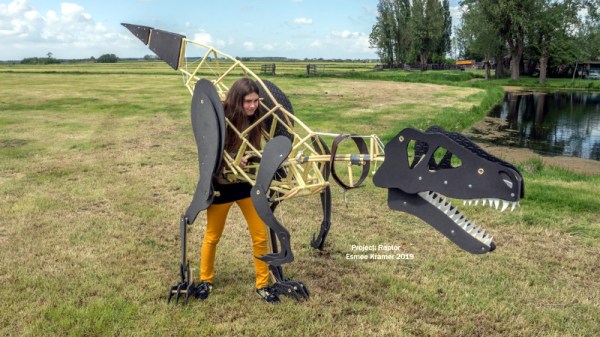
[Esmée Kramer] puts that same principle to work in her incredible articulated dinosaur costume, and by the looks of it, Steven Spielberg could have saved some money if he had his special effects team get their supplies at the Home Depot. Built out of PVC pipes and sheets of foam, her skeletal raptor moves with an unnerving level of realism. In fact, we’re almost relieved to hear she doesn’t currently have plans on skinning the creature; some things are better left to the imagination.

In her write-up on LinkedIn (apparently that’s a thing), [Esmée] explains some of the construction tricks she used to help bring her dinosaur to life, such as heating the pipes and folding them to create rotatable joints. Everything is controlled by way of thin ropes, with all the articulation points of the head mirrored on the “steering wheel” in front of her.

Now to be fair, it takes more than a bundle of PVC pipes to create a convincing dinosaur. Obviously a large part of why this project works so well is the artistry that [Esmée] demonstrates at the controls of her creation. Judging by her performance in the video after the break, we’re going to assume she’s spent a not inconsiderable amount of time stomping around the neighborhood in this contraption to perfect her moves.

In the past we’ve seen the Raspberry Pi used to upgrade life-sized animatronic dinosaurs, but even with the added processing power, those dinos don’t hold a candle to the smooth and organic motion that [Esmée] has achieved here. Just goes to show that sometimes low-tech methods can outperform the latest technological wizardry.

Continue reading “Lifelike Dinosaur Emerges From The Plumbing Aisle”