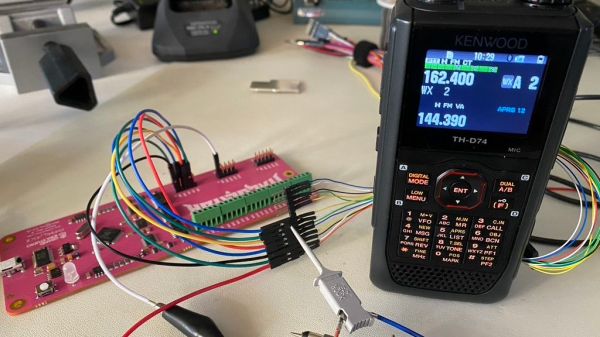
Amateur radio operators have always been at the top of their game when they’ve been hacking radios. A ham license gives you permission to open up a radio and modify it, or even to build a radio from scratch. True, as technology has advanced the opportunities for old school radio hacking have diminished, but that doesn’t mean that the new computerized radios aren’t vulnerable to the diligent ham’s tender ministrations.
A case in point: the Kenwood TH-D74A’s firmware has been dumped and partially decoded. A somewhat informal collaboration between [Hash (AG5OW)] and [Travis Goodspeed (KK4VCZ)], the process that started with [Hash]’s teardown of his radio, seen in the video below. The radio, a tri-band handy talkie with capabilities miles beyond even the most complex of the cheap imports and with a price tag to match, had a serial port and JTAG connector. A JTAGulator allowed him to probe some of the secrets, but a full exploration required spending $140 on a spare PCB for the radio and some deft work removing the BGA-packaged Flash ROM and dumping its image to disk.
[Travis] picked up the analysis from there. He found three programs within the image, including the radio’s firmware and a bunch of strings used in the radio’s UI, in both English and Japanese. The work is far from complete, but the foundation is there for further exploration and potential future firmware patches to give the radio a different feature set.
This is a great case study in reverse engineering, and it’s really worth a trip down the rabbit hole to learn more. If you’re looking for a more formal exploration of reverse engineering, you could do a lot worse than HackadayU’s “Reverse Engineering with Ghidra” course, which just wrapping up. Watch for the class videos soon. Continue reading “High-End Ham Radio Gives Up Its Firmware Secrets”

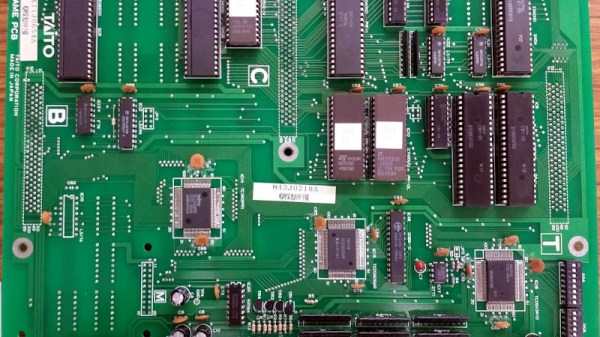
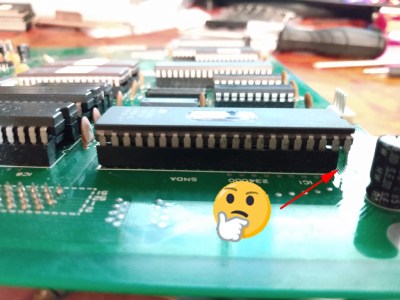 We might expect that the tool of choice would be a logic analyser or similar, but unexpectedly the solution to this hack was found in MAME. The arcade emulator conceals a wealth of information about these boards, from which you can discover their differences and try out possible solutions. The hardware hacks are surprisingly straightforward, a few bodge wires and an extra address line for a larger ROM. A programmable logic array required dumping and rewriting to fix a graphics corruption issue and a little bit of ROM tweaking after emulating a controller problem in MAME was required, but it seems that yes, one game can run on another. Certainly less painful than