Don’t Toss That Bulb, It Knows Your Password

Whether it was here on Hackaday or elsewhere on the Internet, you’ve surely heard more than a few cautionary tales about the “Internet of Things” by now. As it turns out, giving every gadget you own access to your personal information and Internet connection can lead to unintended consequences. Who knew, right? But if you need yet another example of why trusting your home appliances with your secrets is potentially a bad idea, [Limited Results] is here to make sure you spend the next few hours doubting your recent tech purchases.

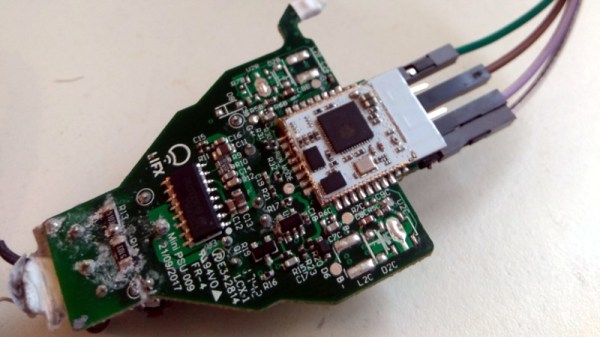
In a series of posts on the [Limited Results] blog, low-cost “smart” bulbs are cracked open and investigated to see what kind of knowledge they’ve managed to collect about their owners. Not only was it discovered that bulbs manufactured by Xiaomi, LIFX, and Tuya stored the WiFi SSID and encryption key in plain-text, but that recovering said information from the bulbs was actually quite simple. So next time one of those cheapo smart bulb starts flickering, you might want to take a hammer to it before tossing it in the trash can; you never know where it, and the knowledge it has of your network, might end up.
Regardless of the manufacturer of the bulb, the process to get one of these devices on your network is more or less the same. An application on your smartphone connects to the bulb and provides it with the network SSID and encryption key. The bulb then disconnects from the phone and reconnects to your home network with the new information. It’s a process that at this point we’re all probably familiar with, and there’s nothing inherently wrong with it.

The trouble comes when the bulb needs to store the connection information it was provided. Rather than obfuscating it in some way, the SSID and encryption key are simply stored in plain-text on the bulb’s WiFi module. Recovering that information is just a process of finding the correct traces on the bulb’s PCB (often there are test points which make this very easy), and dumping the chip’s contents to the computer for analysis.

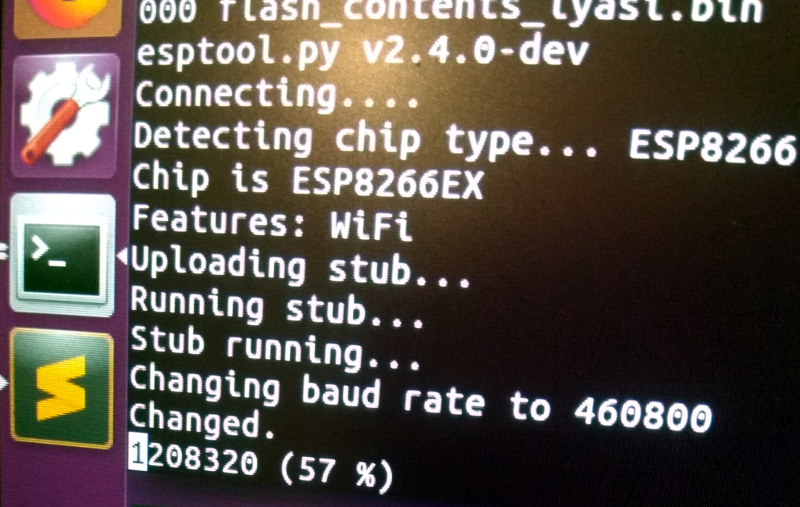
It’s not uncommon for smart bulbs like these to use the ESP8266 or ESP32, and [Limited Results] found that to be the case here. With the wealth of information and software available for these very popular WiFi modules, dumping the firmware binary was no problem. Once the binary was in hand, a little snooping around with a hex editor was all it took to identify the network login information. The firmware dumps also contained information such as the unique hardware IDs used by the “cloud” platforms the bulbs connect to, and in at least one case, the root certificate and RSA private key were found.

On the plus side, being able to buy cheap smart devices that are running easily hackable modules like the ESP makes it easier for us to create custom firmware for them. Hopefully the community can come up with slightly less suspect software, but really just keeping the things from connecting to anything outside the local network would be a step in the right direction.

(Some days later…)

[Limited Results] had hinted to us that he had previously disclosed some vulnerabilities to the bulb’s maker, but that until they fixed them, he didn’t want to make them public. They’re fixed now, and it appears that the bulbs were sending everything over the network unencrypted — your data, OTA firmware upgrades, everything.  They’re using TLS now, so good job [Limited Results]! If you’re running an old version of their lightbulbs, you might have a look.

On WiFi credentials, we were told: “In the case where sensitive information in the flash memory wasn’t encrypted, the new version will include encrypted storage processing, and the customer will be able to select this version of the security chips, which can effectively avoid future security problems.” Argue about what that actually means in the comments.


Win Back Some Privacy With A Cone Of Silence For Your Smart Speaker

To quote the greatest philosopher of the 20th century: “The future ain’t what it used to be.” Take personal assistants such as Amazon Echo and Google Home. When first predicted by sci-fi writers, the idea of instant access to the sum total of human knowledge with a few utterances seemed like a no-brainer; who wouldn’t want that? But now that such things are a reality, having something listening to you all the time and potentially reporting everything it hears back to some faceless corporate monolith is unnerving, to say the least.

There’s a fix for that, though, with this cone of silence for your smart speaker. Dubbed “Project Alias” by [BjørnKarmann], the device consists of a Raspberry Pi with a couple of microphones and speakers inside a 3D-printed case. The Pi is programmed to emit white noise from its speakers directly into the microphones of the Echo or Home over which it sits, masking out the sounds in the room while simultaneously listening for a hot-word. It then mutes the white noise, plays a clip of either “Hey Google” or “Alexa” to wake the device up, and then business proceeds as usual. The bonus here is that the hot-word is customizable, so that in addition to winning back a measure of privacy, all the [Alexas] in your life can get their names back too. The video below shows people interacting with devices named [Doris], [Marvin], [Petey], and for some reason, [Milkshake].

We really like this idea, and the fact that no modifications are needed to the smart speaker is pretty slick, as is the fact that with a few simple changes to the code and the print files it can be used with any smart speaker. And some degree of privacy from the AI that we know is always listening through these things is no small comfort either.

Continue reading “Win Back Some Privacy With A Cone Of Silence For Your Smart Speaker”

UPnP, Vulnerability As A Feature That Just Won’t Die

UPnP — in a perfect world it would have been the answer to many connectivity headaches as we add more devices to our home networks. But in practice it the cause of a lot of headaches when it comes to keeping those networks secure.

It’s likely that many Hackaday readers provide some form of technical support to relatives or friends. We’ll help sort out Mom’s desktop and email gripes, and we’ll set up her new router and lock it down as best we can to minimise the chance of the bad guys causing her problems. Probably one of the first things we’ll have all done is something that’s old news in our community; to ensure that a notorious vulnerability exposed to the outside world is plugged, we disable UPnP on whatever cable modem or ADSL router her provider supplied.

Continue reading “UPnP, Vulnerability As A Feature That Just Won’t Die”

BSD Breathes New Life Into Obsolete Equipment

An old laptop or desktop computer that’s seen better days might still have a little bit of use left in it for a dedicated task. Grabbing a lightweight flavor of Linux and running a web server, firewall, or Super Nintendo emulator might get a few more years out of it. You can also get pretty creative repurposing obsolete single purpose  machines, as [Kristjan] did with some old Cisco server equipment.

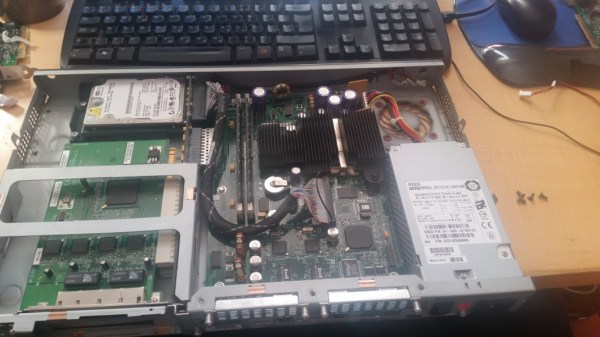
The computer in question isn’t something commonly found, either. It’s an intrusion detection system meant to mount in a server rack and protect the server itself from malicious activity. While [Kristjan] mentions that Cisco equipment seems to be the definition of planned obsolescence, we think that this Intel Celeron machine with an IDE hard drive may have gone around the bend quite some time ago. Regardless, it’s modern enough to put back to work in some other capacity.

To that end, a general purpose operating system was installed, and rather than use Linux he reached for BSD to get the system up and running. There’s one other catch, though, besides some cooling issues. Since the machine was meant to be used in a server, there’s no ACPI which means no software shutdown capability. Despite all the quirks, you can still use it to re-implement a network security system if you wanted to bring it full-circle.

Five Year Old Bug Spawns Router Botnet Monster

In the news has been yet another router botnet. [Hui Wang] and [RootKiter] of 360Netlab announced their discovery of what they call the “BCMUPnP_Hunter” rootkit. They estimate this botnet to be running on over 100,000 routers worldwide.

There are two elements of this story that I found particularly baffling. First, this botnet infects routers using a vulnerability that was first reported by Defensecode over five years ago, in 2013! The second oddity is the wide range of devices that are vulnerable and are now part of the botnet. Dozens of brands and at least 116 models have been found to be infected.

One of the details of this story hasn’t been reported entirely accurately. The bug is not built into the Broadcom chipset. Unlike Spectre and Meltdown, it’s not actually a hardware fault. Broadcom distributes a Software Development Kit (SDK) that enables device manufacturers like D-Link, TP-Link, and Linksys to quickly develop firmware for routers using Broadcom chips. The vulnerability lies in this code, rather than part of the hardware itself.

Continue reading “Five Year Old Bug Spawns Router Botnet Monster”

E-Mail Service Claims It Doesn’t Store Your Mail

There have been many news stories lately about companies misusing your data, including your e-mails. What’s more, these giant repositories of data are favorite targets for hackers. Even if you trust the big corporations, you are also betting on their security. Criptext claims they have (possibly) the most private e-mail service ever. It uses the open Signal protocol and stores private keys and encrypted mail only on your device. All the applications to access your mail are open source, so presumably, someone would eventually spot any backdoors or open holes.

At the moment the service is free and the company reports that even when a paid offering is ready, there will still be a free tier. Of course, you can send and receive normal e-mail, too. You can also use a passphrase you send to someone else (presumably not by e-mail) so they can read an encrypted message.

Continue reading “E-Mail Service Claims It Doesn’t Store Your Mail”

Building A Proof Of Concept Hardware Implant

You’ve no doubt heard about the “hardware implants” which were supposedly found on some server motherboards, which has led to all sorts of hand-wringing online. There’s no end of debate about the capabilities of such devices, how large they would need to be, and quite frankly, if they even exist to begin with. We’re through the looking-glass now, and there’s understandably a mad rush to learn as much as possible about the threat these types of devices represent.

EEPROM (left) can be edited to enable SMBus access on this card (header to the right)

[Nicolas Oberli] of Kudelski Security wanted to do more than idly speculate, so he decided to come up with a model of how an implanted hardware espionage device could interact with the host system. He was able to do this with off the shelf hardware, meaning anyone who’s so inclined can recreate this “Hardware Implant Playset” in their own home lab for experimentation. Obviously this is not meant to portray a practical attack in terms of the hardware itself, but gives some valuable insight into how such a device might function.

One of the most obvious attack vectors for hardware implants is what’s known as the Baseboard Management Controller (BMC). This is a chip used on modern motherboards to allow for remote control and monitoring of the system’s hardware, and promises to be a ripe target for attackers. There are a few sideband channels which can be used by the BMC chip to talk to other chips. To keep things simple [Nicolas] focused on the older I2C-derived SMBus (rather than the newer and more complex NC-SI), demonstrating what can be done once you have control of that bus.

Only problem was, he didn’t have a motherboard with a BMC to experiment with. After a little research, the answer came in the form of the Intel EXPI9301CTBLK network card, which features the 82574L SMBus chip. This allows for experimenting with a subset of SMBus functionality on any machine with a PCI-E slot. Even better, the card has an SMBus header on the top to plug into. [Nicolas] describes in detail how he enabled the SMBus interface by modifying the card’s EEPROM, which then allowed him to detect it with his HydraBus.

With the hardware setup, the rest of the write-up focuses on what you can do with direct control of SMBus on the network card. [Nicolas] demonstrates not only creating and sending Ethernet packets, but also intercepting an incoming packet. In both cases, a running instance of tcpdump on the host computer fails to see the packets even exist.

He goes on to explain that since SMBus is very similar to I2C and only requires four wires, the techniques shown could easily be moved from the Hydrabus dev board used in the demo, to a small microcontroller like the ATtiny85. But you would still need to find a way to add that microcontroller directly onto the network card without it being obvious to the casual observer.

Our previous coverage of suspected hardware implants sparked considerable discussion, and it looks like no matter what side of the fence you’re on, the debate isn’t going away anytime soon.