Sun-Seeking Sundial Self-Calibrates In No Time

Sundials, one of humanity’s oldest ways of telling time, are typically permanent installations. The very good reason for this is that telling time by the sun with any degree of accuracy requires two-dimensional calibration — once for cardinal direction, and the other for local latitude.

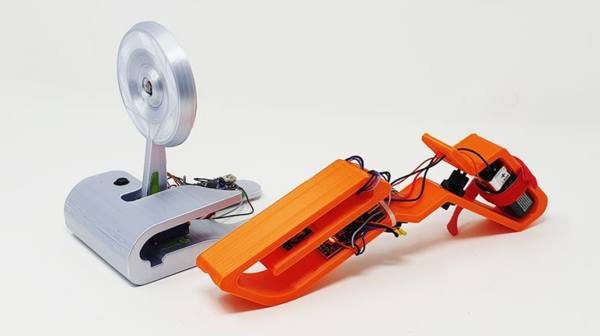
[poblocki1982] is an amateur astronomer and semi-professional sundial enthusiast who took the time to make a self-calibrating equatorial ‘dial that can be used anywhere the sun shines. All this solar beauty needs is a level surface and a few seconds to find its bearings.

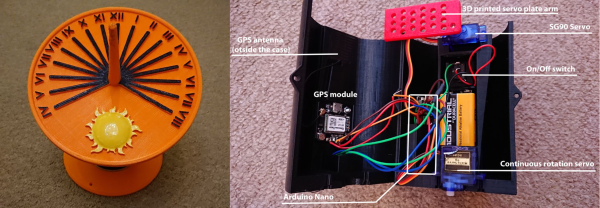
Switch it on, set it down, and the sundial spins around on a continuous-rotation servo until the HMC5883L compass module finds the north-south orientation. Then the GPS module determines the latitude, and a 180° servo pans the plate until it finds the ideal position. Everything is controlled with an Arduino Nano and runs on a 9V battery, although we’d love to see it run on solar power someday. Or would that be flying too close to the sun? Check out how fast this thing calibrates itself in the short demo after the break.

Not quite portable enough for you? Here’s a reverse sundial you wear on your wrist.

Quarantine Clock Answers The Important Question

For many people, these last few weeks have been quite an adjustment. When the normal routine of work or school is suddenly removed, it’s not unusual for your internal clock to get knocked out of alignment. It might have started with struggling to figure out if it was time for lunch or dinner, but now it’s gotten to the point that even the days are starting to blur together. If it takes more than a few seconds for you to remember whether or not it’s a weekday, [whosdadog] has come up with something that might help you get back on track.

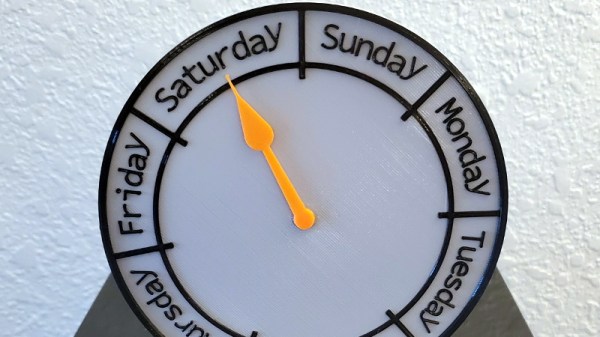
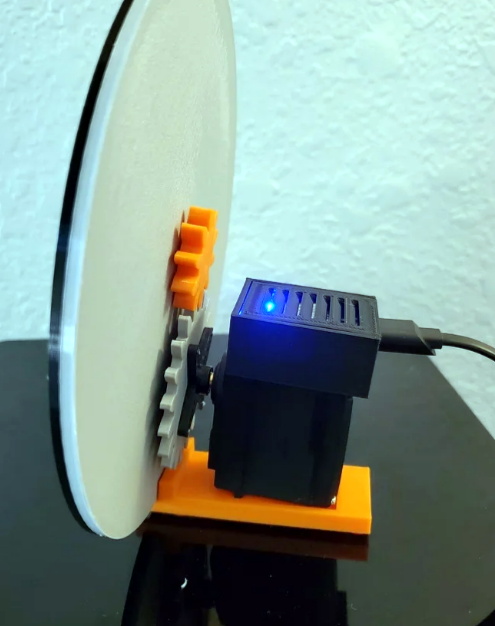
Rather than showing the time of day, this 3D printed clock tells you where you are in the current week. Each day at midnight, the hand will advance to the center of the next day. If you wanted, a slight reworking of the gearing and servo arrangement on the rear of the device could allow it to sweep smoothly through each day. That would give you an idea of your progress through each 24 hour period, but then again, if you don’t even know if it’s morning or night you might be too far gone for this build anyway.

The clock’s servo is driven by a Wemos D1 Mini ESP8266 development board, which naturally means it has access to WiFi and can set itself to the current time (or at least, day) with NTP. All you’ve got to do is put your network information into the Sketch before flashing it to the ESP, and you’re good to go.

Naturally this project is a bit tongue-in-cheek, but we do think the design has practical applications. With a new face and some tweaked code, it could be an easy way to show all sorts of data that doesn’t require a high degree of granularity. Our very own [Elliot Williams] recently built a display to help his young son understand his new at-home schedule which operates on a similar principle.

This Animatronic Mouth Mimics Speech With Servos

Of the 43 muscles that comprise the human face, only a few are actually important to speaking. And yet replicating the movements of the mouth by mechanical means always seems to end up only partly convincing. Servos and linkages can only approximate the complex motions the lips, cheeks, jaw, and tongue are capable of. Still, there are animatronics out there that make a good go at the job, of which this somewhat creepy mechanical mouth is a fine example.

Why exactly [Will Cogley] felt the need to build a mechanical maw with terrifying and fairly realistic fangs is anyone’s guess. Recalling his lifelike disembodied animatronic heart build, it just seems like he pursues these builds for the challenge of it all. But if you thought the linkages of the heart were complex, wait till you see what’s needed to make this mouth move realistically. [Will] has stuffed this pie hole with nine servos, all working together to move the jaw up and down, push and pull the corners of the mouth, raise and lower the lips, and bounce the tongue around.

It all seems very complex, but [Will] explains that he actually simplified the mechanical design to concentrate more on the software side, which is a text-to-speech movement translator. Text input is translated to phonemes, each of which corresponds to a mouth shape that the servos can create. It’s pretty realistic although somewhat disturbing, especially when the mouth is placed in an otherwise cuddly stuffed bear that serenades you from the nightstand; check out the second video below for that.

[Will] has been doing a bang-up job on animatronics lately, from 3D-printed eyeballs to dexterous mechatronic hands. We’re looking forward to whatever he comes up with next — we think.

Continue reading “This Animatronic Mouth Mimics Speech With Servos”

A Flag-Waving Hat For All Occasions

When [Taste the Code] saw that his YouTube channel was approaching 1,000 subscribers, it was time to do something special. But celebration is no reason to be wasteful. This flag-waving celebratory hat has endless possibilities for the future.

The build is simple, which is just right for these strange times of scarcity. An Arduino Uno hot-glued to the back of the hat is directly driving a pair of 9g servos on the front. [Taste the Code] made the flags by sticking two stickers back to back with a bamboo skewer in between. The code is flavored such that the flags will wave in one of three randomly-chosen patterns — swing around, swing in reverse, and wild gesticulations.

After the novelty of the whole 1k subs thing wears off, [Taste the Code] can change the flags over to Jolly Rogers to help with social distancing. And someday in the future when things are really looking up, they can be changed over to SARS-CoV-2 victory flags, or fly the colors of a local sports team. We think it would be way cool to program some kind of real semaphore message into the flags, though the mobility might be too limited for that. Check out the build video after the break, which happens picture-in-picture as [Taste the Code] dishes out a channel retrospective and lays out a course for the future.

Even though YouTube messed with subscriber counts, we think it’s still worth making a cool counter. Here’s one with a Tetris twist.

Continue reading “A Flag-Waving Hat For All Occasions”

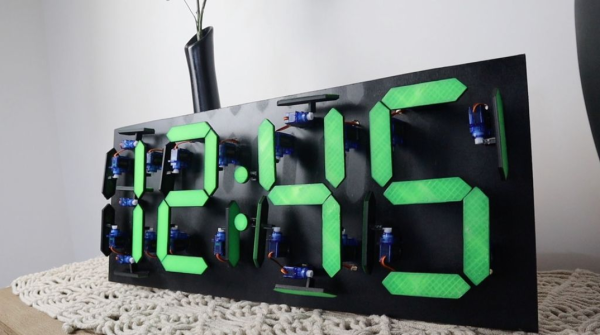
Servo-Powered 7-Segments Choreograph This Chronograph

Good clocks are generally those that keep time well. But we think the mark of a great clock is one that can lure the observer into watching time pass. It doesn’t really matter how technical a timepiece is — watching sand shimmy through an hourglass has its merits, too. But just when we were sure that there was nothing new to be done in the realm of 7-segment clocks, [thediylife] said ‘hold my beer’ and produced this beauty.

A total of 28 servos are used to independently control four displays’ worth of 3D-printed segments. The servos pivot each segment back and forth 90° between two points: upward and flat-faced to display the time when called upon, and then down on its side to rest while its not needed.

Circuit-wise, the clock’s not all that complicated, though it certainly looks like a time-consuming build. The servos are controlled by an Arduino through a pair of 16-channel servo drivers, divided up by HH and MM segments. The Arduino fetches the time from a DS1302 RTC module and splits the result up into four-digit time. Code-wise, each digit gets its own array, which stores the active and inactive positions for each servo. Demo and full explanation of the build and code are waiting after the break.

When it comes to 7-segment displays, we say the more the merrier. Here’s a clock that uses pretty much all of them.

Continue reading “Servo-Powered 7-Segments Choreograph This Chronograph”

Pulse Visualizer Is A Real Work Of Heart

Some projects are all-around simple, such as the lemon battery or the potato clock. Other projects are rooted in simple ideas, but their design and execution elevates them to another level. [Sharathnaik]’s heart visualizer may not be all that electronically complex, but the execution is pulse-pounding.

The closest that most of us will get to seeing our own heartbeat is watching the skin twitch in our neck or wrist. You know that your heart doing the work of keeping you alive, but it’s hard to appreciate how it exerts itself. With just a few components and printed parts, the heart’s pumping action comes to life as your pulse drives single-x scissor mechanisms to push and pull the plastic plates.

This heart visualizer isn’t nearly as complex as the organ it models, and it’s an easy build for anyone just starting out in electronics. Put your finger on the heart rate sensor in the base, and an Arduino Nano actuates a single servo to your own personal beat. We’d love to see it work overtime while someone gets worked up. For now, there’s an even-tempered demo after the break, followed by an assembly video.

Heartbeat sensing can be romantic, too. Here’s a lovely circuit sculpture that runs at the rate of the receiver.

Continue reading “Pulse Visualizer Is A Real Work Of Heart”

Unique Musical Instrument Defies Description

Since the first of our ancestors discovered that banging a stick on a hollow log makes a jolly sound, we hominids have been finding new and unusual ways to make music. We haven’t come close to tapping out the potential for novel instruments, but then again it’s not every day that we come across a unique instrument and a new sound, as is the case with this string-plucking robot harp.

Named “Greg’s Harp” after builder [Frank Piesik]’s friend [Gregor], this three-stringed instrument almost defies classification. It’s sort of like a harp, but different, and sort of like an electric guitar, but not quite. Each steel string has three different ways to be played: what [Frank] calls “KickUps”, which are solenoids that strike the strings; an “eBow” coil stimulator; and a small motor with plastic plectra that pluck the strings. Each creates a unique sound at the fundamental frequency of the string, while servo-controlled hoops around each string serve as a robotic fretboard to change the notes. Sound is picked up by piezo transducers, and everything is controlled by a pair of Nanos and a Teensy, which takes care of MIDI duties.

Check out the video below and see if you find the sound both familiar and completely new. We’ve been featuring unique instruments builds forever, from not-quite-violins to self-playing kalimbas to the Theremincello, but we still find this one enchanting.

Continue reading “Unique Musical Instrument Defies Description”