Does WiFi Kill Houseplants?

Spoiler alert: No.

To come to that conclusion, which runs counter to the combined wisdom of several recent YouTube videos, [Andrew McNeil] ran a pretty neat little experiment. [Andrew] has a not inconsiderable amount of expertise in this area, as an RF engineer and prolific maker of many homebrew WiFi antennas, some of which we’ve featured on these pages before. His experiment centered on cress seeds sprouting in compost. Two identical containers were prepared, with one bathed from above in RF energy from three separate 2.4 GHz transmitters. Each transmitter was coupled to an amplifier and a PCB bi-quad antenna to radiate about 300 mW in slightly different parts of the WiFi spectrum. Both setups were placed in separate rooms in east-facing windows, and each was swapped between rooms every other day, to average out microenvironmental effects.

After only a few days, the cress sprouted in both pots and continued to grow. There was no apparent inhibition of the RF-blasted sprouts – in fact, they appeared a bit lusher than the pristine pot. [Andrew] points out that it’s not real science until it’s quantified, so his next step is to repeat the experiment and take careful biomass measurements. He’s also planning to ramp up the power on the next round as well.

We’d like to think this will put the “WiFi killed my houseplants” nonsense to rest – WiFi can even help keep your plants alive, after all. But somehow we doubt that the debate will die anytime soon.

Continue reading “Does WiFi Kill Houseplants?”

Mayak Turns WiFi Traffic Into Sound

Dial-up modems were well known for their screeching soundtrack during the connection process. Modern networking eschews audio based communication methods, so we no longer have to deal with such things. However, all is not lost. [::vtol::]’s Mayak installation brings us a new sound, all its own.

The installation consists of four WiFi routers, connected to four LTE modems. These are configured as open hotspots that anyone can connect to. [::vtol::] was careful to select routers that had highly responsive activity LEDs. The activity LEDs are wired to an Arduino, which processes the inputs, using them to trigger various sounds from an attached synthesizer.

As users connect to the routers and go about their business on the Internet, the activity LEDs flash and the synthesizer translates this into an otherworldly soundtrack. The hardware is all hung on a beautiful metal and acrylic frame, which stands as a striking form in the sparse gallery.

The piece creates a very electronic soundscape, but you may prefer your installations to have a more mechanical racket. Video after the break.

Continue reading “Mayak Turns WiFi Traffic Into Sound”

Blink An LED On The Internet Of Things

Blinking an LED is generally considered the hardware equivalent of the classic “Hello World” project. It’s a quick and simple test to show that you’ve got the basics worked out, and a launching point for bigger and better things. So why should it be any different in this glorious new Internet of Things era?

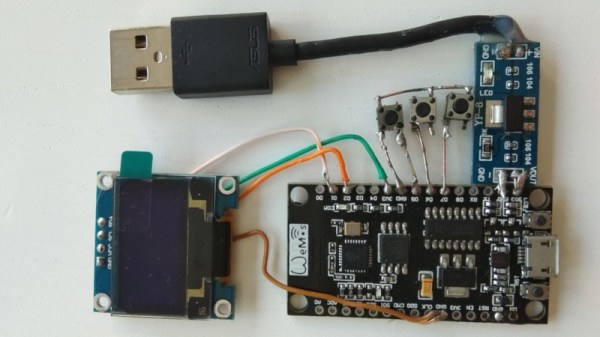
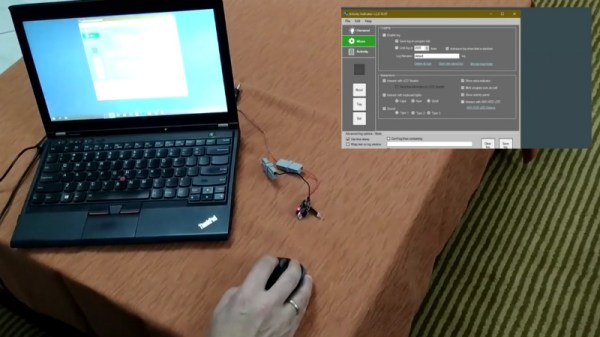
The “WiFi HDD LED” created by [Limbo] is essentially just that, a status LED that can be triggered remotely thanks to the WiFi capability of the ever-popular ESP8266. Don’t think there’s much use for a wireless LED that blinks when your computer’s hard drive is thrashing around? Maybe not, but it’s definitely worth checking out if you’re looking for a good way to get your feet wet in the world of ESP hacking.

On the hardware side, this is exactly what you’d expect: an LED hanging off the digital pin of an ESP8266 module. If you go with the bare ESP-01 like [Limbo], things are somewhat more complex due to the need for a voltage regulator, but if you’re using one of the more common ESP development boards then there’s nothing else you need to add. Really, as a proof of concept you could even use the built-in LED on those boards.

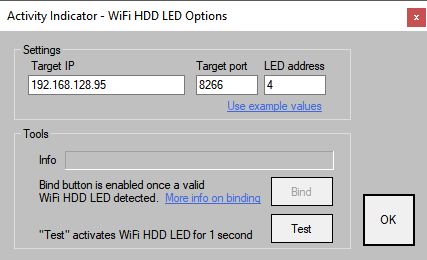
As you might imagine, this project is more about the software than the hardware. The code on both sides of the equation has been released as open source for your hacking pleasure, and is more capable than you’d probably expect. The LED is actually an extension of a system activity monitor that [Limbo] had previously developed and includes a binding function to make sure you’re talking to the right blinking ESP. It’s probably overkill for many purposes, but it’s a good example of how to do more robust UDP connections than we’re used to seeing.

This project is one of many that prove there’s more than one way to accomplish a particular goal, and that there’s something to be learned from even the most eccentric of hacks.

Continue reading “Blink An LED On The Internet Of Things”

When Will Our Cars Finally Speak The Same Language? DSRC For Vehicles

At the turn of the 21st century, it became pretty clear that even our cars wouldn’t escape the Digital Revolution. Years before anyone even uttered the term “smartphone”, it seemed obvious that automobiles would not only become increasingly computer-laden, but they’d need a way to communicate with each other and the world around them. After all, the potential gains would be enormous. Imagine if all the cars on the road could tell what their peers were doing?

Forget about rear-end collisions; a car slamming on the brakes would broadcast its intention to stop and trigger a response in the vehicle behind it before the human occupants even realized what was happening. On the highway, vehicles could synchronize their cruise control systems, creating “flocks” of cars that moved in unison and maintained a safe distance from each other. You’d never need to stop to pay a toll, as your vehicle’s computer would communicate with the toll booth and deduct the money directly from your bank account. All of this, and more, would one day be possible. But only if a special low-latency vehicle to vehicle communication protocol could be developed, and only if it was mandated that all new cars integrate the technology.

Except of course, that never happened. While modern cars are brimming with sensors and computing power just as predicted, they operate in isolation from the other vehicles on the road. Despite this, a well-equipped car rolling off the lot today is capable of all the tricks promised to us by car magazines circa 1998, and some that even the most breathless of publications would have considered too fantastic to publish. Faced with the challenge of building increasingly “smart” vehicles, manufacturers developed their own individual approaches that don’t rely on an omnipresent vehicle to vehicle communication network. The automotive industry has embraced technology like radar, LiDAR, and computer vision, things which back in the 1990s would have been tantamount to saying cars in the future would avoid traffic jams by simply flying over them.

In light of all these advancements, you might be surprised to find that the seemingly antiquated concept of vehicle to vehicle communication originally proposed decades ago hasn’t gone the way of the cassette tape. There’s still a push to implement Dedicated Short-Range Communications (DSRC), a WiFi-derived protocol designed specifically for automotive applications which at this point has been a work in progress for over 20 years. Supporters believe DSRC still holds promise for reducing accidents, but opponents believe it’s a technology which has been superseded by more capable systems. To complicate matters, a valuable section of the radio spectrum reserved for DSRC by the Federal Communications Commission all the way back in 1999 still remains all but unused. So what exactly does DSRC offer, and do we really still need it as we approach the era of “self-driving” cars?

Continue reading “When Will Our Cars Finally Speak The Same Language? DSRC For Vehicles”

A Malicious WiFi Backdoor In A Keyboard’s Clothing

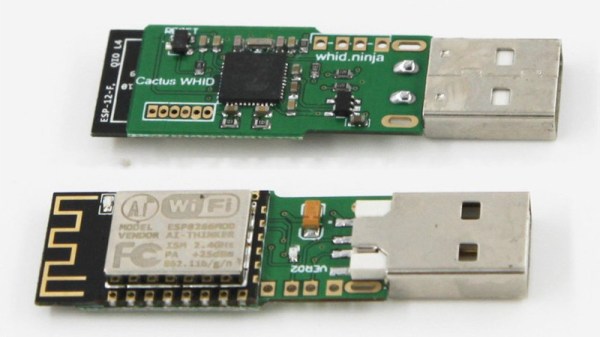
The USB Rubber Ducky burst onto the scene a few years ago, and invented a new attack vector – keystroke injection. The malicious USB device presents itself as a keyboard to the target system, blurting out keystrokes at up to 1000 words per minute. The device is typically used to open a phishing site or otherwise enter commands to exfiltrate data from the victim. Now things have stepped up a notch, with ESPloitV2 – a WiFi-enabled take on the same concept.

Running on the Cactus WHID platform, the device is so named for the ESP12 WiFi microcontroller it employs, along with an Atmega 32u4 for USB HID device emulation. By virtue of its wireless connection, no longer does the aspiring hacker have to rely on pre-cooked routines. Various exploits can be stored in the ESP12’s spacious 4 megabytes of flash, and there’s even the potential to live type your attack if you’re feeling bold.

It goes to show that the trust we implicitly place in foreign USB devices is potentially our future downfall. BadUSB is another great example, and the USB Wrapper is a great way to get a charge if you’re stuck using an untrusted port.


Humans Vs. Zombies Via The ESP8266

Zombies, for the most part, remain fictional and are yet to trouble human communities. Despite the many real world calamities we face, the zombie concept remains a compelling one and the subject of many books, films, and video games. [CNLohr] was at MagStock Eight when he met [Aaron], who has developed a real world game in this vein. (YouTube, embedded below.)

[Aaron]’s game goes by the name of SpyTag, and is played by a group of people who each have a small device affixed to their wrist. Two players start off as zombies, and the rest are humans. The zombies can use their devices as proximity detectors to hunt down nearby humans, and the humans can use their devices to detect nearby zombies, helping them escape and evade.

The devices operate using the ESP8266, in AP+station mode. The proximity sensing works on a very simple method. Devices show their human or zombie status by appearing as a WiFi AP by that name, and proximity detection is achieved by showing the signal strength of the opposite AP on an LED bar on the device. Once zombies get close enough to human devices, the humans are infected and become zombies themselves.

It’s a tidy and lightweight way to implement the gameplay, and requires no infrastructure or support hardware outside of the wristband hardware for the players. While this method would likely be vulnerable to spoofing, [CNLohr] reports that future work will likely switch to using the ESP-NOW protocol to make the game more secure.

[Aaron] has shared the project on Github for those interested in digging deeper into the code. We’ve seen a similar game played before, using IR instead. Video after the break.

[Thanks to Baldpower for the tip!]

Continue reading “Humans Vs. Zombies Via The ESP8266”

Badland Brawler Lets Arduino Tackle Terrain

For an electronics person, building the mechanics of a robot — especially a robust robot — can be somewhat daunting. [Jithin] started with an off-the-shelf 4 wheel drive chassis to build an off-road Arduino robot he calls the Badland Brawler. The kit was a bit over $100, but as you can see in the video below, it is pretty substantial, with an enclosed frame and large mud tires.

The remaining parts include an Arduino, a battery, and a motor driver IC. The Arduino is one with WiFi (an MKR 1000, in fact) and there’s a phone app for controlling the robot.

Honestly, once you have the chassis taken care of, the rest is pretty easy. Of course, the phone app is a bit more effort, but you could replace it in a number of ways. Blynk, comes to mind, for example.

The motor drivers are easy to figure out. This would be a great platform for some sensors to allow for more autonomy. We liked how the frame had mount points for a lot of different boards and sensors and could hold everything, for the most part, inside. That’s probably a good idea for a robot which will be traversing rugged terrain.

If you do decide to roll your own app with Blynk, we’ve done it with a very different kind of robot. Four-wheel drive robots don’t have to be big, as we’ve seen in the past.

Continue reading “Badland Brawler Lets Arduino Tackle Terrain”