Electroloom Throws In The Towel

The once successful Kickstarter and National Science Foundation (NSF) research grant winner Electroloom is saying “Thanks and Farewell” to its backers, supporters, and sponsors. The startup ran out of funding while developing printer-like machine that uses electrospinning to automatedly produce ready-to-use garments.

Electroloom has been an ambitious project to explore if electrospinning could be made viable for garment manufacturing. The process that uses a high voltage to transform a resinous liquid into non-woven fabric was originally invented for textile fabrication, although its low throughput has always been a limiting factor. The method was mostly used in laboratory and medical applications. In 2014, Electroloom began developing a process that would bring the technology back to its fibrous roots, building an amazing prototype machine that could print an entire shirt in one piece. Electroloom’s Kickstarter campaign was funded in 2015, and earlier this year, an NSF research grant was awarded to the startup.

Continue reading “Electroloom Throws In The Towel”

Tearing Into Delta Sigma ADCs Part 2

In part one, I compared the different Analog to Digital Converters (ADC) and the roles and properties of Delta Sigma ADC’s. I covered a lot of the theory behind these devices, so in this installment, I set out to find a design or two that would help me demonstrate the important points like oversampling, noise shaping and the relationship between the signal-to-noise ratio and resolution.

Modulator Implementation

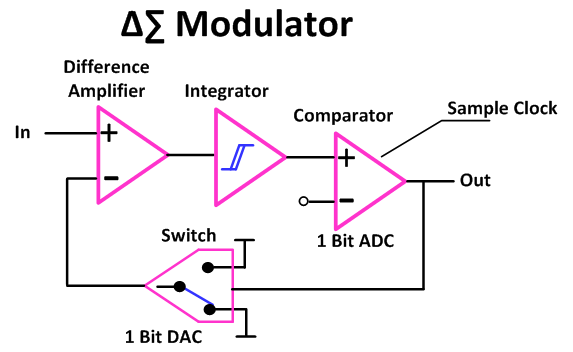
modulatorCheck out part one to see the block diagrams of what what got us to here. The schematics shown below are of a couple of implementations that I played with depicting a single-order and a dual-order Delta Sigma modulators.

schematicBasically I used a clock enabled, high speed comparator, with two polarities in case I got it the logic backwards in my current state of burn out to grey matter ratio. The video includes the actual schematic used.

Since I wasn’t designing for production I accepted the need for three voltages since my bench supply was capable of providing them and this widget is destined for the drawer with the other widgets made for just a few minutes of video time anyway. Continue reading “Tearing Into Delta Sigma ADCs Part 2”

Drones, Clever Hacks, And CG Come Together For Star Wars Fan Film

We weren’t certain if this Star Wars fan film was out kind of thing until we saw the making of video afterwards. They wanted to film a traditional scene in a new way. The idea was to take some really good quadcopter pilots, give them some custom quadcopters, have them re-enact a battle in a scenic location, and then use some movie magic to bring it all together.

The quadcopters themselves are some of those high performance racing quadcopters with 4K video cameras attached. The kind of thing that has the power to weight ratio of a rocket ship. Despite what the video implies, they are unfortunately not TIE Fighter shaped. After a day of flying and a few long hikes to retrieve the expensive devices after inevitable crashes (which, fortunately, provided some nice footage), the next step was compositing.

However, how to trick the viewer into believing they were in a X-Wing quadcopter? A cheap way to do it would be to spend endless hours motion tracking and rendering a cockpit in place. It won’t look quite real. The solution they came up with is kind of dumb and kind-of brilliant. Mount a 3D printed cockpit on a 2×4 with a GoPro. Play the flight footage on a smartphone while holding the contraption. Try to move the cockpit in the same direction as the flight. We’re not certain if it was a requirement to also make whooshing and pew pew laser noises while doing so, but it couldn’t hurt.

In the end it all came together to make a goofy, yet convincingly good fan film. Nice work! Videos after the break.

Continue reading “Drones, Clever Hacks, And CG Come Together For Star Wars Fan Film”

EMF Fire Pong

One of the installations that consistently drew a large crowd after dark at EMF Camp 2016 was a game. This wasn’t a conventional computer game though, instead it was a line of gas jets along which a pair of players had to bat a jet of flame between them at ever-increasing speed until one player missed the return. This was the Fire Pong game created by members of Nottingham Hackspace, and though there seems to have been no online write-up of it as yet they have posted enough pictures of its build for us to deduce something of its construction.

A network of gas pipes and jets with all valves brought out to a clearly labeled control panel appears to control the gas flow through solenoid valves connected to a relay board driven by what appears to be an Arduino Pro Mini. The bats are huge for theatrical effect, but contain accelerometers to sense player swipes and send the information back to the gas control circuits. A pair of much larger flame generators indicate the end of a rally, and the score is displayed on a large LED scoreboard. There is very likely to be more to the system than we can glean from these pictures and a shot of the various components, but as yet we are so-to-speak in the dark on their details.

If you will excuse the quality constraints of a mobile phone camera in a darkened field, a video of the game in action is below the break. There was a significant queue for a turn at the bat, this was one of the event’s more popular night-time attractions.

Continue reading “EMF Fire Pong”

Hackaday Prize Entry: An Open Source Retina Scanner

An ophthalmoscope is a device used to examine the back of the eye. This is useful for diagnosing everything from glaucoma, diabetic retinopathy, to detecting brain tumors. As you would expect from anything related to medicine, these devices cost a lot, making them inaccessible for most of the world’s population. This project for the Hackaday Prize is for an ophthalmoscope that can be built for under $400.

An ophthalmoscope is a relatively simple device, that really only requires a clinician to wear a head-mounted lamp and hold a condensing lens in front of the patient’s eye. Light is reflected off the retina and into the clinician’s view. Of course, the simplest ophthalmoscope requires a bit of training to get right, and there’s’ no chance of being able to take a picture of a patient’s retina to share with other clinicians.

The Open Indirect Ophthalmoscope gets around these problems by using a digital camera in the form of a Raspberry Pi camera module. This camera, with the help of a 3 W LED, is able to image the back of the eye, snap a picture, and send that image anywhere in the world. It’s a simple device that can be constructed from a few mirrors, a cheap lens, and a few 3D-printed parts, but is still very valuable for the detection of ophthalmological disorders.

Drone Doesn’t Know Much About Art, But Knows What It Likes

There is an artistic technique known as stippling where an artist creates a picture using small dots of ink or paint. The result is almost like using a dot matrix printer at low resolution. [Paul Kry] at McGill University doesn’t directly teach art, but he did teach drones to produce pictures using the stippling technique.

As you can see in the video below, the drones carry an ink-soaked sponge. Internal sensors and a motion capture system get them to the right spot and then they move to put the ink down on the work surface. It isn’t perfect, but it does make recognizable drawings and presumably a little inconsistency makes it even more artsy.

Continue reading “Drone Doesn’t Know Much About Art, But Knows What It Likes”

Fun Audio Waveform Generator Is More Than The Sum Of Its Parts

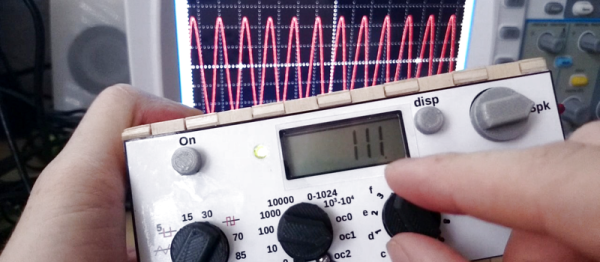
[Joekutz] wanted to re-build an audio-rate function generator project that he found over on Instructables. By itself, the project is very simple: it’s an 8-bit resistor-ladder DAC, a nice enclosure, and the rest is firmware.

[Joekutz] decided this wasn’t enough. He needed an LCD display, a speaker, and one-hertz precision. The LCD display alone is an insane hack. He reverse-engineers a calculator simply to use the display. But instead of mapping each key on the calculator and typing each number in directly, he only taps the four 1, +, =, and clear keys. He can then enter arbitrary numbers by typing in the right number of ones and adding them up. 345 = 111 + 111 + 111 + 11 + 1. In his video, embedded below, he describes this as a “rather stupid” idea. We think it’s hilarious.

Continue reading “Fun Audio Waveform Generator Is More Than The Sum Of Its Parts”