Fail Of The Week: Ferrofluid

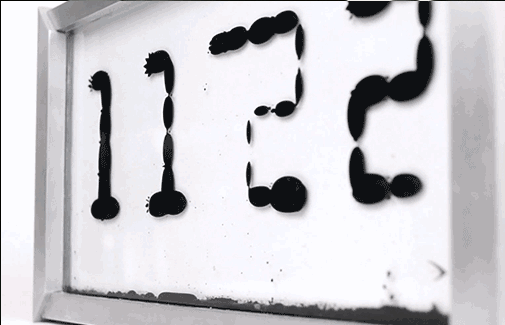
It’s more of a half-fail than a full fail, but [Basti] is accustomed to getting things right (eventually) so it sticks in his craw that he wasn’t able to fully realize his ferrofluid dreams (German, translated here). Anyway, fail or demi-fail, the project is certainly a lesson in the reality of ferrofluid.

ferro

We’ve all seen amazing things done with ferrofluid and magnets. How hard can it be to make an interactive ferrofluid wedding present for his sister? Where ferrofluid spikes climb up a beautifully cut steel heart in a jar? (Answer: very hard.)

Continue reading “Fail Of The Week: Ferrofluid”

It’s Not A Bridge, And Not A Tunnel. Or, Maybe It’s Both?

The gist of the idea is to suspend an underwater tunnel from floating pontoons. By the time you finished reading that sentence, you probably already had a list of things in your head that seem to make this a terrible idea. After all, it does seem to combine the worst aspects of both underwater tunnels and bridges. But, the idea may actually be a good one, and it’s already being seriously considered in Norway.

Continue reading “It’s Not A Bridge, And Not A Tunnel. Or, Maybe It’s Both?”

By Christian Taube - Own work, CC BY-SA 2.5, https://commons.wikimedia.org/w/index.php?curid=1503038

Tools Of The Trade – Through Hole Assembly

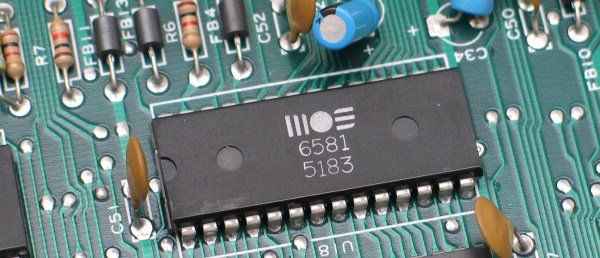
In our last installment of Tools of the Trade, we had just finished doing the inspection of the surface mount part of the PCB. Next in the process is the through hole components. Depending on the PCB, the order may change slightly, but generally it makes more sense to get all the SMT work done before moving to the through hole work.

Through hole used to be the standard, but as the need for size reduction and automation increased, SMT gained favor. However, there are still a lot of reasons to use through hole components, so they aren’t going away entirely (at least not any time soon). One of the biggest advantages of THT is mechanical strength, which makes it better suited for connectors than SMT. If you’ve ever popped a microusb connector off a PCB by breathing on it heavily, you’ll understand. So, how do we most efficiently get through hole components on a PCB, and how do the big boys do it?

Continue reading “Tools Of The Trade – Through Hole Assembly”

JumpRoaCH Is Kind Of Cute, Kind Of Creepy

There’s a theory that the fear of scurrying things is genetic. Likewise, a similar theory arose about the tendency for humans to find helpless things cute. After all, our useless babies do best in a pest free environment. This all could explain why we found this robotic roach to be both a little cute and a little creepy.

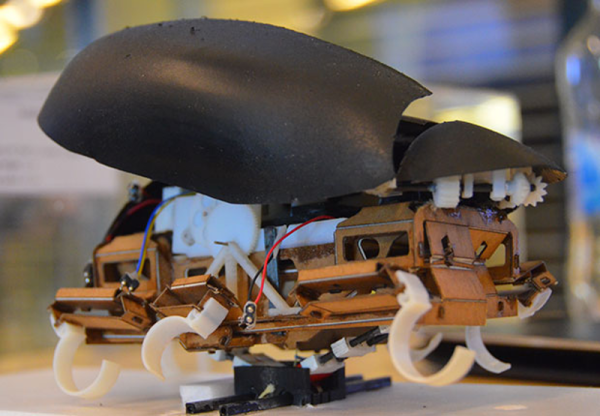
The university sponsored project, JumpRoaCH, is a collaboration between South Korea’s SNU Biorobotics Lab and Berkeley’s Biomimetic Millisystems Lab. Imitating insects has been a popular avenue for robotic research, and often results in very interesting experiments.

This robot looks like a ladybug going through its rebellious teen phase. It runs on six hook shaped legs which allow it to traverse a wider array of surfaces than wheels would, at the expense of speed and higher vibrations. The robot does a very convincing, if wobbly, scurry across the surface of its test table.

It also has a secret attack in the form of a single Rockem Sockem Robot arm located on its belly. With a powerful burst, the arm can launch the robot up a few feet to a higher surface. If the robot lands on its wheels the researchers high-five. If the robot lands on its back, it can use its ,”wings,” to flip itself right-side-up again.

The resulting paper (PDF file) has a nice description of the robot and its clever jumping mechanism. At least if these start multiplying like roaches, hackers will never short for tiny motors for their projects. Video after the break.

Continue reading “JumpRoaCH Is Kind Of Cute, Kind Of Creepy”

Bunnie And Snowden Explore IPhone’s Hackability

[Bunnie Huang] and [Edward Snowden] have teamed up to publish a paper exploring the possibility of introspection on the iPhone.

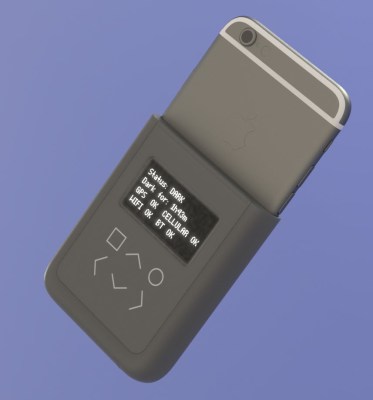
A rendering of the proposed introspection device attached to an iPhone6

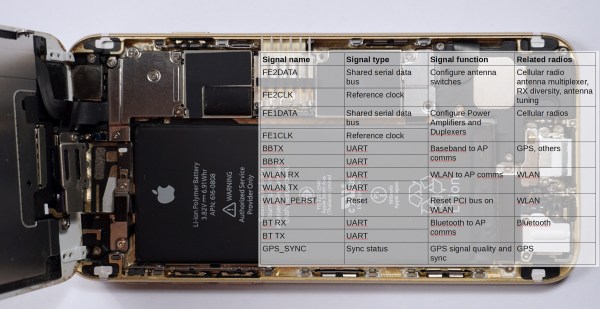
The idea is that phones are increasingly complex and potentially vulnerable to all kinds of digital surveillance. Even airplane mode is insufficient for knowing that your phone isn’t somehow transmitting information. The paper looks at the various radios on the iPhone, going so far as opening up the device and reading signals at each of the chips for cell, WiFi, Bluetooth, GPS, and NFC to determine whether the chip itself is doing anything, regardless of what the screen says. This introspection can then be used to be confident that the phone is not communicating when it shouldn’t be.

The paper goes on to propose a device that they will prototype in the coming year which uses an FPC that goes into the phone through the SIM card port. It would contain a battery, display, buttons, multiple SIM cards, and an FPGA to monitor the various buses and chips and report on activity.

Significant hacking of an iPhone will still be required, but the idea is to increase transparency and be certain that your device is only doing what you want it to.

Hackaday Prize Entry: A Simple Spectrophotometer

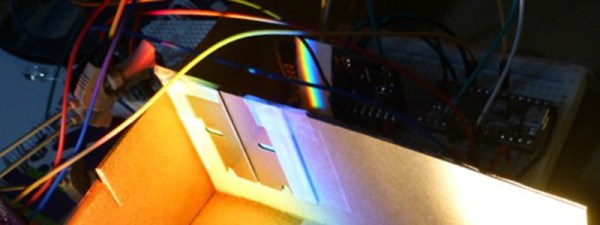
Building on the work of other Citizen Science efforts, [doctek]’s entry for the Hackaday Prize promises to detect pollution, identify chemicals, and perform other analyses with a simple handheld device. It’s a spectrophotometer, and [doctek] is putting some real engineering into this build.

A spectrophotometer is one of the simplest devices able to perform spectroscopy, requiring only a light source, a photoresistor, and some means of producing monochromatic light. By putting a sample in front of the photoresistor, the absorption spectrum of the sample can be measured. With this data, it’s a simple matter to identify the sample.

A light and a photoresistor are simple enough, but as with every precision measurement device, the devil is in the details. [doctec] is using new, low-noise, low-offset opamps, and precision references to get his data. Some of the parts in the schematic were actually designed in this century – a far cry from the ‘plug the photoresistor into the analog input’ projects we see so often.

[doctec] is using a Teensy 3.0 to drive the electronics and collect the data, and he already has the mechanics of this build pretty much figured out. It’s a great project that shows off some engineering skill, making it a great entry for The Hackaday Prize.


Pips Help Everyone Around The House

Sometimes you start a project with every intention of using it in a specific way, or maybe your plan is to have a very well-defined set of features. Often, though, our projects go in a completely different direction than we might have intended. That seems to be the case with [Dave] and his Pips. These tiny devices were originally intended to be used by people with disabilities, but it turns out that they’re a perfect platform for this “Internet of Things” thing that we’ve been hearing so much about.

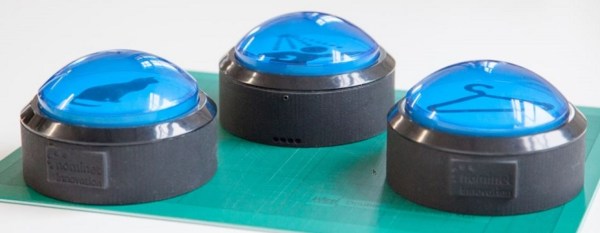
Built around the Bright Blue Bean microcontroller platform to take advantage of its low energy requirements, the Pips were originally intended to be placed around the house where they would light up to remind the user to perform some task. Once the button was pushed, the next Pip in the sequence would activate. While they are quite useful for people with cognitive or sensory impairments, they can also be used in a similar way to the Amazon Dash button or any other simple internet-enabled device. Especially when used in conjunction with a home automation setup, this device could be used in novel ways, such as automating your morning routine without having to add a weight sensor to your bed.

We are also pleased to see that all of the project files are available on GitHub for anyone looking to try this out. Its interesting when something that was originally intended to help out anyone with a disability finds a use somewhere else that it might not have originally been intended for. After all, though, the principle of using things in novel ways is kind of the entire basis of this community.