Keeping Magnetized Marbles From Stopping The Music

Take a couple of thousand steel balls, add a large wooden gear with neodymium magnets embedded in it, and what do you get? Either the beginnings of a wonderful kinetic music machine, or a mess of balls all stuck together and clogging up the works.

The latter was the case for [Martin], and he needed to find a way to demagnetize steel balls in a continuous process if his “Marble Machine X” were to see the light of day. You may recall [Martin] as a member of the band Wintergatan and the inventor of the original Marble Machine, a remarkable one-man band that makes music by dropping steel balls on various instruments. As fabulous a contraption as the original Marble Machine was, it was strictly a studio instrument, too fragile for touring.

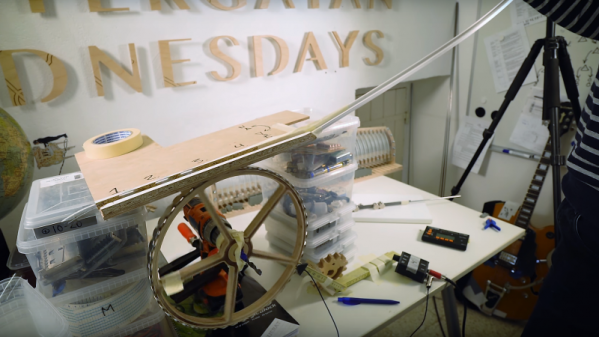
Marble Machine X is a complete reimagining of the original, intended to be robust enough to go on a world tour. [Martin] completely redesigned the lift mechanism, using magnets to grip the balls from the return bin and feed them up to a complicated divider. But during the lift, the balls became magnetized enough to stick together and no longer roll into the divider. The video below shows [Martin]’s solution: a degausser using magnets of alternating polarity spinning slowly under the sticky marbles. As a side note, it’s interesting and entertaining to watch a musician procrastinate while debugging a mechanical problem.

We can’t wait to see Marble Machine X in action, but until it’s done we’ll just settle for [Martin]’s other musical hacks, like his paper-tape programmed music box or this mashup of a synthesizer and a violin.

Continue reading “Keeping Magnetized Marbles From Stopping The Music”

A Grandfather Clock BarBot

As the saying goes, it’s five o’clock somewhere; when the clock finally strikes the hour, that same clock can pour you a drink thanks to redditor [Diggedypomme].

This bar-clock can dispense beverages with up to four different spirits and four mixers, and takes orders over voice, keyboard, or web-controls. A belt-driven drink loading platform pushes out through a spring-loaded door and once the vessel is in place and the order received, peristaltic pumps dispense the spirits while servos open taps for the mixers — a far easier method to administer the often carbonated liquids. A Raspberry Pi acts as this old-timer’s brain, an Arduino controls the lights, and a HAT to controls the servos. Here’s a more in-depth tour of what’s going on behind the bar, but check out the video after the break for a full run through of a few drink orders!

Continue reading “A Grandfather Clock BarBot”

Three Wires = One Motor

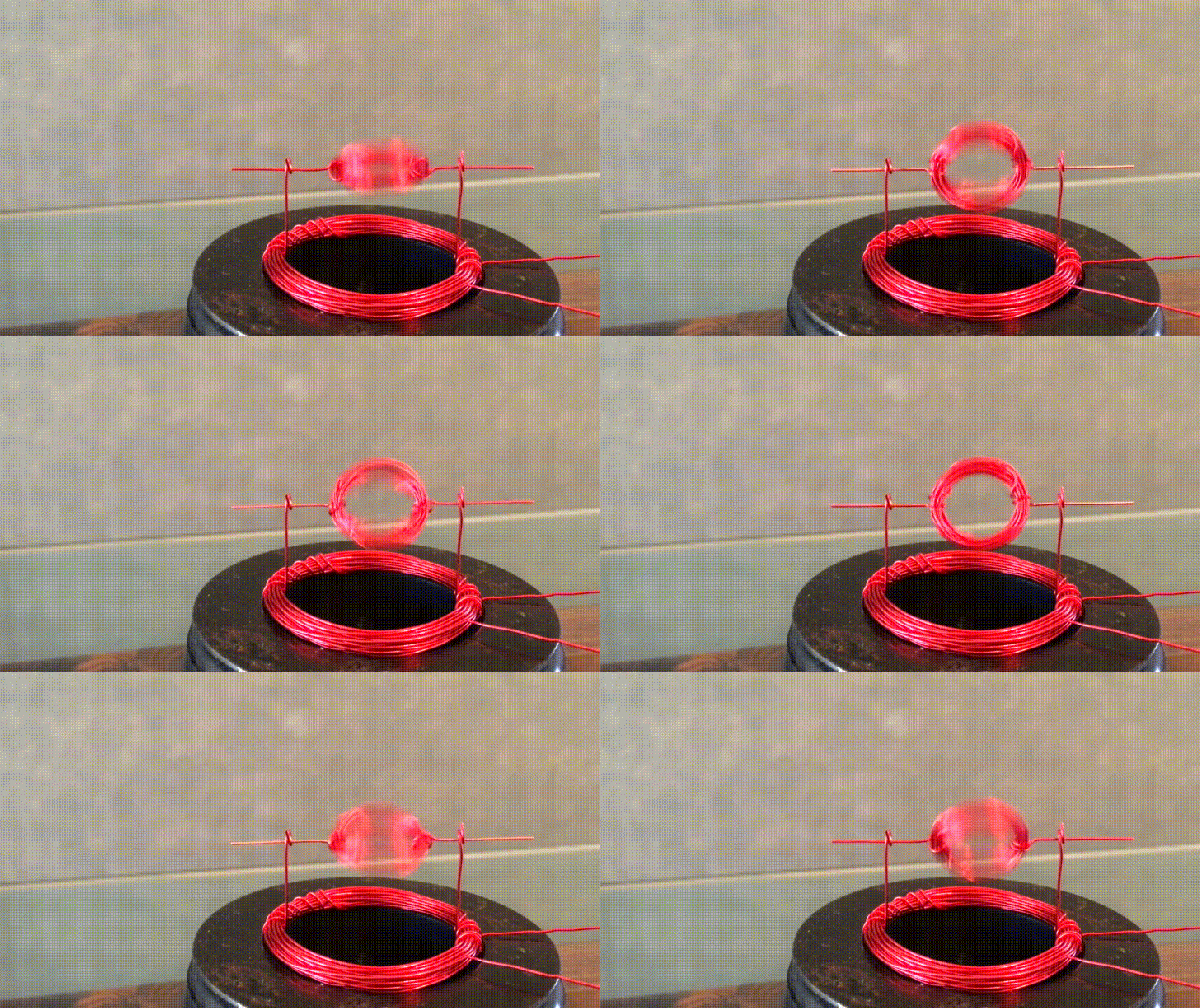
Here’s a quick build to show off fundamentals of electric current to new makers — or a cool party trick that might earn you a buck. [Jay] from the [Plasma Channel] shows off how you can make a simple motor with only three pieces of enameled wire in under five minutes.

Start with a roll of 26-guage — or thicker — magnet wire, and a pair of scissors or knife. For the base, wrap fifteen to twenty turns of wire around any spherical object about one and a half inches in diameter, leaving a few inches extra on both ends. Wrap those ends around your coil a few tines to secure it and straighten out the excess length — one will act as a support and the other will connect to your power source. Another piece of wire — similarly wrapped around the base coil — acts as the other support and the other terminal. Scrape off the wire coating from one side on both support wires and curl them into small loops. Halfway done!

Continue reading “Three Wires = One Motor”

HandHolo: A Homebrew ARG

Taking a dive into VR or augmented reality — once, dreamed-of science fiction — is not only possible for the average consumer, but crafting those experiences is as well! Hackaday.io user [kvtoet]’s HandHolo is a homebrew method to cut your teeth on peeking into a virtual world.

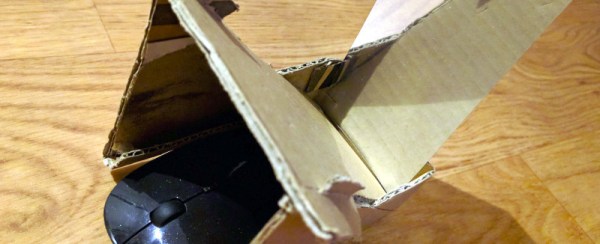
This project requires a smartphone running Android Oreo as its backbone, a Bluetooth mouse, a piece of cardboard and a small mirror or highly reflective surface. The phone is slotted into the cardboard housing — prototype with what you have! — above the mouse, and the mirror angled opposite the screen reflects the image back to the user as they explore the virtual scene.

Within Unity, [kvtoet]’s used a few scripts that access phone functions — namely the gyroscope, which is synchronised to the mouse’s movements. That movement is translated into exploration of the virtual space built in Unity and projected onto the portal-like mirror. Check it out!

Continue reading “HandHolo: A Homebrew ARG”

Repairs You Can Print: Fixing A Chewed Up Remote

What is it about remote controls? They’re like some vortex of household chaos, burrowing into couch cushions while accusations fly about who used it last. Or they land in just the right spot on the floor to be stepped on during a trip to the bathroom. And don’t get us started about the fragility of their battery case covers; it’s a rare remote in a house with kids whose batteries aren’t held in by strips of packing tape.

But [Alex Rich]’s Bose radio remote discovered another failure mode: imitating a dog chew toy. Rather than fork out $90 for a replacement, [Alex] undertook a 3D-printed case to repair the chewed remote. He put an impressive amount of reverse engineering into the replacement case, probably expending much more than $90 worth of effort. But it’s the principle of the thing, plus he wanted to support some special modifications to the stock remote. One was a hardware power switch to disconnect the batteries entirely, hidden in the bottom shell of the case. The second was the addition of a link to his thermostat to adjust the volume automatically when the AC comes on. That required a Trinket inside the remote and a few mods to make room for it.

Yes, this project dates from a few years back, but [Alex] only just brought it to our attention for the Repairs You Can Print contest. Got some special unobtanium part that you were able to print to get out of a jam? Enter and win prizes to add to the glory of fixing something yourself.

Travel In Style On An Electric Air Sled

What do you do during the winter months in Ohio? Sledding of course! Sledding normally takes place on hills, but [Peter Sripol] is no slave to the terrain. He’s built an air sled to conquer the barren wastelands of unplowed parking lots. Air sleds aren’t as outlandish as you might think — the Soviet Union had decades of success with them.

The project starts with toboggan style plastic sled. [Peter] built a frame into the plastic using an aluminum square. The frame is used to support a motor pod at the back of the sled. The motor, of course, comes from his DIY electric plane project. Don’t worry — [Peter] didn’t cannibalize his plane. The plane’s motors are being upgraded, and this is one of the originals.

The motor itself is quite a beast. It’s a 150cc equivalent brushless outrunner motor from HobbyKing. It’s not cheap either at around $450 USD.  The motor is controlled by an equally beefy brushless controller wired into a standard R/C car receiver. A pistol grip transmitter makes a great wireless throttle for the system.

Steering is a much more mechanical affair. The sled’s rudder is controlled much like that of an airplane. A steel cable pull-pull system is connected to a stick mounted in front of the pilot. The unreinforced styrofoam rudder turned out to be a weak point in the build — check out the video after the break to see the full story.

Continue reading “Travel In Style On An Electric Air Sled”

Mechanisms: The Screw Thread

They hold together everything from the most delicate watch to the largest bridge. The world is literally kept from coming apart by screws and bolts, and yet we don’t often give a thought to these mechanisms. Part of that is probably because we’ve gotten so good at making them that they’re seen as cheap commodities, but the physics and engineering behind the screw thread is interesting stuff.

We all likely remember an early science lesson wherein the basic building blocks of all mechanisms laid out. The simple machines are mechanisms that use an applied force to do work, such as the inclined plane, the lever, and the pulley. For instance, an inclined plane, in the form of a splitting wedge, directs the force of blows against its flat face into a chunk of wood, forcing the wood apart.

Screw threads are another simple machine, and can be thought of as a long, gently sloped inclined plane wrapped around a cylinder. Cut a long right triangle out of paper, wrap it around a pencil starting at the big end, and the hypotenuse forms a helical ramp that looks just like a thread. Of course, for a screw thread to do any work, it has to project out more than the thickness of a piece of paper, and the shape of the projection determines the mechanical properties of the screw.

Continue reading “Mechanisms: The Screw Thread”