Hackers Beware: Shenzhen Is Closing

If you’re among those of us with immediate plans for a PCB or parts order from China, watch out – Shenzhen just recently got put on a week-long lockdown. Factories, non-essential stores and public places are closed, and people are required to spend time at home – for a city that makes hardware thrive, this sounds like a harsh restriction. Work moves to remote where possible, but some PCB fabs and component warehouses might not be at our service for at least a week.

It might be puzzling to hear that the amount of cases resulting in closures is as low as 121, for a city of 12.6 million people. The zero-tolerance policy towards COVID has been highly effective for the city, with regular testing, adhered-to masking requirements and vaccinations – which is how we’ve been free to order any kinds of boards and components we needed throughout the past two years. In fact, 121 cases in one day is an unprecedented number for Shenzhen, and given their track record and swift reaction, it is reasonable to expect the case count dropping back to the regular (under 10 cases per day) levels soon.

Not all manufacturing facilities are located in Shenzhen, either. Despite what certain headlines might have you believe, supply chain shortages aren’t a certainty from here. A lot of the usual suspects like PCBWay and JLCPCB are merely reporting increased lead times as they reallocate resources, and while some projects are delayed for now, a lot of fabs you’d use continue operating with minor delays at most. SeeedStudio has its operations impacted more severely, and your Aliexpress orders might get shipped a bit later than usual – but don’t go around calling this a Chinese New Year v2 just yet. For those who want to keep a closer eye on the situation and numbers, the [Shenzhen Pages] Twitter account provides from-the-ground updates on the situation.

Wondering how your supply chain might be affected? We’ve talked about this way back in February 2020, addressing then-warranted worries that Chinese New Year would grow into a longer disruption than planned due to COVID becoming into a factor to manage. If you’re yet to discover the significance of Shenzhen, books have been written on this marvellous city, where you can build a successful hardware company in a week’s time. We’ve even had a meetup there once!

Header image: Charlie fong, CC BY-SA 4.0.
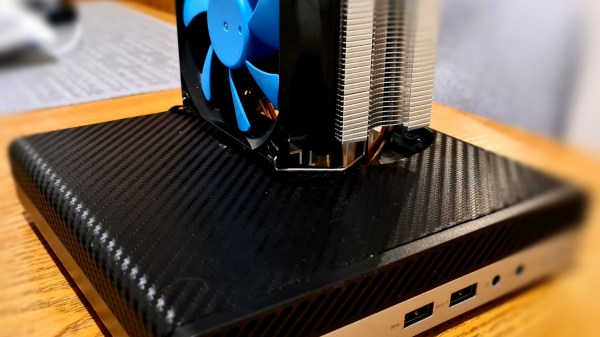
Mini PC with the mod described, a large tower fan sticking out of a hole in the top cover

MiniPC Surgery Makes It 50% Cooler

[G3R] writes to us about a mod they did on a HP ProDesk/EliteDesk 400 G3 miniPC they use as a home emulation center. The miniPC would overheat as soon as the CPU load increased, resulting in frame drops and stutters, as well as throttling CPU. [G3R] took the original cooling solution, threw out half of it and modified the remaining half to accept a tower CPU cooler.

The modification is invasive in all the right ways. [G3R] shows how to de-fin the current heatsink and smooth it over with a… welder? Our guess is that the heatsink fins were soldered to the heatsink base, and in that case, a heat gun should also work. Afterwards, you’re supposed to cut a hole in the upper case, then re-wire the fan connections, and create custom brackets to attach the tower fan – [G3R] explains how to do it all and what to watch out for.

The results are fascinating. After performing the mod, both idle and under-load temps got cut down by 50%! Idle temps went from 50 to 25 °C, and under-load temps dropped from 79 to 40 °C – surely, with way less throttling involved. Not only this lets [G3R] play Breath Of The Wild without hiccups, it also certainly improves overall lifespan of the mini-PC, despite the intervention being mechanically harsh.

Making our devices, quite literally, cooler is a venerable tradition of hackers. Just a few weeks ago, we covered a simple 3D printable LGA 1700 CPU bracket which can gain you some much-desired thermal contact. Sometimes we encounter proprietary and weird cooling fans that fail, and then we understand their workings and build a substitute. And, even if your GPU was never meant to have a fan, you can add one anyway!

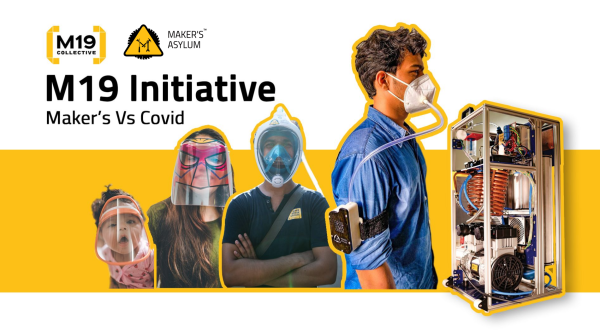
Remoticon 2021 // Vaibhav Chhabra And The M19 Collective Make One Million Faceshields

[Vaibhav Chhabra], the co-founder of Maker’s Asylum hackerspace in Mumbai, India, starts his Remoticon talk by telling a short story about how the hackerspace rose to its current status. Born out of frustration with a collapsed office ceiling, having gone through eight years of moving and reorganizations, it accumulated a loyal participant base – not unusual with hackerspaces that are managed well. This setting provided a perfect breeding ground for the M19 effort when COVID-19 reached India, mixing “what can we do” and “what should we do” inquiries into a perfect storm and starting the 49 day work session that swiftly outgrew the hackerspace, both physically and organizationally.

When the very first two weeks of the Infinite Two Week Quarantine Of 2020 were announced in India, a group of people decided to wait it out at the hackerspace instead of confining themselves to their homes. As various aspects of our society started crashing after the direct impact of COVID-19, news came through – that of a personal protective equipment shortage, especially important for frontline workers. Countries generally were not prepared when it came to PPE, and India was no different. Thus, folks in Maker’s Asylum stepped up, finding themselves in a perfect position to manufacture protective equipment when nobody else was prepared to help.

Continue reading “Remoticon 2021 // Vaibhav Chhabra And The M19 Collective Make One Million Faceshields” →

Raspberry Pi And The Story Of SD Card Corruption

Tales of Raspberry Pi SD card corruption are available online by the fistful, and are definitely a constant in Pi-adjacent communities. It’s apparent that some kind of problems tend to arise when a Raspberry Pi meets an SD card – which sounds quite ironic, since an SD card is the official and recommended way of booting a Pi. What is up with all of that?

I can start with a history lesson. Back when Raspberry Pi launched in 2012 – which is now 10 years ago – there were SD card controller driver problems, which makes sense given the wide variety of SD cards available out there. They were verifiably fixed one by one at some point in time, as debugging goes, their impact decreased and bugs with individual cards got smoothed over. This is how the “Pi SD card corruption” meme was originally born; however, if the problems were to end there, so would the meme. Yet, tales of broken SD cards plague us to this day – way less severe than they were in the beginning, but pronounced enough that you’ll see people encounter them every now and then.

Over the years, a devoted base of Pi SD card haters has grown. Their demand has been simple – Raspberry Pi has to get an ability to boot from something else, in large part because of corruption reasons, but also undeniably because of speed and capacity/cost limitations of SD cards. Thanks to their demands and work, we’ve seen a series of projects grow from unofficial efforts and hacks into officially supported Raspberry Pi abilities – USB boot being initially more of a workaround but now something you can enable out of the box, SSD-equipped Pi enclosures becoming more of a norm, and now, NVMe boot appearing on the horizon. Every few years, we get a new way to boot a Pi. Continue reading “Raspberry Pi And The Story Of SD Card Corruption” →

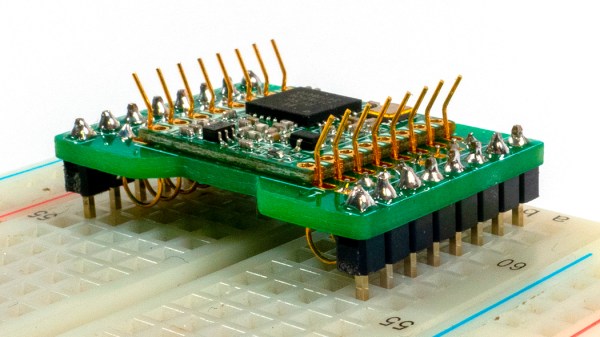
RFM9x module held in an adapter board with flexipins

FlexyPins Might Help With Those Pesky Castellated Modules

[SolderParty] just announced FlexyPins (Twitter, alternative view) – bent springy clips that let you connect modules with castellated pins. With such clips, you can quickly connect and disconnect any castellated module, swapping them without soldering as you’re prototyping, testing things out, or pre-flashing modules before assembly. They’re reportedly gold-plated, and a pack of ~100 will set you back 6EUR, shipping not included.

Of course, this is basically “fancy pieces of wire”, purpose-shaped, gold-plated and, hopefully, made out of material that is springy enough and doesn’t snap easily after bending a few times. We’ve seen this concept used for prototyping before, with random pieces of wire doing a pretty good job of maintaining connectivity, but these clips bring it that much closer to production-grade. It also makes us wonder – just how hard it is to solder 30-40 of them into a circuit? Do they self-align enough with the footprints given, or do you have to hold them with tweezers at a peculiar angle as you solder them? Time will tell, of course.

Continue reading “FlexyPins Might Help With Those Pesky Castellated Modules” →

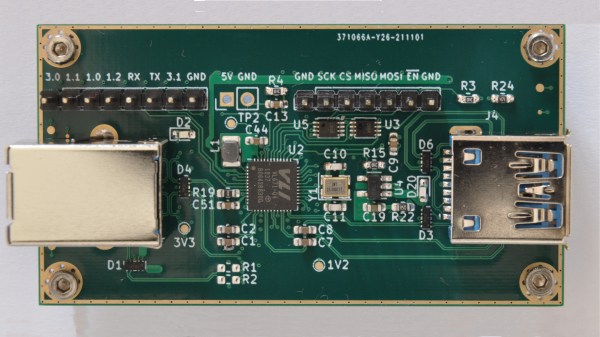
Top side of the VL670 breakout board, with two USB connectors and the VL670 chip in the center.

A Chip To Bridge The USB 2 – USB 3 Divide

On Twitter, [whitequark] has  found and highlighted an intriguing design – a breakout board for the VL670, accompanied by an extensive yet very easy to digest write-up about its usefulness and inner workings. The VL670 is a chip that addresses a surprising problem – converting USB 2.0 signals into USB 3.0.

If you have a USB 2.0 device and a host with only USB 3.0 signals available, this chip is for you. It might be puzzling – why is this even needed? It’s about the little-known dark secret of USB3, that anyone can deduce if they ever have to deal with a 9-pin USB 3.0 connector where one of the three differential pairs doesn’t quite make contact.

When you see a blue “3.0” port, it’s actually USB 2 and USB 3 — two separate interfaces joined into a single connector. USB 3 uses two single-directional differential pairs, akin to PCI-E, whereas USB 2 uses a single bidirectional one, and the two interfaces on a blue connector operate basically independently of each other. There’s many implications to this that are counterintuitive if you simply take “USB 3.0” for “faster backwards-compatible USB”, and they have painful consequences.

For instance, USB 3 hub ICs have two separate hub entities inside – one for USB 3 and one for USB 2. Even if you have a USB 3 hub plugged into a USB 3 port, multiple USB 2 devices plugged into it still cannot break through the USB 2 uplink limit of 480 MBps. If you ever thought that a faster hub with a faster uplink would fix your USB 2 device speed problems – USB-IF engineers, apparently, thought differently; and you might have to find a workaround for your “many cheap SDRs and Pi 4 in a box” setup. Continue reading “A Chip To Bridge The USB 2 – USB 3 Divide” →

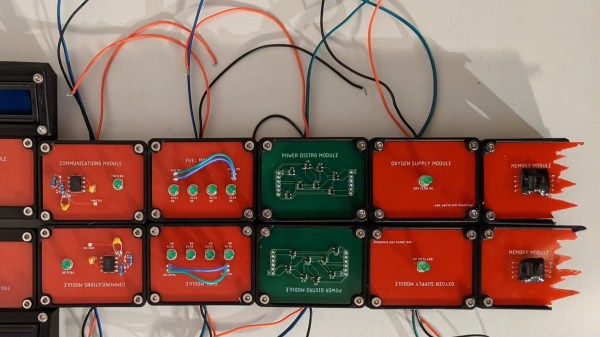
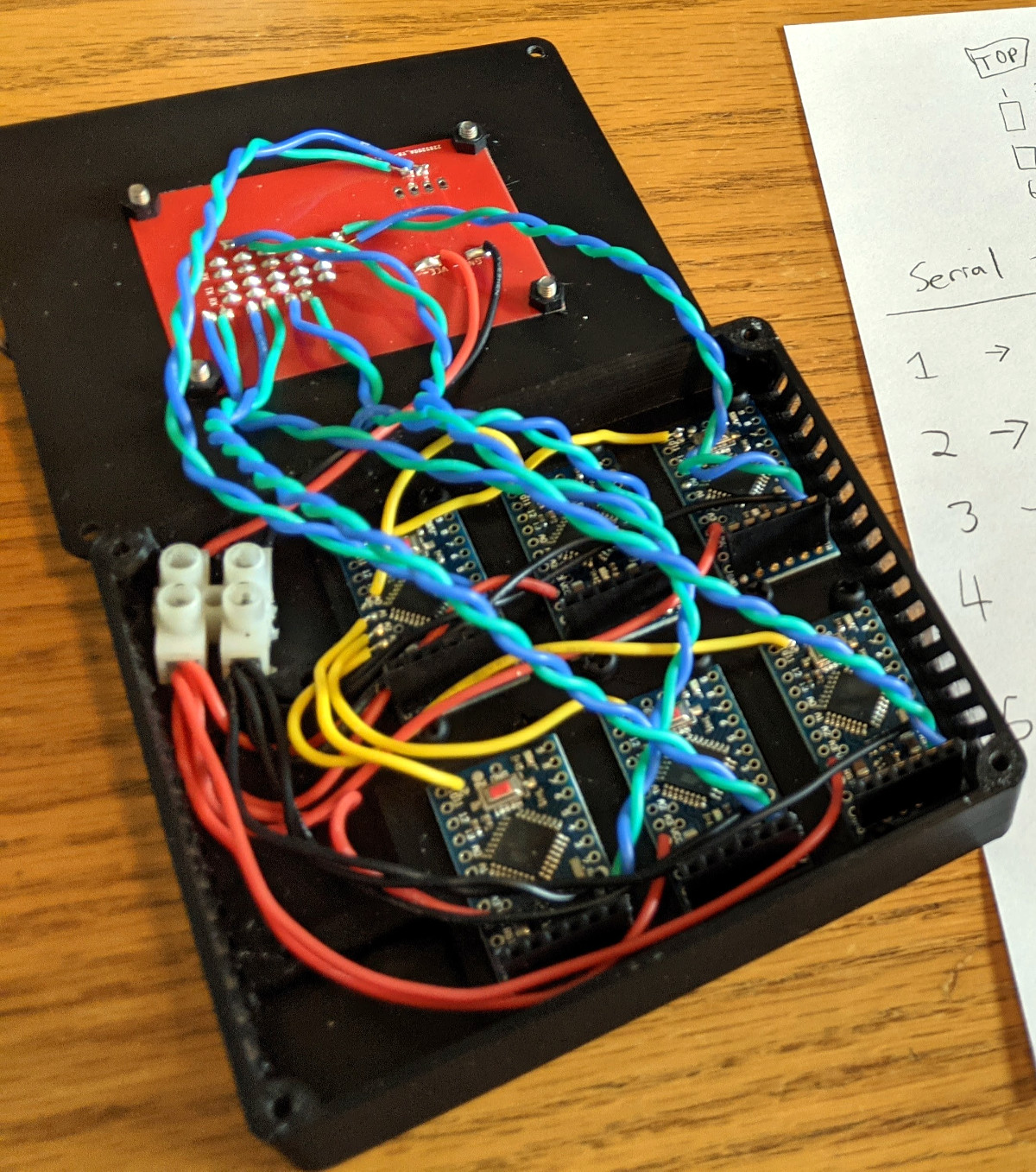
Modules described in the article (two copies of the challenge shown, so, two lines of modules)

Spaceship Repair CTF Covers Hardware Hacker Essentials

At even vaguely infosec-related conferences, CTFs are a staple. For KernelCon 2021, [Tyler Rosonke] resolved to create a challenge breaking the traditions, entertaining and teaching people in a different way, while satisfying the constraints of that year’s remote participation plans. His imagination went wild in all the right places, and a beautifully executed multi-step hardware challenge was built – only in two copies!

Story behind the challenge? Your broken spaceship has to be repaired so that you can escape the planet you’re stuck on. The idea was to get a skilled, seasoned hacker solving challenges for our learning and amusement – and that turned out to be none other than [Joe “Kingpin” Grand]!

The modules themselves are what caught our attention. Designed to cover a wide array of hardware hacker skills, they cover soldering, signal sniffing, logic gates, EEPROM dumping and more – and you have to apply all of these successfully for liftoff. If you thought “there’s gotta be a 555 involved”, you weren’t wrong, either, there’s a module where you have to reconfigure a circuit with one!

KernelCon is a volunteer-driven infosec conference in Omaha, and its 2022 installment starts in a month – we can’t wait to see what it brings! Anyone doing hardware CTFs will have something to learn from their stories, it seems. The hacking session, from start to finish, was recorded for our viewing pleasure; linked below as an hour and a half video, it should be a great background for your own evening of reverse-engineering for leisure!

This isn’t the first time we’ve covered [Tyler]’s handiwork, either. In 2020, he programmed a batch of KernelCon badges while employing clothespins as ISP clips. Security conferences have most certainly learned just how much fun you can have with hardware, and if you ever need a case study for that, our review of 2019 CypherCon won’t leave you hanging.

Continue reading “Spaceship Repair CTF Covers Hardware Hacker Essentials” →