X-Carve, The Logical Upgrade To A Shapeoko

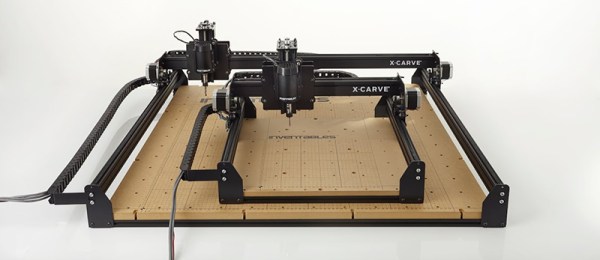
When it comes to small CNC carving machines for hackerspaces and extremely well-equipped garages, the Shapeoko, or something like it, has been the default machine. It’s dead simple – a Dremel attached to linear rails – and is useful for everything from milling PCBs to routing complex woodworking project to plotting designs with a pen. Now, [Bart Dring], the guy behind the Buildlog.net lasers and Inventables have teamed up to create the next generation of carving machines. It’s called the X-Carve, and while it’s fully compatible with the Shapeoko 2, it adds a few improvements that make for a much better machine.

The X-Carve does away with the Dremel-based spindle and replaces it with something that can produce torque. There’s a 24VDC spindle in the stock arrangement that will give you speed control through Gcode. There is, of course, adapters to fit the Dewalt and Bosch routers most commonly used in these types of machines.

As far as the gantry goes, the X and Y axes are makerslide; no change there. The Z axis leadscrew has an optional upgrade to Acme threaded rod, an improvement over the M8 threaded rod found in just about every other DIY machine kit. The entire machine is basically all the upgrades a Shapeoko should have, with stronger corners, NEMA 23 motors, and increased rigidity.

There are a few versions of the X-Carve, ranging from an upgrade kit to the Shapeoko 2 to a fully loaded kit with a square meter of machine space. The big, high-end kit ships for around $1250, but a smaller kit with 500mm rails, NEMA 17s, and threaded rod lead screw is available for around $800.

[Bart] and [Zach], the founder of Inventables sat down and shot a video going over all the features of the X-Carve. You can check that out below.

Continue reading “X-Carve, The Logical Upgrade To A Shapeoko”

BeagleSNES For Game Boy, Game Boy Advance, NES, And – Yes – SNES

By far the most common use for the Raspberry Pi is shoving a few dozen emulators on an SD card and calling it a day. Everybody’s got to start somewhere, right? There are other tiny, credit card-sized Linux boards out there, and [Andrew] is bringing the same functionality of the Raspi to the BeagleBone Black and BeagleBoard with BeagleSNES, an emulator for all the sane pre-N64 consoles.

BeagleSNES started as a class project in embedded system design, but the performance of simply porting SNES9X wasn’t very good by default. [Andrew] ended up hacking the bootloader and kernel, profiling the emulator, and slowly over the course of three years of development making this the best emulator possible.

After a few months of development, [Andrew] recently released a new version of BeagleSNES that includes OpenGL ES, native gamepad support through the BeagleBone’s PRU, and support for all the older Nintendo consoles and portables. Video demos below.

Continue reading “BeagleSNES For Game Boy, Game Boy Advance, NES, And – Yes – SNES”

The Hard Drive MIDI Controller

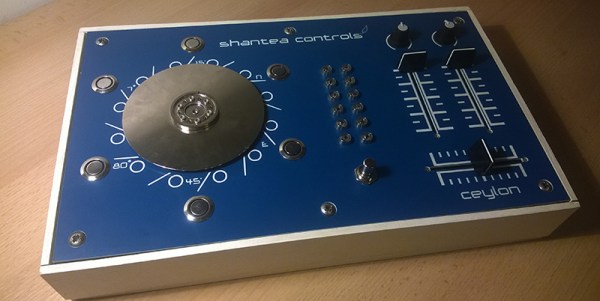
[shantea] builds MIDI controllers, and after a successful first endeavor with a matrix of buttons and knobs, he decided to branch out to something a little bit cooler. It’s called Ceylon, and it’s effectively a turntable controller built from an old hard drive.

As a contrast to the first MIDI controller, this would be a stripped-down build, with just three faders, LEDs for eye candy, a pair of pots for gain control, and a hard disk surrounded by six anti-vandal buttons. The hard disk is the star of the show, acting as a rotary encoder.

When manually spun, the hard disk generates a few phases of sinusoidal waves. The faster you spin it, the higher the amplitude and frequency. These signals are far too weak to be sampled directly by a microcontroller, and for digital control – as in, MIDI – you don’t need to read the analog signals anyway. These signals were turned digital with the help of an LM339 quad comparator. With two of these comparators and signals out of the hard disk that are 90 degrees out of phase, quadrature encoding is pretty easy.

The software for this MIDI controller is based on the OpenDeck Platform, a neat system that allows anyone to create their own MIDI controllers and devices.  It’s also a great looking board that seems to perform well. Video below.

Continue reading “The Hard Drive MIDI Controller”

RetroPie Turned Game Gear

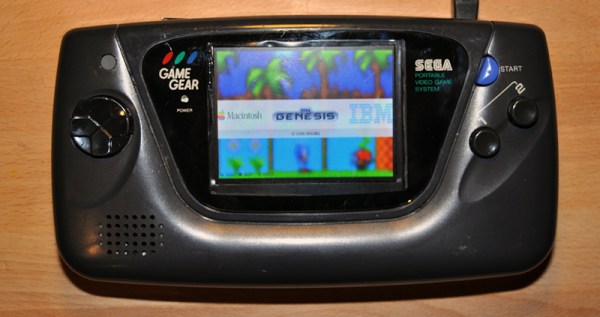
Running vintage console emulators on a Raspberry Pi seems to be the thing all the cool kids are doing. The coolest RetroPie builds take a vintage console – usually of the Nintendo genus – stuff a Raspi in there somehow, and Bob’s your uncle. [Phil Herlihy] over at Adafruit is throwing his hat into the ring with a similar build. For this one, though, he’s using Sega’s oft-maligned Game Gear. He might actually get more than a few hours out of the battery with this one, and the battery is rechargeable, too. You can’t beat that.

The build begins with tearing down an old Game Gear, chopping up the PCB to save the button contact, and starting to fit all the components in there. The display is completely replaced with a 3.5″ composite display, a bit larger than the 3.2″ display found in a stock Game Gear. That’s not a problem, there’s a surprising amount of space behind the bezel, and if you’re good enough with an xacto blade and a file, it will look stock.

The rest of the components include an amplifier board, battery charge regulator, a 2500mAh LiPo, and a Teensy to read the buttons. There are a few modifications required for the Pi, but the finished device presents a USB port to the outside world; keep a keyboard by your side, and this is a portable Pi in every respect.

Building A Transcutaneous Electrical Nerve Stimulation Device In A Weekend

Transcutaneous electrical nerve stimulation (TENS) is a technique that applies electrical current to nerves and muscles for the relief of pain. Before you ask, yes, some of these devices are FDA approved for various ailments. [Eric], [Conor], [Jacob], [lnr0626] and [rdrdrdrd] were down at HackDFW this weekend and built a TENS device from parts in their scrap bin.

A semi-decent TENS machine can cost somewhere between $70 and $200, but the team here have reduced the cost tremendously simply by separating the futzing analog/contact pad part from the signal generation part of the project. The signal generation actually happens on an Android phone, with settings to ‘relieve pain’, ‘relax’, ‘pulse’, and ‘random’. These signals are generated as audio and sent out over the headphone port. From there, the signal is amplified and sent to the neat skin-contact pads.

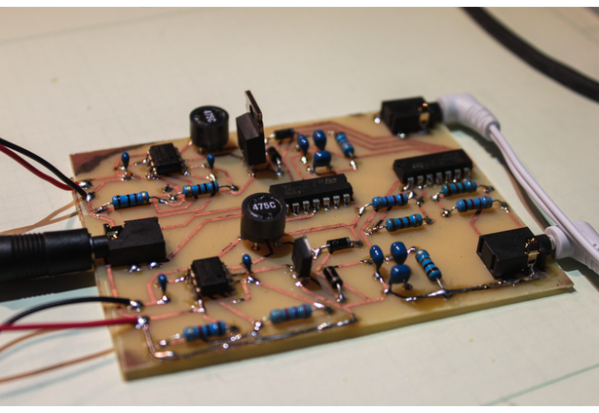
After prototyping their circuit, the team actually etched a circuit board for the final phase of the hackathon. Demo video below.

Continue reading “Building A Transcutaneous Electrical Nerve Stimulation Device In A Weekend”

Using The Red Pitaya As An SDR

The Red Pitaya is a credit-card sized board that runs Linux, has Ethernet, and a good bit of RAM. This sounds a lot like a Raspberry Pi and BeagleBone Black, but the similarities end there. The Red Pitaya also has two RF inputs, two RF outputs, and a load of digital IOs, all connected to an Xilinx SoC that includes an FPGA. [Pavel] realized the Pitaya had all the components of a software-defined radio, and built an implementation to prove it.

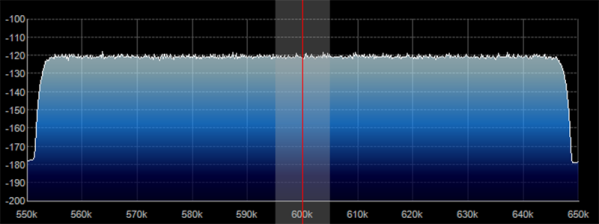
The input for the SDR taps directly into one of the high impedance inputs with a simple loop antenna made out of telephone cable. The actual software-defined part of this radio borrows heavily from an Xilinx application note, while everything is controlled by either SDR# or HDSDR.

[Pavel] included a pre-built SD card image with all his software, so cloning this project is simply a matter of copying an SD card and building an antenna. The full source is also available, interesting if you would like to muck about with FPGAs and SDRs.

NXP & Freescale Merge

Buyouts, acquisitions, and mergers of semiconductor companies are not unfamiliar territory for anyone who deals with chips and components for a living. Remember Mostek? That’s STMicroelectronics now. The switches used to type this post – Cherry blues – were made by ON Semiconductor. Remember Motorola? Freescale.

Today marks another merger, this time between NXP and Freescale. The merger will result in a $40 Billion dollar company, putting it in the top ten largest semiconductor companies.

Hackaday readers should know NXP for being the only company ever to produce an ARM microcontroller in a DIP package along with thousands of other cool components. Freescale is perhaps best known for their i.MX6 series of ARM processors, but of course both companies have a portfolio that stretches back decades and is filled with tens of thousands of parts.