Magic 8 Ball Provides Tech Support

ChatGPT might be making the news these days for being able to answer basically any question it’s asked, those of us who are a little older remember a much simpler technology that did about the same thing. The humble “Magic 8 Ball” could take nearly the same inputs, provided they were parsed in simple yes/no form, and provide marginal help similar to the AI tools of today. For a toy with no battery or screen, this was quite an accomplishment. But the small toy couldn’t give specific technical support help, so [kodi] made one that can.

The new 8 Ball foregoes the central fluid-filled chamber for an STM32 Blue Pill board with a few lithium batteries to power it. The original plastic shell was split in two with a hacksaw and fitted with a 3D printed ring which allows the two halves to be reconnected and separated again when it needs to charge. It uses a circular OLED to display the various messages of tech support, which are displayed when an accelerometer detects that the toy has been shaken.

Granted, most of the messages are about as helpful to solving a tech support issue as the original magic 8 Ball’s would have been, but we appreciate the ingenuity and carefree nature of a project like this. It also did an excellent job at operating in a low-power state as well, to avoid needing to charge it often. There have been a few other digital conversions of these analog fortune tellers as well, like this one which adds GIFs to each of the original answers.

Hams Watch For Meteors

After passing an exam and obtaining a license, an amateur radio operator will typically pick up a VHF ratio and start talking to other hams in their local community. From there a whole array of paths open up, and some will focus on interesting ways of bouncing signals around the atmosphere. There are all kinds of ways of propagating radio waves and bouncing them off of various reflective objects, such as the Moon, various layers of the ionosphere, or even the auroras, but none are quite as fleeting as bouncing a signal off of a meteor that’s just burned up in the atmosphere.

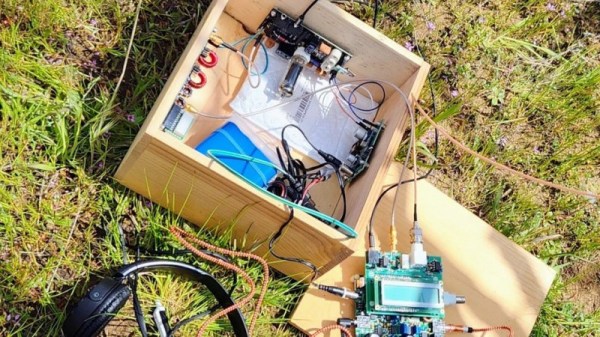
While they aren’t specifically focused on communicating via meteor bounce, The UK Meteor Beacon Project hopes to leverage amateur radio operators and amateur radio astronomers to research more about meteors as they interact with the atmosphere. A large radio beacon, which has already been placed into service, broadcasts a circularly-polarized signal in the six-meter band which is easily reflected back to Earth off of meteors. Specialized receivers can pick up these signals, and are coordinated among a network of other receivers which stream the data they recover over the internet back to a central server.

With this information, the project can determine where the meteor came from, some of the properties of the meteors, and compute their trajectories by listening for the radio echoes the meteors produce. While this is still in the beginning phases and information is relatively scarce, the receivers seem to be able to be built around RTL-SDR modules that we have seen be useful across a wide variety of radio projects for an absolute minimum of cost.

Continue reading “Hams Watch For Meteors”

An Old Netbook Spills Its Secrets

For a brief moment in the late ’00s, netbooks dominated the low-cost mobile computing market. These were small, low-cost, low-power laptops, some tiny enough to only have a seven-inch display, and usually with extremely limiting hardware even for the time. There aren’t very many reasons to own a machine of this era today, since even the cheapest of tablets or Chromebooks are typically far more capable than the Atom-based devices from over a decade ago. There is one set of these netbooks from that time with a secret up its sleeve, though: Phoenix Hyperspace.

Hyperspace was envisioned as a way for these slow, low-power computers to instantly boot or switch between operating systems. [cathoderaydude] wanted to figure out what made this piece of software tick, so he grabbed one of the only netbooks that it was ever installed on, a Samsung N210. The machine has both Windows 7 and a custom Linux distribution installed on it, and with Hyperspace it’s possible to switch almost seamlessly between them in about six seconds; effectively instantly for the time. Continue reading “An Old Netbook Spills Its Secrets”

Long-Distance Gaming Over Packet Radio

The amateur radio community often gets stereotyped as a hobby with a minimum age requirement around 70, gatekeeping airwaves from those with less experience or simply ignoring unfamiliar beginners. While there is a small amount of truth to this on some local repeaters or specific frequencies, the spectrum is big enough to easily ignore those types and explore the hobby without worry (provided you are properly licensed). One of the best examples of this we’ve seen recently of esoteric radio use is this method of using packet radio to play a game of Colossal Cave Adventure.

Packet radio is a method by which digital information can be sent out over the air to nodes, which are programmed to receive these transmissions and act on them. Typically this involves something like email or SMS messaging, so playing a text-based game over the air is not too much different than its intended use. For this build, [GlassTTY] aka [G6AML] is using a Kenwood TH-D72 which receives the packets from a Mac computer. It broadcasts these packets to his node, which receives these packets and sends them to a PDP-11 running the game. Information is then sent back to the Kenwood and attached Mac in much the same way as a standard Internet connection.

The unique features of packet radio make it both an interesting and useful niche within the ham radio community, allowing for all kinds of uses where data transmission might otherwise be infeasible or impossible. A common use case is APRS, which is often used on VHF bands to send weather and position information out, but there are plenty of other uses for it as well.

Continue reading “Long-Distance Gaming Over Packet Radio”

How Much Programming Can ChatGPT Really Do?

By now we’ve all seen articles where the entire copy has been written by ChatGPT. It’s essentially a trope of its own at this point, so we will start out by assuring you that this article is being written by a human. AI tools do seem poised to be extremely disruptive to certain industries, though, but this doesn’t necessarily have to be a bad thing as long as they continue to be viewed as tools, rather than direct replacements. ChatGPT can be used to assist in plenty of tasks, and can help augment processes like programming (rather than becoming the programmer itself), and this article shows a few examples of what it might be used for.

AI comments are better than nothing…probably.

While it can write some programs on its own, in some cases quite capably, for specialized or complex tasks it might not be quite up to the challenge yet. It will often appear extremely confident in its solutions even if it’s providing poor or false information, though, but that doesn’t mean it can’t or shouldn’t be used at all.

The article goes over a few of the ways it can function more as an assistant than a programmer, including generating filler content for something like an SQL database, converting data from one format to another, converting programs from one language to another, and even help with a program’s debugging process.

Some other things that ChatGPT can be used for that we’ve been able to come up with include asking for recommendations for libraries we didn’t know existed, as well as asking for music recommendations to play in the background while working. Tools like these are extremely impressive, and while they likely aren’t taking over anyone’s job right now, that might not always be the case.

Glowscope Reduces Microscope Cost By Orders Of Magnitude

As smartphones become more ubiquitous in society, they are being used in plenty of ways not imaginable even ten or fifteen years ago. Using its sensors to gather LIDAR information, its GPS to get directions, its microphone to instantly translate languages, or even use its WiFi and cellular radios to establish a wireless hotspot are all things which would have taken specialized hardware not more than two decades ago. The latest disruption may be in microscopy, as this build demonstrates a microscope that would otherwise be hundreds of thousands of dollars.

The microscope is a specialized device known as a fluorescence microscope, which uses a light source to excite fluorescent molecules in a sample which can illuminate structures that would otherwise be invisible under a regular microscope. For this build, the light is provided by readily-available LED lighting as well as optical filters typically used in stage lighting, as well as a garden-variety smartphone. With these techniques a microscope can be produced for around $50 USD that has 10 µm resolution.

While these fluorescence microscopes do have some limitations compared to units in the hundred-thousand-dollar range, perhaps unsurprisingly, they are fairly impressive for such a low-cost alternative. More details about these builds can also be found in their research paper published in Nature. Even without the need for fluorescence microscopy, a smartphone has been shown to be a fairly decent optical microscope, provided you have the right hardware to supplement the phone’s camera.

Enjoy An Open-Source Espresso

One of the core principles of the open-source movement is that anyone who wants to build on a piece of work, in whatever way they want, is easily able to. With source code freely available, the original project can be expanded upon, modified, updated, or simply looked at and used as inspiration. Usually we think about this in the realm of software freedom, but hardware is an important component as well. And not just electronics hardware, either. [Norm] demonstrates this espresso machine which was built on these open-source foundations.

The project takes some inspiration from the open-source Gaggiuino project, which was another build that modified an entry-level espresso maker with finer control over temperature and pressure. [Norm] was not willing to sacrifice his espresso machine for this cause, though, which is how this machine with its cobbled-together hardware came to be. An older machine with some worn parts was sacrificed to the coffee gods instead, making use of its pumps, boiler, and a few other bits of hardware especially from the hydraulics system. The software control is built around the Gaggiuino project, and includes a custom control board for user interface.

Right now the coffee maker does indeed work, but [Norm] hopes to make some improvements to the device including adding an enclosure of some sort, both to prevent accidental contact with the boiler and to give it a sleek, professional look. We kind of like it the way it is, while acknowledging that it isn’t quite ready for commercial production like this. It has a similar industrial feel as this espresso machine we featured a few years ago that is made out of old engine components.