A Trip Down The Vacuum Clamping Rabbit Hole

We all know how easy it is to fall down the rabbit hole,  something that turns a seemingly simple job into an accidental journey of experimentation and discovery. And perhaps nobody is more prone to rabbit-holing than [Matthias Wandel], at least judging by his recent foray into quantitating different techniques for vacuum clamping in the woodshop. (Video, embedded below.)

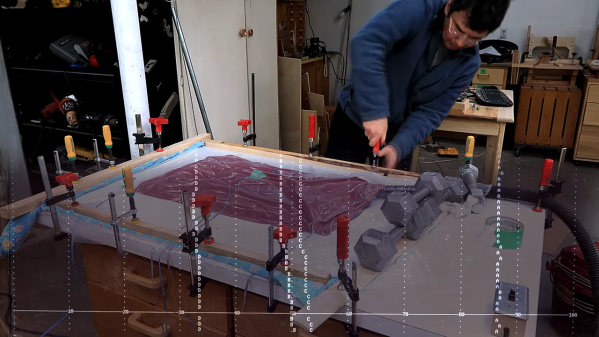
To understand where this all came from, you’ll have to dial back to [Matthias]’s first video, where he was just trying to make a simple corkboard. In an effort to get even pressure over the whole surface of the board, he came up with a shop-expedient vacuum clamp, made from a sheet of thick plastic, some scraps of wood and clamps, and a couple of vacuums. With the workpiece sandwiched between a smooth, flat table and the plastic sheet, he was able to suck the air out and apply a tremendous amount of force to the corkboard.

The comments to the first video led to the one linked below, wherein [Matthias] aimed to explore some of the criticisms of his approach. Using a quartet of BMP280 pressure sensor breakout boards and a Raspberry Pi, he was able to nicely chart the pressure inside his clamping jig. He found that not only did the sensors make it easy to find and fix leaks, they also proved that adding a porous layer between the workpiece and the vacuum bag wouldn’t likely improve clamping. He was also able to show which of his collection of vacuums worked best — unsurprisingly, the Miele sucked the hardest, although he found that it wasn’t suitable for continuous clamping duty.

We can see a lot of uses for a jig like this, and we really like it when trips down the rabbit hole yield such interesting results. Especially quantitative results; remember [Matthias]’s exploration of basement humidity?

Continue reading “A Trip Down The Vacuum Clamping Rabbit Hole”

Coffee Stirrers Act As Lens For This Digital Straw Camera

What happens when you mix over 23,000 coffee stirrers and a Raspberry Pi camera together? Probably nothing except for a mess, unless you very specifically pack the plastic straws and orient the camera just right. In that case, you get this very cool lenless digital straw camera that takes artfully ghostly images.

Image of Yoda photographed through many straws

Actually, lensless is a bit of a reach for [Adrian Hanft]’s creation. While the camera he’s using to grab the image has a lens, the objective, for lack of a better term, is just a tightly packed bundle of straws. We’ve seen this approach to photography before, but there the camera used film placed at the back of the straw bundles to capture the pixelated image.

Here, a ground glass screen stands in for the film; a long lightproof box behind that provide a place to mount a camera to capture the images. Cleverly, [Adrian] built the camera mount from Lego, allowing cameras and lenses to be quickly swapped out. A Nintendo gamepad controller talks to custom software running on a Raspberry Pi and allows the photographer to control exposure and scroll through pictures using a smartphone as a display. There’s a short build video below, for those who can’t get enough of straw-packing techniques.

As with the film version of this camera, we just love the look of the photographs that come from this — the texture of the straw honeycomb and the defocused subject make for a striking effect.

Continue reading “Coffee Stirrers Act As Lens For This Digital Straw Camera”

RCA Plug Plays Sixteen-Minute Chiptune Piece, All By Itself

Frequenters of arcades back in the golden age of video games will likely recall the mix of sounds coming from a properly full arcade, the kind where you stacked your quarters on a machine to stake your claim on being next in line to play. They were raucous places, filled with the simple but compelling sounds that accompanied the phosphor and silicon magic unfolding all around.

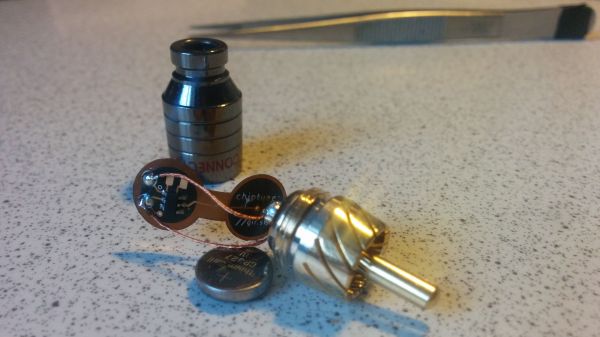
The days of such simple soundtracks may be gone, but they’re certainly not forgotten, with this chiptunes generator built into an RCA plug being both an homage to the genre and a wonderful example of optimization and miniaturization. It’s the work of [girst] and it came to life as an attempt to implement [Rob Miles]’ Bitshift Variations in C Minor algorithmically generated chiptunes composition in hardware. For the first attempt, [girst] chose an ATtiny4 as the microcontroller, put it and the SMD components needed for a low-pass filter on a flex PCB, and wrapped the whole thing around a button cell battery. Stuffed into the shell of an RCA plug, the generator detects when it has been inserted into an audio input jack and starts the 16-minute piece. [girst] built a second version, too, using the Padauk PSM150c “Three-Cent Microcontroller” chip.

This is quite an achievement in chiptunes minimization. We’ve seen chiptunes in 32 bytes, Altoids tin chiptunes, and an EP on a postage-stamp-sized PCB, but this one might beat them all on size alone.

Continue reading “RCA Plug Plays Sixteen-Minute Chiptune Piece, All By Itself”

Enjoy An ASCII Version Of Star Wars In The Palm Of Your Hand For May The 4th

Everyone by now has probably seen the original — and best; fight us — installment of the Star Wars franchise, and likely the ASCII-art animation version of it that improves greatly on the film by eliminating all those distracting special effects, human actors, and the soundtrack. But what we haven’t had until now is a portable player for ASCIIWars, to enjoy the film in all its character-based glory while you’re on the go.

While this tribute to [Simon Jansen]’s amazing ASCII-art achievement might seem like a simple repackaging of the original, [Frank] actually had to go to some lengths to make this work. After getting [Simon]’s blessing, the build started with a WEMOS D1 Mini, a good platform for the project less for its wireless capabilities and more for its 4 MB of flash memory. A 240×360 TFT LCD display was selected to show the film; the scale of the display made most fonts hard to read, so [Frank] used Picopixel, a font designed for legibility on small screens. The animation file is stored on the SPIFFS file system on the D1’s flash memory, and a few lines of code parse it and send it to the display. The final touch is mounting the whole thing is an old slide viewer, which magnifies the display to make it a little easier to see.

As much as we applaud [Frank]’s tribute to [Simon]’s effort, there’s no reason to confine this to the Star Wars universe. If you read up on the history of ASCII art, which goes surprisingly far back, you might be inspired to render another classic film in ASCIImation and put it on a viewer like this. ASCII-Metropolis, anyone?

Continue reading “Enjoy An ASCII Version Of Star Wars In The Palm Of Your Hand For May The 4th”

Open-Source Oxygen Hack Chat

Join us on Wednesday, May 5 at noon Pacific for the Open-Source Oxygen Hack Chat with Maher Daoudi and the OxiKit Team!

In such tumultuous times, it may be hard to remember last week, let alone last year. But if you dig back a bit, you may recall what a panic the world was in at this point in 2020 about the ventilator crisis. With COVID-19 cases on the rise and the potential for great numbers of patients needing intensive care, everyone and their brother was hacking together makeshift ventilators, in the well-intentioned belief that their inventions would help relieve the coming shortage of these lifesaving medical mechanical miracles.

As it came to pass, though, more COVID-19 patients have benefited from high-flow oxygen therapy than from mechanical ventilation. That’s great news in places where medical oxygen is cheap and easily available, but that’s always the case. We’ve seen recent reports of hospitals in India running out of oxygen, and even rural and remote areas of the developed world can find themselves caught without enough of the vital gas.

To meet the world’s increasing demand for high-flow oxygen therapy, the team at OxiKit has developed an open-source oxygen concentrator that can be built for far less than what commercial concentrators cost. By filtering the nitrogen out of the air, the concentrator provides oxygen at 90% or higher purity, at a flow of up to 25 liters per minute.

Oxikit founder Maher Daoudi and some of the technical team will join us for this Hack Chat to discuss the details of making oxygen concentrators. We’ll learn about how they work, what the design process for their current concentrator was like, and how they got past the obstacles and delivered on the promise of high-flow oxygen for the masses.

join-hack-chatOur Hack Chats are live community events in the Hackaday.io Hack Chat group messaging. This week we’ll be sitting down on Wednesday, May 5 at 12:00 PM Pacific time. If time zones have you tied up, we have a handy time zone converter.

Click that speech bubble to the right, and you’ll be taken directly to the Hack Chat group on Hackaday.io. You don’t have to wait until Wednesday; join whenever you want and you can see what the community is talking about.
Continue reading “Open-Source Oxygen Hack Chat”

Genetically Modified Mosquitos: Biohacking For Disease Prevention

Many years ago, I took a summer trip to the Maryland shore with some friends. One of my buddies and I got bored with playing football on the beach, so we decided to take a hike on one of the many trails back into the wooded area behind the dunes. At the trailhead we noticed a prominent sign, warning about the presence of “very aggressive mosquitos” and not to enter without first applying ample insect repellent. We scoffed at the warning as only young idiots could and soldiered on, bare-legged and confident that we’d be fine.

About three minutes into our hike, a small group came pelting down the trail in a panic. “It’s true! Turn back!” they shouted as they flew past us. Undeterred, or at least unwilling to appear that way to each other, we pressed on, only to discover a few minutes later that we were making a substantial blood sacrifice to the next generation of mosquitos on Assateague Island. We couldn’t bear more than a few seconds before turning tail and running back to the beach and jumping into the ocean to get rid of the last few dozen bloodsuckers.

I learned a valuable lesson from that experience, as well as developing a deep and abiding hatred of mosquitos. It turns out I’m in good company — pretty much everyone hates mosquitos, which are not just a nuisance but can be downright dangerous to be around. But if tests with genetically engineered mosquitos currently underway in Florida turn out well, we may be able to finally turn the tide against mosquito-borne diseases, simply by killing all the females before they ever reach adulthood.

Continue reading “Genetically Modified Mosquitos: Biohacking For Disease Prevention”

Hackaday Links Column Banner

Hackaday Links: May 2, 2021

Mars is getting to be a busy place, what with helicopters buzzing around and rovers roving all about the place. Now it’s set to get a bit more crowded, with the planned descent of the newly-named Chinese Zhurong rover. Named after the god of fire from ancient Chinese mythology, the rover, which looks a little like Opportunity and Spirit and rides to the surface aboard something looking a little like the Viking lander, will carry a suite of scientific instruments around Utopia Planitia after it lands sometime this month. Details are vague; China usually plays its cards close to the vest, and generally makes announcements only when a mission is a fait accompli. But it appears the lander will leave its parking orbit, which it entered back in February, sometime this month. It’s not an easy ride, and we wish Zhurong well.

Speaking of space, satellites don’t exactly grow on trees — until they do. A few groups, including a collaboration between UPM Plywood and Finnish startup Arctic Astronautics, have announced intentions to launch nanosatellites made primarily of wood. Japanese logging company Sumitomo Forestry and Kyoto University also announced their partnership, formed with the intention to prove that wooden satellites can work. While it doesn’t exactly spring to mind as a space-age material, wood does offer certain advantages, including relative transparency to a wide range of the RF spectrum. This could potentially lead to sleeker satellite designs, since antennae and sensors could be located inside the hull. Wood also poses less of a hazard than a metal spaceframe does when the spacecraft re-enters the atmosphere. But there’s one serious disadvantage that we can see: given the soaring prices for lumber, at least here in the United States, it may soon be cheaper to build satellites out of solid titanium than wood.

If the name Ian Davis doesn’t ring a bell with you, one look at his amazing mechanical prosthetic hand will remind you that we’ve been following his work for a while now. Ian suffered a traumatic amputation of the fingers of his left hand, leaving only his thumb and palm intact, and when his insurance wouldn’t pay for a prosthetic hand, he made his own. Ian has gone through several generations, each of which is completely mechanical and controlled only by wrist movements. The hands are truly works of mechanical genius, and Ian is now sharing what he’s learned to help out fellow hand-builders. Even if you’re not building a hand, the video is well worth watching; the intricacy of the whiffle-tree mechanism used to move the fingers is just a joy to behold, and the complexity of movement that Ian’s hand is capable of is just breathtaking.

If mechanical hands don’t spark your interest, then perhaps the engineering behind top fuel dragsters will get you going. We’ll admit that most motorsports bore us to tears, even with the benefit of in-car cameras. But there’s just something about drag cars that’s so exciting. The linked video is a great dive into the details of the sport, where engines that have to be rebuilt after just a few seconds use, fuel flows are so high that fuel lines the size of a firehouse are used, and the thrust from the engine’s exhaust actually contributes to the car’s speed. There’s plenty of slo-mo footage in the video, including great shots of what happens to the rear tires when the engine revs up. Click through the break for more!

Continue reading “Hackaday Links: May 2, 2021”