Cleaning Up The Yard With AI — Avian Intelligence

Despite epithets like “bird-brain,” our feathered friends are actually pretty smart. Being able to maneuver in three dimensions at high speed must have something to do with it, and the cognitive abilities of birds are well-documented and still being researched. So it naturally makes sense to harness avian brainpower to keep one’s yard clean, right?

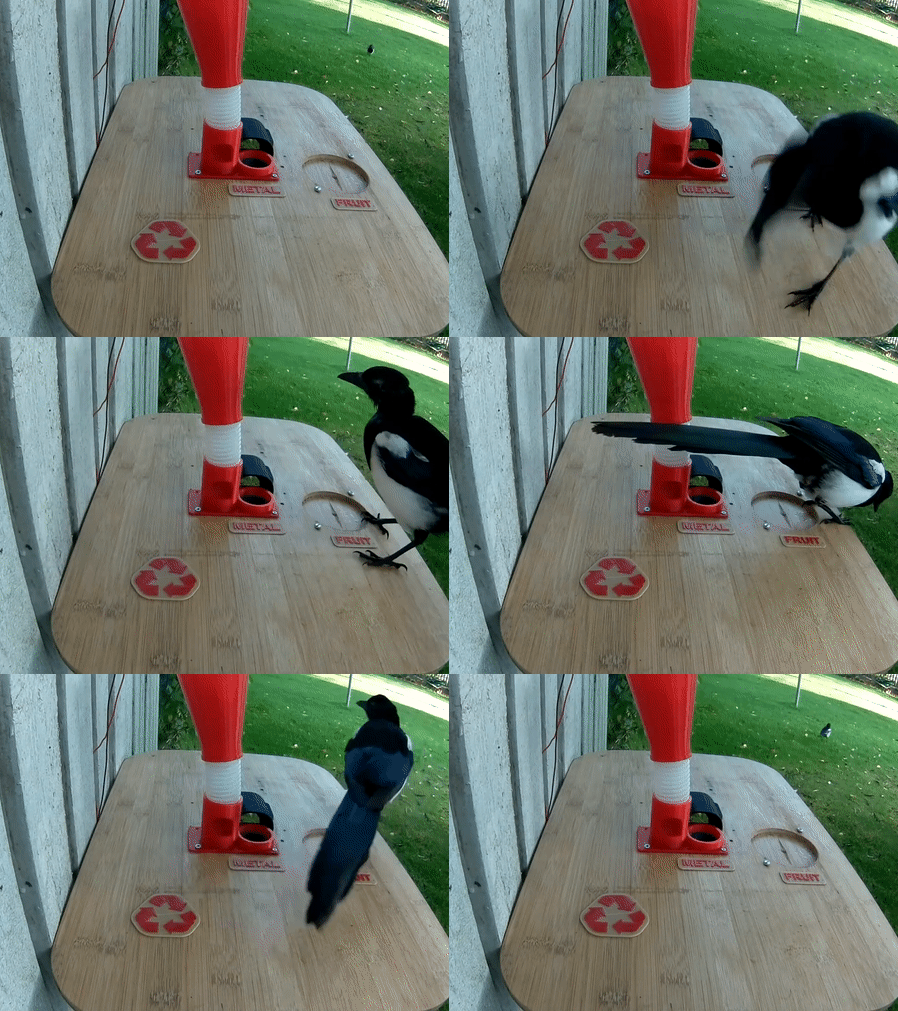
For the record, the magpies that [Hans] is training are very intelligent and strikingly beautiful birds who delight in swooping down to harass people, and who will gladly steal food from other birds and then poop on it and fly away. So they’re jerks, but that doesn’t mean they can’t be useful jerks. The goal with his BirdBox system is to use classic operant conditioning, where a desired voluntary behavior is reinforced by a reward. In this case, the reward is a treat dispensed by a 3D-printed vibratory dispenser when the bird collects a bottlecap from the yard and deposits it in the proper slot. The video below shows the birds doing exactly what they’re supposed to do.

[Hans] tells us that the trick is getting the birds to accept the BirdBox and to have them integrate it into their “patrol schematic” of their territory. Once that’s done, it’s a simpler matter to have them associate the bottlecaps with the reward. The other challenge is making everything bulletproof, or in this case magpie-proof. Did we mention that magpies are jerks?

The possibilities for trading peanuts for yardwork are endless; [Hans] mentions plans he has for fallen fruit clean-up, and mentions a persistent garden slug problem that the birds might be employed to remediate. If you want to try this, it might be a good idea to brush up on the work of [B.F. Skinner] and his pigeons of war.

Continue reading “Cleaning Up The Yard With AI — Avian Intelligence”

State Of The Art For Nixies Gets A Boost From Dalibor Farny’s Supersize Prototype

Never one to pass up on a challenge, artisanal Nixie tube maker [Dalibor Farný] has been undertaking what he calls “Project H”, an enormous array of 121 Nixie tubes for an unnamed client. What’s so special about that? Did we mention that each Nixie is about the size of a sandwich plate?

Actually, we did, back in May when we first noted Project H in our weekly links roundup. At that time [Dalibor] had only just accepted the project, knowing that it would require inventing everything about these outsized Nixies from scratch. At 150 mm in diameter, these will be the largest Nixies ever made. The design of the tube is evocative of the old iconoscope tubes from early television history, or perhaps the CRT from an old oscilloscope.

Since May, [Dalibor] has done most of the design work and worked out the bugs in a lot of the internal components. But as the video below shows, he still has some way to go. Everything about his normal construction process had to be scaled up, so many steps, like the chemical treatment of the anode cup, are somewhat awkward. He also discovered that mounting holes in the cathodes were not the correct diameter, requiring some clench-worthy manual corrections. The work at the glassblower’s lathe was as nerve wracking as it was fascinating; every step of the build appears fraught with some kind of peril.

Sadly, this prototype failed to come together — a crack developed in the glass face of the tube. But ever the pro, [Dalibor] took it in stride and will learn from this attempt. Given that he’s reduced the art of the Nixie to practice, we’re confident these big tubes will come together eventually.

Continue reading “State Of The Art For Nixies Gets A Boost From Dalibor Farny’s Supersize Prototype”

Mechanical Engineering Hack Chat

Join us on Wednesday, September 30 at noon Pacific for the Mechanical Engineering Hack Chat with Adam Zeloof!

Almost every non-trivial project involves some level of cross-discipline work. If you build a robot, for instance, you need to worry not just about the electronics but also the mechanical design. You need to make sure that the parts you use will be strong enough to deal with the forces that it’ll face, you have to know how much power it’ll take to move your bot, and you have to deal with a thousand details, from heat flow to frictional losses to keeping things moving with bearing and seals.

Unfortunately for many of us, the mechanical engineering aspects of a project are foreign territory. We lack the skills to properly design mechanical systems, and so resort to seat-of-the-pants decisions on materials and fasteners, or over-engineering in the extreme — the bigger the bolt, the better. Right?

Some of us, though, like Adam Zeloof, actually know a thing or two about proper mechanical engineering. Strength of materials, finite element analysis, thermodynamics — all that stuff that most of us just wing are Adam’s stock in trade. Adam brings a trained mechanical engineer’s skillset to his multi-discipline projects, like the Rotomill or his reverse-engineered ride-share scooter. And many of you will have been lucky enough to see Adam’s excellent 2019 Superconference talk on thermal design for PCBs.

Adam joins us on the Hack Chat to talk about anything and everything to do with mechanical engineering. Join us with your burning — sometimes literally — questions on how to make your designs survive the real world, where things break and air resistance can’t be ignored.

join-hack-chatOur Hack Chats are live community events in the Hackaday.io Hack Chat group messaging. This week we’ll be sitting down on Wednesday, September 30 at 12:00 PM Pacific time. If time zones baffle you as much as us, we have a handy time zone converter.

Click that speech bubble to the right, and you’ll be taken directly to the Hack Chat group on Hackaday.io. You don’t have to wait until Wednesday; join whenever you want and you can see what the community is talking about.

Continue reading “Mechanical Engineering Hack Chat”

Hackaday Links Column Banner

Hackaday Links: September 27, 2020

Hardly a week goes by without a headline screaming about some asteroid or another making a close approach to Earth; it’s only by reading the fine print that we remember what an astronomer’s definition of “close” means. Still, 2020 being what it is, it pays to stay on top of these things, and when you do the story can get really interesting. Take asteroid 2020 SO, a tiny near-Earth asteroid that was discovered just last week. In a couple of weeks, 2020 SO will be temporarily captured into Earth orbit and come with 50,000 km near the beginning of December. That’s cool and all, but what’s really interesting about this asteroid is that it may not be a rock at all. NASA scientists have reverse-engineered the complex orbit of the object and found that it was in the vicinity of Earth in late 1966. They think it may be a Centaur booster from the Surveyor 2 moon mission, launched in September 1966 in the runup to Apollo. The object will be close enough for spectral analysis of its. surface; if it’s the booster, the titanium dioxide in the white paint should show up loud and clear.

Lasers are sort of forbidden fruit for geeks — you know you can put an eye out with them, and still, when you get your hands on even a low-power laser pointer, it’s hard to resist the urge to shine it where you shouldn’t. That includes into the night sky, which as cool as it looks could be bad news for pilots, and then for you. Luckily, friend of Hackaday Seb Lee-Delisle has figured out a way for you to blast lasers into the night sky to your heart’s content. The project is called Laser Light City and takes place in Seb’s home base of Brighton int he UK on October 1. The interactive installation will have three tall buildings with three powerful lasers mounted on each; a smartphone app will let participants control the direction, shape, and color of each beam. It sounds like a load of fun, so check it out if you’re in the area.

We got an interesting story from a JR Nelis about a quick hack he came up with to help his wife stay connected. The whole post is worth a read, but the short version of the story is that his wife has dementia and is in assisted living. Her landline phone is her social lifeline, but she can’t be trusted with it, lest she makes inappropriate calls. His solution was to modify her favorite cordless phone by modifying the keypad, turning it into a receive-only phone. It’s a sad but touching story, and it may prove useful to others with loved ones in similar situations.

We pay a lot of attention to the history of the early computer scene, but we tend to concentrate on computers that were popular in North America and the UK. But the Anglo-American computers were far from the only game in town, and there’s a new effort afoot to celebrate one of the less well-known but still important pioneer computers: the Galaksija. Aside from having a cool name, the Yugoslavian Z80 computer has a great story that will be told in documentary form, as part of the crowdsourced Galaksija project. The documentary stars our own Voja Antonic, who was key to the computer’s development. In addition to the film, the project seeks to produce a replica of the Galaksija in kit form. Check out the Crowd Supply page and see if it’s something you’re willing to back.

There’s an interesting new podcast out there: the Pick, Place, Podcast. Hosted by Chris Denney and Melissa Hough, it comes out every other week and is dedicated to the electronic assembly industry. They’ve currently got eight episodes in the can ranging from pick and place assembly to parts purchasing to solder paste printing. If you want to learn a little more about PCB assembly, this could be a real asset. Of course don’t forget to make time for our own Hackaday Podcast, where editors Mike and Elliot get together to discuss the week in hardware hacking.


Old Polaroid Gets A Pi And A Printer

There’s nothing like a little diversion project to clear the cobwebs — something to carry one through the summer doldrums and charge you up for the rest of the hacking year. At least that’s what we think was up with [Sam Zeloof]’s printing Polaroid retro-conversion project.

Normally occupied with the business of learning how to make semiconductors in his garage, or more recently working on his undergraduate degree in electrical engineering, [Sam], like many of us, found himself with time to spare this summer. In search of a simple, fun project that wouldn’t glaze over the eyes of people when he showed it off, he settled on a printing party camera. The guts are pretty standard fare: a Raspberry Pi and Pi cam, coupled with a thermal receipt printer for instant hardcopy. The donor camera was a Polaroid Pronto from eBay, in good shape on the outside and mostly complete on the inside. A Dremel took care of the latter, freeing up space occupied by all the plastic bits that held the film cartridge and running gear of the film handling system.

The surgery made enough room to squeeze in the Pi Zero and a LiPo battery pack, along with a buck converter. Adding in the receipt printer and its drive board and mounting the Pi cam presented some challenges, but everything fit without breaking the original look and feel of the Polaroid. The camera now produces low-res hardcopy instantly using a dithering algorithm, and store high-resolution images on an SD card for later download. As a bonus, [Sam] included a simulated time and date stamp in the lower corner of the saved images, like those that used to show up on film.

[Sam]’s camera looks like a ton of fun. We’ve seen other Polaroid conversions, including a stunning SX-70 digital upgrade, but this one shines for its simplicity and instant hardcopy.

[via Tom’s Hardware]

Linear Clock Ratchets Up The Action

On the face of it, making a clock that displays the time by moving a pointer along a linear scale shouldn’t be too hard. After all, steppers and linear drives should do the job in a jiffy. Throw an Arduino in and Bob’s your uncle, right?

Wrong. At least that’s not the way [Leo Fernekes] decided to build this unique ratcheting linear clock, a brilliant decision that made the project anything but run-of-the-mill. The idea has been kicking around in [Leo]’s head for years, and there it stayed until inspiration came in the unlikely form of [This Old Tony], one of our favorite YouTube machinists. [Old Tony] did a video on the simple genius of latching mechanisms, like the ones in retractable pens, and that served as an “A-ha!” moment for [Leo]. For a ratchet, he used a strip of bandsaw blade oriented so the teeth point upward. A complex bit of spring steel, bent to engage with the blade’s teeth, forms a pawl to keep the pointer moving upward until it reaches the top.

[Leo] decided early on that this would be an impulse clock, like the type used in schools and factories. He used a servo to jog a strip of tape upward once each minute; the tape is engaged by jaws that drag the pointer along with it, moving the pawl up the ratchet by one tooth and lifting the pointer one minute closer to the top. The pointer releases at the top and falls back to start the cycle over; to arrest its freefall, [Leo] had the genius idea of attaching magnets and using eddy currents induced in the aluminum frame for the job. Finished off with a 3D-printed Art Deco scale, the clock is a unique timepiece that’s anything but boring.

We really appreciate [Leo]’s unique and creative take on projects, and his range. Check out his everlasting continuity tester and his phage-like sentry gun for some neat build details.

Continue reading “Linear Clock Ratchets Up The Action”

Tracking Down Radio Frequency Noise Source, With Help From Mother Nature

Amateur radio operators and shortwave listeners have a common enemy: QRM, which is ham-speak for radio frequency interference caused by man-made sources. Indiscriminate, often broadband in nature, and annoying as hell, QRM spews forth from all kinds of sources, and can be difficult to locate and fix.

But [Emilio Ruiz], an operator from Mexico, got a little help from Mother Nature recently in his quest to lower his noise floor. Having suffered from a really annoying blast of RFI across wide swaths of the radio spectrum for months, a summer thunderstorm delivered a blessing in disguise: a power outage. Hooking his rig up to a battery — all good operators are ready to switch to battery power at a moment’s notice — he was greeted by blessed relief from all that noise. Whatever had caused the problem was obviously now offline.

Rather than waste the quiet time on searching down the culprit, [Emilio] worked the bands until the power returned, and with it the noise. He killed the main breaker in the house and found that the noise abated, leading him on a search of the premises with a portable shortwave receiver. The culprit? Unsurprisingly, it was a cheap laptop power supply. [Emilio] found that the switch-mode brick was spewing RFI over a 200-meter radius; a dissection revealed that the “ferrite beads” intended to suppress RFI emissions were in fact just molded plastic fakes, and that the cord they supposedly protected was completely unshielded.

We applaud [Emilio]’s sleuthing for the inspiration it gives to hunt down our own noise-floor raising sources. It kind of reminds us of a similar effort by [Josh (KI6NAZ)] a while back.