Good news, Fusion 360 fans — Autodesk just announced that they won’t be removing support for STEP file exports for personal use licensees of the popular CAD/CAM platform after all.
As we noted last week, Autodesk had announced major changes to the free-to-use license for Fusion 360. Most of the changes, like the elimination of simulations, rolling back of some CAM features, and removal of generative design tools didn’t amount to major workflow disruptions for many hobbyists who have embraced the platform. But the loss of certain export formats, most notably STEP files, was a bone of contention and the topic of heated discussion in the makerverse. Autodesk summed up the situation succinctly in their announcement, stating that the reversal was due to “unintended consequences for the hobbyist community.”
While this is great news, bear in mind that the other changes to the personal use license are still scheduled to go into effect on October 1, while the planned change to limit the number of active projects will go into effect in January 2021. So while Fusion 360 personal use licensees will still have STEP files, the loss of other export file formats like IGES and SAT are still planned.
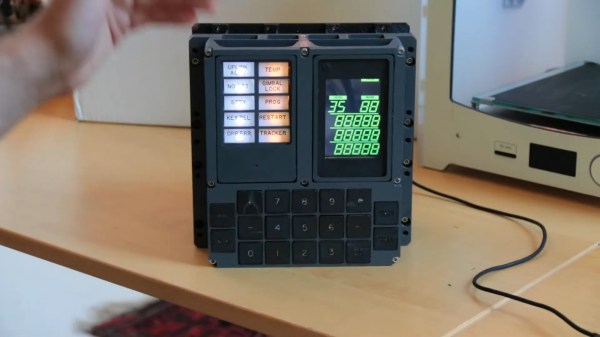
It’s hard to say what exactly it is about the Apollo DSKY that captures so many hackers’ imaginations. Whatever it is, the “Display and Keyboard” unit from the Apollo Guidance Computer has inspired dozens of teardowns, simulations, and reproductions over the years, to varying degrees of success. But this mechanically faithful DSKY replica really knocks it out of the park in terms of attention to detail.
The product of [M. daSilva], this DSKY replica takes a somewhat different path than many of the others we’ve seen. By working from as many original documents as possible, he was able to reproduce the physical size and shape of the DSKY very accurately — no mean feat when working from copies of copies of the original paper prints. Still, the details that are captured, like the gussets and reinforcements that were added to strengthen the original die-cast parts, really make this DSKY look the part. It’s functional, too, thanks to a Raspberry Pi running VirtualAGC, with a Nextion 4.3″ LCD display standing in for the original electroluminescent display. We were surprised to learn the DSKY had a port for nitrogen purging the case; check out the video tour below for that and other tidbits.
Of course, just because [M. daSilva] chose to concentrate on dimensional accuracy for this go-around doesn’t preclude more faithful electronics in the future. Perhaps he can team up with [Ben Krasnow] or [Fran Blanche] and really make this a showpiece.
We occasionally get stories on the tips line that just make us want to know more. This is especially true with tech stories covered by the mass media, which usually leave out the juicy tidbits that would just clutter up the story for the majority of non-technical readers. That leaves us to dig a little deeper for the satisfying details.
The latest one of these gems to hit the tips line is the tale of a regular broadband outage in a Welsh village. As in, really regular — at 7:00 AM every day, the internet customers of Aberhosan suffered a loss of their internet service. Customers of Openreach, the connectivity arm of the British telco BT, complained about the interruptions as customers do, and technicians responded to investigate the issue. Nobody was able to find the root cause, and despite replacing nearly all the cables in the system, the daily outages persisted for 18 months.
In the end, Openreach brought in a crack team from their Chief Engineer’s office to investigate. Working against COVID-19 restrictions, the team set up a spectrum analyzer in the early morning hours, to capture any evidence of whatever was causing the problem. At the appointed hour they saw a smear of radio frequency interference appear, a high-intensity pulse of noise at just the right frequency to interfere with the village’s asymmetric digital subscriber line (ADSL) broadband service.
A little sleuthing led to the home of a villager and a second-hand TV, which was switched on every day at 7:00 AM. The TV was found to be emitting a strong RF impulse when it was powered up, strong enough to knock out the ADSL service to the entire village. Openreach categorized this as SHINE, or single high-level impulse noise. We’d never heard of this, but apparently it’s common enough that BT warns customers about it and provides helpful instructions for locating sources with an AM radio.
We’ll say one thing for the good people of Aberhosan: they must be patient in the extreme to put up with daily internet outages for 18 months. And it’s funny how there was no apparent notice paid by the offending television’s owner that his or her steady habit caused the outage. Perhaps they don’t have a broadband connection, and so wouldn’t have noticed the borking.
In any case, the owner was reportedly “mortified” by the news and hasn’t turned the TV on since learning of the issue. This generally seems to be the reaction when someone gets caught inadvertently messing up the spectrum — remember the Great Ohio Key Fob Mystery?
Thanks to [Kieran Donnelly] for spotting this for us.
Most kids catch on to the fact that matter can exist in three states — solid, liquid, and gas — pretty early in life, usually after playing in the snow a few times. The ice and snowflakes, the wet socks, and the fog of water vapor in breath condensing back into water droplets all provide a quick and lasting lesson in not only the states of matter but the transitions between them. So it usually comes as some surprise later when they learn of another and perhaps more interesting state: plasma.
For the young scientist, plasma is not quite so easy to come by as the other phases of matter, coming about as it does from things they’re usually not allowed to muck with. High voltage discharges, strong electromagnetic fields, or simply a lot of heat can strip away electrons from a gas and make the ionized soup that we call plasma. But once they catch the bug, few things can compare to the dancing, frenetic energy of a good plasma discharge.
Jay Bowles picked up the plasma habit quite a while back and built his YouTube channel around it. Tesla coils, Van de Graaff generators, coils and capacitors of all types — whatever it takes to make a spark, Jay has probably made and used it to make the fourth state of matter. He’ll join us on the Hack Chat to talk about all the fun things to do with plasma, high-voltage discharge, and whatever else sparks his interest.
Click that speech bubble to the right, and you’ll be taken directly to the Hack Chat group on Hackaday.io. You don’t have to wait until Wednesday; join whenever you want and you can see what the community is talking about.
No matter what they’re flying, good pilots have a “feel” for their aircraft. They know instantly when something is wrong, whether by hearing a strange sound or a feeling a telltale vibration. Developing this sixth sense is sometimes critical to the goal of keeping the number of takeoff equal to the number of landings.
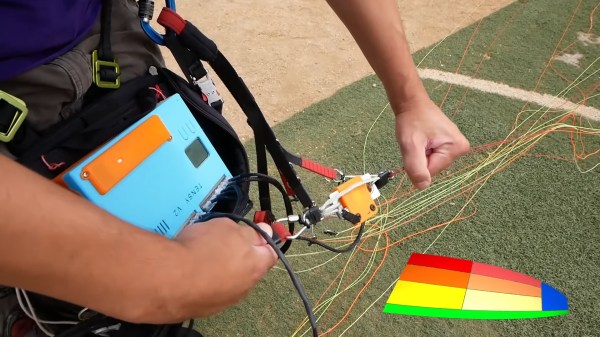
The same thing goes for non-traditional aircraft, like paragliders, where the penalty for failure is just as high. Staying out of trouble aloft is the idea behind this paraglider line tension monitor designed by pilot [Andre Bandarra]. Paragliders, along with their powered cousins paramotors, look somewhat like parachutes but are actually best described as an inflatable wing. The wing maintains its shape by being pressurized by air coming through openings in the leading edge. If the pilot doesn’t maintain the correct angle of attack, the wing can depressurize and collapse, with sometimes dire results.
Luckily, most pilots eventually develop a feel for collapse, sensed through changes in the tension of the lines connecting the wing to his or her harness. [Andre]’s “Tensy” — with the obligatory “McTenseface” surname — that’s featured in the video below uses an array of strain gauges to watch to the telltale release of tension in the lines for the leading edge of the wing, sounding an audible alarm. As a bonus, Tensy captures line tension data from across the wing, which can be used to monitor the performance of both the aircraft and the pilot.
There are a lot of great design elements here, but for our money, we found the lightweight homebrew strain gauges to be the real gem of this design. This isn’t the first time [Andre] has flown onto these pages, either — his giant RC paraglider was a big hit back in January.
The announcement of Autodesk’s changes to the Fusion 360 personal use license terms this week caused quite a dustup. Our article on the announcement garnered a lot of discussion and not a few heated comments. At the end of the day, though, Autodesk is going to do what it’s going to do, and the Fusion 360 user community is just going to have to figure out how to deal with the changes. One person who decided to do something other than complain is Justin Nesselrotte, who came up with a quick and easy bulk export tool for Fusion 360. This gets to the heart of the issue since the removal of export to STEP, IGES, and SAT files is perhaps the most painful change for our community. Justin’s script automatically opens every design and exports it to the file type of your choice. Since the license changes go into effect on October 1, you’d better get cracking if you want to export your designs.
Over on Twitter, Hackaday superfriend Timon gives us a valuable lesson in “you get what you pay for.” He found that a bunch of his header pin jumper cables weren’t even remotely assembled properly. The conductors of the jumper wire were only loosely inserted into the terminal’s crimp, where apparently no crimping pressure had been applied. The wires were just rattling around inside the crimp, rather than making sold contact. We’ve covered the art and science of crimping before, and it’s pretty safe to say that these jumpers are garbage. So if you’re seeing weird results with a circuit, you might want to take a good, close look at your jumpers. And as always, caveat emptor.
The GNU Radio Conference wrapped up this week, in virtual format as so many other conferences have been this year, and it generated a load of interesting talks. They’ve got each day’s proceedings over on their YouTube channel, so the videos are pretty long; luckily, each day’s stream is indexed on the playbar, so along with the full schedule you can quickly find the talks you’re interested in. One that caught our eye was a talk on the Radio Resilience Competition, a hardware challenge where participants compete head-to-head using SDRs to get signals through in an adversarial environment. It sounds like a fascinating challenge for the RF inclined. More details about registering for the competition can be had on the Radio Resilience website.
You know those recipe sites that give you a few choices on what to make for dinner based on the ingredients you have on hand? We always thought that was a clever idea, and now something like it has come to our world. It’s called DIY Hub, and it aims to guide makers toward projects they can build based on the parts they have on hand. Users create projects on the site, either hosting the project directly on the site or providing a link to projects on another site. Either way, the project’s BOM is cataloged so that users can find something to build based on parts stored in their “Garage”. Granted, most of us suffer from the exact opposite problem of not knowing what to build next, but this could be an interesting tool for stimulating the creative process, especially for teachers and parents. It’s currently in beta, and we’d love to see a few Hackaday.io projects added to the site.
And finally, we got a tip to an oldie but a goodie: How to Build a Castle. No, we don’t expect to see a rash of 13th-century castle builds gracing our pages anytime soon — although we certainly wouldn’t be opposed to the idea. Rather, this is a little something for your binge-watching pleasure. The BBC series, which was actually called Secrets of the Castle, was a five-part 2014 offering that went into great detail on the construction of Guédelon Castle, an experimental archaeology project in France that seeks to build a castle using only the materials and methods available in the 1200s. The series is hosted by historian Ruth Goodman and archaeologists Peter Ginn and Tom Pinfold, and it’s great fun for anyone interested in history and technology.
Change is inevitable, and a part of life. But we’re told that nobody likes change. So logically, it seems we’ve proved nobody likes life. QED.
That may be a reach, but judging by the reaction of the Fusion 360 community to the announced changes to the personal use license, they’re pretty much hating life right now. The clear message from Autodesk is that Fusion 360 — the widely used suite of CAD and CAM software — will still offer a free-to-use non-commercial license for design and manufacturing work, with the inclusion of a few very big “buts” that may be deal-breakers for some people. The changes include:
Project storage is limited to 10 active and editable documents
Exports are now limited to a small number of file types. Thankfully this still includes STL files but alas, DXF, DWG, PDF exports are all gone
Perhaps most importantly to the makerverse, STEP, SAT, and IGES file types can no longer be exported, the most common files for those who want to edit a design using different software.
2D drawings can now only be single sheet, and can only be printed or plotted
Rendering can now only be done locally, so leveraging cloud-based rendering is no longer possible
CAM support has been drastically cut back: no more multi-axis milling, probing, automatic tool changes, or rapid feeds, but support for 2, 2.5, and 3 axis remains
All support for simulation, generative design, and custom extensions has been removed
Most of these changes go into effect October 1, with the exception of the limit on active project files which goes into effect in January of 2021. We’d say that users of Fusion 360’s free personal use license would best be advised to export everything they might ever think they need design files for immediately — if you discover you need to export them in the future, you’ll need one of the other licenses to do so.
The problem with these personal use licenses is that it’s easy to get used to them and think of them as de facto open-source licenses; changing the terms then ends up leaving a bad taste in everyone’s mouth. To their credit, Autodesk is offering a steep discount on the commercial license right now, which might take some of the sting out of the changes.
Update 09-25-2020: Autodesk has announced that STEP file export will remain in the free version of Fusion 360