Raising The Titanic’s Radio Room

For some reason, of all the ships that have sailed the oceans, it’s the unlucky ones that capture our imagination. Few ships have been as unlucky as the RMS Titanic, sinking as she did on the night of April 15, 1912 after raking across an iceberg on her maiden voyage, and no ship has grabbed as much popular attention as she has.

During her brief life, Titanic was not only the most elegant ship afloat but also the most technologically advanced. She boasted the latest in propulsion and navigation technology and an innovation that had only recently available: a Marconi wireless room, used both for ship-to-shore and ship-to-ship communications.

The radio room of the Titanic landed on the ocean floor with the bow section of the great vessel. The 2.5-mile slow-motion free fall destroyed the structure of the room, but the gear survived relatively intact. And now, more than a century later, there’s an effort afoot to salvage that gear, with an eye toward perhaps restoring it to working condition. It’s a controversial plan, of course, but it is technologically intriguing, and it’s worth taking a look at what’s down there and why we should even bother after all these years.

Continue reading “Raising The Titanic’s Radio Room”

Train All The Things Contest Update

Back in January when we announced the Train All the Things contest, we weren’t sure what kind of entries we’d see. Machine learning is a huge and rapidly evolving field, after all, and the traditional barriers that computationally intensive processes face have been falling just as rapidly. Constraints are fading away, and we want you to explore this wild new world and show us what you come up with.

Where Do You Run Your Algorithms?

To give your effort a little structure, we’ve come up with four broad categories:

  • Machine Learning on the Edge
    • Edge computing, where systems reach out to cloud resources but run locally, is all the rage. It allows you to leverage the power of other people’s computers the cloud for training a model, which is then executed locally. Edge computing is a great way to keep your data local.
  • Machine Learning on the Gateway
    • Pi’s, old routers, what-have-yous – we’ve all got a bunch of devices laying around that bridge space between your local world and the cloud. What can you come up with that takes advantage of this unique computing environment?
  • Machine Learning in the Cloud
    • Forget about subtle — this category unleashes the power of the cloud for your application. Whether it’s Google, Azure, or AWS, show us what you can do with all that raw horsepower at your disposal.
  • Artificial Intelligence Blinky
    • Everyone’s “hardware ‘Hello, world'” is blinking an LED, and this is the machine learning version of that. We want you to use a simple microprocessor to run a machine learning algorithm. Amaze us with what you can make an Arduino do.

These Hackers Trained Their Projects, You Should Too!

We’re a little more than a month into the contest. We’ve seen some interesting entries bit of course we’re hungry for more! Here are a few that have caught our eye so far:

  • Intelligent Bat Detector – [Tegwyn☠Twmffat] has bats in his… backyard, so he built this Jetson Nano-powered device to capture their calls and classify them by species. It’s a fascinating adventure at the intersection of biology and machine learning.
  • Blackjack Robot – RAIN MAN 2.0 is [Evan Juras]’ cure for the casino adage of “The house always wins.” We wouldn’t try taking the Raspberry Pi card counter to Vegas, but it’s a great example of what YOLO can do.
  • AI-enabled Glasses – AI meets AR in ShAIdes, [Nick Bild]’s sunglasses equipped with a camera and Nano to provide a user interface to the world. Wave your hand over a lamp and it turns off. Brilliant!

You’ve got till noon Pacific time on April 7, 2020 to get your entry in, and four winners from each of the four categories will be awarded a $100 Tindie gift card, courtesy of our sponsor Digi-Key. It’s time to ramp up your machine learning efforts and get a project entered! We’d love to see more examples of straight cloud AI applications, and the AI blinky category remains wide open at this point. Get in there and give machine learning a try!

This DIY Dynamometer Shows Just What A Motor Can Do

Back in high school, all the serious gearheads used to brag about two things: their drag strip tickets, and their dynamometer reports. The former showed how fast their muscle car could cover a quarter-mile, while the latter was documentation on how much power their carefully crafted machine could deliver. What can I say; gas was cheap and we didn’t have the Internet to distract us.

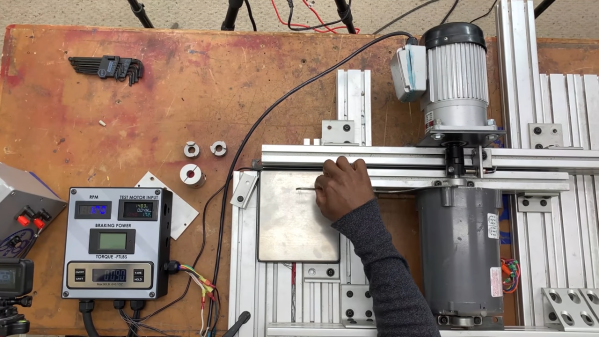
Bragging rights are not exactly what [Jeremy Fielding] has in mind for his DIY dynamometer, nor is getting the particulars on a big Detroit V8 engine. Rather, he wants to characterize small- to medium-sized electric motors, with an eye toward repurposing them for different projects. To do this, he built a simple jig to measure the two parameters needed to calculate the power output of a motor: speed and torque. A magnetic tachometer does the job of measuring the motor’s speed, but torque proved a bit more challenging. The motor under test is coupled to a separate electric braking motor, which spins free when it’s not powered. A lever arm of known length connects to the braking motor on one end while bearing on a digital scale on the other. With the motor under test spun up, the braking motor is gradually powered, which rotates its housing and produces a force on the scale through the lever arm. A little math is all it takes for the mystery motor to reveal its secrets.

[Jeremy]’s videos are always instructional, and the joy he obviously feels at discovery is infectious, so we’re surprised to see that we haven’t featured any of his stuff before. We’ve seen our share of dynos before, though, from the tiny to the computerized to the kind that sometimes blows up.

Continue reading “This DIY Dynamometer Shows Just What A Motor Can Do”

On-Demand Manufacturing Hack Chat

Join us on Wednesday, March 4 at noon Pacific for the On-Demand Manufacturing Hack Chat with Dan Emery!

The classical recipe for starting a manufacturing enterprise is pretty straightforward: get an idea, attract investors, hire works, buy machines, put it all in a factory, and profit. Things have been this way since the earliest days of the Industrial Revolution, and it’s a recipe that has largely given us the world we have today, for better and for worse.

One of the downsides of this model is the need for initial capital to buy the machines and build the factory. Not every idea will attract the kind of money needed to get off the ground, which means that a lot of good ideas never see the light of day. Luckily, though, we live in an age where manufacturing is no longer a monolithic process. You can literally design a product and have it tested, manufactured, and sold without ever taking one shipment of raw materials or buying a single machine other than the computer that makes this magic possible.

As co-founder of Ponoko, Dan Emery is in the thick of this manufacturing revolution. His company capitalizes on the need for laser cutting, whether it be for parts used in rapid prototyping or complete production runs of cut and engraved pieces. Their service is part of a wider ecosystem that covers almost every additive and subtractive manufacturing process, including 3D-printing, CNC machining, PCB manufacturing, and even final assembly and testing, providing new entrepreneur access to tools and processes that would have once required buckets of cash to acquire and put under one roof.

Join us as we sit down with Derek and discuss the current state of on-demand manufacturing and what the future holds for it. We’ll talk about Ponoko’s specific place in this ecosystem, and what role outsourced laser cutting could play in getting your widget to market. We’ll also take a look at how Ponoko got started and how it got where it is today, as well as anything else that comes up.

join-hack-chatOur Hack Chats are live community events in the Hackaday.io Hack Chat group messaging. This week we’ll be sitting down on Wednesday, March 4 at 12:00 PM Pacific time. If time zones have got you down, we have a handy time zone converter.

Click that speech bubble to the right, and you’ll be taken directly to the Hack Chat group on Hackaday.io. You don’t have to wait until Wednesday; join whenever you want and you can see what the community is talking about.


Hackaday Links Column Banner

Hackaday Links: March 1, 2020

Talk about buried treasure: archeologists in Germany have – literally – unearthed a pristine Soviet spy radio, buried for decades outside of Cologne. While searching for artifacts from a Roman empire settlement, the archeologists found a pit containing the Soviet R-394KM transceiver, built in 1987 and apparently buried shortly thereafter without ever being used. It was found close to a path in the woods and not far from several sites of interest to Cold War-era spies. Curiously, the controls on the radio are labeled not in Cyrillic characters, but in the Latin alphabet, suggesting the radio was to be used by a native German speaker. The area in which it was found is destined to be an open-cast lignite mine, which makes us think that other Cold War artifacts may have fallen victim to the gore-covered blades of Bagger 288.

Good news for Betelgeuse fans, bad news for aficionados of cataclysmic cosmic explosions: it looks like the red giant in Orion isn’t going to explode anytime soon. Betelgeuse has been dimming steadily and rapidly since October of 2019; as a variable star such behavior is expected, but the magnitude of its decline was seen by some astronomers as a sign that the star was reaching the point in its evolution where it would go supernova. Alas, Betelgeuse started to brighten again right on schedule, suggesting that the star is not quite ready to give up the ghost. We’d have loved to witness a star so bright it rivals the full moon, but given the times we live in, perhaps it’s best not to have such a harbinger of doom appear.

If you plan to be in the Seattle area as the winter turns to spring, you might want to check out the Vintage Computer Fair Pacific Northwest. We visited back during the show’s first year and had a good time, and the Living Computers: Museum + Labs, where the event is held, is not to be missed. The Museum of Flight is supposed to be excellent as well, and not far away.

Mozilla announced this week that Firefox would turn on DNS over HTTPS (DoH) by default in the United States. DoH encrypts the DNS requests that are needed to translate a domain name to an IP address, which normally travel in clear text and are therefore easily observed. Easily readable DNS transactions are also key to content blockers, which has raised the hackles of regulators and legislators over the plan, who are singing the usual “think of the children” song. That DoH would make user data collection and ad-tracking harder probably has nothing to do with their protests.

And finally, sad news from California as daredevil and amateur rocketeer “Mad” Mike Hughes has been killed in a crash of his homemade rocket. The steam-powered rocket was to be a follow-up to an earlier, mostly successful flight to about 1,900 feet (580 m), and supposed to reach about 5,000 feet (1.5 km) at apogee. But in an eerily similar repeat of the mishap that nearly killed Evel Knievel during his Snake River Canyon jump in 1974, Mike’s parachute deployed almost as soon as his rocket left the launch rails. The chute introduced considerable drag before being torn off the rocket by the exhaust plume. The rocket continued in a ballistic arc to a considerable altitude, but without a chute Mike’s fate was sealed. Search for the video at your own peril, as it’s pretty disturbing. We never appreciated Mike’s self-professed Flat Earth views, but we did like his style. We suppose, though, that such an ending was more likely than not.

Single Bolt Transformed Into A Work Of Art

Every once in a while, this job helps you to discover something new and completely fascinating that has little to do with hacking but is worth sharing nonetheless. Turning a single brass bolt into a beautiful Cupid’s bow is certainly one of those times.

Watching [Pablo Cimadevila] work in the video below is a real treat, on par with a Clickspring build for craftsmanship and production values. His goal is to use a largish brass bolt as the sole source of material for a charming little objet d’art, which he achieves mainly with the use of simple hand tools. The stave of the bow is cut from the flattened shank of the bolt with a jeweler’s saw, with the bolt head left as a display stand. The offcuts are melted down and drawn out into wire for both the bowstring and the shaft of the arrow, a process that’s fascinating in its own right. The heart-shaped arrowhead and the faces of the bolt head are bedazzled with rubies; the technique [Pablo] uses to create settings for the stones is worth the price of admission alone. The complete video below is well worth a watch, but if you don’t have the twelve minutes to spare, a condensed GIF is available.

[Pablo]’s artistry reminds us a bit of this not-quite-one-bolt combination lock. We love the constraint of sourcing all a project’s materials from a single object, and we really appreciate the craftsmanship that goes into builds like these.

Continue reading “Single Bolt Transformed Into A Work Of Art”

A Simple Yet Feature-Packed Programmable DC Load

If you’ve got the hankering to own a lab full of high-end gear but your budget is groaning in protest, rolling your own test equipment can be a great option. Not everything the complete shop needs is appropriate for a DIY version, of course, but a programmable DC load like this one is certainly within reach of most hackers.

This build comes to us courtesy of [Scott M. Baker], who does his usual top-notch job of documenting everything. There’s a longish video below that covers everything from design to testing, while the link above is a more succinct version of events. Either way, you’ll get treated to a good description of the design basics, which is essentially an op-amp controlling the gate of a MOSFET in proportion to the voltage across a current sense resistor. The final circuit adds bells and whistles, primarily in the form of triple MOSFETS and a small DAC to control the set-point. The DAC is driven by a Raspberry Pi, which also supports either an LCD or VFD display, an ADC for reading the voltage across the sense resistor, and a web interface for controlling the load remotely. [Scott]’s testing revealed a few problems, like a small discrepancy in the actual amperage reading caused by the offset voltage of the op-amp. The MOSFETs also got a bit toasty under a full load of 100 W; a larger heatsink allows him to push the load to 200 W without releasing the smoke.

We always enjoy [Dr. Baker]’s projects, particularly for the insight they provide on design decisions. Whether you want to upgrade the controller for a 40-year-old game console or giving a voice to an RC2014, you should check out his stuff.

Continue reading “A Simple Yet Feature-Packed Programmable DC Load”