Retrotechtacular: The Speaking Clock Goes Silent

It used to be that time was a lot more relative than it is today. With smartphones synced to GPS and network providers’ clocks, we all pretty much have access to an authoritative current time, giving few of us today the wiggle room to explain a tardy arrival at work to an impatient boss by saying our watch is running slow.

Even when that excuse was plausible, it was a bit weak, since almost every telephone system had some sort of time service. The correct time was but a phone call away, announced at first by live operators then later by machines called speaking clocks. Most of these services had been phased out long ago, but one, the speaking clock service in Australia, sounded for the last time at the end of September.

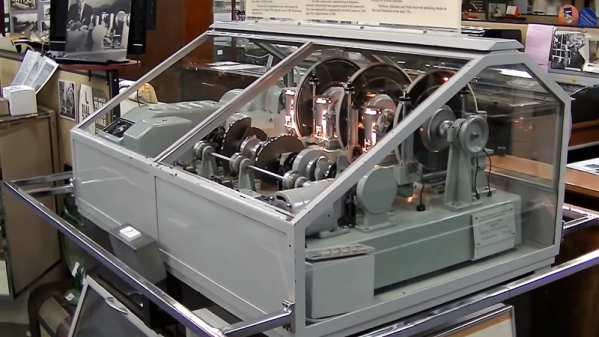
While the decommissioned machine was just another beige box living in a telco rack, the speaking clocks that preceded it were wonderfully complex electromechanical devices, and perfect fodder for a Retrotechtacular deep-dive. Here’s a look at the Australian speaking clock known as “George” and why speaking clocks were once the highest of technology.

Continue reading “Retrotechtacular: The Speaking Clock Goes Silent”

Simple Seismic Sensor Makes Earthquake Detection Personal

When an earthquake strikes, it’s usually hard to miss. At least that’s the case with the big ones; the dozens or hundreds of little quakes that go largely unnoticed every day are interesting too, and make sense to track. That’s usually left to the professionals, with racks of sensitive equipment and a far-flung network of seismic sensors. That doesn’t mean you can’t keep track of doings below your feet yourself, with something like this DIY seismograph.

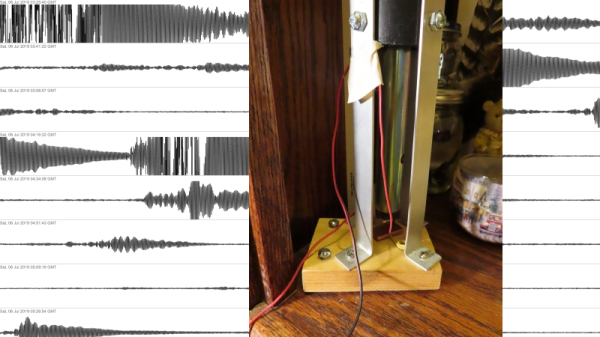
Technically, what [Alex] built is better called a “seismic detector” since it’s not calibrated in any way. It’s just a simple sensor for detecting ground vibrations, whether they be due to passing trucks or The Big One. [Alex] lives in California, wedged between the Hayward, Calaveras, and San Andreas faults in San Jose, so there is plenty of opportunity for testing his device. The business end is a simple pendulum sensor, with a heavy metal bob hanging from a long wire inside a length of plastic pipe. Positioned close to the bob is a copper plate; the bob and the plate form an air-dielectric variable capacitor that controls the frequency of a simple 555 oscillator. The frequency is measured by a PIC microcontroller and sent to a Raspberry Pi, which displays the data on a graph. You can check in on real-time seismic activity in San Jose using the link above, or check out historical quakes, like the 7.1 magnitude Ridgecrest quake in July. [Alex]’s sensor is sensitive enough to pick up recent quakes in Peru, Fiji, and Nevada, and he even has some examples of visualizing the Earth’s core using data from the sensor. How cool is that?

We’ve seen other seismic detectors before, like this piezo-based device, or even one made from toilet parts. We like the simplicity of the capacitive sensor [Alex] used, though.

SatNOGS Update Hack Chat

Join us on Wednesday, October 30 at noon Pacific for the SatNOGS Update Hack Chat with Pierros Papadeas and the SatNOGS team!

Ever since the early days of the Space Race, people have been fascinated with satellites. And rightly so; the artificial moons we’ve sent into orbit are engineering marvels, built to do a difficult job while withstanding an incredibly harsh environment. But while most people are content to just know that satellites are up there providing weather forecasts and digital television, some of us want a little more.

Enter SatNOGS. Since winning the very first Hackaday Prize in 2014, SatNOGS has grown into exactly what Pierros Papadeas and the rest of the team envisioned: a globe-spanning network of open-source satellite ground stations, feeding continuous observations into an open, accessible database. With extensive documentation and an active community, SatNOGS has helped hundreds of users build ground stations with steerable antennas and get them connected. The network tracks hundreds of Low-Earth Orbit (LEO) satellites each day, including increasingly popular low-cost Cubesats.

Join us as the SatNOGS crew stops by the Hack Chat to give us an update on their efforts over the last few years. We’ll discuss how winning the Hackaday Prize changed SatNOGS, how the constellation of satellites has changed and how SatNOGS is dealing with it, and what it takes to build a global network and the community that makes it work.

join-hack-chatOur Hack Chats are live community events in the Hackaday.io Hack Chat group messaging. This week we’ll be sitting down on Wednesday, October 30 at 12:00 PM Pacific time. If time zones have got you down, we have a handy time zone converter.

Click that speech bubble to the right, and you’ll be taken directly to the Hack Chat group on Hackaday.io. You don’t have to wait until Wednesday; join whenever you want and you can see what the community is talking about.

Hacking Mars: InSight Mole Is On The Move Again

Your job might be tough, but spare a thought for any of the engineers involved in the Mars InSight lander mission when they learned that one of the flagship instruments aboard the lander, indeed the very instrument for which the entire mission was named, appeared to be a dud. That’s a bad day at work by anyone’s standards, and it happened over the summer when it was reported that the Mars Interior Exploration using Seismic Investigations, Geodesy and Heat Transport lander’s Heat Flow and Physical Properties Package (HP³), commonly known as “The Mole”, was not drilling itself into the Martian regolith as planned.

But now, after months of brainstorming and painstaking testing on Earth and on Mars, it looks as if the mole is working again. NASA has announced that, with a little help from the lander’s backhoe bucket, the HP³ penetrator has dug itself 2 cm into the soil. It’s a far cry from the 5-meter planned depth for its heat-transfer experiments, but it’s progress, and the clever hack that got the probe that far might just go on to salvage a huge chunk of the science planned for the $828 million program.

Continue reading “Hacking Mars: InSight Mole Is On The Move Again”

World’s Smallest MIDI Synth, Now Even Better

We’re pretty sure there’s no internationally recognized arbiter of records like “World’s smallest full-featured polyphonic stereo MIDI synthesizer that fits in a DIN shell”. If there isn’t, there sure should be, and we’re pretty sure [mitxela]’s Flash-Synth would hold that particular record.

This is one of those lessons that some people just can’t leave a challenge alone. First [mitxela] built a MIDI synthesizer into a DIN connector, then a couple of months later he made a somewhat more streamlined version. While both were feats of engineering derring-do, neither was entirely satisfactory. With only square wave synthesis and a limit of eight voices, plus some unpleasant audio issues and a total lack of manufacturability, the next challenge was clear.

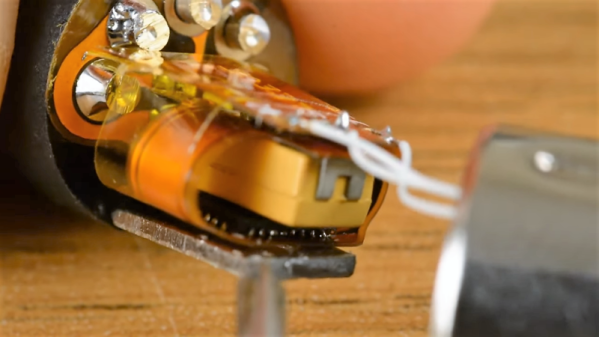
We won’t pretend to follow all the audio arcana, of which the video below and the build log have plenty, but the technical achievement is obvious enough. The Flash-Synth has an STM32, a tantalum SMD filter capacitor that dwarfs it, and a few support components on a flexible PCB that folds back on itself twice. This bit of circuit origami is connected to a 5-pin DIN plug and stuffed into the connector’s shell, which in turn mates to a custom-machined metal housing. A stereo audio jack lives at the other end of the assembly, and the whole synth is powered parasitically off the MIDI port.

The first half of the video below is mostly a demo that proves the synth sounds great and can do just about anything; skip to the 22-minute mark for the gory build details. Suffice it to say that [mitxela]’s past experience with ludicrous scale soldering served him well here.

Continue reading “World’s Smallest MIDI Synth, Now Even Better”

Hackaday Links Column Banner

Hackaday Links: October 27, 2019

A year ago, we wrote about the discovery of treasure trove of original documentation from the development of the MOS 6502 by Jennifer Holdt-Winograd, daughter of the late Terry Holdt, the original program manager on the project. Now, Ms. Winograd has created a website to celebrate the 6502 and the team that built it. There’s an excellent introductory video with a few faces you might recognize, nostalgia galore with period photographs that show the improbable styles of the time, and of course the complete collection of lab notes, memos, and even resumes of the team members. If there were a microchip hall of fame – and there is – the 6502 would be a first-round pick, and it’s great to see the history from this time so lovingly preserved.

Speaking of the 6502, did you ever wonder what the pin labeled SO was for? Sure, the data sheets all say pin 38 of the original 40-pin DIP was the “Set Overflow” pin, an active low that set the overflow bit in the Processor Status Register. But Rod Orgill, one of the original design engineers on the 6502, told a different story: that “SO” was the initials of his beloved dog Sam Orgill. The story may be apocryphal, but it’s a Good Doggo story, so we don’t care.

You may recall a story we ran not too long ago about the shortage of plutonium-238 to power the radioisotope thermoelectric generators (RTGs) for deep-space missions. The Cold War-era stockpiles of Pu-238 were running out, but Oak Ridge National Laboratory scientists and engineers came up with a way to improve production. Now there’s a video showing off the new automated process from the Periodic Videos series, hosted by the improbably coiffed Sir Martyn Poliakoff. It’s fascinating stuff, especially seeing workers separated from the plutonium by hot-cells with windows that are 4-1/2 feet (1.4 meters) thick.

Dave Murray, better known as YouTube’s “The 8-Bit Guy”, can neither confirm nor deny the degree to which he participated in the golden age of phone phreaking. But this video of his phreaking presentation at the Portland Retro Gaming Expo reveals a lot of suspiciously detailed knowledge about the topic. The talk starts at 4:15 or so and is a nice summary of blue boxes, DTMF hacks, war dialing, and all the ways we curious kids may or may not have kept our idle hands busy before the Interwebz came along.

Do you enjoy a puzzle? We sure do, and one was just laid before us by a tipster who prefers to stay anonymous, but for whom we can vouch as a solid member of the hacker community. So no malfeasance will befall you by checking out the first clue, a somewhat creepy found footage-esque video with freaky sound effects, whirling clocks, and a masked figure reading off strings of numbers in a synthesized voice. Apparently, these clues will let you into a companion website. We worked on it for a bit and have a few ideas about how to crack this code, but we don’t want to give anything away. Or more likely, mislead anyone.

And finally, if there’s a better way to celebrate the Spooky Season than to model predictions on how humanity would fare against a vampire uprising, we can’t think of one. Dominik Czernia developed the Vampire Apocalypse Calculator to help you decide when and if to panic in the face of an uprising of the undead metabolically ambiguous. It supports several models of vampiric transmission, taken from the canons of popular genres from literature, film, and television. The Stoker-King model makes it highly likely that vampires would replace humans in short order, while the Harris-Meyer-Kostova model of sexy, young vampires is humanity’s best bet except for having to live alongside sparkly, lovesick vampires. Sadly, the calculator is silent on the Whedon model, but you can set up your own parameters to model a world with Buffy-type slayers at your leisure. Or even model the universe of The Walking Dead to see if it’s plausible that humans are still alive 3599 days into the zombie outbreak.

Restoring A Rusty Rebar Cutter

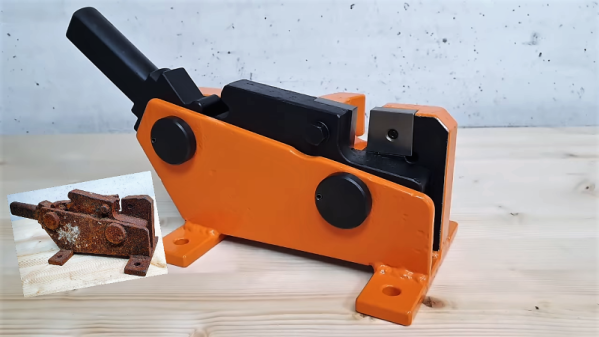
We’ve all probably come across hunks of junk that used to be tools, long-neglected and chemically welded into a useless mass of solid rust. Such items are available for a pittance at the local flea market, or more likely found in an old barn or rotting on a junk pile. They appear to be far beyond salvage, but with the proper application of elbow grease and penetrating lubricants, even a nasty old seized-up rebar cutter can live again.

We honestly almost passed up on the video below when it came across our feed. After all, a rebar cutter is a dead-simple device, and half the fun of restoration videos like those made by [my mechanics] is seeing all the parts removed, restored, and replaced. But it ended up being far more interesting than we expected, and far more challenging too.

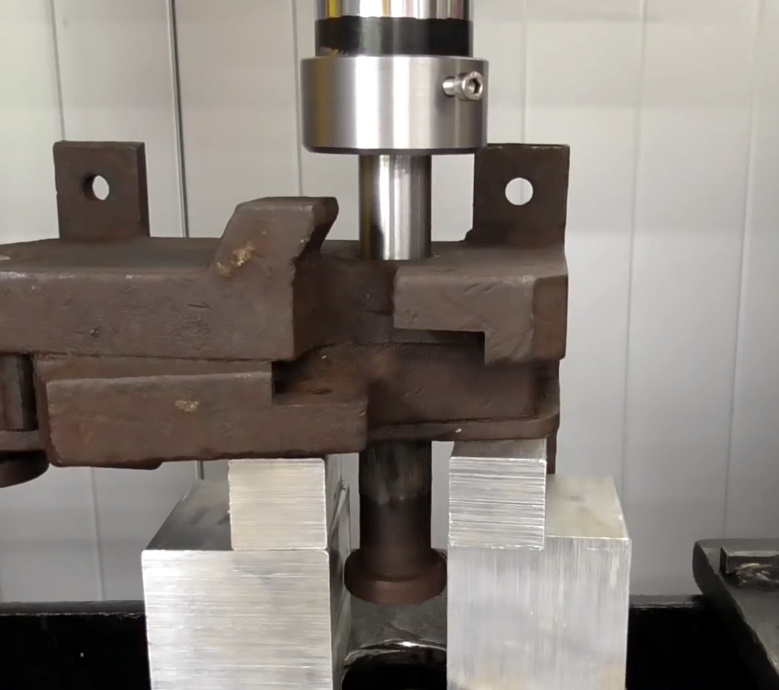
The cutter was missing its original handle and looked for all the world like it had been cast from a solid piece of iron oxide. [my mechanics] was able to get the main pivot bolts free with a combination of leverage, liberal application of penetrating oil, drilling, and the gentle persuasion of a hydraulic press.

These efforts proved destructive to both bolts, so new ones were made on the lathe, as were a number of other parts beyond saving. New cutters were fabricated from tool steel and a new handle was built; before anyone comments on anyone’s welding skills, please read [Jenny]’s recent article on the subject.

The finished product is strikingly dissimilar to the starting lump of oxidized junk, so there’s going to to be some debate in calling this a “restoration” in the classical sense. The end result of a [my mechanics] video is invariably a tool or piece of gear that looks far better than it did the day it was made, and any one of them would get a place of honor on our shelf. That said, he’d probably be swiftly shown the door if he worked at the Smithsonian.

Whatever you want to call these sort of videos, there are tons of them out there. We’ve featured a few examples of the genre, from the loving rehabilitation of classic Matchbox cars to rebuilding an antique saw set. They’re enough to make us start trolling garage sales. Or scrap yards.

Continue reading “Restoring A Rusty Rebar Cutter”