Snoopy Come Home: The Search For Apollo 10

When it comes to the quest for artifacts from the Space Race of the 1960s, few items are more sought after than flown hardware. Oh sure, there have been stories of small samples of the 382 kg of moon rocks and dust that were returned at the cost of something like $25 billion making it into the hands of private collectors, and chunks of the moon may be the ultimate collector’s item, but really, at the end of the day it’s just rock and dust. The serious space junkie wants hardware – the actual pieces of human engineering that helped bring an epic adventure to fruition, and the closer to the moon the artifact got, the more desirable it is.

Sadly, of the 3,000,000 kg launch weight of a Saturn V rocket, only the 5,600 kg command module ever returned to Earth intact. The rest was left along the way, mostly either burned up in the atmosphere or left on the surface of the Moon. While some of these artifacts are recoverable – Jeff Bezos himself devoted a portion of his sizable fortune to salvage one of the 65 F1 engines that were deposited into the Atlantic ocean – those left on the Moon are, for now, unrecoverable, and in most cases they are twisted heaps of wreckage that was intentionally crashed into the lunar surface.

But at least one artifact escaped this ignominious fate, silently orbiting the sun for the last 50 years. This lonely outpost of the space program, the ascent stage from the Apollo 10 Lunar Module, appears to have been located by a team of amateur astronomers, and if indeed the spacecraft, dubbed “Snoopy” by its crew, is still out there, it raises the intriguing possibility of scoring the ultimate Apollo artifact by recovering it and bringing it back home.

Continue reading “Snoopy Come Home: The Search For Apollo 10”
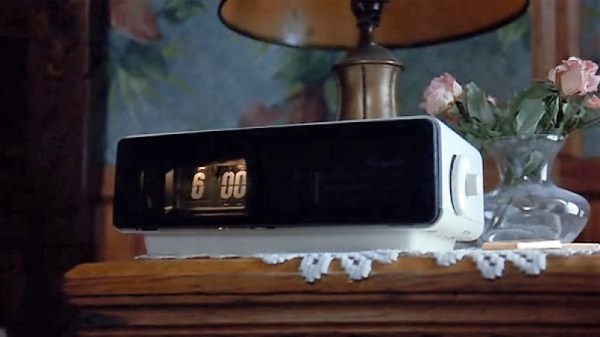
Split Flap Clock Keeps Time Thanks To Custom Frequency Converter

Why would anyone put as much effort into resurrecting a 1970s split-flap clock as [mitxela] did when he built this custom PLL frequency converter? We’re not sure, but we do like the results.

The clock is a recreation of the prop from the classic 1993 film, Groundhog Day, rigged to play nothing but “I Got You Babe” using the usual sound boards and such. But the interesting part was getting the clock mechanism keeping decent time. Sourced from the US, the clock wanted 120 VAC at 60 Hz rather than the 240 VAC, 50 Hz UK standard. The voltage difference could be easily handled, but the frequency mismatch left the clock running unacceptably slow.

That’s when [mitxela] went all in and designed a custom circuit to convert the 50 Hz mains to 60 Hz. What’s more, he decided to lock his synthesized waveform to the supply current, to take advantage of the long-term frequency control power producers are known for. The write-up goes into great detail about the design of the phase-locked loop (PLL), which uses an ATtiny85 to monitor the rising edge of the mains supply and generate the PWM signal that results in six cycles out for every five cycles in. The result is that the clock keeps decent time now, and he learned a little something too.

If the name [mitxela] seems familiar, it’s probably because we’ve featured many of his awesome builds before. From ludicrous-scale soldering to a thermal printer Polaroid to a Morse-to-USB keyboard, he’s always got something cool going on.

Grate Design On This Cutting Edge Raspberry Pi Case

Love ’em or hate ’em, you’ve got to hand it to Apple: they really know how to push people’s buttons with design. Their industrial designers can make a product so irresistible – and their marketing team can cannonball the hype train sufficiently – that people will stand in line for days to buy a new product, and shell out unfathomable amounts of money for the privilege.

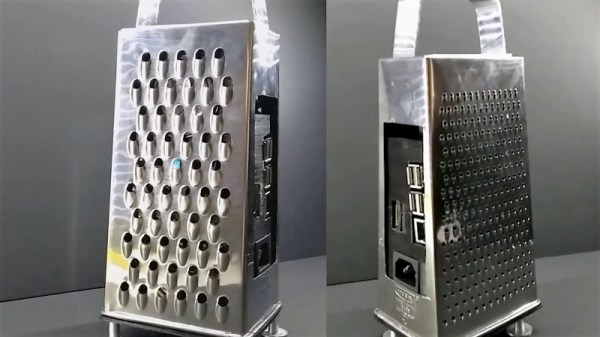
But what if you’re a poor college student without the budget for such treasures of industrial design? Simple – you take matters into your own hands and stuff a Raspberry Pi into a cheese grater. That’s what a group of engineering students from the University of Aveiro in Portugal called [NeRD-AETTUA] did, in obvious homage to the world’s most expensive cheese grater. The video below for the aptly named RasPro is somewhat less slick that Apple’s promos for the Mac Pro, but it still gets the basics across. Like the painstakingly machined brushed aluminum housing on the Mac, the IKEA cheese grater on the RasPro is just a skin. It covers a 3D-printed chassis that houses a beefy power supply and fan to go along with the Raspberry Pi 3. There’s also a speaker for blasting the tunes, which seems to be the primary use for the RasPro.

All things considered, the cheese grater design isn’t really that bad a form factor for a Pi case. If that doesn’t appeal, though, take your pick: laser-cut plywood, an Altoids tin, or even inside your PC.

Continue reading “Grate Design On This Cutting Edge Raspberry Pi Case”

Automated Dice Tester Uses Machine Vision To Ensure A Fair Game

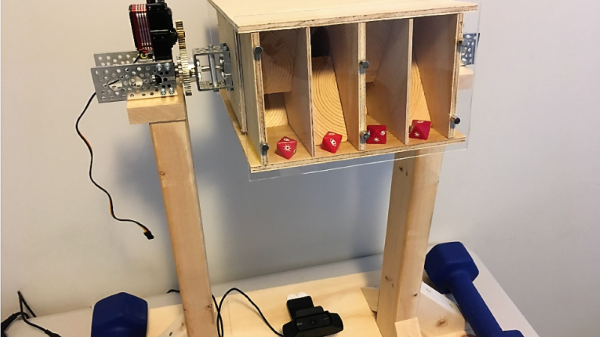
People take their tabletop games very, very seriously. [Andrew Lauritzen], though, has gone far above and beyond in pursuit of a fair game. The game in question is Star War: X-Wing, a strategy wargame where miniature pieces are moved according to rolls of the dice. [Andrew] suspected that commercially available dice were skewing the game, and the automated machine-vision dice tester shown in the video after the break was the result.

The rig is a very clever design that maximizes the data set with as little motion as possible. The test chamber is a box with clear ends that can be flipped end-for-end by a motor; walls separate the chamber into four channels to test multiple dice on each throw, and baffles within the channels assure randomization. A webcam is positioned below the chamber to take a snapshot of each “throw”, which is then analyzed in OpenCV. This scheme has the unfortunate effect of looking at the dice from the table’s perspective, but [Andrew] dealt with that in true hacker fashion: he ignored it since it didn’t impact the statistics he was interested in.

And speaking of statistics, he generated a LOT of them. The 62-page report of results from his study is an impressive piece of work, which basically concludes that the dice aren’t fair due to manufacturing variability, and that players could use this fact to cheat. He recommends pooled sets of dice to eliminate advantages during competitive play. 

This isn’t the first automated dice roller we’ve seen around these parts. There was the tweeting dice-bot, the Dice-O-Matic, and all manner of electronic dice throwers. This one goes the extra mile to keep things fair, and we appreciate that.

Continue reading “Automated Dice Tester Uses Machine Vision To Ensure A Fair Game”

Hams Gone Wild: Amateur Radio Field Day 2019

Of all the images that amateur radio conjures up, the great outdoors doesn’t usually figure heavily. People seem to think hams sit in a dark room at a desk heavy with radio gear, banging out Morse code into late into the night and heedless of the world outside the window. All of which sort of sounds like hard-core gaming, really.

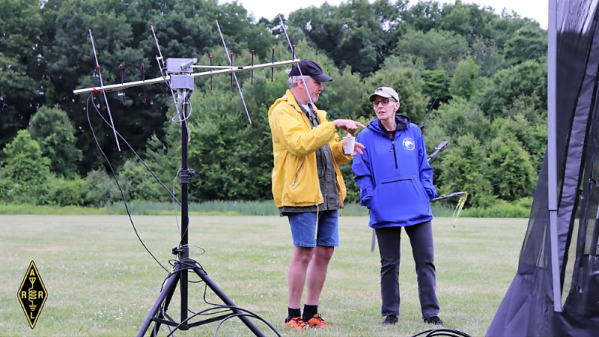
And while that image certainly applies in a lot of cases, hams do like to get out and about at least once a year. That day is upon us with the 2019 Amateur Radio Field Day. Hams across North America reserve the fourth full weekend of each June to tear themselves out of their shacks and get into the world to set up operations in some kind of public venue, generally a park or other green space. Part cookout, part community outreach, and part slumber party – it lasts all weekend and goes around the clock – hams use field day as a chance to show the general public where amateur radio really shines: real-time worldwide communications under austere conditions.

It’s also a chance to get folks excited about getting their license, with many Field Day locations hosting “Get on the Air” stations so that unlicensed folks can try making a contact under the supervision of a licensed operator. Licensed but underequipped hams also get the chance to spin the knobs on someone else’s gear, and maybe line up that first rig purchase. And there are plenty of opportunities to learn about new modes as well, such as FT8 and WSPR. As an example your scribe is looking for some guidance on getting started with APRS, the automated packet reporting system that’s used for things like high-altitude balloon tracking.

If you have any interest at all in learning how to properly operate radio equipment, you owe it to yourself to track down the nearest Field Day location and stop by. The American Radio Relay League (ARRL) has a ton of Field Day information, from a map to locate the 1500 Field Day sites to rules for the contests that will be run that weekend to guides for setting up and operating an effective Field Day setup. There will be 40,000 hams out there this year, and they’d all be thrilled if you drop by and ask a few questions.

Continue reading “Hams Gone Wild: Amateur Radio Field Day 2019”

These Projects Bent Over Backward To Win The Flexible PCB Contest

Back in March, the call went out: take your wiggliest, floppiest, most dimensionally compliant idea, and show us how it would be better if only you could design it around a flexible PCB. We weren’t even looking for a prototype; all we needed was an idea with perhaps a sketch, even one jotted on the legendary envelope or cocktail napkin.

When we remove constraints like that, it’s interesting to see how people respond. We have to say that the breadth of applications for flex PCBs and the creativity shown in designing them into projects was incredible. We saw everything from circuit sculpture to wearables. Some were strictly utilitarian and others were far more creative. In the end we got 70 entries, and with 60 prizes to be awarded, the odds were ever in your favor.

Now that the entries have been evaluated and the winners decided, it’s time to look over the ways you came up with to put a flexible PCB to work. Normally we list all the winners in our contest wrap-ups, but with so many winners we can’t feature everyone. We’ll just call out a few of the real standout projects here, but you really should check the list of winning projects to see the full range of what this call for flexibility brought out in our community.

Continue reading “These Projects Bent Over Backward To Win The Flexible PCB Contest”

EasyEDA Hack Chat With Dillon He

Join us Wednesday at 5:00 PM Pacific time for the Easy EDA Hack Chat with Dillon He!

Note the different time than our usual Hack Chat slot! Dillon will be joining us from China.

Since the birth of electronic design automation in the 1980s, the universe of products to choose from has grown tremendously. Features from schematic editing to circuit simulation to PCB design and autorouting can be found in every permutation imaginable, and you’re sure to find something that fits your needs, suits your budget, and works on your platform.

Dillon He started EasyEDA back in 2010 with Eric Cui, and since then the cloud-based EDA tool has become a popular choice. From working across teams to its “run anywhere” capabilities, EasyEDA has become the go-to tool for hundred of thousands of designers. Dillon will drop by the Hack Chat to answer all your questions about EasyEDA — how it started, where it is now, and what we can expect in the future.

join-hack-chatOur Hack Chats are live community events in the Hackaday.io Hack Chat group messaging. This week we’ll be sitting down on Wednesday, June 19 at 5:00 PM Pacific time. If time zones have got you down, we have a handy time zone converter.

Click that speech bubble to the right, and you’ll be taken directly to the Hack Chat group on Hackaday.io. You don’t have to wait until Wednesday; join whenever you want and you can see what the community is talking about.