X-Rays Are The Next Frontier In Space Communications

Hundreds of years from now, the story of humanity’s inevitable spread across the solar system will be a collection of engineering problems solved, some probably in heroic fashion. We’ve already tackled a lot of these problems in our first furtive steps into the wider galaxy. Our engineering solutions have taken humans to the Moon and back, but that’s as far as we’ve been able to send our fragile and precious selves.

While we figure out how to solve the problems keeping us trapped in the Earth-Moon system, we’ve sent fleets of robotic emissaries to do our exploration by proxy, to make the observations we need to frame the next set of engineering problems to be solved. But as we reach further out into the solar system and beyond, our exploration capabilities are increasingly suffering from communications bottlenecks that restrict how much data we can ship back to Earth.

We need to find a way to send vast amounts of data back as quickly as possible using as few resources as possible on both ends of the communications link. Doing so may mean turning away from traditional radio communications and going way, way up the dial and developing practical means for communicating with X-rays.

Continue reading “X-Rays Are The Next Frontier In Space Communications”

Marketing And Selling Hardware Hack Chat

Join us Wednesday at noon Pacific time for the Marketing and Selling Hardware Hack Chat with Shawn Hymel!

It may not be every hardware hacker’s dream, but a fair number of us harbor fantasies of thinking up the Next Big Thing and kissing the day job goodbye forever. It’s an understandable dream and a laudable goal, but as they say, a goal is a dream with a plan and a deadline. What’s your plan for turning your project into a marketable product? Chances are good you don’t have one, and if you ever expect to get to your goal you’re going to need one.

Shawn Hymel is an engineer who led several marketing campaigns for Spark Fun and recently shared his thoughts on marketing with attendees of the first-ever KiCon conference in Chicago. He’ll be dropping by the Hack Chat to talk about everything you ever wanted to know about marketing your hardware projects but were afraid to ask.

join-hack-chat

Our Hack Chats are live community events in the Hackaday.io Hack Chat group messaging. This week we’ll be sitting down on Wednesday, May 8 at noon Pacific time. If time zones have got you down, we have a handy time zone converter.

Click that speech bubble to the right, and you’ll be taken directly to the Hack Chat group on Hackaday.io. You don’t have to wait until Wednesday; join whenever you want and you can see what the community is talking about.

3D Printed Parts Let You Hold Work The Way You Want

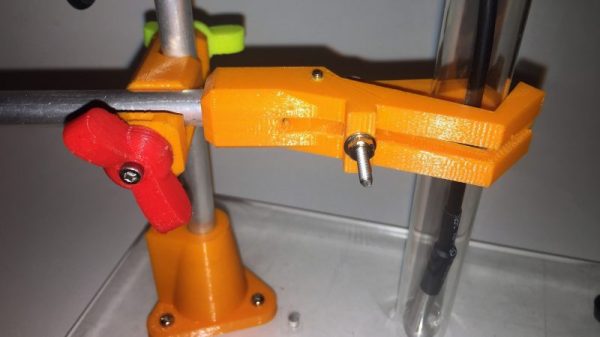
Fixturing and work holding can be huge problems for hackers. Let’s face it – that $5, alligator clip-festooned “Helping Hand” is good for only the smallest of workpieces, and the problem only gets worse as the size scales up. One can jury rig fixtures for things like microscopes and lights, but a systematic approach like this 3D-Printed work fixturing Erector Set really appeals to our need for organization.

As [Tinkers Projects] explains it, the genesis of this project came from a need to mount a microscope firmly over a PCB. Rather than build a one-off fixture, the idea of a complete system of clamps and connectors seemed to make more sense. Based on 10-mm aluminum rods and a bewildering number of 3D-printed pieces, the set has just about everything needed to fixture pretty much anything. There’s a vertical element that acts as the central support, connectors for putting another rod perpendicular to that, plus neat attachments like a three-fingered clamp for small cylindrical objects and a couple of blocks that act like a stick-vise for PCBs and similar workpieces. And yes, there’s even a fixture with alligator clips. The whole thing seems very well thought out and has a little mad scientist vibe to it, but while some fixtures look as if they came right from the chemistry lab, we’d be cautious about chemical compatibility and use near heat sources.

[Elliot Williams] did a rundown of what people are using for helping hands a couple of years ago which made us covet articulating dial indicator arms for our bench. Still, [Tinkers Projects]’ approach has a lot of appeal and is probably cheaper and more versatile to boot.

Vintage Terminal Converted For Galactic Use In Time For May The Fourth

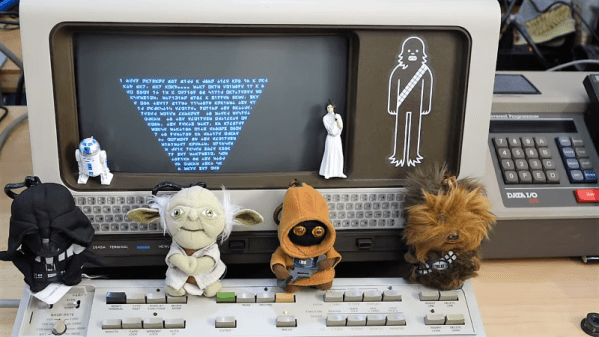
“Not as clumsy or random as Windows. An elegant terminal, for a more civilized age.” [Ben Kenobi] might well have said that about the Hewlett-Packard 264x-series of serial terminals, in use starting at just about the time the original installment of the Star Wars franchise was released.  With their wide-screen CRTs and toaster-oven aesthetic, they were oddballs in the terminal market, and [CuriousMarc] has gone and made one even odder by converting an H-P 2645A to display the Aurebesh character set from the movies.

A look under the hood of this lovely bit of retrocomputing history makes one think the designers almost foresaw the need to add support for a made-up language nearly half a century later. The terminal has a backplane and bus for pluggable cards, one of which carries the ROMs that [Marc] extracted and reprogrammed with the Aurebesh characters. He had a little trouble at first, needing to bodge the chip select and forgetting that he had made other “special modifications” to the terminal. The video below shows the results, along with some fatherly mortification of his daughters and a suitable tribute to the lately late [Peter Mayhew], he who donned the Wookiee suit and made a seven-foot space Sasquatch lovable.

Need more for you “May the Fourth” fix? How about a clumsy and random blaster, a cosplay speeder bike, or a fleet of droids?

Continue reading “Vintage Terminal Converted For Galactic Use In Time For May The Fourth”

Auto-Trickler Gently Doles Out Powder To Assist Reloading

Do you even trickle?

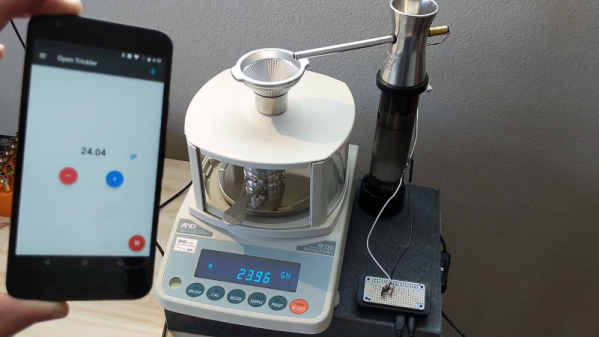
[Eric] does, and like everything else about reloading, trickling is serious business. Getting an exact charge of powder to add to a cartridge is not a simple task, and very tedious when done manually. This smartphone-controlled auto-trickler is intended to make the job easier, safer, and more precise.

Reloading ammunition is a great way for shooters to save money and recycle the brass casings that pile up at the end of a long day at the range. It can be a fairly simple process of cleaning the casings, replacing the spent primers, adding the correct powder charge, and seating a new bullet. It’s all pretty straightforward, but the devil is in the details, especially with the powder charge. A little too much can be a big problem, so tricklers were invented to allow the reloader to sneak up on the proper charge. [Eric]’s auto-trickler interfaces to a digital powder scale and uses a standard cell phone vibration motor to gently coax single kernels of powder from a hopper until the proper charge has accumulated. It’s easier to understand by watching the video below.

The hardware behind the trickler is pretty standard — just a Raspberry Pi Zero to talk to the smartphone UI via Bluetooth, and to monitor and control the scale via USB. [Eric] has made all the code open source so that anyone can build their own auto-trickler, which we applaud; he did the same thing with his rifle-mounted accelerometer. This project might have applications far beyond reloading where precision dispensing is required.

Continue reading “Auto-Trickler Gently Doles Out Powder To Assist Reloading”

Camera Sees Electromagnetic Interference Using An SDR And Machine Vision

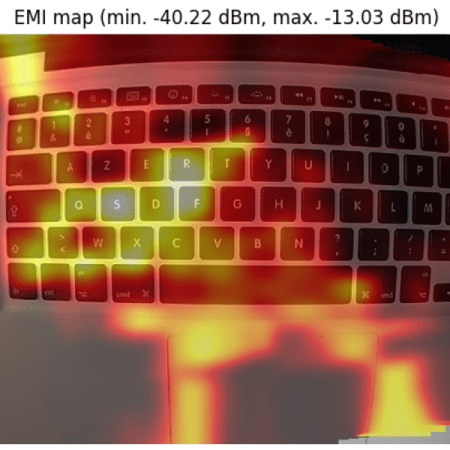
It’s one thing to know that your device is leaking electromagnetic interference (EMI), but if you really want to solve the problem, it might be helpful to know where the emissions are coming from. This heat-mapping EMI probe will answer that question, with style. It uses a webcam to record an EMI probe and the overlay a heat map of the interference on the image itself.

Regular readers will note that the hardware end of [Charles Grassin]’s EMI mapper bears a strong resemblance to the EMC probe made from semi-rigid coax we featured recently. Built as a cheap DIY substitute for an expensive off-the-shelf probe set for electromagnetic testing, the probe was super simple: just a semi-rigid coax jumper with one SMA plug lopped off and the raw end looped back and soldered. Connected to an SDR dongle, the probe proved useful for tracking down noisy circuits.

[Charles]’ project takes that a step further by adding a camera that looks down upon the device under test. OpenCV is used to track the probe, which is moved over the DUT manually with the help of an augmented reality display that helps track coverage, with a Python script recording its position and the RF power measurements. The video below shows the capture process and what the data looks like when reassembled as an overlay on top of the device.

Even if EMC testing isn’t your thing, this one seems like a lot of fun for the curious. [Charles] has kindly made the sources available on GitHub, so this is a great project to just knock out quickly and start mapping.

Continue reading “Camera Sees Electromagnetic Interference Using An SDR And Machine Vision”

AI At The Edge Hack Chat

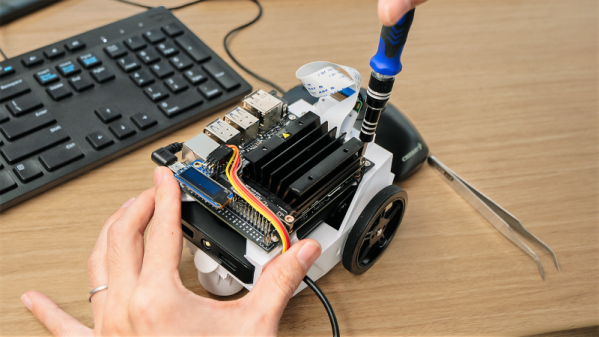
Join us Wednesday at noon Pacific time for the AI at the Edge Hack Chat with John Welsh from NVIDIA!

Machine learning was once the business of big iron like IBM’s Watson or the nearly limitless computing power of the cloud. But the power in AI is moving away from data centers to the edge, where IoT devices are doing things once unheard of. Embedded systems capable of running modern AI workloads are now cheap enough for almost any hacker to afford, opening the door to applications and capabilities that were once only science fiction dreams.

John Welsh is a Developer Technology Engineer with NVIDIA, a leading company in the Edge computing space. He’ll be dropping by the Hack Chat to discuss NVIDIA’s Edge offerings, like the Jetson Nano we recently reviewed. Join us as we discuss NVIDIA’s complete Jetson embedded AI product line up, getting started with Edge AI, and where Edge AI is headed.

join-hack-chat

Our Hack Chats are live community events in the Hackaday.io Hack Chat group messaging. This week we’ll be sitting down on Wednesday, May 1 at noon Pacific time. If time zones have got you down, we have a handy time zone converter.

Click that speech bubble to the right, and you’ll be taken directly to the Hack Chat group on Hackaday.io. You don’t have to wait until Wednesday; join whenever you want and you can see what the community is talking about.