Omni Wheels Move This CNC Plotter

We’ve always had a soft spot for omni wheels and the bots that move around somewhat bumpily on them. Likewise, CNC pen plotters are always a welcome sight in our tip line. But a CNC plotter using omni wheels is new, and the results are surprisingly good.

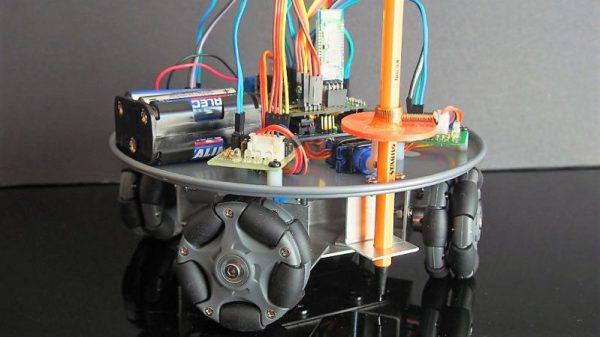
Built from the bottom of a spring-form baking pan, [lingib]’s plotter is simplicity itself. Four steppers turn the omni wheels while a hobby servo raises and lowers the pen. The controller is an Uno with a Bluetooth module for smartphone control. Translating wheel rotations into X- and Y-axis motions was not exactly trivial, and the video below shows the results. Lines are a bit wobbly, and it’s clear that the plotter isn’t hitting the coordinates very precisely. But given the somewhat compliant nature of the omni wheels, we’re surprised [lingib] got results as good as these, and we applaud the effort.

[lingib] reports the most expensive part of this $100 build was the omni wheels themselves. We suppose laser-cut MDF omni wheels could reduce the price, or even Mecanum wheels from bent metal and wood. We’re not sure either will help with the precision, though.


Continue reading “Omni Wheels Move This CNC Plotter”

Painting With Light And A Little G-Code

Most photographs are made in the fraction of a second that the camera’s shutter is gathering reflected light from the scene. But there’s fun to be had by leaving the shutter open and directing light into the camera. Called light painting, it can be as simple as a camera on a tripod in a dark room and a penlight spelling out dirty words – not like we’d know – or as complicated as this CNC dot-matrix light printer.

The first idea that [Jeremy S. Cook] had for this build didn’t go so well. He fitted an LED to the gantry of his 3D-printer, intending to send it G-code representing bitmaps. The idea would be to set it up in a dark place, open the shutter, and let the machine build up the image by rastering through the X- and Y- axes while blinking the LED on and off at the right time. But since the gantry only moves in one axis, he abandoned the printer in favor of his CNC router. He printed a collar to fit the dust collector shroud we previously featured, added a battery-powered LED, and affixed a pushbutton switch to the let the Z-axis turn on the light. It took some tweaking such as adding a translucent PLA diffuser, to get decent images, but in the end it worked. We like the soft look of the floating voxels, which were really helped by the later addition of a Nano and a Neopixel. Check out the build in the video below.

One thing we’d suggest is better reflection control. [Jeremy] used a black platen as a background, but it wasn’t quite enough. We suggest going none more black next time.

Continue reading “Painting With Light And A Little G-Code”

Learning Through Play Hack Chat With Greg Zumwalt

Join us Wednesday at noon Pacific time for the Learning Through Play Hack Chat!

You may think you’ve never heard of Greg Zumwalt, but if you’ve spent any time on Instructables or Thingiverse, chances are pretty good you’ve seen some of his work. After a long career that ranged from avionics design and programming to video game development, Greg retired and found himself with the time to pursue pet projects that had always been on the back burner, including his intricate 3D-printed automata. His motto is “I fail when I decide to stop learning,” and from the number of projects he turns out and the different methods he incorporates, he has no intention of failing.

Please join us for this Hack Chat, where we’ll discuss:

  • Lifelong learning through play;
  • Toy-building as a means to skillset growth;
  • Sources of inspiration and getting new ideas; and
  • What sorts of projects Greg has in the pipeline.

You are, of course, encouraged to add your own questions to the discussion. You can do that by leaving a comment on the Learning Through Play Hack Chat and we’ll put that in the queue for the Hack Chat discussion.

join-hack-chatOur Hack Chats are live community events on the Hackaday.io Hack Chat group messaging. This week we’ll be sitting down on Wednesday, March 13, at noon, Pacific time. If time zones have got you down, we have a handy time zone converter.

Click that speech bubble to the right, and you’ll be taken directly to the Hack Chat group on Hackaday.io. You don’t have to wait until Wednesday; join whenever you want and you can see what the community is talking about.

Engineering For The Long Haul, The NASA Way

The popular press was recently abuzz with sad news from the planet Mars: Opportunity, the little rover that could, could do no more. It took an astonishing 15 years for it to give up the ghost, and it took a planet-wide dust storm that blotted out the sun and plunged the rover into apocalyptically dark and cold conditions to finally kill the machine. It lived 37 times longer than its 90-sol design life, producing mountains of data that will take another 15 years or more to fully digest.

Entire careers were unexpectedly built around Opportunity – officially but bloodlessly dubbed “Mars Exploration Rover-B”, or MER-B – as it stubbornly extended its mission and overcame obstacles both figurative and literal. But “Oppy” is far from the only long-duration success that NASA can boast about. Now that Opportunity has sent its last data, it seems only fitting to celebrate the achievement with a look at exactly how machines and missions can survive and thrive so long in the harshest possible conditions.

Continue reading “Engineering For The Long Haul, The NASA Way”

A No-Cost, Heavy Metal Lathe From Junkyard Parts

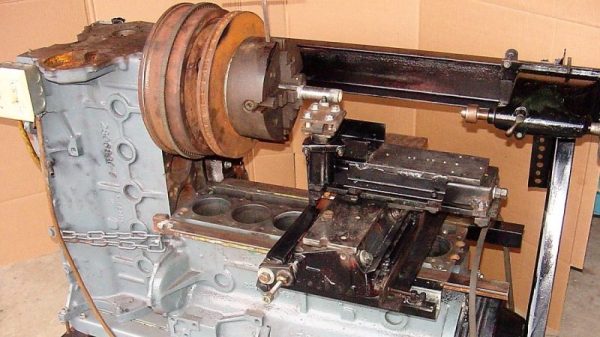
We have to admit that our first thought on seeing a Frankenlathe made from old engine blocks was that it was a set piece from a movie like The Road Warrior. And when you think about it, the ability to cobble together such a machine tool would probably make you pretty handy to have around in an apocalypse.

Sadly, surviving the zombie mutant biker uprising seemed not to be the incentive for [Paul Kuphaldt]’s version of the [Pat Delany] “Multimachine”. He seemed to be in it for the money, or more precisely from the lack of it. He was shooting for a zero-dollar build, and although he doesn’t state how close he came, we’re going to guess it was pretty close. The trick is to find big castings for the bed and headstock – Mopar slant 6 blocks in this case. The blocks are already precision machined dead flat and square, and the cylinder bores provide ample opportunities for stitching the castings together. The drivetrain comes from a 3-speed manual transmission, a 3/4-ton Chevy truck axle donated the spindle, and a V8 cylinder head was used for the cross slide. The tailstock seems to be the only non-automotive part on the machine.

We’d love to see a video of it in action, but there are ample pictures on [Paul]’s website to suggest that the heavy castings really make a difference in keeping vibration down. Don’t get us wrong – we love cast aluminum Gingery lathes too. But there’s something substantial about this build that makes us feel like a trip to the boneyard.

[via r/homemadetools]

The $50 Ham: Getting Your Ticket Punched

Today we start a new series dedicated to amateur radio for cheapskates. Ham radio has a reputation as a “rich old guy” hobby, a reputation that it probably deserves to some degree. Pick up a glossy catalog from DX Engineering or cruise their website, and you’ll see that getting into the latest and greatest gear is not an exercise for the financially challenged. And thus the image persists of the recent retiree, long past the expense and time required to raise a family and suddenly with time on his hands, gleefully adding just one more piece of expensive gear to an already well-appointed ham shack to “chew the rag” with his “OMs”.

Not a $50 ham. W9EVT’s shack. Source: QRZ.com

As I pointed out a few years back in “My Beef With Ham Radio”, I’m an inactive ham. My main reason for not practicing is that I’m not a fan of talking to strangers, but there’s a financial component to my reticence as well – it’s hard to spend a lot of money on gear when you don’t have a lot to talk about. I suspect that there are a lot of would-be hams out there who are turned off from the hobby by its perceived expense, and perhaps a few like me who are on the mic-shy side.

This series is aimed at dispelling the myth that one needs buckets of money to be a ham, and that jawboning is the only thing one does on the air. Each installment will feature a project that will move you further along your ham journey that can be completed for no more than $50 or so. Wherever possible, I’ll be building the project or testing the activity myself so I can pursue my own goal of actually using my license for a change.

Continue reading “The $50 Ham: Getting Your Ticket Punched”

Fun With A Hydrogen Thyratron

There’s something oddly menacing about some vacuum tubes. The glass, the glowing filaments, the strange metal grids and wires suspended within – all those lead to a mysterious sci-fi look and the feeling that strange things are happening in there.

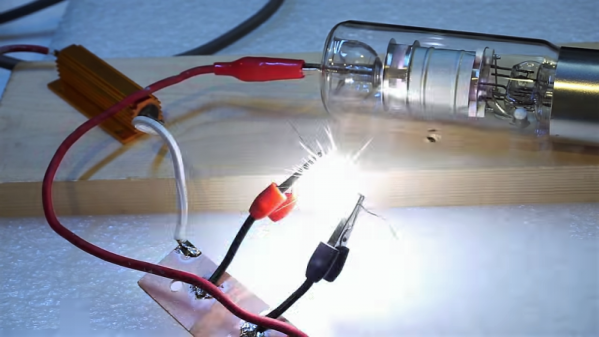
Add in a little high voltage and a tube that makes its own hydrogen, and you’ve got something extra scary. This hydrogen thyratron ended up being just the thing for [Kerry Wong]’s high-voltage, high-current experiments. One would normally turn to the solid-state version of the thyratron, the silicon controlled rectifier (SCR), to switch such voltages. But the devices needed to handle the 30 amps [Kerry] had in mind were exorbitant, and when the IGBTs he used as a substitute proved a little too fragile he turned to the Russian surplus market for help. There he found a TGI1-50/5 hydrogen thyratron, a tube that has a small hydrogen gas generator inside – thyratrons are actually gas-filled rather than vacuum tubes and switch heavy currents through plasma conduction. [Kerry] set up a demo circuit with a small RC network to provide the fast switching pulse preferred by the thyratron, and proceeded to run 3500 volts through a couple of 1/4-W resistors with predictable results. The video below shows the fireworks.

Can’t get enough of the thyratron’s lovely purple glow? We’ve seen it before on this beautiful old switch-mode power supply. The versatile tubes also helped rebuild the first vocal encryption system.

Continue reading “Fun With A Hydrogen Thyratron”