New Contest: Flexible PCBs

The now-humble PCB was revolutionary when it came along, and the whole ecosystem that evolved around it has been a game changer in electronic design. But the PCB is just so… flat. Planar. Two-dimensional. As useful as it is, it gets a little dull sometimes.

Here’s your chance to break out of Flatland and explore the third dimension of circuit design with our brand new Flexible PCB Contest.

We’ve teamed up with Digi-Key for this contest. Digi-Key’s generous sponsorship means 60 contest winners will receive free fabrication of three copies of their flexible PCB design, manufactured through the expertise of OSH Park. So now you can get your flex on with wearables, sensors, or whatever else you can think of that needs a flexible PCB.

Continue reading “New Contest: Flexible PCBs”

Door Springs And Neopixels Demonstrate Quantum Computing Principles

They may be out of style now, and something of a choking hazard for toddlers, but there’s no denying that spring doorstops make a great sound when they’re “plucked” by a foot as you walk by. Sure, maybe not on a 2:00 AM bathroom break when the rest of the house is sleeping, but certainly when used as sensors in this interactive light show.

The idea behind [Robin Baumgarten]’s “Quantum Garden” is clear from the first video below: engaging people through touch, sound, and light. Each of the 228 springs, surrounded by a Neopixel ring, is connected to one of the 12 inputs on an MPR121 capacitive touch sensor. The touch sensors and an accelerometer in the base detect which spring is sproinging and send that information to a pair of Teensies. A PC then runs the simulations that determine how the lights will react. The display is actually capable of some pretty complex responses, including full-on games. But the most interesting modes demonstrate principles of quantum computing, specifically stimulated Raman adiabatic passage (STIRAP), which describes transfers between quantum states. While the kids in the first video were a great stress test, the second video shows the display under less stimulation and gives a better idea of how it works.

We like this because it uses a simple mechanism of springs to demonstrate difficult quantum concepts in an engaging way. If you need more background on quantum computing, [Al Williams] has been covering the field for a while. Need the basics? Check out [Will Sweatman]’s primer.

Continue reading “Door Springs And Neopixels Demonstrate Quantum Computing Principles”

Simple Hack Completely Changes The Sound Of This Piano

We’re partial to musical instrument hacks around here, mainly because we find instruments to be fascinating machines. Few are more complex than the piano, and, as it turns out, few are quite so hackable. Still, we have to admit that this ragtime piano hack took us by surprise.

We always thought that the rich variety of tones that can be coaxed from a piano, from the tinny sound of an Old West saloon piano to the rich tones of a concert grand, were due mainly to the construction of the instrument and the way it’s played. Not so, apparently, as [Measured Workshop] demonstrated by installing a “mandolin rail” in a small upright piano. The instrument had seen better days, so step one was disassembly and cleaning. A wooden rail spanning the entire width of the string board was added, with a curtain of fabric draping down to the level of the hammers. The curtain was cut into a fringe in the same spacing as the hammers – marking the hammer locations with cornstarch was a nice trick – and metal clips were crimped to each fringe. The completed mandolin rail can be raised and lowered using a new foot pedal, completely changing the tone as the hammers hit the strings with the metal clips rather than their soft felt heads. It makes the piano sound a little like a harpsichord, or the aforementioned saloon instrument, and at the touch of a foot, it’s back to its original tone.

Most of the piano hacks we offer tend toward the electronic variety, so it’s nice to see a purely mechanical piano hack for a change. And if the hacked piano doesn’t work out as an instrument, you can always turn it into a workbench.

Continue reading “Simple Hack Completely Changes The Sound Of This Piano”

From Software To Tindie Hack Chat With Brian Lough

Join us Wednesday at noon Pacific time for the From Software to Tindie Hack Chat!

Brian Lough has followed a roundabout but probably not unusual route to the hardware hacking scene. Educated in Electronic and Computer Engineering, Brian is a software developer by trade who became enamored of Arduino development when the ESP8266 hit the market. He realized the microcontrollers such as these offered incredible capabilities on the cheap, and the bug bit him.

Since then, Brian has fully embraced the hardware hacking way, going so far as to live stream complete builds in a sort of collaborative “hack-along” with his viewers. He’s also turned a few of his builds into legitimate products, selling them on his Tindie store and even going so far as to automate testing before shipping to catch errors and improve quality.

Please join us for this Hack Chat, where we’ll discuss:

  • How software hacking leads to hardware hacking;
  • The creative process and how live streaming helps or hinders it;
  • The implications of going from project to product; and
  • What sorts of new projects might we see soon?

Continue reading “From Software To Tindie Hack Chat With Brian Lough”

Vacuum-Powered Rotary Tool Redux, This Time Machined

We love to see projects revisited, especially when new materials or methods make it worth giving the first design another go around. This twin-turbine vacuum-powered Dremel tool is a perfect example of what better tools can do for a build.

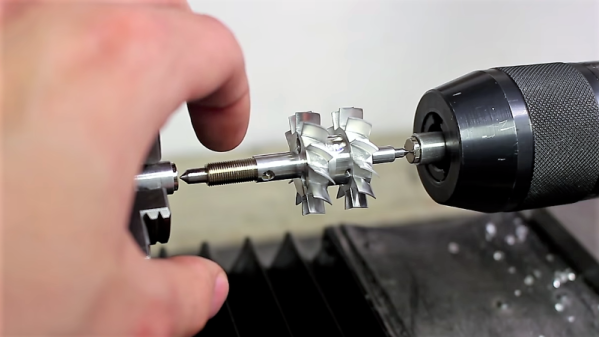
You may recall [JohnnyQ90]’s first attempt at a vacuum powered rotary tool. That incarnation, very similar in design to the current work, was entirely 3D-printed, and caused no little controversy in the comments about the wisdom of spinning anything made on an FDM printer at 43,000 RPM. Despite the naysaying, [Johnny] appears to have survived his own creation. But the turbo-tool did have its limitations, including somewhat anemic torque. This version, machined rather than printed and made almost completely from aluminum, seems to have solved that problem, perhaps thanks to the increased mass of the rotating parts. The twin rotors and the stator were milled with a 5-axis CNC machine, which has been a great addition to [JohnnyQ90]’s shop. The turbine shaft, looking like something from a miniature jet engine, was meticulously balanced using magnets mounted in the headstock and tailstock of a lathe. The video below shows the build and a few tests; we’re not big fans of the ergonomics of holding the tool on the end of that bulky hose, but it sure seems to work well. And that sound!

We first noticed [JohnnyQ90] when he machined aluminum from soda cans to make a mini Tesla turbine. His builds have come a long way since then, and we look forward to what he’ll come up with next.

Continue reading “Vacuum-Powered Rotary Tool Redux, This Time Machined”

Does WiFi Kill Houseplants?

Spoiler alert: No.

To come to that conclusion, which runs counter to the combined wisdom of several recent YouTube videos, [Andrew McNeil] ran a pretty neat little experiment. [Andrew] has a not inconsiderable amount of expertise in this area, as an RF engineer and prolific maker of many homebrew WiFi antennas, some of which we’ve featured on these pages before. His experiment centered on cress seeds sprouting in compost. Two identical containers were prepared, with one bathed from above in RF energy from three separate 2.4 GHz transmitters. Each transmitter was coupled to an amplifier and a PCB bi-quad antenna to radiate about 300 mW in slightly different parts of the WiFi spectrum. Both setups were placed in separate rooms in east-facing windows, and each was swapped between rooms every other day, to average out microenvironmental effects.

After only a few days, the cress sprouted in both pots and continued to grow. There was no apparent inhibition of the RF-blasted sprouts – in fact, they appeared a bit lusher than the pristine pot. [Andrew] points out that it’s not real science until it’s quantified, so his next step is to repeat the experiment and take careful biomass measurements. He’s also planning to ramp up the power on the next round as well.

We’d like to think this will put the “WiFi killed my houseplants” nonsense to rest – WiFi can even help keep your plants alive, after all. But somehow we doubt that the debate will die anytime soon.

Continue reading “Does WiFi Kill Houseplants?”

Arduino Revives A Classic 1980s Minitel Terminal

Before there was the Internet, there were a lot of would-be Internets. Compuserve comes to mind, as do Prodigy, GEnie, Delphi, and the innumerable BBS systems that were once gateways to worlds beyond our CRT monitors and 300 baud Hayes Supermodems.

Service providers varied by region, of course. The French postal and telephone service rolled out their service, Médium interactif par numérisation d’information téléphonique, in 1978. Mercifully and memorably shortened to Minitel, the service was originally intended primarily as an online telephone directory, and later expanded to include other services. [Kevin Driscoll] and [Julien Mailland] recently resurrected a Minitel terminal, a Videotex terminal that was the gateway to the service. The terminal they used, a model 1B, is a stylish machine with a monochrome CRT display and compact “AZERTY” keyboard. [Kevin] and [Julien] built a Videotex server for it using an Uno and a logic-level converter to keep the two talking. Using the hardware, they’ve developed a Twitter client, a webcam display, and dumb Linux terminal.

[Julien] and  [Kevin] previously authored a great history of Minitel that’s worth a read. And we’ve seen a few Minitel hacks before, including converting one to USB for use as a Raspberry Pi terminal.