Retrotechtacular: Disposing Of Sodium, 1947-Style

A high school friend once related the story about how his father, a chemist for an environmental waste concern, disposed of a problematic quantity of metallic sodium by dumping it into one of the more polluted rivers in southern New England. Despite the fact that the local residents were used to seeing all manner of noxious hijinx in the river, the resulting explosion was supposedly enough to warrant a call to the police and an expeditious retreat back to the labs. It was a good story, but not especially believable back in the day.

After seeing this video of how the War Department dealt with surplus sodium in 1947, I’m not so sure. I had always known how reactive sodium is, ever since demonstrations in chemistry class where a flake of the soft gray metal would dance about in a petri dish full of water and eventually light up for a few exciting seconds. The way the US government decided to dispose of 20 tons of sodium was another thing altogether. The metal was surplus war production, probably used in incendiary bombs and in the production of aluminum for airplanes. No longer willing to stockpile it, the government tried to interest industry in the metal, but to no avail due to the hazard and expense of shipping the stuff. Sadly (and as was often the case in those days), they just decided to dump it.

Continue reading “Retrotechtacular: Disposing Of Sodium, 1947-Style”

Giant Robot Arm Uses Fluid Power, Not Electronics

Fair warning that [Freerk Wieringa]’s videos documenting his giant non-electric robot build are long. We’ve only watched the first two episodes and the latest installment so far, all of which are posted after the break. Consider it an investment to watch a metalworking artist undertake an incredible build.

The first video starts with the construction of the upper arm of the robot. Everything is fabricated using simple tools; the most sophisticated tools are a lathe and a TIG welder. As the arm build proceeds we see that there are no electronic controls to be found. Control is through hydraulic cylinders in a master-slave setup; the slave opens a pneumatic valve attached to the elbow of the arm, which moves the lower arm until the valve closes and brings the forelimb to a smooth stop. It’s a very clever way of providing feedback without the usual sensors and microcontrollers. And the hand that goes at the end of the arm is something else, too, with four fingers made from complex linkages, all separately actuated by cylinders of their own. The whole arm looks to be part of a large robot, probably about 3 or 4 meters tall. At least we hope so, and we hope we get to see it by the end of the series.

True, we’ve seen terrifyingly large robots before, but to see one using fluid power for everything is a treat.

Continue reading “Giant Robot Arm Uses Fluid Power, Not Electronics”

The Modular Connector And How It Got That Way

They adorn the ends of Cat5 network patch cables and the flat satin cables that come with all-in-one printers that we generally either toss in the scrap bin or throw away altogether. The blocky rectangular plugs, molded of clear plastic and holding gold-plated contacts, are known broadly as modular connectors. They and their socket counterparts have become ubiquitous components of the connected world over the last half-century or so, and unsurprisingly they had their start where so many other innovations began: from the need to manage the growth of the telephone network and reduce costs. Here’s how the modular connector got that way.

Continue reading “The Modular Connector And How It Got That Way”

Pirates Don’t Stand A Chance Against This 3-D Printed Pan-Tilt Gimbal

Attention: No pirates maritime wealth redistribution agents were harmed in the making of the video below.

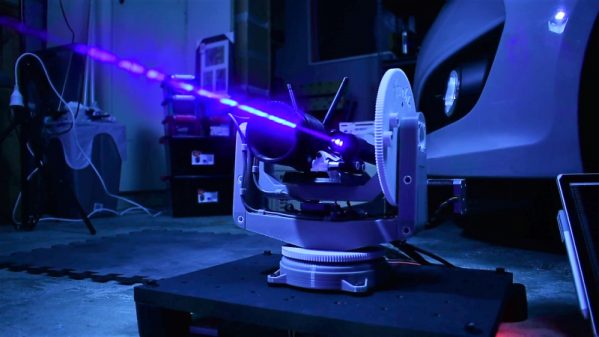
Some projects are for work, some are for fun, and some, like this entirely 3D-printed camera pan-tilt gimbal, start out as work and then turn into fun. As professional digital FX artist [FlorianH] tells the tale, he was in need of such a rig for some motion-control work. Buying off the shelf is always an option, except when it’s boring, so [Florian] invested an untold number of hours in front of Fusion 360 meticulously designing every last part, except for some bearings, the NEMA 17 steppers, and some fasteners. Ten One hundred hours of printing later and the device was ready for assembly and a quick test, which showed that this thing is smooth as silk.

And the pirate snuff-vid? That was just for fun, and we enjoyed it immensely. [Florian] assures us that none of the explosions were added in post; all are practical effects, done with flash cotton and a bit of powdered charcoal. We asked – you know, for reference.

We’ve featured lots of pan-tilt rigs before, using everything from hobby servos to purely mechanical linkages. But this one has a certain flair to it that we really like.

Continue reading “Pirates Don’t Stand A Chance Against This 3-D Printed Pan-Tilt Gimbal”

Add Some Edge To Your Blades With Blown-Arc Plasma

If you polled science fiction fans on what piece of technology portrayed by the movies that they most desire, chances are pretty good that the lightsabers from the Star Wars franchise would be near the top of the list. There’s just something about having that much power in the palm of your hand and still needing to be up close and personal to fight with it. Plus being able to melt holes in bulkheads is pretty keen, as are the cool sounds.

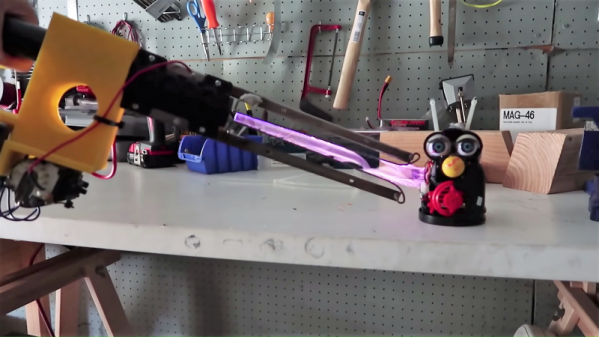
Sadly, the day we can shape and contain plasma in a blade-shaped field is probably pretty far off, but that didn’t stop [Alan Pan] from trying the next best thing: a handheld plasma-projecting blade. He starts with a basic Jacob’s ladder. We’ve seen many of these before, but the basic idea is to ionize the air between two parallel, vertical conductors; the hot plasma heats the air causing it to rise until it reaches the top and snuffs itself out, starting the process over again at the bottom. His twist is to force the plasma into a sheet between the electrodes with air from a leaf blower, forming a blown-arc plasma. That’s pretty cool looking by itself, but he also stretched the electrodes along razor-sharp wood planer blades, for extra danger. We have to admit that the thing looks pretty intimidating, even if the plasma doesn’t really pack bulkhead-melting thermal power. Check out the results in the video below.

We’d love to see [Alan] make good on his promise to make the whole thing self-contained with an electric ducted fan or mini jet engine. Even as it is, it’s still pretty neat. It’s not really his first lightsaber rodeo, but at least this one doesn’t need butane.

Continue reading “Add Some Edge To Your Blades With Blown-Arc Plasma”

Pristine Apple I Sells At Auction For A Jaw-Dropping Price

If you think Apple products are overpriced now, wait until they’re 50 years old.

This original Apple I recently sold at auction for $375,000, making it one of the most expensive 6502-based computers in history. Given that only something like 60 or 70 of the machines were ever made are known to exist, most built by hand by [Jobs] and [Wozniak], it’s understandable how collectors fought for the right to run the price up from the minimum starting bid of $50,000. And this one was particularly collectible. According to the prospectus, this machine had few owners, the most recent of whom stated that he attended a meeting of the legendary Homebrew Computer Club to see what all the fuss was. He bought it second-hand from a coworker for $300, fiddled with it a bit, and stashed it in a closet. A few years later, after the Apple ][ became a huge phenomenon, he tried to sell the machine to [Woz] for $10,000. [Woz] didn’t bite, and as a result, the owner realized a 125,000% return on his original investment, before inflation.

The machine was restored before hitting the auction block, although details of what was done were not shared. But it couldn’t have been much since none of the previous owners had even used the prototyping area that was so thoughtfully provided on the top edge of the board. It was sold with period-correct peripherals including a somewhat janky black-and-white security monitor, an original cassette tape interface, and a homebrew power supply. Sadly, there’s no word who bought the machine – it was an anonymous purchase.

Hackers, check your scrap bins. Anything hanging out there that might be worth six figures in a few decades? It’s unlikely, but if you get lucky, hacking just might turn into your retirement plan.

Thanks to [my wife] for the tip on this one.

How To Build An Inverter, And Why Not To Bother

It’s ridiculously easy to lay hands on a cheap DC-to-AC inverter these days. They’re in just about every discount or variety store and let you magically plug in mains powered devices where no outlets exist. Need 120- or 240-VAC in your car? No problem – a little unit that plugs into the lighter socket is available for a few bucks.

So are these commodity items worth building yourself? Probably not as [GreatScott!] explains, but learning how they work and what their limitations are will probably help your designs. The cheapest and most common inverters have modified square wave outputs, which yield a waveform that’s good enough for most electronics and avoids the extra expense of producing a pure sinusoidal output. He explains that the waveform is just a square wave with a slight delay at the zero-crossing points to achieve the stepped pattern, and shows a simple H-bridge circuit to produce it. He chose to drive the output section with an Arduino, to easily produce the zero-crossing delay. He uses this low-voltage inverter to demonstrate how much more complicated the design needs to get to overcome the spikes caused by inductive loads and the lack of feedback from the output.

Bottom line: it’s nice to know how inverters work, but some things are better bought than built. That won’t stop people from building them, of course, and knowing what you’re doing in this field has been worth big bucks in the past.

Continue reading “How To Build An Inverter, And Why Not To Bother”