Swedish Front Plus Japanese Back Makes For Useful Hybrid Camera

Professional or amateur, doing things the hard way doesn’t always make for better results. Take photography as an example. Once upon a time, the success or failure of what happened during the instant that the camera’s shutter was open was only known hours or days later after processing the film. Ruin the shot with bad exposure or suboptimal composition? Too bad. Miss a once-in-a-lifetime moment as a result? Ouch.

Once instant photography came along, pros were quick to adopt it as a quick and dirty way to check everything before committing the shot to higher-quality film. Camera manufacturers made special instant film cartridges that could be swapped for roll film, and charged through the teeth for them. Unwilling to shell out big bucks, [Isaac Blankensmith] hacked his own instant film back for his Hasselblad medium-format camera. The unlucky donor camera was a Fujifilm Instax, a camera that uses film packs similar to those used by Polaroid and Kodak instant cameras from the 70s and 80s. Several of these cameras were dissected – carefully; those flash capacitors pack a wallop – and stripped down to the essential film-handling bits. An adapter was fabricated from laser-cut acrylic to mount the film back to the Hasselblad, with care taken to match the original focal plane. The shots are surprisingly good; despite a minor light leak from the adapter, they’re fine for the purpose. The best part: the whole build took just 48 hours from conception to first shots.

Speaking of Polaroid, we’ve featured quite a few hacks of Edwin Land’s venerable cameras over the year. From replacing the film with a printer to an upgrade to 35-mm film, instant cameras in general and Polaroids in particular seem to have quite a following among hackers.

Thanks for tipping us off, [macsimski].

The 555 And How It Got That Way

There’s a certain minimum set of stuff the typical Hackaday reader is likely to have within arm’s reach any time he or she is in the shop. Soldering station? Probably. Oscilloscope? Maybe. Multimeter? Quite likely. But there’s one thing so basic, something without which countless numbers of projects would be much more difficult to complete, that a shop without one or a dozen copies is almost unthinkable. It’s the humble 555 timer chip, a tiny chunk of black plastic with eight leads that in concert with just a few extra components can do everything from flashing an LED a couple of times a second to creating music and sound effects.

We’ve taken a look under the hood of the 555 before and featured many, many projects that show off the venerable chip’s multiple personalities quite well. But we haven’t looked at how Everyone’s First Chip came into being, and what inspired its design. Here’s the story of the 555 and how it got that way.

Continue reading “The 555 And How It Got That Way”

Clock Monitors Deep Space Network, Keeps Vigil Over Lost Mars Rover

It’s been a long, long time since we heard from Opportunity, the remarkable Mars rover that has shattered all expectations on endurance and productivity but has been silent since a planet-wide dust storm blotted out the Sun and left it starved for power. Right now, it’s perched on the edge of a crater on Mars, waiting for enough sunlight to charge its batteries so it can call home. All we can do is sit, and wait.

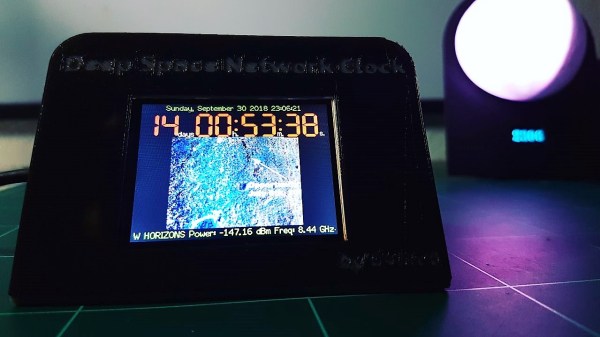
To pass the time until Opportunity stirs again, [G4lile0] built this Deep Space Network clock. Built around an ESP32 and a TFT display, the clock monitors the Deep Space Network (DSN) website to see if mission control is using any of the huge antennas at its disposal to listen for signals from the marooned rover. If the DSN is listening, it displays a special animation exhorting the rover to phone home; otherwise, it shows which of the many far-flung probes the network is communicating with, along with a slideshow of Mars mission photos to keep the spirits up. When the day finally comes that Opportunity checks in, an alarm will sound so [G4lile0] can pop the champagne and celebrate with the rest of us.

We realize that the odds that Opportunity will survive this ordeal are decreasing by the Sol. It’s an uphill battle; after all, the machine was 55 times its original 90-day design life when it went dark, so it’s an uphill battle. Then again, it has beaten the odds before, so there’s still hope.

Continue reading “Clock Monitors Deep Space Network, Keeps Vigil Over Lost Mars Rover”

Reading Old Data Tapes, The Hard Way

Those who were around for the pre-floppy days of computer mass storage were likely to have made the mistake of slipping a cassette tape containing data into a stereo tape deck. Instead of hearing the expected Awesome Mix, the speakers gave off an annoying bleat, warbling between two discordant tones and no doubt spoiling the mood.

What you likely heard was the Kansas City standard, an early attempt to provide the budding microcomputer industry with a mass-storage standard. It was successful enough that you can still find KCS tapes in need of decoding to this day. That job would be a snap with a microcontroller, which is exactly why [matseng] chose to do it the hard way and built a KCS decoder with nothing but discrete components.

The goal was to decode the frequency-shift-keyed (FSK) signal into an 8-bit parallel output, and maybe drive a seven-segment display as the characters came off the tape at a screaming 300 baud. Not an IC is in sight in the schematics; as [matseng] says, it’s nothing but “Qs, Rs, and Cs.” All the amps, flip-flops, and counters needed are built from a forest of transistors, and even the seven-segment display is a DIY affair of LEDs in a 3D-printed and hot-glue frame. The video below shows the display doing its best to show the alphanumeric characters encoded on the audio tape. And for who absolutely need a dose of Arduino, [matseng] used one along with a dead-bug low-pass filter to emulate KCS signals, for easier development.

We always appreciate hackers who take the road less traveled to arrive at a solution, but if you’re pressed for time to decode some KCS tapes, fear not – all you need is a PC and Audacity.

Continue reading “Reading Old Data Tapes, The Hard Way”

Homebrew Linear Actuators Put The Moves On This Motion Simulator

Breaking into the world of auto racing is easy. Step 1: Buy an expensive car. Step 2: Learn how to drive it without crashing. If you’re stuck at step 1, and things aren’t looking great for step 2 either, you might want to consider going with a virtual Porsche or Ferrari and spending your evenings driving virtual laps rather than real ones.

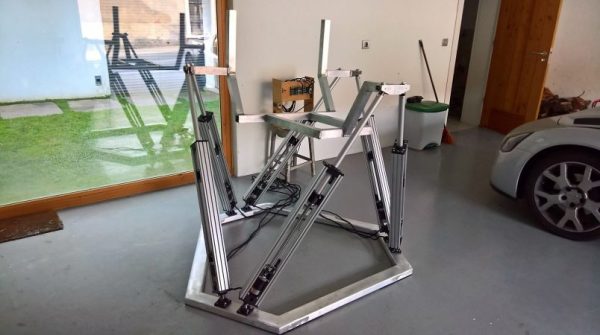
The trouble is, that can get a bit boring after a while, which is what this DIY motion simulator platform is meant to address. In a long series of posts with a load of build details, [pmvcda] goes through what he’s come up with so far on this work in progress. He’s building a Stewart platform, of the type we’ve seen before but on a much grander scale. This one will be large enough to hold a race car cockpit mockup, which explains the welded aluminum frame. We were most interested in the six custom-made linear actuators, though. Aluminum extrusions form the frame holding BLDC motor, and guide the nut of a long ball screw. There are a bunch of 3D-printed parts in the actuators, each of which is anchored to the frame and to the platform by simple universal joints. The actuators are a little on the loud side, but they’re fast and powerful, and they’ve got a great industrial look.

If car racing is not your thing and you’d rather build a full-motion flight simulator, here’s one that also uses DIY actuators.

Continue reading “Homebrew Linear Actuators Put The Moves On This Motion Simulator”

Robot Solves Rubik’s Cube With One Hand Tied Behind Its Back

For all those who have complained about Rubik’s Cube solving robots in the past by dismissing purpose-built rigs that hold the cube in a non-anthropomorphic manner: checkmate.

The video below shows not only that a robot can solve the classic puzzle with mechanical hands, but it can also do it with just one of them – and that with only three fingers. The [Yamakawa] lab at the University of Tokyo built the high-speed manipulator to explore the kinds of fine motions that humans perform without even thinking about them. Their hand, guided by a 500-fps machine vision system, uses two opposing fingers to grip the lower part of the cube while using the other finger to flick the top face of the cube counterclockwise. The entire cube can also be rotated on the vertical axis, or flipped 90° at a time. Piecing these moves together lets the hand solve the cube with impressive speed; extra points for the little, “How’s that, human?” flick at the end.

It might not be the fastest cube solver, or one that’s built right into the cube itself, but there’s something about the dexterity of this hand that we really appreciate.

Continue reading “Robot Solves Rubik’s Cube With One Hand Tied Behind Its Back”

Ants, Dirt, Rain, And The Commodore 64 That Wouldn’t Quit

Some electronics gear is built for the roughest conditions. With rugged steel cases, weatherproof gaskets, and cables passing through sealed glands, these machines are built to take the worst that Mother Nature can throw at them, shrugging off dust, mud, rain, and ice. Consumer-grade computers from the start of the home PC era, however, are decidedly not such machines.

Built to a price point and liable to succumb to a spilled Mountain Dew, few machines from that era that received any kind of abuse lived to tell the tale. Not so this plucky Commodore 64C, which survived decades exposed to the elements. As [Adrian Black] relates in the video below, this machine was on a scrap heap in an Oregon field, piled there along with other goodies by one of those “pickers” that reality TV loves so much. The machine was a disaster. It hadn’t been soaked in oil, but it was loaded with pine needles and an ant colony. The worst part, though, was the rust. The RF shielding had corroded into powder in some places, leaving reddish rust stains all over the place. Undeterred, [Adrian] gave the machine a good bath, first in water, then in isopropanol. Liberal applications of Deoxit helped with header connections, enough to see that the machine miraculously booted. It took some finagling, especially with the 6526 I/O controller, but [Adrian] was eventually able to get everything on the motherboard working, even the sound chip.

Whether this machine survived due to good engineering or good luck is debatable, but it’s a treat to see it come back to life. We hope a full restoration is in the works, not least as a way to make up for the decades of neglect.

Continue reading “Ants, Dirt, Rain, And The Commodore 64 That Wouldn’t Quit”