Feeling The Heat Of High-Frequency Trading

It’s high summer here in North America, and for a lot of us, this one has been a scorcher. Media reports have been filled with coverage of heat wave after heat wave, with temperature records falling like dominoes.

But as they say, it’s not the heat, it’s the humidity, and that was painfully true in the first week of July as a slug of tropical air settled into the northeast United States. With dewpoints well into the 70s (25°C plus) and air temperatures pushing the century-mark (38°C), people suffered and systems from transportation to the electrical grid strained under the load. But as punishing as such soupy conditions are for people, there are other effects that are less well known but of critical importance to financial markets, where increased humidity can lead to billion-dollar losses for markets. Welcome to the weird world of high-frequency trading.

Continue reading “Feeling The Heat Of High-Frequency Trading”

Rolling Out A Slick Rotary Phase Converter

Home machinists can often find great deals on used industrial equipment, and many a South Bend lathe or Bridgeport milling machine has followed someone home. Then comes the moment to plug it in, and the new owner discovers that the three-phase plug needed to power the new beast is nowhere to be found in the shop. Thus commences the weeping and the gnashing of teeth.

Luckily, [Handmade Extreme] is ahead of the curve in terms of shop power, and built a rotary phase converter to power his machines. Industry generally runs on three-phase AC systems, mainly because three-phase electric motors are so much more efficient and compact than the equivalent single-phase motor. But residential electrical service is either split-phase or, in the UK where [Handmade Extreme] is based, single phase. A rotary phase converter is an electromechanical device that can generate the missing phases – in essence a three-phase motor that can run on one winding and generate the missing phases across the other windings. It needs some supporting control circuitry to do so, such as timers and contactors to switch the winding connections once the motor starts, plus capacitors for motor starting and for balancing the voltage across the phases. The control gear is DIN-rail mounted and neatly wired to a smart-looking control panel. Everything is housed in a sturdy enclosure that’s big enough to serve as a mobile tool cart. It’s a really nice job – watch the whole build in the video below.

If you’re interested in power distribution, we’ve got a primer that covers the basics. And if you’re in the market for machine tools, [Quinn]’s machine tool buyer’s guide will let you decide if a three-phase machine is worth the extra effort.

Continue reading “Rolling Out A Slick Rotary Phase Converter”

Cheap PSoC Enables Electrochemistry Research

You may think electrochemistry sounds like an esoteric field where lab-coated scientists labor away over sophisticated instruments and publish papers that only other electrochemists could love. And you’d be right, but only partially, because electrochemistry touches almost everything in modern life. For proof of that look no further than your nearest pocket, assuming that’s where you keep your smartphone and the electrochemical cell that powers it.

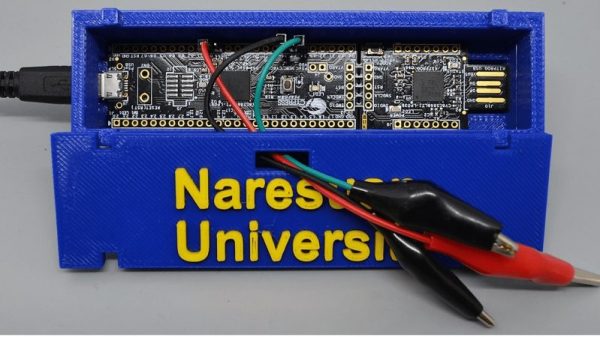
Electrochemistry is the study of the electrical properties of chemical reactions and does indeed need sophisticated instrumentation. That doesn’t mean the instruments have to break the grant budget, though, as [Kyle Lopin] shows with this dead-simple potentiostat built with one chip and one capacitor. A potentiostat controls the voltage on an electrode in an electrochemical cell. Such cells have three electrodes — a working electrode, a reference electrode, and a counter electrode. The flow of electrons between these electrodes and through the solutions under study reveal important properties about the reduction and oxidation states of the reaction. Rather than connect his cell to an expensive potentiostat, [Kyle] used a Cypress programmable system-on-chip development board to do everything. All that’s needed is to plug the PSoC into a USB port for programming, connect the electrodes to GPIO pins, and optionally add a 100 nF capacitor to improve the onboard DAC’s accuracy. The video below covers the whole process, albeit with a barely audible voiceover.

Still not sure about electrochemistry? Check out this 2018 Hackaday Prize entry that uses the electrochemistry of life to bring cell phones back to life.

Continue reading “Cheap PSoC Enables Electrochemistry Research”

Hacked Vacuum Chamber Won’t Suck A Hole In Your Budget

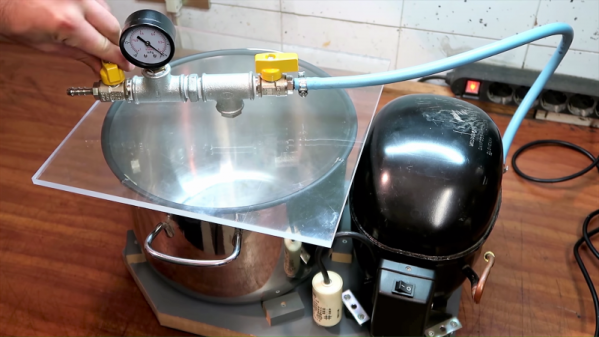
There’s nothing like a true hack, where something useful is concocted from bits of scrap and bargain store finds. Builds like these are much more than the sum of their parts, especially when they result in a useful tool, like this DIY vacuum chamber that’s good for all sorts of jobs.

Everything [Black Beard Projects] used to accomplish this build is readily available almost everywhere in the world, although we have to note that appliance recycling efforts and refrigerant recovery programs have made it somewhat harder to lay hands on things like the old fridge compressor used here. The big steel cooking pot is an easy thrift store find, though, and while [Black Beard] used high-quality stainless fittings and valves to plumb the chamber, pretty much any cheap fittings will do.

The one sketchy area of the build is the plexiglass sheet used for the chamber top, which seems a little on the thin side to us. You can see it flexing in the video below as vacuum is pulled; it survived, but we can see it failing catastrophically at some point. We stand ready to be reassured in the comments. Still, it’s a tidy build with a few nice details, like wiring a switch into the old start capacitor box and using car door edge protector as a gasket on the chamber.

Fridge compressor hacks are standard fare, of course, being used to make everything from air compressors to two-stroke engines. Sometimes they’re even used to keep things cool too.

Continue reading “Hacked Vacuum Chamber Won’t Suck A Hole In Your Budget”

Ancient Teletype Revived In Labor Of Retrocomputing Love

Readers with not too many years under their belts may recall a time when the classic background sound effect for radio and television news programs included a staccato mechanical beat, presumably made by the bank of teletype machines somewhere in the studio, clattering out breaking stories onto rolls of yellow paper. It was certainly true that teletypes were an important part of the many communications networks that were strung together over the 20th century, but these noisy, greasy beasts had their day and are now largely museum pieces.

Which is exactly where the ancient Model 19 Teletype machine that [CuriousMarc] and company are restoring is destined. Their ongoing video series, six parts long as of this writing, documents in painstaking detail how this unit worked and how they are bringing it back to its 1930s glory. Teletypes were made to work over telephone lines with very limited bandwidth, and the hacks that went into transmitting text messages with a simple 5-bit encoding scheme are fascinating. The series covers the physical restoration of the machine, obviously well-loved during its long service with the US Navy. Of particular interest is the massive power supply with its Thyratron tubes and their mysterious blue glow.

The whole series is worth a watch if you’re even slightly interested in retrocomputing. We’re particularly taken with the mechanical aspects of these machines, though, which have a lot in common with mechanical calculators. [Al Williams] recently covered the non-replacement of the power supply caps for this unit, which is an interesting detour to this restoration.

Continue reading “Ancient Teletype Revived In Labor Of Retrocomputing Love”

Engineering The Perfect Throw For Rock Skipping

Summer is here (at least in the Northern Hemisphere) and World’s Greatest Uncle [Mark Rober] is at it again with his nieces and nephews. This time he’s all about skipping stones, that shoreline pastime that kids sometimes find frustrating and adults find humiliating when trying to demonstrate the technique.

But what exactly is the proper technique? [Mark] didn’t know, so he built a robot to find out. Yes, we know it’s not a robot – it’s just a commercial clay pigeon launcher with a few modifications — but work with us here. His idea is to build a rig that can eliminate as many variables as possible when a human tries to skip a stone, and work back one variable at a time to find the perfect set of factors. The prototype in the video below did a respectable job skipping stones, but it was nowhere near optimal. [Mark] then engaged the kids on a careful exploration of the mechanics of rock skipping using the rig, eventually going so far as to eliminate variability in the rocks by making clay pigeons of his own. The results are fantastic; at a 20° approach angle and a 20° tilt of the rock relative to the water, those artificial stones just seem to go on forever. Even skipping natural stones was much improved by what they learned, which is completely counter to the age-old advice to release as low and as parallel to the water as possible.

The real gem in this video, though, is [Mark] describing his engineering design process. Watch and learn, because he clearly knows a thing or two about turning ideas into fun stuff, such as enormous Super Soakers, fully automatic snowball guns, and dart-catching dartboards.

Continue reading “Engineering The Perfect Throw For Rock Skipping”

The Photo Lab That Flew To The Moon

When planning a trip by car these days, it’s pretty much standard practice to spin up an image of your destination in Google Maps and get an idea of what you’re in for when you get there. What kind of parking do they have? Are the streets narrow or twisty? Will I be able to drive right up, or will I be walking a bit when I get there? It’s good to know what’s waiting for you, especially if you’re headed someplace you’ve never been before.

NASA was very much of this mind in the 1960s, except the trip they were planning for was 238,000 miles each way and would involve parking two humans on the surface of another world that we had only seen through telescopes. As good as Earth-based astronomy may be, nothing beats an up close and personal look, and so NASA decided to send a series of satellites to our nearest neighbor to look for the best places to land the Apollo missions. And while most of the feats NASA pulled off in the heyday of the Space Race were surprising, the Lunar Orbiter missions were especially so because of how they chose to acquire the images: using a film camera and a flying photo lab.

Continue reading “The Photo Lab That Flew To The Moon”