Tariff Expansion Set To Hit 3D-Printing Right In The Filament

Mere weeks after tariffs were put into place raising the cost of many Chinese-sourced electronics components by 25%, a second round of tariffs is scheduled to begin that will deal yet another blow to hackers. And this time it hits right at the heart of our community: 3D-printing.

A quick scan down the final tariff list posted by the Office of the US Trade Representative doesn’t reveal an obvious cause for concern. In among the hundreds of specific items listed one will not spot “Filaments for additive manufacturing” or anything else that suggests that 3D-printing supplies are being targeted. But hidden in the second list of tariff items, wedged into what looks like a polymer chemist’s shopping list, are a few entries for “Monofilaments with cross-section dimension over 1 mm.” Uh-oh!

Continue reading “Tariff Expansion Set To Hit 3D-Printing Right In The Filament”

IBM PCjr Revived By An ATX Power Supply And Many False Starts

The IBM PCjr was a computer only the marketing geniuses of a multi-billion dollar corporation could love. On the face of it, it seemed like a great idea – a machine for the home market, meant to complement the “big boy” IBM PC in the office and compete against the likes of Apple and Commodore. What it ended up as was a universally hated, only partially PC-compatible machine which sold a mere half-million units before being mercifully killed off.

That doesn’t mean retrocomputing fans don’t still snap up the remaining machines, of course. [AkBKukU] scored a PCjr from a thrift store, but without the original external brick power supply. An eBay replacement for the 18-VAC supply would have cost more than the computer, so [AkBKukU] adapted a standard ATX power supply to run the PCjr. It looked as if it would be an easy job, since the external brick plugs into a power supply card inside the case which slots into the motherboard with a card-edge connector. Just etch up a PCB, solder on an ATX Molex connector, and plug it in, right? Well, not quite. The comedy of errors that ensued, from the backward PCB to the mysteriously conductive flux, nearly landed this one in the “Fail of the Week” bin. But [AkBKukU] soldiered on, and his hand-scratched adapter eventually prevailed; the video below tells the whole sordid tale, which thankfully ended with the sound of the machine booting from the 5-1/4″-floppy drive.

In the end, we’ve got to applaud [AkBKukU] for taking on the care and feeding of a machine so unloved as to be mentioned only a handful of times even on these pages. One of those articles marks the 25th anniversary of the PCjr, and lays out some of the reasons for its rapid disappearance from the market.

Continue reading “IBM PCjr Revived By An ATX Power Supply And Many False Starts”

The VU Meter And How It Got That Way

Given its appearance in one form or another in all but the cheapest audio gear produced in the last 70 years or so, you’d be forgiven for thinking that the ubiquitous VU meter is just one of those electronic add-ons that’s more a result of marketing than engineering. After all, the seemingly arbitrary scale and the vague “volume units” label makes it seem like something a manufacturer would slap on a device just to make it look good. And while that no doubt happens, it turns out that the concept of a VU meter and its execution has some serious engineering behind that belies the really simple question it seeks to answer: How loud is this audio signal?

Continue reading “The VU Meter And How It Got That Way”

Results Of 3D-Printed Cylinder Head Testing Fail To Surprise

It’s the suburbanista’s weekend nightmare: you’re almost done with the weekly chores, taking the last few passes with the lawn mower, when you hear a pop and bang. The cylinder head on your mower just blew, and you’re out of commission. Or are you? You’ve got a 3D printer – couldn’t it save the day?

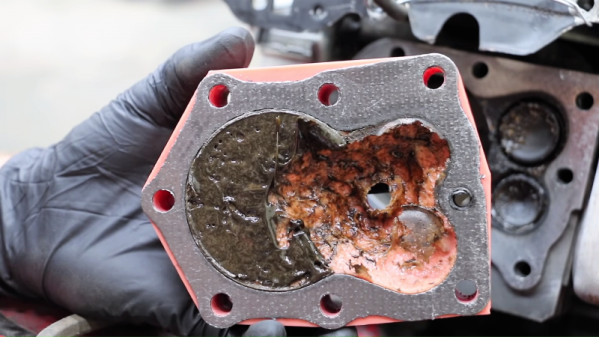
If this bench test of plastic cylinder heads is any indication, it’s possible – just as long as you’ve only got 40 seconds of mowing left to do. [Project Farm] has been running all sorts of tests on different materials as field-expedient cylinder heads for small gasoline engines, using everything from JB Weld epoxy to a slab of walnut. For this test, two chunky heads were printed, one from ABS, of the thermochromic variety apparently, the other in PLA. The test went pretty much as expected for something made of thermoplastic exposed to burning gasoline at high pressure, although ABS was the clear winner with two 40-second runs. The PLA only lasted half as long before the spark plug threads melted and the plug blew out. A gasket printed from flexible filament was also tested, with predictably awful results.

As bad as all this was, it still shows that 3D-printed parts are surprisingly tough. Each part was able to perform decently under a compression test, showing that they can stand up to pressure as long as there’s no heat. If nothing else, it was a learning experience. And as an aside, the cylinder heads were printed by [Terry] from the RedNeckCanadians YouTube channel. That video is worth a watch, if just for a few tips on making a 3D-printed copy of an object. Continue reading “Results Of 3D-Printed Cylinder Head Testing Fail To Surprise”

Ask Hackaday: Is There A Common Mechanical Parts Library?

Like many stories, this one started on the roof. This particular roof is located in Michigan and keeps the rain and snow off of the i3Detroit hackerspace. Being an old industrial building, things up on the roof can start getting creaky, and when an almighty screech started coming from one of the rooftop vents as it swiveled in the wind, Nate, one of the group’s coordinators, knew it was time to do something about it.

Previous attempts to silence the banshee with the usual libations had failed, so Nate climbed up to effect a proper repair with real bearings. He dug into the unit, measured for the bearing, and came down to order the correct items. That’s when it struck him: How many should I order? After all, bearings are useful devices, not just to repair a wonky vent but especially handy in a hackerspace, where they can be put to all sorts of uses. Would extra bearings be put to good use, or would they just sit on a shelf gathering dust?

That’s when Nate dropped us a line and asked a question that raises some interesting possibilities, and one which we couldn’t answer offhand: Is there a readily accessible online library of common mechanical parts?

Continue reading “Ask Hackaday: Is There A Common Mechanical Parts Library?”

Thumbs Up For This Custom Atari 5200 Controller

It may be nearly 40 years old, but the Atari 5200 still inspires legions of fans to relive the 8-bit glory days of their youth. There was much to love about the game console, but the joystick-and-keypad controllers were not among its many charms. The joystick didn’t auto-center, the buttons were mushy, and the ergonomics were nonexistent.

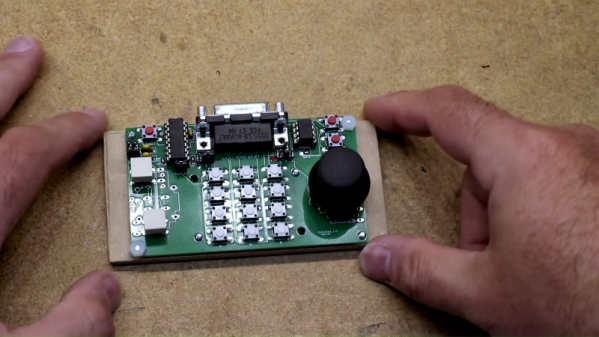
Retro-aficionados need not suffer in silence, though, thanks to this replacement controller for the Atari 5200. [Scott Baker] didn’t want to settle for one of the commercial replacements or, horrors, an adapter for the old PC-style joystick, so he rolled his own. Working from the original Atari schematics, [Scott] devised a plan for using a readily available thumbstick controller as the basis for his build. The essential problem was how to adapt the 10k pots on the new joystick to work in an environment expecting 500k pots, which he solved using an analog to digital and back to analog approach. The ADCs on an ATtiny85 convert each joystick pot’s voltage to a digital value between 0 and 255, which is sent to a 100K digital potentiometer. A little fiddling with RC constants brings it back in line with what the console expects. The thumbstick and buttons live on a custom PCB – kudos to [Scott] for designing an ambidextrous board. The video below shows the design and the finished product in action.

[Scott] is on a bit of a 5200 kick these days; he just finished up a Raspberry Pi multi-cartridge for the venerable console. His controller should make retro-gameplay on the console a little easier on the hands.

Continue reading “Thumbs Up For This Custom Atari 5200 Controller”

Remote Controlled Electric Snowblower Sports FPV For Safety

As summer scorches the northern hemisphere, here’s something to cool your thoughts: winter is only four months away. And with it will come the general misery and the proclamations that “It’ll never be warm again,” not to mention the white stuff and the shoveling. Or perhaps not, if you’re lucky enough to have a semi-autonomous electric snowblower in the garage.

The device [Dane Kouttron] describes is a strange beast indeed, and one that came to him under somewhat mysterious circumstances. It appears to be a standard Ariens two-stage blower, the kind normally driven by a fairly beefy internal combustion engine so as to have enough power to run the auger, the impeller, and the drive wheels. But a previous owner had removed the gas engine and attached a 4-kW brushless motor to run the auger and impeller. Realizing the potential of this machine and with a winter storm heading his way, [Dane] used the old engine mount to hold giant LiFePO₄ batteries from a cell tower backup battery, slapped a couple of electric wheelchair motors onto the drive wheels, mounted a motor to swivel the exhaust chute, and added control electronics from a retired battlebot. Setting such a machine loose in the wild would be bad, so an FPV system was added just in time for storm cleanup. Upgrades for version 2 include better weight distribution for improved stability and traction, and of course googly eyes. Check out the video below to see it flinging snow and moving around faster than any snowblower we’ve ever seen.

We’ll never get lucky enough to have such wonders gifted on us as [Dane] did, but we applaud him for picking up the torch where someone else obviously left off. And who knows; perhaps the previous maker took inspiration from this remote-controlled snowblower build?

Continue reading “Remote Controlled Electric Snowblower Sports FPV For Safety”