Take a couple of thousand steel balls, add a large wooden gear with neodymium magnets embedded in it, and what do you get? Either the beginnings of a wonderful kinetic music machine, or a mess of balls all stuck together and clogging up the works.
The latter was the case for [Martin], and he needed to find a way to demagnetize steel balls in a continuous process if his “Marble Machine X” were to see the light of day. You may recall [Martin] as a member of the band Wintergatan and the inventor of the original Marble Machine, a remarkable one-man band that makes music by dropping steel balls on various instruments. As fabulous a contraption as the original Marble Machine was, it was strictly a studio instrument, too fragile for touring.
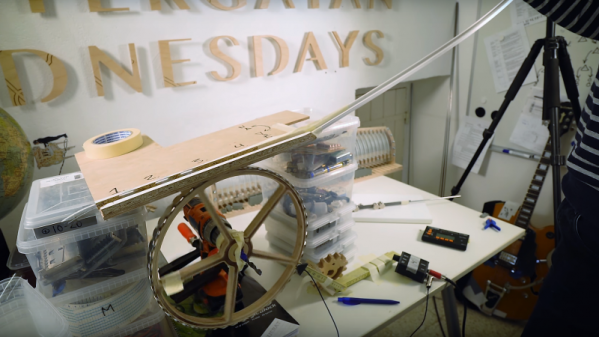
Marble Machine X is a complete reimagining of the original, intended to be robust enough to go on a world tour. [Martin] completely redesigned the lift mechanism, using magnets to grip the balls from the return bin and feed them up to a complicated divider. But during the lift, the balls became magnetized enough to stick together and no longer roll into the divider. The video below shows [Martin]’s solution: a degausser using magnets of alternating polarity spinning slowly under the sticky marbles. As a side note, it’s interesting and entertaining to watch a musician procrastinate while debugging a mechanical problem.
What is it about remote controls? They’re like some vortex of household chaos, burrowing into couch cushions while accusations fly about who used it last. Or they land in just the right spot on the floor to be stepped on during a trip to the bathroom. And don’t get us started about the fragility of their battery case covers; it’s a rare remote in a house with kids whose batteries aren’t held in by strips of packing tape.
But [Alex Rich]’s Bose radio remote discovered another failure mode: imitating a dog chew toy. Rather than fork out $90 for a replacement, [Alex] undertook a 3D-printed case to repair the chewed remote. He put an impressive amount of reverse engineering into the replacement case, probably expending much more than $90 worth of effort. But it’s the principle of the thing, plus he wanted to support some special modifications to the stock remote. One was a hardware power switch to disconnect the batteries entirely, hidden in the bottom shell of the case. The second was the addition of a link to his thermostat to adjust the volume automatically when the AC comes on. That required a Trinket inside the remote and a few mods to make room for it.
Yes, this project dates from a few years back, but [Alex] only just brought it to our attention for the Repairs You Can Print contest. Got some special unobtanium part that you were able to print to get out of a jam? Enter and win prizes to add to the glory of fixing something yourself.
They hold together everything from the most delicate watch to the largest bridge. The world is literally kept from coming apart by screws and bolts, and yet we don’t often give a thought to these mechanisms. Part of that is probably because we’ve gotten so good at making them that they’re seen as cheap commodities, but the physics and engineering behind the screw thread is interesting stuff.
We all likely remember an early science lesson wherein the basic building blocks of all mechanisms laid out. The simple machines are mechanisms that use an applied force to do work, such as the inclined plane, the lever, and the pulley. For instance, an inclined plane, in the form of a splitting wedge, directs the force of blows against its flat face into a chunk of wood, forcing the wood apart.
Screw threads are another simple machine, and can be thought of as a long, gently sloped inclined plane wrapped around a cylinder. Cut a long right triangle out of paper, wrap it around a pencil starting at the big end, and the hypotenuse forms a helical ramp that looks just like a thread. Of course, for a screw thread to do any work, it has to project out more than the thickness of a piece of paper, and the shape of the projection determines the mechanical properties of the screw.
No matter how mad your 3D printing skills may be, there comes a time when it makes more sense to order a replacement part than print it. For [billchurch], that time was the five-hour window he had to order an OEM part online and have it delivered within two days. The race was on — would he be able to model and print a replacement latch for his dishwasher’s detergent dispenser, or would suffer the ignominy of having to plunk down $30 for a tiny but complicated part?
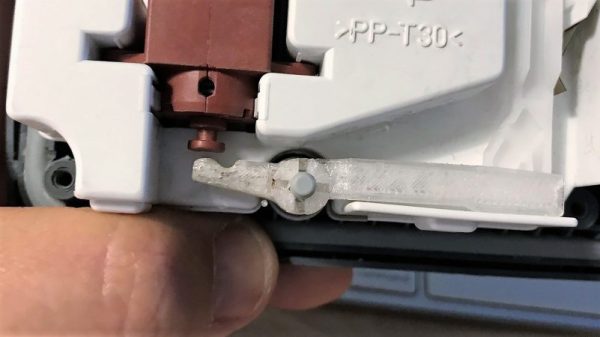
As you can probably guess, [bill] managed to beat the clock. But getting there wasn’t easy, at least judging by the full write-up on his blog. The culprit responsible for the detergent problem was a small plastic lever whose pivot had worn out. Using a caliper for accurate measurements, [bill] was able to create a model in Fusion 360 in just about two hours. There was no time to fuss with fillets and chamfers; this was a rush job, after all. Still, even adding in the 20 minutes print time in PETG, there was plenty of time to spare. The new part was a tight fit but it seemed to work well on the bench, and a test load of dishes proved a success. Will it last? Maybe not. But when you can print one again in 20 minutes, does it really matter?
Have you got an epic repair that was made possible by 3D printing? We want to know about it. And if you enter it into our Repairs You Can Print Contest, you can actually win some cool prizes to boot. We’ve got multiple categories and not that many entries yet, so your chances are good.
What must it be like to devote your life to answering a single simple but monumental question: Are we alone? Astronomer Jill Tarter would know better than most what it’s like, and knows that the answer will remain firmly stuck on “Yes” until she and others in the Search for Extraterrestrial Intelligence project (SETI) prove it otherwise. But the path she chose to get there was an unconventional as it was difficult, and holds lessons in the power of keeping you head down and plowing ahead, no matter what.
Endless Hurdles
To get to the point where she could begin to answer the fundamental question of the uniqueness of life, Jill had to pass a gauntlet of obstacles that by now are familiar features of the biography of many women in science and engineering. Born in 1944, Jill Cornell grew up in that postwar period of hope and optimism in the USA where anything seemed possible as long as one stayed within established boundaries. Girls were expected to do girl things, and boys did boy things. Thus, Jill, an only child whose father did traditional boy things like hunting and fixing things with her, found it completely natural to sign up for shop class when she reached high school age. She was surprised and disappointed to be turned down and told to enroll in “Home Economics” class like the other girls.
She eventually made it to shop class, but faced similar obstacles when she wanted to take physics and calculus classes. Her guidance counselor couldn’t figure why a girl would need to take such classes, but Jill persisted and excelled enough to get accepted to Cornell, the university founded by her distant relation, Ezra Cornell. Jill applied for a scholarship available to Cornell family members; she was turned down because it was intended for male relatives only.
Undeterred, Jill applied for and won a scholarship from Procter & Gamble for engineering, and entered the engineering program as the only woman in a class of 300. Jill used her unique position to her advantage; knowing that she couldn’t blend into the crowd like her male colleagues, she made sure her professors always knew who she was. Even still, Jill faced problems. Cornell was very protective of their students in those days, or at least the women; they were locked in their dorms at 10:00 each night. This stifled her ability to work on projects with the male students and caused teamwork problems later in her career.
No Skill is Obsolete
Despite these obstacles, Jill, by then married to physics student Bruce Tarter, finished her degree. But engineering had begun to bore her, so she changed fields to astrophysics for her post-graduate work and moved across the country to Berkeley. The early 70s were hugely inspirational times for anyone with an eye to the heavens, with the successes of the US space program and leaps in the technology available for studies the universe. In this environment, Jill figured she’d be a natural for the astronaut corps, but was denied due to her recent divorce.
Disappointed, Jill was about to start a research job at NASA when X-ray astronomer Stu Boyer asked her to join a ragtag team assembled to search for signs of intelligent life in the universe. Lacking a budget, Boyer had scrounged an obsolete PDP-8 from Berkeley and knew that Jill was the only person who still knew how to program the machine. Jill’s natural tendency to fix and build things began to pay dividends, and she would work on nothing but SETI for the rest of her career.
SETI efforts have been generally poorly funded over the years. Early projects were looked at derisively by some scientists as science fiction nonsense, and bureaucrats holding the purse strings rarely passed up an opportunity to score points with constituents by ridiculing efforts to talk to “little green men.” Jill was in the thick of the battles for funding, and SETI managed to survive. In 1984, Jill was one of the founding members of the SETI Institute, a private corporation created to continue SETI research for NASA as economically as possible.
The SETI Institute kept searching the skies for the next decade, developing bigger and better technology to analyze data from thousands of frequencies at a time from radio telescopes around the world. But in 1993, the bureaucrats finally landed the fatal blow and removed SETI funding from NASA’s budget, saving taxpayers a paltry $10 million. Jill and the other scientists kept going, and within a year, the SETI Institute had raised millions in private funds, mostly from Silicon Valley entrepreneurs, to continue their work.
Part of the Allen Telescope Array. Source: SETI Institute
The Institute’s Project Phoenix, of which Jill was Director until 1999, kept searching for signs of life out there until 2004, with no results. They proposed an ambitious project to improve the odds — an array of 350 radio telescopes dedicated to SETI work. Dubbed the Allen Telescope Array after its primary patron, Microsoft co-founder Paul Allen, the array has sadly never been completed. But the first 42 of the 6-meter dishes have been built, and the ATA continues to run SETI experiments every day.
Jill Tarter retired as Director of SETI Research for the Institute in 2012, but remains active in the SETI field. Her primary focus now is fundraising, leveraging not only her years of contacts in the SETI community but also some of the star power she earned when it became known that she was the inspiration for the Ellie Arroway character in Carl Sagan’s novel Contact, played by Jodie Foster in the subsequent Hollywood film.
Without a reasonable SETI program, the answer to “Are we alone?” will probably never be known. But if it is answered, it’ll be thanks in no small part to Jill Tarter and her stubborn refusal to stay within the bounds that were set for her.
The Flashing Light Prize is back this year with a noble twist. And judging from the small set of entries thus far, this is going to be an interesting challenge.
Last year’s Flashing Light Prize was an informal contest with a simple goal: flash an incandescent lamp in the most interesting way possible. This year’s rules are essentially the same as last year, specifying mainly that the bulb itself has to light up — no mechanical shutters — and that it has to flash at 1 Hz with a 50% duty cycle for at least five minutes. But where last year’s contest specified incandescent lamps, this year you’ve got to find a way to flash something with neon in it. It could be an off-the-shelf neon pilot light, a recycled neon sign, or even the beloved Nixie tube. But we suspect that points will be awarded for extreme creativity, so it pays to push the envelope. Last year’s winner used a Wimhurst machine to supply the secondary of an ignition coil and flash a pair of bulbs connected across the primary, so the more Rube Goldberg-esque, the better your chances.
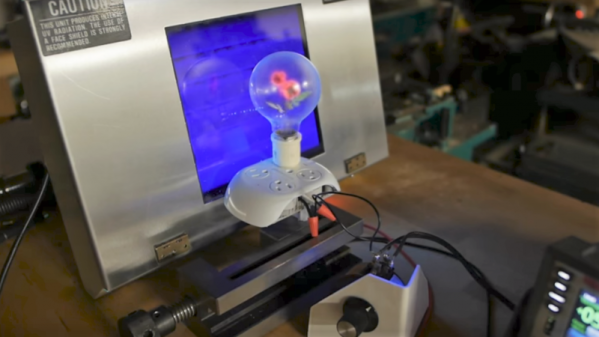
There are only a handful of entries right now, with our favorite being [Ben Krasnow]’s mashup of electricity, mechanics, chemistry, and physics. You’ve got until March 15th to post your flashing neon creation, and there are two categories this year, each with a £200 prize. Get your flash on and win this one for Hackaday.
Few mechanical clocks are silent, and many find the sounds they make pleasant. But the stately ticking of an old grandfather clock or the soothing sound of a wind-up alarm clock on the nightstand are nothing compared to the clattering cacophony that awaits [ProtoG] when he finishes the clock that this electromechanical decimal to binary to hex converter and display will be part of.
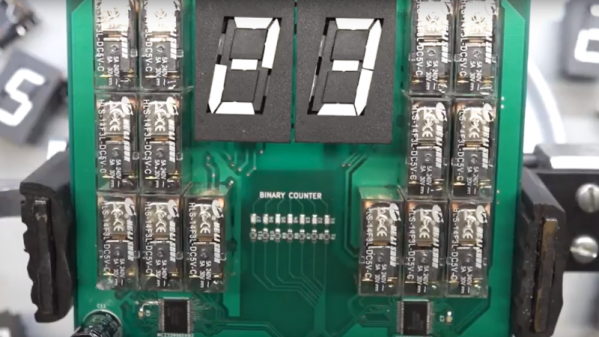
Undertaken as proof of concept before committing to a full six digit clock build, we’d say [ProtoG] is hitting the mark. Yes, it’s loud, but the sound is glorious. The video below shows the display being put through its paces, and when the clock rate ramps up, the rhythmic pulsations of the relays driving the seven-segment flip displays is hypnotizing. The relays, one per segment of the Alfa Zeta flip displays, have DPDT contacts wired to flip a segment by reversing polarity. As a work in progress, [ProtoG] hasn’t shared many more details yet, but he promises to keep us up to date on the converter aspect of the circuit. Right now it just seems like a simple but noisy driver. We’ll be following this one with interest.