IoTP: The Internet Of Toilet Paper

Our first impression of this IoT toilet paper roll was that somebody was pulling our leg. Watching the infomercial-esque video below is alternately hilarious and horrifying, but it leaves you with the unmistakable feeling that this is all a joke, and a pretty good one at that.  Right up until you get to the big Kimberly-Clark logo at the end, that is, and you realize that the international paper concern must be looking at this seriously.

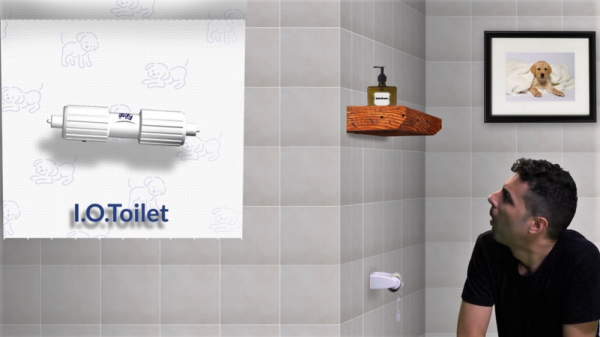
When you read [zvizvi]’s Instructables post, you find out that this project is indeed a legitimate attempt to meld an Amazon Dash button with your toilet paper dispenser. For his proof-of-concept build, [zvizvi] started with a gag “talking TP” roll off eBay, designed to play back a voice clip when the paper is used. It had all the right guts, and being just the size for a Wemos Mini and an accelerometer for motion detection was a bonus. The smart spindle can tally the amount of paper used, so you’ll never be caught without a square to spare. And of course, critical TP usage parameters are uploaded to a cloud server, so that more toilet paper can be rushed to your door when you’re getting low.

The whole idea, including justification based on monitoring TP use as a proxy for bowel health, seems ridiculous, but we suspect there may be some brilliance here. Joke if you will, but in the end it’s probably better than an Internet of Farts.

Continue reading “IoTP: The Internet Of Toilet Paper”

Jeroen Domburg Miniaturizes A Mac

His name may not ring a bell, but his handle will — Sprite_tm, a regular to these pages and to Hackaday events around the world. Hailing from The Netherlands by way of Shanghai, Jeroen Domburg dropped by the Hackaday Superconference 2017 to give a talk on a pet project of his: turning a Macintosh into, well, a pet.

You could say this is Jeroen’s second minification of vintage hardware. At last year’s Hackaday Superconference, he brought out the tiniest Game Boy ever made. This incredible hardware and software hack stuffs a complete Game Boy into something you can lose in your pocket. How do you top a miniature version of the most iconic video game system ever made? By creating a miniature version of the most iconic computer ever made, of course.

The tiny object in front of Jeroen in the title image is, in fact, a working Macintosh Plus that he built. Recreating mid-80’s technology using 2017 parts seems like it would be easy, and while it’s obviously easier than breaking the laws of physics to go the other direction, Jeroen faced some serious challenges along the way, which he goes into some detail about in his talk.

Continue reading “Jeroen Domburg Miniaturizes A Mac”

A TEMPEST In A Dongle

If a couple of generations of spy movies have taught us anything, it’s that secret agents get the best toys. And although it may not be as cool as a radar-equipped Aston Martin or a wire-flying rig for impossible vault heists, this DIY TEMPEST system lets you snoop on computers using secondary RF emissions.

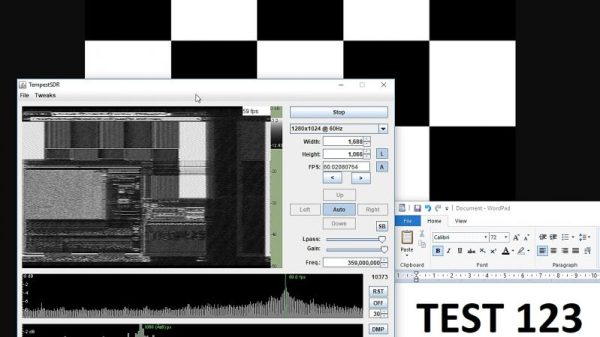
If the term TEMPEST sounds familiar, it’s because we’ve covered it before. [Elliot Williams] gave an introduction to the many modalities that fall under the TEMPEST umbrella, the US National Security Agency’s catch-all codename for bridging air gaps by monitoring the unintended RF, light, or even audio emissions of computers. And more recently, [Brian Benchoff] discussed a TEMPEST hack that avoided the need for thousands of dollars of RF gear, reducing the rig down to an SDR dongle and a simple antenna. There’s even an app for that now: TempestSDR, a multiplatform Java app that lets you screen scrape a monitor based on its RF signature. Trouble is, getting the app running on Windows machines has been a challenge, but RTL-SDR.com reader [flatfishfly] solved some of the major problems and kindly shared the magic. The video below shows TempestSDR results; it’s clear that high-contrast images at easiest to snoop on, but it shows that a $20 dongle and some open-source software can bridge an air gap. Makes you wonder what’s possible with deeper pockets.

RF sniffing is only one of many ways to exfiltrate data from an air-gapped system. From power cords to security cameras, there seems to be no end to the ways to breach systems.

Continue reading “A TEMPEST In A Dongle”

Mechanical Build Lets You Jump Cacti In Real Life

Simple to learn, hard to master, a lifetime to kick the habit. This applies to a lot of computer games, but the T-rex Runner game for Chrome and its various online versions are particularly insidious. So much so that the game drove one couple to build a real-world version of the digital game.

For those not familiar with the game, it’s a simple side-scroller where the goal is to jump and duck a running dinosaur over and under obstacles — think Flappy Birds, but faster paced. When deciding on a weekend hackathon project, [Uri] thought a real-life version of the game would be a natural fit, since he was already a fan of the digital version. With his girlfriend [Ariella] on the team, [Uri] was able to come up with a minimally playable version of the game, with a stepper motor providing the dino jumps and a simple straight conveyor moving the obstacles. People enjoyed it enough that version 2.0 was planned for the Chrome Developer Summit. This version was much more playable, with an oval track for the obstacles and better scorekeeping. [Uri] and [Ariella] had to expand their skills to complete the build — PCB design, E-Paper displays, laser cutting, and even metal casting were all required. The video below shows the final version — but where are the pterosaurs to duck?

Real-world jumping dinos aren’t the first physical manifestation of a digital game. As in the cyber world, Pong was first — either as an arcade version or a supersized outdoor game.

Continue reading “Mechanical Build Lets You Jump Cacti In Real Life”

Start Tracking Satellites With This Low-Cost Azimuth-Elevation Positioner

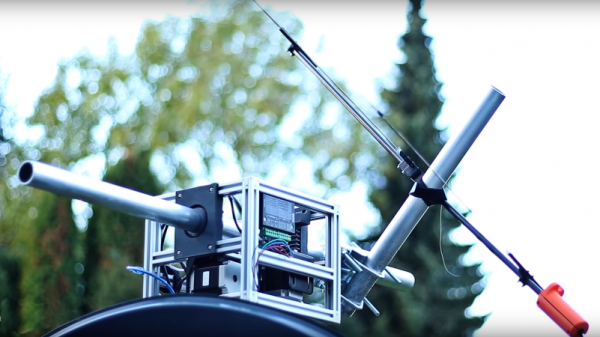
Tracking satellites and the ISS is pretty easy. All you really need is an SDR dongle or a handheld transceiver, a simple homebrew antenna, and a clear view of the sky. Point the antenna at the passing satellite and you’re ready to listen, or if you’re a licensed amateur, talk. But the tedious bit is the pointing. Standing in a field or on top of a tall building waving an antenna around gets tiring, and unless you’re looking for a good arm workout, limits the size of your antenna. Which is where this two-axis antenna positioner could come in handy.

While not quite up to the job it was originally intended for — positioning a 1.2-meter dish antenna — [Manuel] did manage to create a pretty capable azimuth-elevation positioner for lightweight antennas. What’s more, he did it on the cheap — only about €150. His design seemed like it was going in the right direction, with a sturdy aluminum extrusion frame and NEMA23 steppers. But the 3D-printed parts turned out to be the Achille’s heel. At the 1:40 mark in the video below (in German with English subtitles), the hefty dish antenna is putting way too much torque on the bearings, delaminating the bearing mount. But with a slender carbon-fiber Yagi, the positioner shines. The Arduino running the motion control talks GS232, so it can get tracking data directly from the web to control the antenna in real time.

Here’s hoping [Manuel] solves some of the mechanical issues with his build. Maybe he can check out this hefty dish positioner for weather satellite tracking for inspiration.

Continue reading “Start Tracking Satellites With This Low-Cost Azimuth-Elevation Positioner”

Low-End Parts Make Tesla Coil With A High-End Look

We all know the saying: cheap, fast, or good — pick any two. That rule seems to apply across the spectrum of hackerdom, from software projects to hardware builds. But this DIY Tesla coil build might just manage to deliver on all three.

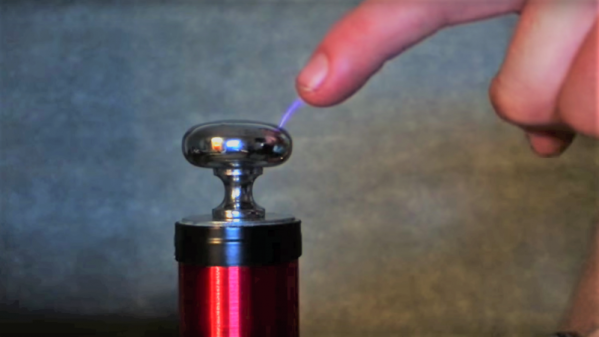
Cheap? [Jay Bowles]’ Tesla coil is based on a handheld bug zapper that you can find for a couple of bucks, or borrow from the top of the fridge in the relatively bug-free winter months. The spark gap is just a couple of screws set into scraps of nylon cutting board — nothing fancy there. Fast? Almost everything needed to build this is stuff lying around the house, and depending on the state of your junk bin you may not even have to order the polypropylene caps [Jay] recommends. Good? That’s a relative term, of course, and if you define it as a coil capable of putting out pumpkin-slaying lightning bolts or playing “Yakkity Sax”, you’ll likely be disappointed. But there’s no denying that this Tesla coil looks good, from its Lexan base to the door-pull top load. And running off a couple of AA batteries, it’s safe to use too.

[Jay] put a lot of care into winding and dressing the secondary coil neatly, and the whole thing would look great as a desktop toy. Not into the winding part? You can always etch a PCB Tesla coil instead.

Continue reading “Low-End Parts Make Tesla Coil With A High-End Look”

Junkyard Crossbow Aims To Be A Car Killer

[James], aka [Turbo Conquering Mega Eagle], is not your typical Hackaday poster boy. Most of his builds have a  “Junkyard Wars” vibe, and he’d clearly be a good man to have around in a zombie apocalypse. Especially if the undead start driving tanks around, for which purpose his current anti-tank compound crossbow is apparently being developed.

At its present prototype phase, [James]’ weapon o’ doom looks more fearsome than it actually is. But that’s OK — we’re all about iterative development here. Using leaf springs from a Toyota Hi-Lux truck, this crossbow can store a lot of energy, which is amplified by ludicrously large aluminum cams. [James] put a lot of effort into designing a stock that can deal with these forces, ending up with a composite design of laminated wood and metal. He put a lot of care into the trigger mechanism too, and the receiver sports not only a custom pistol grip cast from aluminum from his fire extinguisher foundry, but a hand-made Picatinny rail for mounting optics. Test shots near the end of the video below give a hint at the power this fully armed and operational crossbow will eventually have. The goal is to disable a running car by penetrating the engine block, and we’re looking forward to that snuff film.

If rubber band-powered crossbows are more your speed, take you pick — fully automatic, 3D-printed, or human-launching.

Continue reading “Junkyard Crossbow Aims To Be A Car Killer”