Pulleys Within Pulleys Form A Unique Transmission For Robots

After a couple of millennia of fiddling with gears, you’d think there wouldn’t be much new ground to explore in the field of power transmission. And then you see something like an infinitely variable transmission built from nested pulleys, and you realize there’s always room for improvement.

The electric motors generally used in robotics can be extremely efficient, often topping 90% efficiency at high speed and low torque. Slap on a traditional fixed-ratio gearbox, or change the input speed, and efficiency is lost. An infinitely variable transmission, like [Alexander Kernbaum]’s cleverly named Inception Drive, allows the motor to stay at peak efficiency while smoothly changing the gear ratio through a wide range.
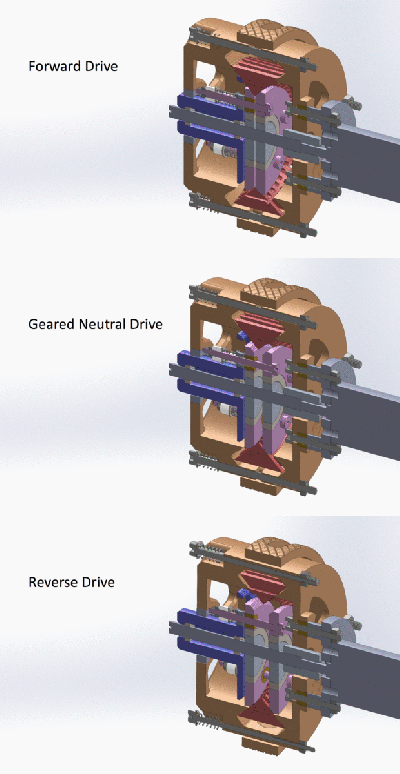
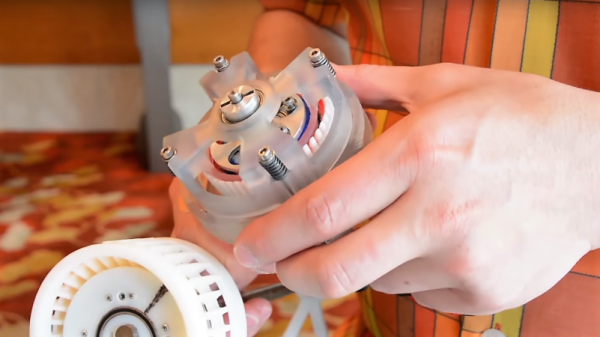
The mechanism takes a bit of thought to fully grok, but it basically uses a pair of split pulleys with variable spacing. The input shaft rotates the inner pulley eccentrically, which effectively “walks” a wide V-belt around a fixed outer pulley. This drives the inner pulley at a ratio depending on the spacing of the pulley halves; the transmission can shift smoothly from forward to reverse and even keep itself in neutral. The video below will help you get your head around it.

We’ve seen a couple of innovative transmissions around here lately; some, like this strain-wave gear and this planetary gearbox, are amenable to 3D printing. Looks like the Inception Drive could be printed too. Hackers, start your printers and see what this drive can do.

Continue reading “Pulleys Within Pulleys Form A Unique Transmission For Robots”
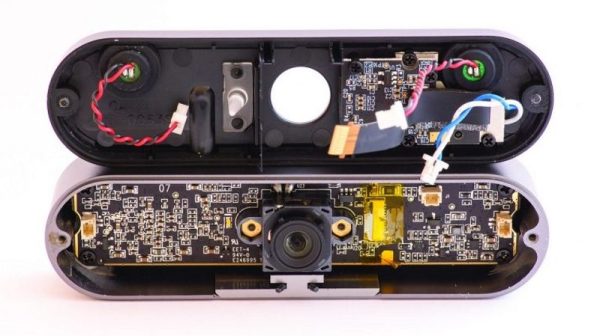
Giving A 4k Webcam Special Eyes

It’s a problem as old as photography: your camera is only as good as your lens. As cameras shrink, so do lenses, and so do the options for upgrading to a better lens. And forget about switching to a different focal length or aperture — it’s often just not an option. Unless you make it an option by adding a CS lens mount to a high-end webcam.

We’ll stipulate that at 4k resolution and packed with all sorts of goodies, the Logitech Brio Pro is a heck of a nice camera. And the lens isn’t bad either, as you’d hope for a camera with almost 9 megapixels at its disposal. But with an optical field of view optimized for video conferencing, it’s hard to use this premium camera for much else. [Saulius] fixed that by taking the camera apart and adding a new case with a built-in C- and CS-mount, resulting in literally thousands of lens choices. [Saulius]’ post has valuable teardown information, which includes exposing the CCD sensor completely. The new case is sold as a kit, but it looks like a 3D-printed case would be pretty easy to whip up.

[Salius] sure seems to love those optical hacks, whether they be a budget microscope camera, high-resolution LIDAR, or capturing license plates at great distances.

Another Day, Another Air Gap Breached

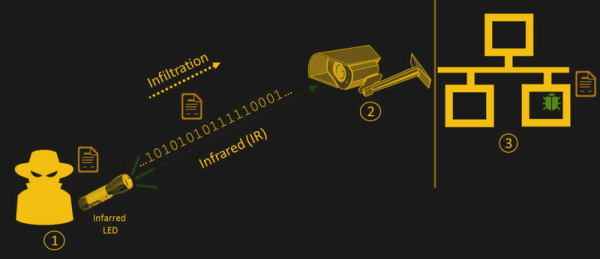
What high-tech, ultra-secure data center would be complete without dozens of video cameras directed both inward and outward? After all, the best informatic security means nothing without physical security. But those eyes in the sky can actually serve as a vector for attack, if this air-gap bridging exploit using networked security cameras is any indication.

It seems like the Cyber Security Lab at Ben-Gurion University is the place where air gaps go to die. They’ve knocked off an impressive array of air gap bridging hacks, like modulating power supply fans and hard drive activity indicators. The current work centers on the IR LED arrays commonly seen encircling the lenses of security cameras for night vision illumination. When a networked camera is compromised with their “aIR-Jumper” malware package, data can be exfiltrated from an otherwise secure facility. Using the camera’s API, aIR-Jumper modulates the IR array for low bit-rate data transfer. The receiver can be as simple as a smartphone, which can see the IR light that remains invisible to the naked eye. A compromised camera can even be used to infiltrate data into an air-gapped network, using cameras to watch for modulated signals. They also demonstrated how arrays of cameras can be federated to provide higher data rates and multiple covert channels with ranges of up to several kilometers.

True, the exploit requires physical access to the cameras to install the malware, but given the abysmal state of web camera security, a little social engineering may be the only thing standing between a secure system and a compromised one.

Continue reading “Another Day, Another Air Gap Breached”

Fun-Size Geiger Counter Sits Atop A 9-Volt Battery

Want a little heads-up before walking into a potentially dangerous radioactive area? Sure, we all do. But the typical surplus Civil Defense Geiger counter is just too bulky to fit into the sleek, modern every-day carry of the smartphone age. So why not slim down your first line of defense against achieving mutant status with this tiny Geiger counter (Facebook)?

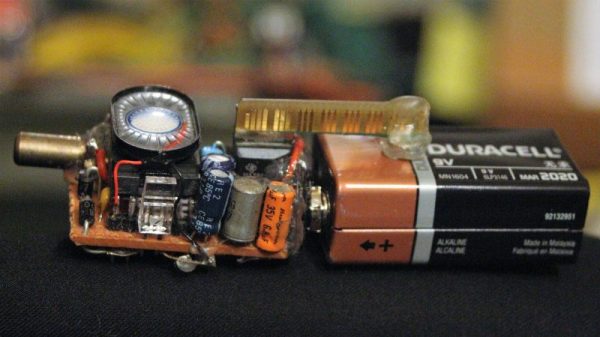
We jest about the use cases for a personal-sized Geiger counter, as [Ian King]’s inspiration for this miniaturized build was based more on a fascination with quantifying the unseen world around us. Details are thin in his post, but [Ian] kindly shared the backstory for this build with us. Working on a budget and mostly with spare parts, the big outlay in the BOM was $20 for a Soviet-era SBM-10 tube, itself a marvel of miniaturization. While waiting the two months needed for the tube to arrive, [Ian] whipped up a perf board circuit with a simple oscillator and a CFL transformer to provide the 400 volts needed for the tube. The whole circuit, complete with tiny speaker and an LED to indicate pulses, sits neatly on top of a 9-volt battery. The video below shows it in action with a test source.

Geiger counters are not exactly rare projects on Hackaday, and with good reason. Take a look at this no-solder scrap bin counter or this traveling GPS Geiger counter built dead-bug style.

Continue reading “Fun-Size Geiger Counter Sits Atop A 9-Volt Battery”

Wind Chimes And Dry Ice Make An Unusual Musical Instrument

When it comes to making music, there are really only a few ways to create the tones needed — pluck something, blow into something, or hit something. But where does that leave this dry-ice powered organ that recreates tunes with wind chimes and blocks of solid CO2?

It turns out this is firmly in the “hit something” camp, as [Leah Edwards] explains of her project. When the metal wind chime tubes come in contact with dry ice, the temperature difference sublimates the solid CO2. The puff of gas lifts the tube slightly, letting it fall back against the brick of dry ice and making a tone. The process is repeated rapidly, providing a vibrato effect while the tube is down. [Leah] used solenoids to lift the tubes and, having recently completed a stint at National Instruments, a bunch of NI gear to control them. The videos below show a few popular tunes and a little bit about the organ build. But what — no songs from Frozen?

We can easily imagine this same build using an Arduino or some other microcontroller. In fact, it puts us in mind of a recent reed organ MIDI project that has a few ideas to offer, like ways to quiet those solenoids.  Continue reading “Wind Chimes And Dry Ice Make An Unusual Musical Instrument”

Hybrid Technique Breaks Backscatter Distance Barrier

Low cost, long range, or low power — when it comes to wireless connectivity, historically you’ve only been able to pick two. But a group at the University of Washington appears to have made a breakthrough in backscatter communications that allows reliable data transfer over 2.8 kilometers using only microwatts, and for pennies apiece.

For those unfamiliar with backscatter, it’s a very cool technology that modulates data onto RF energy incident from some local source, like an FM broadcast station or nearby WiFi router. Since the backscatter device doesn’t need to power local oscillators or other hungry components, it has negligible power requirements. Traditionally, though, that has given backscatter devices a range of a few hundred meters at most. The UW team, led by [Shyamnath Gollokota], describe a new backscatter technique (PDF link) that blows away previous records. By combining the spread-spectrum modulation of LoRa with the switched attenuation of incident RF energy that forms the basis for backscatter, the UW team was able to cover 2800 meters for under 10 microwatts. What’s more, with printable batteries or cheap button cells, the backscatter tags can be made for as little as 10 cents a piece. The possibilities for cheap agricultural sensors, ultracompact and low power wearable sensors, or even just deploy-and-forget IoT devices are endless.

We’ve covered backscatter before, both for agricultural uses and for pirate broadcasting stations. Backscatter also has also seen more cloak and dagger duty.

Continue reading “Hybrid Technique Breaks Backscatter Distance Barrier”

In-Band Signaling: Quindar Tones

So far in this brief series on in-band signaling, we looked at two of the common methods of providing control signals along with the main content of a transmission: DTMF for Touch-Tone dialing, and coded-squelch systems for two-way radio. For this installment, we’ll look at something that far fewer people have ever used, but almost everyone has heard: Quindar tones.

Continue reading “In-Band Signaling: Quindar Tones”