Cleaning Up A Low-Cost Buck-Boost Supply

Cheap DC-DC converters have been a boon on the hobbyist bench for a while now, but they can wreak havoc with sensitive circuits if you’re not careful. The problem: noise generated by the switch-mode supply buried within them. Is there anything you can do about the noise?

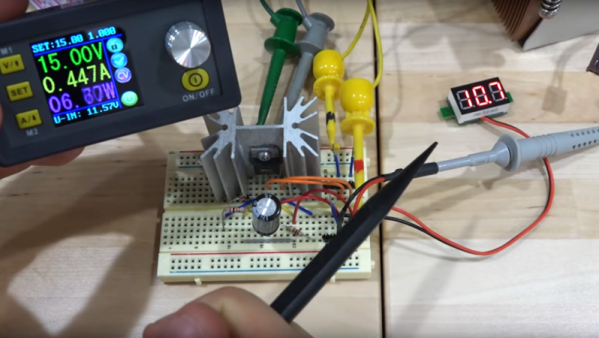
As it turns out, yes there is, and [Shahriar] at The Signal Path walks us through a basic circuit to reduce noise from DC-DC converters. The module under the knife is a popular buck-boost converter with a wide input range, 0-32 VDC output at up to 5 amps, and a fancy controller with an LCD display. But putting the stock $32 supply on a scope reveals tons of harmonics across a 1 MHz band and overall ripple of about 66 mV. But a simple voltage follower built from a power op-amp and a Zener diode does a great job of reducing the spikes and halving the ripple. The circuit is just a prototype and is meant more as a proof of principle and launching point for further development, and as such it’s far from perfect. The main downside is the four-volt offset from the input voltage; there’s also a broad smear of noise at the high end of the spectrum that persists even with the circuit in place. Centered around 900 MHz as it is, we suspect a cell signal of some sort is getting in. 900 kHz.

If you haven’t checked out the videos at The Signal Path, you really should. [Shahriar] really has a knack for explaining advanced topics in RF engineering, and has a bench to die for. We’ve covered quite a few of his projects before, from salvaging a $2700 spectrum analyzer to multiplexing fiber optic transmissions.

Continue reading “Cleaning Up A Low-Cost Buck-Boost Supply”

Fighting Machine Tool Chatter With A 555 Timer

Vibration is a fact of life in almost every machining operation. Whether you’re milling, drilling, turning, or grinding, vibration can result in chatter that can ruin a part. Fighting chatter has generally been a matter of adding more mass to the machine, but if you’re clever about things, chatter reduction can be accomplished electronically, too. (YouTube, embedded below.)

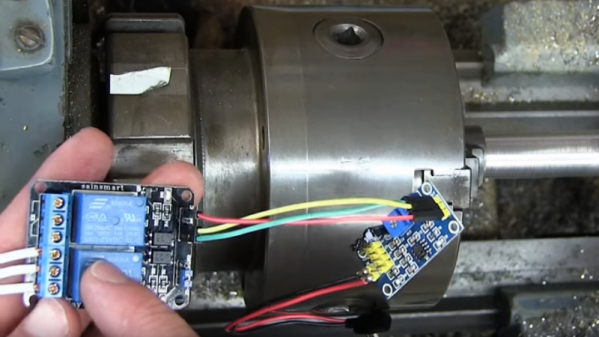
When you know a little something about resonance, machine vibration and chatter start to make sense. [AvE] spends quite a bit of time explaining and demonstrating resonance in the video — fair warning about his usual salty shop language. His goal with the demo is to show that chatter comes from continued excitation of a flexible beam, which in this case is a piece of stock in the lathe chuck with no tailstock support. The idea is that by rapidly varying the speed of the lathe slightly, the system never spends very long at the resonant frequency. His method relies on a variable-frequency drive (VFD) with programmable IO pins. A simple 555 timer board drives a relay to toggle the IO pins on and off, cycling the VFD up and down by a couple of hertz. The resulting 100 RPM change in spindle speed as the timer cycles reduces the amount of time spent at the resonant frequency. The results don’t look too bad — not perfect, but a definite improvement.

It’s an interesting technique to keep in mind, and a big step up from the usual technique of more mass.

Continue reading “Fighting Machine Tool Chatter With A 555 Timer”

Engineering And Artistry Meet An Untimely End At Burning Man

Burning Man is so many different things to so many people, that it defies neat description. For those who attend, it always seems to be a life-changing experience, for good or for ill. The story of one man’s Burning Man exhibition is a lesson in true craftsmanship and mind-boggling engineering, as well as how some events can bring out the worst in people.

For [Malcolm Tibbets], aka [the tahoeturner], Burning Man 2017 was a new experience. Having visited last year’s desert saturnalia to see his son [Andy]’s exhibition, the studio artist decided to undertake a massive display in his medium of choice — segmented woodturning. Not content to display a bamboo Death Star, [Malcolm] went big– really big. He cut and glued 31,000 pieces of redwood into rings of various shapes and sizes and built sculptures of amazing complexity, including endless tubes that knot and loop around and back into each other. Many of the sculpture were suspended from a huge steel tripod fabricated by [Andy], forming an interactive mobile and kinetic sculpture.

Alas, Burning Man isn’t all mellowness in the desert. People tried to climb the tripod, and overnight someone destroyed some of the bigger elements of the installation. [Malcolm] made a follow-up video about the vandalism, but you’ll want to watch the build video below first to truly appreciate the scale of the piece and the loss. Here’s hoping that [Malcolm]’s next display is treated with a little more respect, like this interactive oasis from BM 2016 apparently was.

Thanks to [Keith Olson] for the tip.

Hotline Helps Toddler Keep In Touch With Mom And Dad

Even though the age for first carrying a smartphone seems to be decreasing, there’s a practical lower minimum age at which a kid can reliably use one to make a call. So how do you make sure your tot can reach out and touch mommy or daddy? This toddler-friendly Raspberry Pi hotline is a good start.

With a long trip to Hawaii pending and a toddler staying behind, [kuhnto] wanted a way to make communication as simple as possible. In the days of pervasive landlines, that would have been as simple as a feature phone with a couple of numbers on speed dial buttons. With nothing but cell phones to rely on, [kuhnto] turned to a Raspberry Pi running PBX software and a command line SIP client for making calls over a Google Voice line. The user interface is as simple as can be – a handset and two lighted buttons on a wall-mounted box. All Junior needs to do is pick up the handset and push green to talk to Daddy, blue for Mommy. Something similar might even be useful for elder care.

Kudos to [kuhnto] for thinking through the interface issues to come up with a successful build. We’ve seen other UIs simplified for kids before, such as this button-free jukebox or this special-needs media player.

[via r/DIY]

A Vintage Morse Key Turned Into USB Keyboard

Time was when only the cool kids had new-fangled 102-key keyboards with a number pad, arrow keys, and function keys. They were such an improvement over the lame old 86-key layout that nobody would dream of going back. But going all the way back to a one-key keyboard is pretty cool, in the case of this Morse keyer to USB keyboard adapter.

To revive her dad’s old straight key, a sturdy mid-20th century beast from either a military or commercial setup, [Nomblr] started with a proper teardown and cleaning of the brass and Bakelite pounder. A Teensy was chosen for the job of converting Morse to keyboard strokes; careful consideration to the timing of dits and dahs and allowances for contact debouncing were critical to getting the job done. A new wooden base not only provides stability for the key but hides the Teensy and makes for a new presentation. The video below shows it in action; our only complaint is the lack of sidetone to hear the Morse as you pound out that next great novel one click at a time.

Lovingly restored telegraph gear is a bit of a thing around here; we featured this vintage telegraph sounder revived with a Morse code sender not too long ago.

https://www.youtube.com/watch?v=qh_apYcr4xI

[via r/DIY]

Thanks to [Liz] for the tip

Classic British Phone Gets A Google Makeover

It may seem like an odd concept to younger readers, but there was once a time when people rented their phones rather than buying them outright. Accordingly, these phones were built like tanks, and seeing one of these sturdy classics of midcentury modern design can be a trip down memory lane for some of us. So retrofitting a retro phone with a Raspberry Pi and Google’s AIY seems like a natural project to tackle for nostalgia’s sake.

The phone that [Alasdair Allan] decided to hack was the iconic British desk telephone, the GPO-746, or at least a modern interpretation of the default rental phone from the late 60s through the 70s. But the phone’s looks were more important than its guts, which were stripped away to make room for the Raspberry Pi and Google AIY hat. [Alasdair] originally thought he’d interface the Pi to the rotary dial through DIOs, until he discovered the odd optical interface of the dialer — a mask rotates over a ring of photoresistors, one for each digit, exposing only one to light from an LED illuminated by a microswitch on the finger stop. The digital interface brings up the Google voice assistant, along with some realistic retro phone line sounds. It’s a work in progress, but you can see where [Alasdair] is in the video below.

If stuffing a Google Pi into a retro appliance sounds familiar, it might be this vintage intercom rebuild you have in mind, which [Alasdair] cites as inspiration for his build.

Continue reading “Classic British Phone Gets A Google Makeover”

Smooth And Steady Cuts With An Improvised Power Feeder

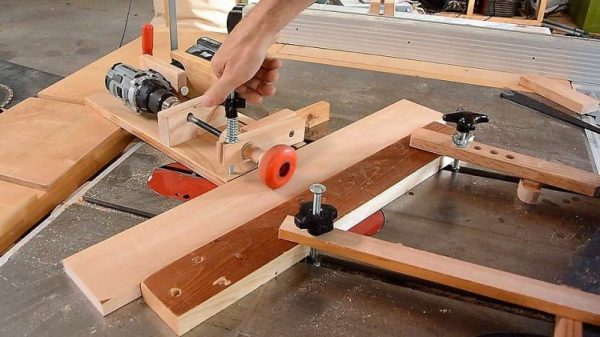
Some woodworking operations require stock to be fed at a smooth, steady rate, for which purpose a power feeder is usually employed. They’re expensive bits of gear, though, and their cost can usually be borne only by high-output production shops. But when you need one, you need one, and hacking a power feeder from a drill and a skate wheel is a viable option.

It should come as no surprise that this woodshop hack comes to us from [Matthias Wandel], who never seems to let a woodworking challenge pass him by. His first two versions of expedient power feeders were tasked with making a lot of baseboard moldings in his new house. Version three, presented in the video below, allows him to feed stock diagonally across his table saw, resulting in custom cove moldings. The completed power feeder may look simple — it’s just a brushless drill in a wooden jig driving a skate wheel — but the iterative design process [Matthias] walks us through is pretty fascinating. We also appreciate the hacks within hacks that always find their way into his videos. No lathe? No problem! Improvise with a drill and a bandsaw.

Surprised that [Matthias] didn’t use some of his famous wooden gears in this build? We’re not. A brushless motor is perfect for this application, with constant torque at low speeds. Want to learn more about BLDC motors? Get the basics with a giant demo brushless motor.

Continue reading “Smooth And Steady Cuts With An Improvised Power Feeder”