Quickie WiFi Scanner

File this project under “Getting Stuff Done” rather than “Shiniest Things”. [filid] works with a local free-WiFi access group, and wanted to map out the signal strength (RSSI) and coverage of their installations. This is a trivial task for an ESP8266, and it was even easier for [filid] because he had already written some WiFi scanner code for the same hardware.

Basically, the device is a Neopixel ring connected to an ESP8266. If it detects a router that’s part of the Freifunk München network, it displays the RSSI on the ring in an attractive circular “bargraph”. When it doesn’t detect a Freifunk node, it displays the number of WiFi routers that it finds. It dumps a lot more detail over the serial port.

The code is short and sweet. Take a look if you’re just getting started with networking using the Arduino firmware on an ESP. Even if you don’t live in Munich, you’ll be able to tweak it to your own situation in a few seconds.

We want to see a GPS and an SD card added to this one, for a standalone wardriving-with-purpose setup. And while we admit that the small form-factor is probably appropriate for this project, how much cooler would it be if it glowed blue like Bilbo’s “Sting”?

When Are 8 Bits More Than 32?

Whenever we write up a feature on a microcontroller or microcontroller project here on Hackaday, we inevitably get two diametrically opposed opinions in the comments. If the article featured an 8-bit microcontroller, an army of ARMies post that they would do it better, faster, stronger, and using less power on a 32-bit platform. They’re usually right. On the other hand, if the article involved a 32-bit processor or a single-board computer, the 8-bitters come out of the woodwork telling you that they could get the job done with an overclocked ATtiny85 running cycle-counted assembly. And some of you probably can. (We love you all!)

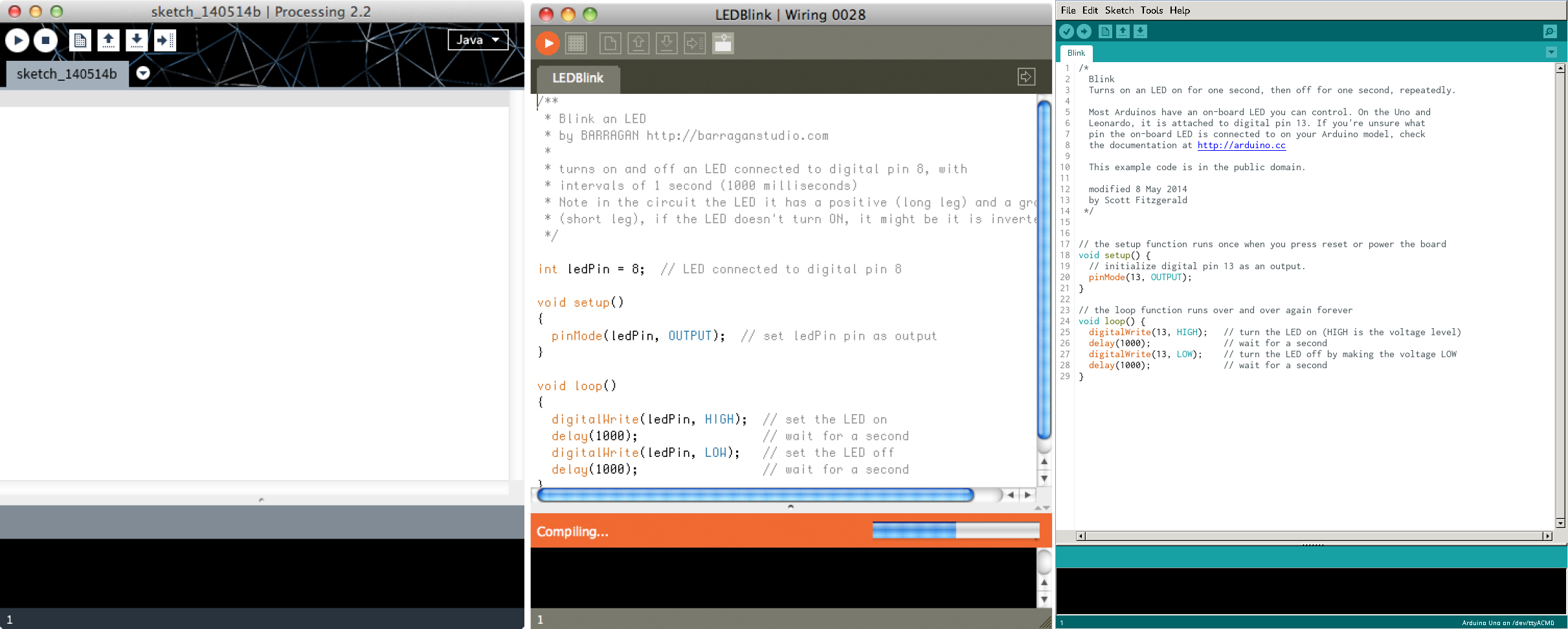
redblue_pillWhen beginners walk into this briar-patch by asking where to get started, it can be a little bewildering. The Arduino recommendation is pretty easy to make, because there’s a tremendous amount of newbie-friendly material available. And Arduino doesn’t necessarily mean AVR, but when it does, that’s not a bad choice due to the relatively flexible current sourcing and sinking of the part. You’re not going to lose your job by recommending Arduino, and it’s pretty hard to get the smoke out of one.

But these days when someone new to microcontrollers asks what path they should take, I’ve started to answer back with a question: how interested are you in learning about microcontrollers themselves versus learning about making projects that happen to use them? It’s like “blue pill or red pill”: the answer to this question sets a path, and I wouldn’t recommend the same thing to people who answered differently.

For people who just want to get stuff done, a library of easy-to-use firmware and a bunch of examples to crib learn from are paramount. My guess is that people who answer “get stuff done” are the 90%. And for these folks, I wouldn’t hesitate at all to recommend an Arduino variant — because the community support is excellent, and someone has written an add-on library for nearly every gizmo you’d want to attach. This is well-trodden ground, and it’s very often plug-and-play.

Continue reading “When Are 8 Bits More Than 32?”

A Slew Of Open-Source Synthesizers

Hackaday reader [Jan Ostman] has been making microcontroller-based DIY synthesizers for quite a while now. Recently, he’s opened up the source for a lot of them so that you can play along at home. All of these virtual-analog synths and soundmakers can be realized on an Arduino or AVR ATmega328 if you happen to have one lying around.

Extra parts like a keyboard, some pushbuttons, or some potentiometer knobs to twiddle won’t hurt if you’d like to make something more permanent or more obviously playable, like [Jan] does. On the other hand, if you’d just like to get your feet wet, I’ve tweaked his code to be more immediately plug-and-play. The code is straightforward enough that it’s a good learning platform. So let’s take a quick tour through three drum machines and a string synth, each of which you can build on a breadboard in just a few minutes.

To install on an Arduino UNO, fetch the zip file from this GitHub repository, and move each subfolder to your Arduino sketch directory. You’re ready to play along.

Continue reading “A Slew Of Open-Source Synthesizers”

Shoot Darts At The Shins Of Total Strangers

[Michael Brumlow] found us and sent us a link. Within a few seconds, we were driving a webcam-enabled Nerf dart tank through his office and trying not to hit walls or get stepped on by his co-workers. Unfortunately, it was out of darts at the time, but you can find them all over the floor if you scout around.

screenshot_remote_botAll of the code details, including the link where you can test drive it yourself, are up on [Michael]’s GitHub. The brains are an Intel Edison board, and the brawns are supplied by an Arduino motor controller shield and (for the latest version) a chassis bought from China.

It runs fairly smoothly, considering the long round trip from [Michael]’s office in Texas, through wherever Amazon keeps their Web Services, over to us in Germany and back. Once we got used to the slight lag, and started using the keyboard’s arrow keys for control, we were driving around like a pro.

It’s got a few glitches still, like the camera periodically overheating and running out of WiFi distance. [Michael] said he’d try to keep it charged up and running while you give it a shot. The controls are multiplexed in the cloud, so your chance of steering it is as good as anyone else’s. It’ll be interesting to see what happens when thousands of Hackaday readers try to control it at once!

It takes a certain kind of bravery to put your telepresence robot up on the open Internets. So kudos to you, [Michael], and we hope that you manage to get some work done this week, even though you will have all of Hackaday driving into your cubicle walls.

Retrotechtacular: Transmission Lines

This great old video (embedded below the break) from Tektronix in the mid-60s covers a topic that seems to confuse folks more than it should — transmission lines. We found it on Paul Carbone’s blog, a great site for aficionados of old analog scopes in its own right.

As with many of these older videos, the pacing is a bit slow by today’s standards, but the quality of the material eventually presented more than makes it worth the effort to reign in your ADHD. For a preview, you can skip to the end where they do a review of all the material.

They start off 5:31 with a pulse travelling down a wire pair, and take a very real-world approach to figuring out the characteristic impedance of the line: if the pulse was created by a battery of 9V, how much current is flowing? If the DC resistance of the wire is zero then there should be an infinite current by Ohm’s law, and that’s clearly not happening. This motivates the standard analysis where you break the wire down into distributed inductance and capacitance.

Of course they do the experiment where you inject a pulse into a long loop of coaxial cable and play around with the termination at the other end of the line. They also measure the velocity factor of the line. Our only gripe is that they don’t tap the line in different places to demonstrate standing waves. The good news is that we’ve got YouTube (and [w3aew]) for that.

If you’ve got 23 minutes to spare, and are curious about transmission lines or just enjoy the soothing voice of a trained radio announcer reading out values of various termination resistors, this old gem is just the ticket. Enjoy!

Continue reading “Retrotechtacular: Transmission Lines”

Cute, Hackable, 3D Printable Robot Family

We first saw the robot Zowi (top row in the banner photo) at Make Munich a few weeks ago, and we were very impressed by how much interesting motion they were getting out of the ‘bot for only using four servo motors. The combination of big feet, strong ankle joints, and clever programming let the cute little bot stand on one leg, do a moonwalk, and even hop. (See the video, below the break.) We knew it was for sale. What we didn’t know is that it was entirely open source.

[Javier Isabel], the inventor, is very good at giving credit where it’s due, and that’s a great thing because his ‘bot is basically an improved BOB robot. That said, you really need to see this thing moving to know what a difference Zowi’s significantly stronger servos and clever programming can make.

But that’s not all! Since everything about Zowi is open, and up on GitHub you can not only 3D print one of your own, but you can easily modify the attractively-boxy case. And a handful of people have taken [Javier] up on the offer, and submitted their modifications back as pull requests. So if you’d rather something mildly more humanoid, and are willing to add a couple more servos, there’s a good basis for your explorations ready to go.

We really like the idea of collaborative toy-robot design, and from what we’ve seen the basic Zowi platform is a winner. Check it out and see if you’re not inspired to add your own personal touch to the design. If you do, be sure to contribute back for others to see!

Thanks [Nils Hitze] for the tip!

Continue reading “Cute, Hackable, 3D Printable Robot Family”

Good Vibrations In 3D-Printed Clay

An engineer with a 3D printer wants everything to be rigid and precise. Wobble induced by flex in the z-axis feedscrews, for instance, makes telltale wavy patterns in the surface that match exactly the screw pitch. Nobody likes those, right? Certainly not an engineer!

good_vibrations-shot0008_thumbnailBut one man’s surface irregularity is another man’s ornamentation. The details we have are sparse, but from looking at the video (also inlined below the break) it’s clear enough: [Olivier van Herpt] and [Ricky van Broekhoven] stuck a vibrating woofer underneath the print bed of their ceramic printer, and use it to intentionally ruin their smooth surface. And they do so to great artistic effect!

We’re not suggesting that you give up entirely on your calibrations, but we do appreciate a little out-of-the-box thinking from time to time. But then our internal engineer raises his head and we wonder if they’re linking the pitch of the woofer to the feed rate of the print head. Your thoughts in the comments?

Continue reading “Good Vibrations In 3D-Printed Clay”