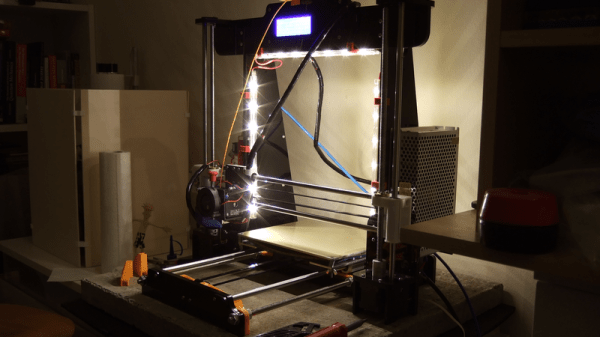
Mass production means that there’s a lot of great hardware out there for dirt cheap. But it also means that the manufacturer isn’t going to spend years working on the firmware to squeeze every last feature out of it. Nope, that’s up to us.
[deqing] took a Bluetooth Low Energy / USB dongle and re-vamped the firmware to turn it into a remote keyboard and mouse, and then wrote a phone app to control it. The result? Plug the USB dongle in, and the computer thinks it sees a keyboard and mouse. Connect the phone via BLE, and you’re typing — even if you don’t have your trusty Model F by your side.
[Deqing] points out that ergonomics and latency will make you hate using this in the long term, but it’s just meant to work until you’ve got SSH up and running on that headless single-board Linux thing. If you’ve ever worked with the USB or BLE specifications, you can appreciate that there’s a bit of work behind the scenes in making everything plug and play, and the web-based interface is admirably slick.
The essence of a spot welder is nothing more than a microwave oven transformer rewound to produce low voltage and high current instead of vice-versa. Some people control the pulse-length during the weld with nothing more than their bare hands, while others feel that it’s better implemented with a 555 timer circuit. [Jim]’s version uses a NodeMCU board, which is desperately overkill, but it was on his desk at the time. His comments in GitHub about coding in Lua are all too familiar — how do arrays work again?
Using the fancier microcontroller means that he can do fancy things, like double-pulse welding and so on. He’s not even touching the WiFi features, but whatever. The OLED and rotary encoder system are sweet, but the star of the show here is the 3D printed case, complete with soft parts where [Jim]’s hand rests when he’s using the welder. It looks like he could have bought this thing. Continue reading “Beautiful DIY Spot Welder Reminds Us We Love 3D Printing”→
If you’ve got a SEGA Dreamcast kicking around in a closet somewhere, and you still have the underutilized add-on Visual Memory Unit (VMU), you’re in for a treat today. If not, but you enjoy incredibly detailed hacks into the depths of slightly aged silicon, you’ll be even more excited. Because [Dmitry Grinberg] has a VMU hack that will awe you with its completeness. With all the bits in place, the hacking tally is a new MAME emulator, an IDA plugin, a never-before ROM dump, and an emulator for an ARM chip that doesn’t exist, running Flappy Bird. All in a month’s work!
The VMU was a Dreamcast add-on that primarily stored game data in its flash memory, but it also had a small LCD display, a D-pad, and inter-VMU communications functions. It also had room for a standalone game which could interact with the main Dreamcast games in limited ways. [Dmitry] wanted to see what else he could do with it. Basically everything.
We can’t do this hack justice in a short write-up, but the outline is that he starts out with the datasheet for the VMU’s CPU, and goes looking for interesting instructions. Then he started reverse engineering the ROM that comes with the SDK, which was only trivially obfuscated. Along the way, he wrote his own IDA plugin for the chip. Discovery of two ROP gadgets allowed him to dump the ROM to flash, where it could be easily read out. Those of you in the VMU community will appreciate the first-ever ROM dump.
On to doing something useful with the device! [Dmitry]’s definition of useful is to have it emulate a modern CPU so that it’s a lot easier to program for. Of course, nobody writes an emulator for modern hardware directly on obsolete hardware — you emulate the obsolete hardware on your laptop to get a debug environment first. So [Dmitry] ported the emulator for the VMU’s CPU that he found in MAME from C++ to C (for reasons that we understand) and customized it for the VMU’s hardware.
Within the emulated VMU, [Dmitry] then wrote the ARM Cortex emulator that it would soon run. But what ARM Cortex to emulate? The Cortex-M0 would have been good enough, but it lacked some instructions that [Dmitry] liked, so he ended up writing an emulator of the not-available-in-silicon Cortex-M23, which had the features he wanted. Load up the Cortex emulator in the VMU, and you can write games for it in C. [Dmitry] provides two demos, naturally: a Mandlebrot set grapher, and Flappy Bird.
Amazed? Yeah, we were as well. But then this is the same guy emulated an ARM chip on the AVR architecture, just to run Linux on an ATMega1284p.
When hardware manufacturers make GUI code-generation tools, the resulting files often look like a canned-spaghetti truck overturned on the highway — there’s metaphorical overcooked noodles and red sauce all over the place. Sometimes we think they’re doing this willfully to tie you into their IDE. Not so the newest version of ST’s graphical STM32CubeMX, which guides you through a pleasant pin-allocation procedure and then dumps out, as of the latest version, a clean Makefile.
Yes, that’s right. This is a manufacturer software suite that outputs something you can actually use with whatever editor, GUI, compiler, or environment that you wish — even the command line. Before this release, you had to go through a hacky but functional script to get a Makefile out of the CubeMX. Now there’s official support for real hackers. Thanks, ST!
If you’re compiling on your own, you’ll need to update the BINPATH variable to point to your compiler. (We use the excellent GNU ARM Embedded Toolchain ourselves, which is super-easy to install on almost any Linux.) If you want to use STM32CubeMX with the Eclipse IDE, [kali prasad yadav] sent us PDF instructions — it’s not hard.
If you doubt that the availability of a free, open, and non-constraining toolchain can matter for a silicon vendor, we’d point to AVR and the Arduino platform that spun off of their support of GCC. Sure, Atmel still pushes their all-in-one wonder, Atmel Studio, which is better than the Arduino IDE by most any metric. But Studio is closed, and Arduino is open. We’d love to see the number of Studio users compared with Arduino users.
Congratulations to ST for taking a big step in the right, open-toolchain, direction.
There are almost as many ways to reflow a surface-mount circuit board as there are hackers. Today, we add another method to the list. [Dasaki] converted a halogen floodlight into an SMT oven, and did so with all the bells and whistles. Check the video below the break.
We’ve actually seen the low-tech version of this hack before, but it’s nothing we would want to use on a daily basis. [Dasaki] needed to get 100 boards done, so it was worth the effort to get it right.
If you’ve ever looked at the server logs of a computer that lives full-time on the Internet, you know it’s a rough world out there. You’ll see hundreds of attempts per day to break in to your one random little box. Are you going to take that sitting down? Christian Haschek didn’t.
Instead of simply banning IPs or closing off services, [Christian] decided to hit ’em where it hurts: in the RAM. Now, whenever a bot hits his server looking for a poorly configured WordPress install, he serves them 10 GB of zeroes, compressed down into 10 MB by gzip:
The classic trick uses zip multiple times on itself, which lets you compress arbitrarily large files into just a few kB. [Christian] tried this with gzip, and discovered that it didn’t automatically recurse, so he’s taking a small bandwidth hit for the team. If you know how to get more data packed smaller using gzip, leave a note in the comments.
Nobody really knows if this works on the bad guys’ servers, but [Christian] said that they stopped hitting him after downloading a couple payloads. If you want to test out what it does to your system, click this link. If you don’t run a server, but phishing e-mails get you hot under the collar, check out [Robbie Gallagher]’s talk on phishing the phishers from last year’s Schmoocon for cathartic tales of revenge.
Our commenteers have all said good things about the open-source TS100 soldering iron pencil: things like “it solders well”. But we’ve all got soldering irons that solder well. What possible extra value does having open-source firmware on a soldering iron bring? [Joric] answered that question for us — it can play Tetris. (Video embedded below.)
While that’s cool and all, it wasn’t until we were reading through the README over at GitHub that the funniest part of this hack hit us. Every time you lose a game, the iron tip temperature increases by 10 degrees. Tetris for masochists? The makings of some horrible bar bets? We’re just glad that it’s open-source, because we’re not that good and it would get too hot to handle fast.
We haven’t tried out a TS100 yet, but this hack is almost pushing us to impulse purchase. There are alternative versions of the firmware if you just don’t like the font, for instance. And now, Tetris. Will this become the hot new gaming platform that you’ve been waiting for? Let us know in the comments.