Digispark Spoofs IR To Get Speakers Under Control

The Microlab 6C are a pretty nice pair of speakers, but [Michał Słomkowski] wasn’t too thrilled with the 8 watts they consume when on standby. The easy fix is to just unplug them when they aren’t in use, but unfortunately the digital controls on the front panel mean he’s got to turn them on, select the correct input, and turn the volume up to the appropriate level every time they’re plugged back in. Surely there must be a better way.

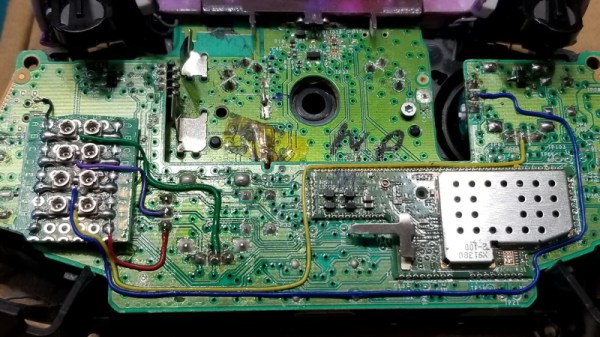
His solution was to use a Digispark to fire off the appropriate IR remote codes so they’d automatically be put back into a usable configuration. But rather than putting an IR LED on one of the GPIO pins, he simply spliced it into the wire leading back from the speaker’s IR receiver. All his code needs to do is generate the appropriate pulses on the line, and the speaker’s electronics think its a signal coming in from the remote.

Distinctive patterns on the IR sensor wires.

Power for the Digispark is pulled from the speaker itself, so it turns on once [Michał] plugs them back in. The code waits five seconds to make sure the hardware has had time to start up, then proceeds with the “Power On”, “Change Input”, and “Volume Up” commands with a few seconds in between each for good measure.

Not only was it easier to skip the IR and inject the signals directly, but it also made for a cleaner installation. Since the microcontroller doesn’t need line of sight to the IR receiver, [Michał] was able to hide it inside the speaker’s enclosure. From the outside, the modification is completely invisible.

We’ve seen similar code injection tricks used before, and it’s definitely one of those techniques you should file away mentally for future reference. Even though more and more modern devices are embracing WiFi and Bluetooth control, the old school IR remote doesn’t seem like it’s going away anytime soon.

Trashed Tablet Lives Again Thanks To New Charger IC

Have you ever pulled a piece of electronics from the trash that looked like nothing was wrong with it, only to take it home and find out it really is dead? Since you’re reading Hackaday, we already know the answer. Trash picking is an honored hacker tradition, and we all know it’s a gamble every time you pull something from the curb. But when the Samsung Galaxy Tab S that [Everett] pulled from the e-waste bin wouldn’t take a charge, he decided to crack it open and see if it was really beyond repair.

The first step was using a USB power meter to see if the tablet was actually pulling any current when plugged in. With just 10 mA on the line, [Everett] knew the device wasn’t even attempting to charge itself. So his next step was to pull the battery and charge it from a bench supply. This got the tablet to wake up, and as far as he could tell, everything else worked as expected. It seemed like the only issue was a blown charging circuit.

Where we’re going, we don’t need ribbon cables.

Now at this point, [Everett] could have just gone online and bought a new motherboard for the tablet and called it a day. But where’s the fun in that? Instead, he wired up a simple charging circuit using a TP4056 IC on a scrap of flexible PCB and mounted it to a square of Kapton tape. He then used 34 AWG magnet wire to connect it between the tablet’s USB port and the battery, bypassing the tablet’s electronics entirely.

The fix worked, but there was a slight problem. Since the TP4056 only goes up to 4.2 V and the battery maxes out at 4.35 V, [Everett] says his hacked charger can only bring the tablet up to 92% capacity according to Android. But considering the alternative, we think its more than a worthy trade-off.

It’s easy to dismiss tablets as largely disposable devices, but this isn’t the first time we’ve seen somebody save one with little more than solder and patience. Of course, what you do with that old tablet once you get it fired back up is another story entirely.

High-Speed Spectrometer Built With Cheap Linear CCD

If you’ve ever dreamed of building a proper spectrometer, it looks like the ESPROS epc901 CCD sensor is absolutely worth your attention. It’s fast, sensitive, easy to interface with, and at just $24 USD, it won’t break the bank. There’s only one problem: implementing it in your project means either working with the bare 2×16 0.5 mm pitch BGA device, or shelling out nearly $1,400 USD for the development kit.

Thankfully, [Adrian Studer] has come up with a compromise. While you’ll still need to reflow the BGA to get it mounted, his open hardware breakout and adapter boards for the ESPROS epc901 make the sensor far easier to work with.

It’s not just a hardware solution either, he also provides firmware code for the STM32L4 based Nucleo development board and some Python scripts that make it easy to pull data from the sensor. The firmware even includes a simple command line interface to control the hardware that you can access over serial.

With the sensor successfully wrangled, [Adrian] partnered with [Frank Milburn] to build an affordable spectrometer around it. The design makes use of a 3D printed chamber, a simple commercial diffraction grating, and an array of entrance slits ranging from 0.5 to 0.0254 millimeters in width that were laser-cut into a sheet of stainless steel.

In the videos after the break, you can see the finished spectrometer being used to determine the wavelength of LEDs, as well as a demonstration of how the high-speed camera module is able to study the spectral variations of a CFL bulb over time. [Adrian] tells us that he and [Frank] are open to suggestions as to what they should point their new spectrometer at next, so let them know in the comments if you’ve got any interesting ideas.

We’ve seen an incredible number of spectrometer builds over the years, and some of the more recent ones are really pushing the envelope in terms of what the DIY scientist is capable of doing in the home lab. While they’re still fairly niche, these instruments are slowly but surely finding their way into the hands of more curious hackers.

Continue reading “High-Speed Spectrometer Built With Cheap Linear CCD”

A Motorized Rotary Shop Table From Scratch

As we’ve seen over the years, it’s possible to bootstrap your own metalworking shop using little more than a pile of scrap steel, a welder, and an angle grinder. With time and dedication, you can build increasingly complex shop tools until you’ve got yourself a nice little post-apocalyptic workshop. It’s the whole idea behind the [Workshop From Scratch] channel, and we never get bored of seeing his incredible backyard engineering.

But eventually, you’ll have built all the basic stuff. What then? Well, as [Workshop From Scratch] shows in a recent video, you can start working on the luxuries. Do you need a motorized table that will let you spin the workpiece and position it an at arbitrary angle? No, probably not. But as the video after the break shows, it’s certainly a handy thing to have around the shop. We especially like how he uses it to quickly and easily produce nearly perfect circular welds.

Note the welded standoffs used to hold on the lid.

From a technical standpoint, this is perhaps one of his more straightforward builds. But at the same time, the attention to detail that he puts into even this “simple” design is phenomenal. Nothing is wasted, and cutoff pieces from one section are often used in imaginative ways elsewhere.

[Workshop From Scratch] is truly a master of working with what you have, and this project is a perfect example. We especially like the tilt mechanism, which uses a massive leadscrew spun by a wiper motor salvaged from an Audi A8 B4. It looks like a fair amount of new hardware went into the control electronics, but even still, we have no doubt that the cost of this build is well below the purchase price of a commercial alternative.

Much like his hydraulic lifting table or motorized plasma cutter, not everyone is going to need something this elaborate in their home shop. But his magnetic vise and mobile drill press cart are far more approachable for the home gamer. Of course even if you don’t follow along and build your own versions of his tools, it’s always worth tuning in just to see him work.

Continue reading “A Motorized Rotary Shop Table From Scratch”

The Battle For Arecibo Has Been Lost

It is with a heavy heart that we must report the National Science Foundation (NSF) has decided to dismantle the Arecibo Observatory. Following the failure of two support cables, engineers have determined the structure is on the verge of collapse and that the necessary repairs would be too expensive and dangerous to conduct. At the same time, allowing the structure to collapse on its own would endanger nearby facilities and surely destroy the valuable research equipment suspended high above the 300 meter dish. Through controlled demolition, the NSF hopes to preserve as much of the facility and its hardware as possible.

Section of the Arecibo Message

When the first support cable broke free back in August, we worried about what it meant for the future of this unique astronomical observatory. Brought online in 1963 as part of a Cold War project to study how ICBMs behaved in Earth’s upper atmosphere, the massive radio telescope is unique in that it has the ability to transmit as well as receive. This capability has been used to produce radar maps of distant celestial objects and detect potentially hazardous near-Earth asteroids.

In 1974, it was even used to broadcast the goodwill of humankind to any intelligent lifeforms that might be listening. Known as the “Arecibo Message”, the transmission can be decoded to reveal an assortment of pictograms that convey everything from the atomic numbers of common elements to the shape of the human body. The final icon in the series was a simple diagram of Arecibo itself, so that anyone who intercepted the message would have an idea of how such a relatively primitive species had managed to reach out and touch the stars.

There is no replacement for the Arecibo Observatory, nor is there likely to be one in the near future. The Five hundred meter Aperture Spherical Telescope (FAST) in China is larger than Arecibo, but doesn’t have the crucial transmission capability. The Goldstone Deep Space Communications Complex in California can transmit, but as it’s primarily concerned with communicating with distant spacecraft, there’s little free time to engage in scientific observations. Even when it’s available for research, the largest dish in the Goldstone array is only 1/4 the diameter of the reflector at Arecibo.

Just last week we wondered aloud whether a nearly 60 year old radio telescope was still worth saving given the incredible advancements in technology that have been made in the intervening years. Now, unfortunately, we have our answer.

RadioShack To Be Reborn As Online-First Retailer

The good news is that as of today RadioShack has officially been purchased by Retail Ecommerce Ventures (REV), giving the troubled company a new lease on life. The downside, at least for folks like us, is that there are no immediate plans to return the iconic electronics retailer to its brick-and-mortar roots. As the name implies, REV specializes in online retail, having previously revamped the Internet presence of other bankrupt businesses such as Pier 1 Imports and Dressbarn.

While the press release doesn’t outright preclude the possibility of new physical RadioShack locations, it’s clear that REV believes the future of retail isn’t to be found in your local strip mall. As the US mulls further lockdowns in response to the continuing COVID-19 pandemic, it’s hard to disagree. There will be millions of bored kids and adults looking for something to do during the long winter nights, and an electronic kit or two shipped to their door might be just the thing.

REV says they plan to relaunch the rather dated RadioShack website just in time for the company’s 100th anniversary in 2021. As of this writing the website currently says that sales have been temporarily halted to allow for inventory restructuring, though it’s unclear if this is directly related to the buyout or not. Getting an accurate count of how much merchandise the company still has on hand after shuttering the majority of their physical locations in 2017 certainly sounds like something the new owners would want to do.

Like most of you, we have fond memories of the Golden Age of RadioShack, back before they thought selling phones and TVs was somehow a good idea. To their credit, they did try and rekindle their relationship with hackers and makers by asking the community what they’d want to see in their stores. But we all know how that story ended. While it doesn’t look like this news will get us any closer to having a neighborhood store that stocks resistors, there’s a certain comfort in knowing that RadioShack kits and books will still be around for the next generation.

Giving Recalled Fitness Trackers A Second Chance

When it was released back in 2012, the Basis B1 fitness tracker was in many ways ahead of its time. In fact, the early smartwatch was so impressive that Intel quickly snapped up the company and made it the cornerstone of their wearable division. Unfortunately a flaw in their next watch, the Basis Peak, ended up literally burning some wearers. Intel was forced to recall the whole product line, and a year later dissolved their entire wearable division.

Given their rocky history, it’s probably no surprise that these gadgets can be had quite cheaply on the second hand market. But can you do anything with them? That’s what [Ben Jabituya] recently decided to find out, and the results of his experiments certainly look very promising. So far he hasn’t found a way to activate a brand-new Basis watch, but assuming you can get your hands on one that was actively being used when Intel pulled the plug, his hacks can be used to get it back up and running.

Examining the downloaded sensor logs.

The Basis Android application has long since been removed from the Play Store, but [Ben] said it wasn’t too hard to find an old version floating around on the web. After decompiling the application he discovered the developers included a backdoor that lets you configure advanced options that would normally be hidden.

How do you access it? As a reminder of the era in which the product was developed, you simply need to log into the application using Jersey and Shore as the username and password, respectively.

Between the developer options and API information he gleaned from the decompiled code, [Ben] was able to create a faux Basis authentication server and point the application to it. That let him get past the login screen, after which he was able to sync with the watch and download its stored data. Between examinations with a hex editor and some open source code that was already available online, he was able to write a Python script for parsing the data which he’s been kind enough to share with the world.

We’re very pleased to see an open source solution that not only gets these “bricked” smartwatches back online, but allows the user to keep all of the generated data under their own control. If you’d like to do something similar with a device that doesn’t have a history of releasing the Magic Smoke, the development of an open source firmware for more modern fitness trackers might be of interest.

Continue reading “Giving Recalled Fitness Trackers A Second Chance”