Open Source DIY Printers Are Alive And Well: What We Saw At ERRF 18

If you follow the desktop 3D printer market, it probably won’t surprise you to hear that nearly every 3D printer on display at the inaugural East Coast RepRap Festival (ERRF) was made in China. Even Printrbot CEO Brook Drumm had to admit that this was the year his company may finally bite the bullet and begin selling a branded and customized printer built overseas.
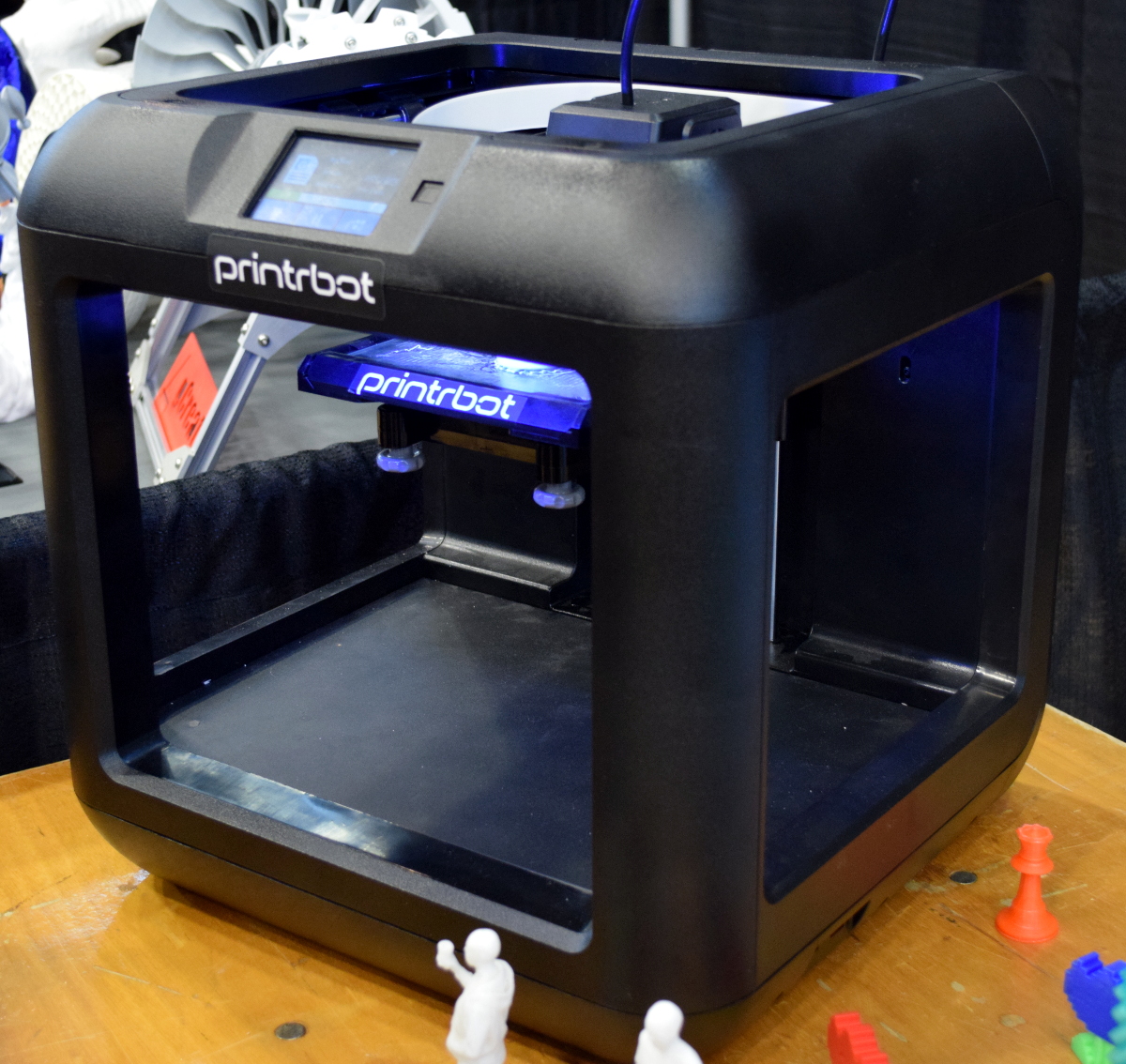
When you can get a decent (but let’s be clear, not great) 3D printer for $200 USD, it’s no surprise that American and European manufacturers are having a hard time staying competitive. But not everyone is seduced by low-cost printers. They know they could buy a decent printer for a couple hundred bucks, but for them that’s not the point. Some hackers are just as (if not more) interested in designing and building the machines than they are churning out little plastic boats with the finished product.

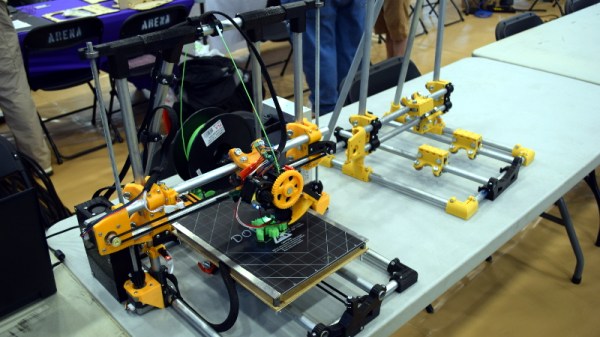
Luckily for us, these are also the type of folks who document their builds and make all their collected information and design files available for others under an open source license. Such builders exemplify the true spirit of the RepRap movement, and we’re happy to report that in a sea of imported printers, there were several interesting home built open source printers.

Whether you want to build your own copy of one of these machines, or simply get inspired by some of the ideas their creators had, these machines are physical proof that just because you can order a cheap 3D printer on eBay right now doesn’t mean you have to.

Continue reading “Open Source DIY Printers Are Alive And Well: What We Saw At ERRF 18”
The A To Z Of Building Your Own Keyboard

We’ve featured a number of people who’ve taken the plunge and created their own customized keyboard; at this point it’s safe to say that there’s enough information and source code out there that anyone who’s looking to build their own board won’t have much trouble figuring out how to do so. That being said, it’s nice to have a comprehensive at a process from start to finish. Why sift through forum posts and image galleries looking for crumbs if you don’t have to?

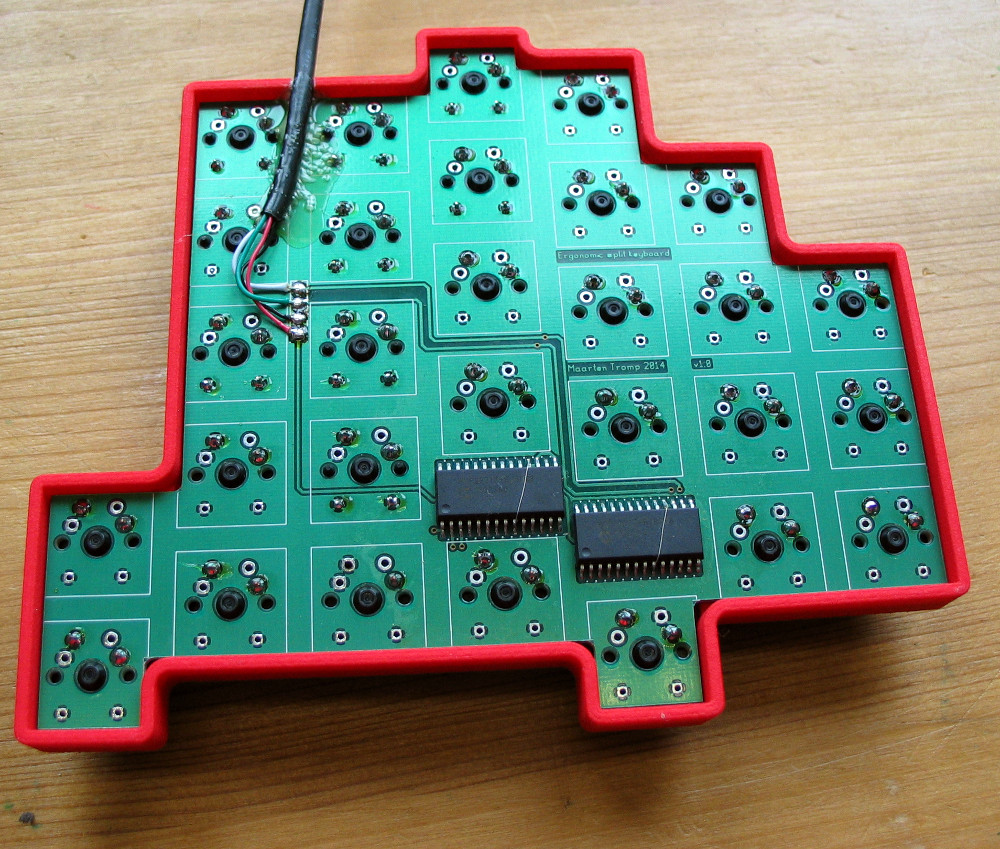
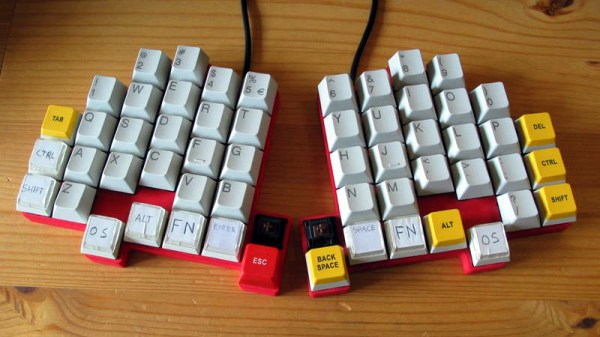
That’s precisely what makes this write-up by [Maarten Tromp] so interesting. He walks the reader through every step of the design and creation of his customized keyboard, from coming up with the rather unique layout to writing the firmware for its AVR microcontroller. It’s a long read, filled with plenty of tips and tricks from a multitude of disciplines.

After looking at other custom boards for inspiration, [Maarten] used OpenSCAD to create a 3D model of his proposed design, and had it printed at Shapeways. His electronics are based around an Atmel ATMega328P using vUSB, and Microchip MCP23017 I/O expanders to connect all the keys. He wrapped it all up by designing a PCB in gEDA PCB and having it sent off for production. As a testament to his attention to detail, everything mated up on the first try.

[Maarten] is happy with the final product, but mentions that in a future revision he would like to add RGB lighting and use a microcontroller that has native USB support. He’d also like to drop the I/O expanders and switch over to Charlieplexing for the key matrix.

From uncommon layouts to diminutive technicolor beauties, it seems there’s no end of custom keyboards in sight. We aren’t complaining.

Coolest Way To Watch 3D Printing: Lights, Camera, Octolapse!

Octoprint is a household name for anyone into 3D printing and anyone regularly reading Hackaday. Described by creator Gina Häußge as “the snappy web interface for your 3D printer”, Octoprint allows you to control effectively any desktop 3D printer over the local network or Internet. It even has webcam support so you can watch your printer while it works, meaning you can finally put that video baby monitor back into the crib with Junior.

While the core functionality of Octoprint is fantastic alone, its true power is unlocked through the plugin system and the community that’s sprung up around it. With plugins, Octoprint can do everything from control RGB light strips in your printer’s enclosure to sending status messages via Discord. One particularly popular plugin that has been making the rounds lately is Octolapse by [FormerLurker]. This plugin provides a comprehensive intelligent system for creating time-lapse videos of prints.

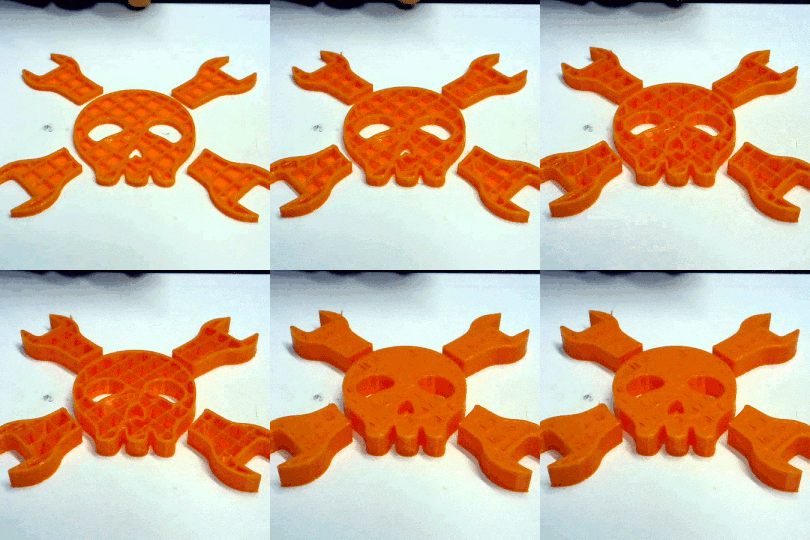
What does that mean? Well, instead of simply taking a picture every few seconds like you’d do traditionally, Octolapse actually keeps track of the printer’s motions while its running. It can then take a picture at the opportune moment to create a number of user-selected effects. More importantly, it can even take control of the printer directly; moving the hotend away from the print before taking a picture. The effect is that the print simply “grows” out of the bed.

I thought it would be interesting to take a closer look at Octolapse and see just what it takes to create one of those awesome time-lapse videos. It turned out to be somewhat trickier than I anticipated, but the end results are so fantastic I’d say it’s a technique worth mastering.

Continue reading “Coolest Way To Watch 3D Printing: Lights, Camera, Octolapse!”

Nintendo Switch Gets Internal Trinket Hardmod

If you haven’t been following the Nintendo Switch hacking scene, the short version of the story is that a vulnerability was discovered that allows executing code on all versions of the Switch hardware and operating system. In fact, it’s believed that the only way to stop this vulnerability from being exploited is for Nintendo to release a new revision of the hardware. Presumably there are a lot of sad faces in the House of Mario right about now, but it’s good news for us peons who dream of actually controlling the devices we purchase.

To run your own code on Nintendo’s latest and greatest, you must first put it into recovery mode by shorting out two pins in the controller connector, and then use either a computer or a microcontroller connected to the system’s USB port to preform the exploit and execute the binary payload. It’s relatively easy, but something you need to do every time you shut the system down. But if you’re willing to install an Adafruit Trinket M0 inside your Nintendo Switch, you can make things a little easier.

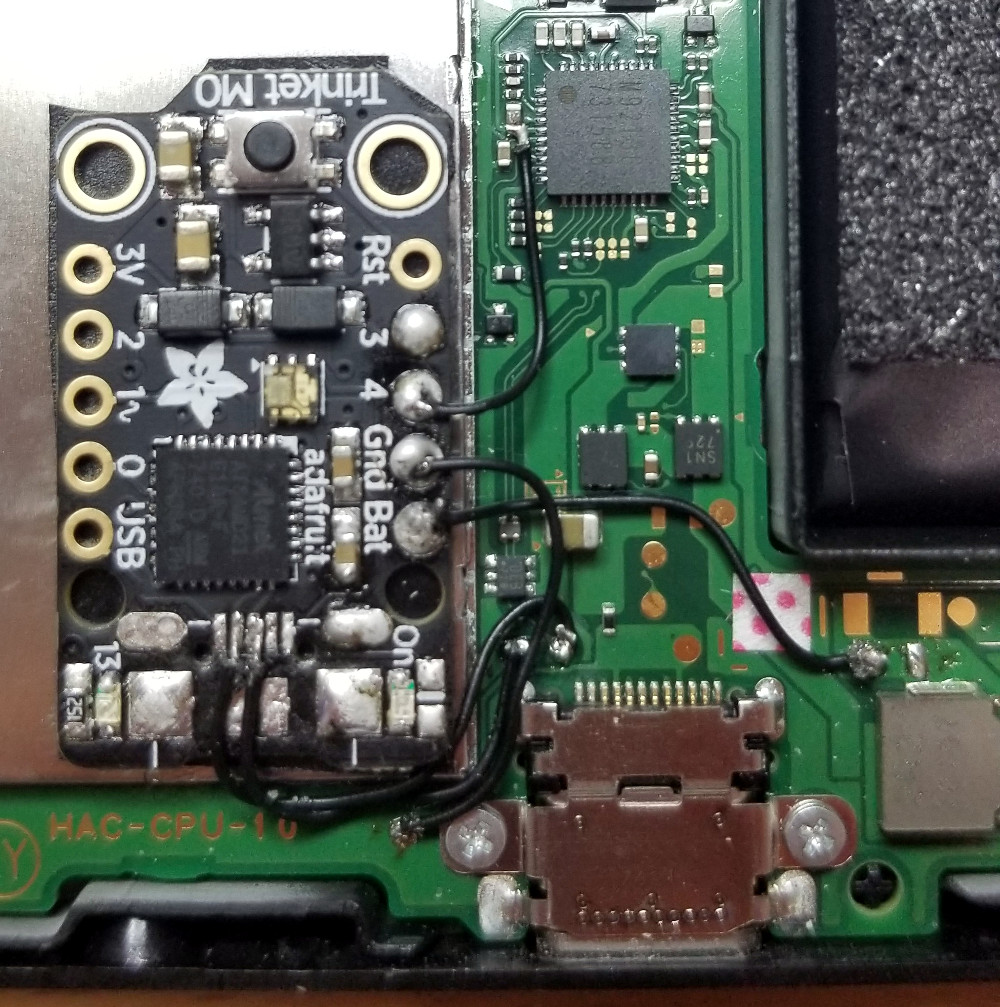
Stemming from work done by [atlas44] and [noemu], the final iteration of this mod was created by [Quantum-cross]. The general idea is to strip down the Trinket M0 board to as small as possible by removing the USB port and a few capacitors, and then install it inside the Switch’s case. By wiring it up to power, the back of the USB-C connector, and the controller connector, the Trinket can interact with all the key components involved in the exploit.

You can even use the Switch’s USB port to update the firmware on the Trinket to load different payloads, though in his walkthrough video after the break, [xboxexpert] mentions eventually this won’t really be necessary as the homebrew software environment on the Switch matures. Indeed, there will almost certainly come a time when performing this exploit on every boot of the system will be made unnecessary, rendering this modification obsolete. But until then, this is a pretty slick way of getting your feet wet in the world of Switch hacking.

It was only six months or so back that we were reading about the first steps towards running arbitrary code on the Nintendo Switch, and just a few months prior to that we saw people experimenting with controlling the system with a microcontroller.

Continue reading “Nintendo Switch Gets Internal Trinket Hardmod”

Handmade Robot Brings Stop Motion To Life

Stop motion animation is often called a lost art, as doing it (or at least, doing it well) is incredibly difficult and time consuming. Every detail on the screen, no matter how minute, has to be placed by human hands hundreds of times so that it looks smooth when played back at normal speed. The unique look of stop motion is desirable enough that it still does get produced, but it’s far less common than hand drawn or even computer animation.

If you ever wanted to know just how much work goes into producing even a few minutes of stop motion animation, look no farther than the fascinating work of [Special Krio]. He not only documented the incredible attention to detail required to produce high quality animation with this method, but also the creation of his custom robotic character.

Characters in stop motion animation often have multiple interchangeable heads to enable switching between different expressions. But with his robotic character, [Special Krio] only has to worry about the environments, and allow his mechanized star do the “acting”. This saves time, which can be used for things such as making 45 individual resin “drops” to animate pouring a cup of tea (seriously, go look).

To build his character, [Special Krio] first modeled her out of terracotta to get the exact look he wanted. He then used a DIY 3D laser scanner to create a digital model, which in turn he used to help design internal structures and components which he 3D printed on an Ultimaker. The terracotta original was used once again when it was time to make molds for the character’s skin, which was done with RTV rubber. Then it was just the small matter of painting all the details and making her clothes. All told, the few minutes of video after the break took years to produce.

This isn’t the first time we’ve seen 3D printing used to create stop motion animation, but the final product here is really in a league of its own.

[Thanks to Antonio for the tip.]

Continue reading “Handmade Robot Brings Stop Motion To Life”

Keep It Close: A Private Git Server Crash Course

At this point, everyone has already heard that Microsoft is buying GitHub. Acquisitions of this scale take time, but most expect everything to be official by 2019. The general opinion online seems to be one of unease, and rightfully so. Even if we ignore Microsoft’s history of shady practices, there’s always an element of unease when somebody new takes over something you love. Sometimes it ends up being beneficial, the beginning of a new and better era. But sometimes…

Let’s not dwell on what might become of GitHub. While GitHub is the most popular web-based interface for Git, it’s not the only one. For example GitLab, a fully open source competitor to GitHub, is reporting record numbers of new repositories being created after word of the Microsoft buyout was confirmed. But even GitLab, while certainly worth checking out in these uncertain times, might be more than you strictly need.

Let’s be realistic. Most of the software projects hackers work on don’t need even half the features that GitHub/GitLab offer. Whether you’ve simply got a private project you want to maintain revisions of, or you’re working with a small group collaboratively in a hackerspace setting, you don’t need anything that isn’t already provided by the core Git software.

Let’s take a look at how quickly and easily you can setup a private Git server for you and your colleagues without having to worry about Microsoft (or anyone else) having their fingers around your code.

Continue reading “Keep It Close: A Private Git Server Crash Course”

Conquering The Earth With Cron

The GOES-R series of Earth observation satellites are the latest and greatest NASA has to offer. As you might expect, part of the GOES-R job description is imaging Earth at high-resolution, but they also feature real-time lighting monitoring as well as enhanced solar flare and space weather capabilities. Four of these brand new birds will be helping us keep an eye on our planet’s condition into the 2030s. Not a bad way to spend around 11 billion bucks.

To encourage innovation, NASA is making the images collected by the GOES-R satellites available to the public through a collaboration with Google Cloud Platform. [Ben Nitkin] decided to play around with this data, and came up with an interactive website that let’s you visualize the Earth from the perspective of GOES-R. But don’t let those slick visuals fool you, the site is powered by a couple cron jobs and some static HTML. Just as Sir Tim Berners-Lee intended it.

But it’s not quite as easy as scheduling a wget command; the images GOES-R collects are separated into different wavelengths and need to be combined to create a false-color image. A cron job fires off every five minutes which downloads and merges the raw GOES-R images, and then another cron job starts a Python script that creates WebM time-lapse videos out of the images using ffmpeg. All of the Python scripts and the crontab file are available on GitHub.

Finally, with the images merged and the videos created, the static HTML website is served out to the world courtesy of a quick and dirty Python web server. The site could be served via something more conventional, but [Ben] likes to keep overhead as low as possible.

If you want to take the more direct route, we’ve covered plenty of projects focused on pulling down images from weather satellites; from using old-school “rabbit ears” to decoding the latest Russian Meteor-M N2 downlink.

Continue reading “Conquering The Earth With Cron”