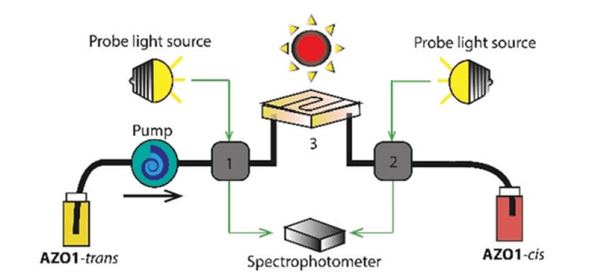
Probably the most efficient way to convert solar energy into electricity is the old fashioned way, heating water into steam and turning a turbine. This remains a messy affair though and you don’t really want a steam boiler on your roof, so solar cells are popular. However, there’s some new research showing how a molecule can absorb solar energy, store it, and then release the heat on demand years later. This could offer new ways to collect and even transport solar power. This new molecule, derived from azobenzene, holds immense promise to change the way we work with solar power.
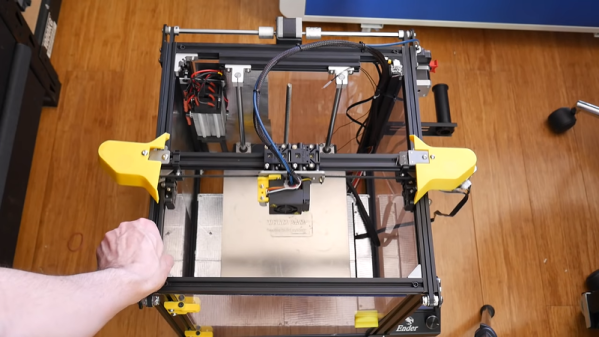
If you are building a CNC machine, a 3D printer, or even a plotter, you have a need for motion in both the X and Y directions. There are many ways to accomplish this, for example, some printers move the tool in the X direction and the bed in the Y direction while others move the entire X carriage in the Y direction and yet more use a delta mechanism. However, one of the oldest means of doing this is the Core XY method. It is interesting because both motors remain stationary and the business end moves entirely on belts or cords. This is similar to the H-Bot technique, but with some differences. [Michael Laws] has a video (see below) that explains how two stationary motors can move a tool anywhere in an XY region.
The idea behind Core XY goes back to at least old drafting tables. You can think of it as an object held by two ends of the same belt. As one end of the belt gets shorter the other end gets longer. The belts are arranged so that motion of one motor causes the tool to move at a 45 degree angle. That means you have to move both motors to go in a straight line.
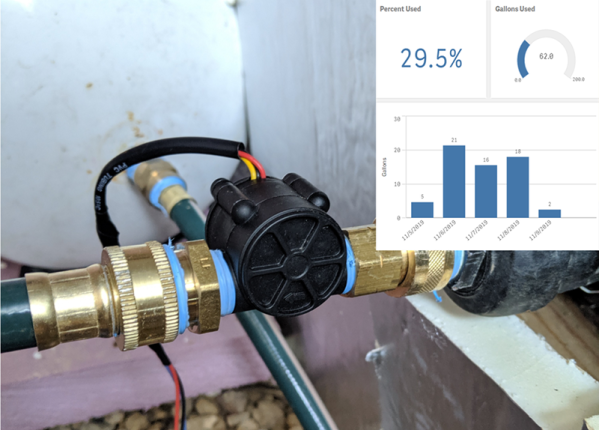
There’s almost always more than one way to get any particular job done. Suppose for instance you have a tank you fill up from a well, and you’d like to know when the time is right to refill the tank. The obvious answer is to measure the level of the tank, and there are plenty of ways to do that. However, [Liam Hanninen] has a different approach. Using a flow meter, he measures how much water leaves the tank. Assuming that you know it was once full, you can deduce how much water is left.
Using a YF-S201 flowmeter on a Raspberry Pi, the code uses Python to populate a database. The meter will need to be calibrated to get an exact volume measurement.
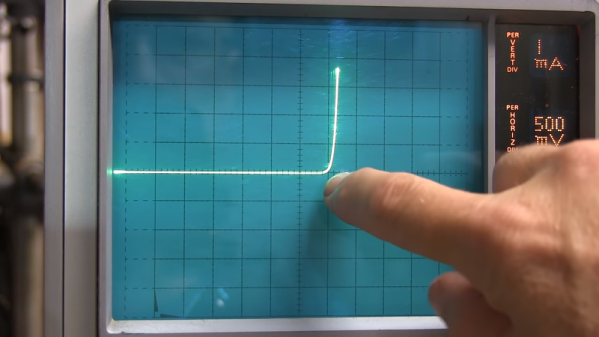
We didn’t think we needed a basic guide to diodes until we saw it was from [W2AEW], and then we knew we’d pick up some new things. Entitled “Diodes from Ideal to Real” the 18-minute video doesn’t disappoint with a mix of notes and time with a curve tracer to learn all about these devices.
As is typical for a [W2AEW] video this doesn’t just cover the simple operation of diode. It includes topics such as dynamic resistance, junction capacitance, and talks about a wide variety of diode types.
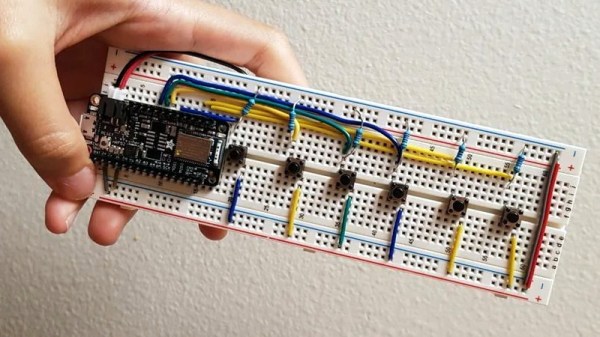
Ever hear of Microsoft Soundscape? We hadn’t, either. But apparently it and similar apps like Blindsquare provide people with vision problems context about their surroundings. The app is made to run in the background of the user’s mobile device and respond to media controls, but if you are navigating around with a cane, getting to media controls on a phone or even a headset might not be very convenient. [Jazzang] set out to build buttons that could control apps like this that could be integrated with a cane or otherwise located in a convenient location.
There are four buttons of interest. Play/pause, Next, Back, and Home. There’s also a mute button and an additional button you can use with the phone’s accessibility settings. Each button has a special function for Soundscape. For example, Next will describe the point of interest in front of you. Soundscape runs on an iPhone so Bluetooth is the obvious choice for creating the buttons.
To simplify things, the project uses an Adafruit Feather nRF52 Bluefruit board. Given that it’s Arduino compatible and provides a Bluetooth Human Interface Device (HID) out of the box, there’s almost nothing else to do for the hardware but wire up the switches and some pull up resistors. That would make the circuit easy to stick almost anywhere.
Software-wise, things aren’t too hard either. The library provides all the Bluetooth HID device trappings you need, and once that’s set up, it is pretty simple to send keys to the phone. This is a great example of how simple so many tasks have become due to the availability of abstractions that handle all of the details. Since a Bluetooth HID device is just a keyboard, you can probably think of many other uses for this setup with just small changes in the software.
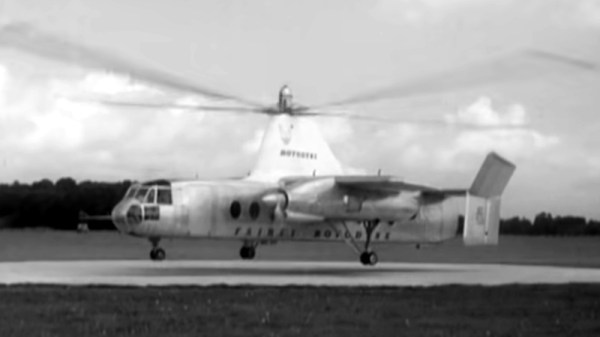
Bacon and eggs, chocolate and peanut butter, salt and pepper; some things just go together. You’d think that a mashup of an airplane and a helicopter would be great, right? The Fairey Rotodyne was just such a thing from the late 1950s and while it looked to be the wave of the future, it never took off — at least, not in the business sense at least. [Mustard] has an excellent video about the machine including some flight footage and explains why it failed to take over the aviation market. You can watch the video below.
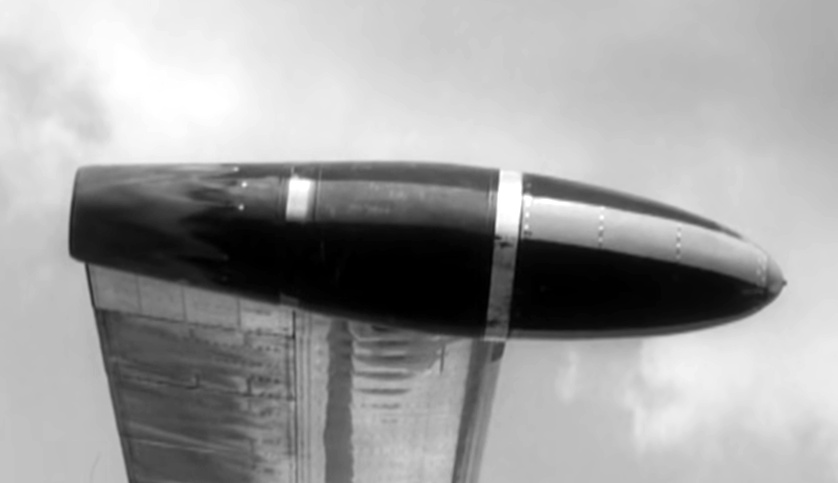
While it does look like a helicopter mated with an airplane, it’s actually a bit different. The rotor isn’t normally powered at all. However, it does turn in forward flight and generates about half the lift the plane needs. That explains the stubby wings. The topside rotor has small jets at the tips that can be used during vertical take off, landing, and hovering modes.
One of the craft’s four tip jets.
For its time, it was fast and efficient, especially compared to contemporary helicopters. This type of plane was known as an autogyro and actually appeared in the 1930s as a safety mechanism since an autogyro can land in an autorotation mode.
According to the video, the noisy tip jets and production delays killed the beast. There was only one prototype built, but there was something we found very attractive about it. There have been, of course, other autogyros. British, German, Japanese, and Russian military have used autogyros at one time or another. The United States Postal Service was known to employ at least one.
Even today, there are about a thousand autogyros used by different military and police organizations. They are cheaper than a helicopter to buy and fly. Sadly, though, it doesn’t look like autogyros will ever become a common sight. Like an airship, they seem like a callback to an earlier time when you have a chance to spot one.
As the world gets more connected and computerized, it is easy to have an unintended consequence pop up and bite you. Especially because, so much of the time, today, things just work. The days of fretting over how to connect two computers, or how to store reasonable amounts of data are gone. Most of us never have to sift through assembly language programs finding three extra bytes to add a feature. Some Russian scientists recently found out about unintended consequences the hard way.
In the United States, the Eagle was long on the endangered species list, but apparently they have a similar problem in Russia. Scientists put a tracker on some migrating eagles in southern Russia and Kazakhstan. A few decades ago, this would have been a big technical challenge, but now you just use cellular technology and have the tracker text its location, right?