Portable Jacob’s Ladder For When…You Know… You Need A Portable Jacob’s Ladder

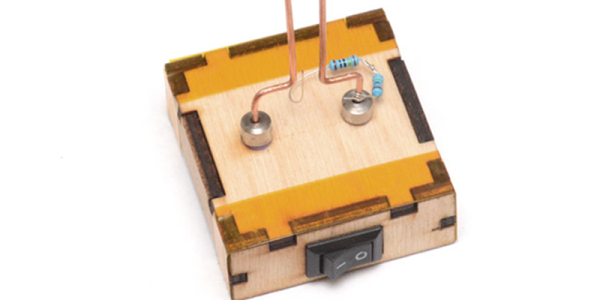
When do you need a portable Jacob’s Ladder? We don’t know, but apparently [mitxela] doesn’t want to leave home (or the laboratory) without one. So he built a portable unit that works for a few minutes on a battery. In the video (see below), he says he wouldn’t presume to claim it was the smallest Jacob’s Ladder ever, but he thought it might be a contender.

The battery is a LiPo cell and although it might last up to four minutes, [mitxela] points out that the transistors probably wouldn’t survive that much on time, despite the heat sinks he put in place. The whole device is 45mm square and 17mm thick. Of course, the wires add some height (about 150mm total).

We were hoping to see more of the insides, but we presume this uses one of the cheap high voltage modules you can procure from the usual Far East sources–or, at least–it could. The rest is just laser cutting and workmanship.

If you haven’t encountered them before (outside of old monster movies), a Jacob’s Ladder lets high voltage ionize the air down at the bottom of the narrow gap. The ionized air is hot and rises, and the current flows through it, despite the electrodes getting further apart. Of course, that means you shouldn’t put on in your zero-gee space station.

You might think a portable Jacob’s ladders is unique. Turns out, it isn’t. If you want something easy (and perhaps not as portable), you can’t get much easier than this one.

Continue reading “Portable Jacob’s Ladder For When…You Know… You Need A Portable Jacob’s Ladder”

Raspberry Pi Malware Mines BitCoin

According to Russian security site [Dr.Web], there’s a new malware called Linux.MulDrop.14 striking Raspberry Pi computers. In a separate posting, the site examines two different Pi-based trojans including Linux.MulDrop.14. That trojan uses your Pi to mine BitCoins some form of cryptocurrency. The other trojan sets up a proxy server.

According to the site:

Linux Trojan that is a bash script containing a mining program, which is compressed with gzip and encrypted with base64. Once launched, the script shuts down several processes and installs libraries required for its operation. It also installs zmap and sshpass.

It changes the password of the user “pi” to “\$6\$U1Nu9qCp\$FhPuo8s5PsQlH6lwUdTwFcAUPNzmr0pWCdNJj.p6l4Mzi8S867YLmc7BspmEH95POvxPQ3PzP029yT1L3yi6K1”.

In addition, the malware searches for network machines with open port 22 and tries to log in using the default Raspberry Pi credentials to spread itself.

Embedded systems are a particularly inviting target for hackers. Sometimes it is for the value of the physical system they monitor or control. In others, it is just the compute power which can be used for denial of service attacks on others, spam, or — in the case — BitCoin mining. We wonder how large does your Raspberry Pi botnet needs to be to compete in the mining realm?

We hope you haven’t kept the default passwords on your Pi. In fact, we hope you’ve taken our previous advice and set up two factor authentication. You can do other things too, like change the ssh port, run fail2ban, or implement port knocking. Of course, if you use Samba to share Windows files and printers, you ought to read about that vulnerability, as well.

Holograms Can’t Be Too Thin

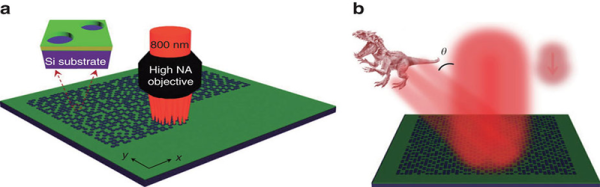
We’ve seen the 3D phone fad come and go, with devices like the Evo 3D, that used a parallax barrier to achieve autostereoscopy (that is, 3D viewing without glasses). These displays aren’t holograms, they are just showing your eyes two different images like a 3D movie or a stereopticon. However, researchers from Australia and China are hoping to change that. They’ve developed a nano-hologram (their term) that is about 1000 times thinner than a human hair. You can see a video about the invention, below.

Conventional holograms modulate the phase of light to give the illusion of three-dimensional depth. But to generate the required phase shifts, those holograms need to be as thick as the optical wavelengths involved. The researchers claim the holograms are “simple” to make, but that depends on what you compare it to. You need some exotic materials, vacuum deposition gear, and a laser that can do femtosecond-long pulses.

The research team has broken this thickness limit with a 25 nanometer hologram. Their technique relies on a topological insulator material a novel quantum material that holds a low refractive index in the surface layer but a much higher refractive index in the bulk of the material. This forms an intrinsic optical resonant cavity which can enhance the phase shifts and makes holography possible.

The next step is to develop a rigid thin film to overlay an LCD screen. The current version has pixels at least ten times too large to be practical for that application, so that’s another hurdle to overcome.

We’ve seen screens that shoot 3D images on movies like Star Wars for years. This isn’t it yet, but it is the next step. Imagine a phone, a wrist watch, or a contact lens that could generate a holographic image. Or a garbage-can-sized robot.

Continue reading “Holograms Can’t Be Too Thin”

540 PCBs Make A Giant LED Cube

Just about anyone can make a simple LED cube. But what if you want to make a 1-meter cube using 512 LEDs? [Hari] wanted to do it, so he created two different kinds of LED boards using EasyEDA. There are 270  of each type of board, for a total of 540 (there are only 512 LEDs, so we guess he got some spares due to how the small boards panelized). The goal is to combine these boards to form a cube measuring over three feet on each side.

To simplify wiring, the boards are made to daisy chain like a cordwood module. However, to get things to line up, each column of LED boards have to rotate 90 degrees. You can see several videos about the project below.

Continue reading “540 PCBs Make A Giant LED Cube”

Inside A Microswitch

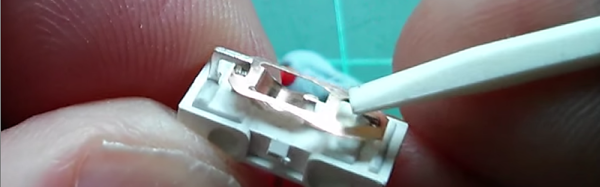
We’ve taken a few microswitches apart, mostly to fix those pesky Logitech mice that develop double-click syndrome, but we’ve never made a video. Luckily, [Julian] did, and it is worth watching if you want to understand the internal mechanism of these components.

[Julian] talks about the way the contacts make and break. He also discusses the mechanical hysteresis inherent in the system because of the metal moving contact having spring-like qualities

Continue reading “Inside A Microswitch”

Disco Flashlight Binary Analog Clock?

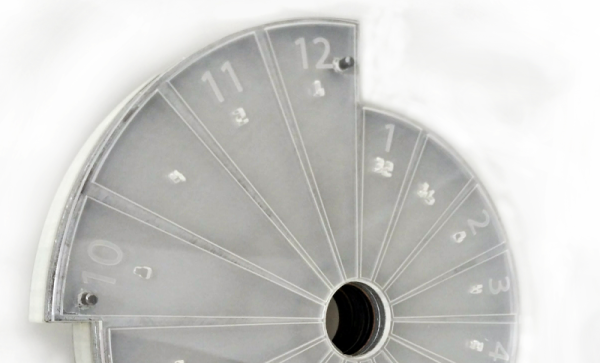
As multitools have lots of different functions in one case, so [Shadwan’s] clock design incorporates a multitude of features. He started the design as a binary clock using a Fibonacci spiral for the shape. However, the finished clock has four modes. The original binary clock, an analog clock, a flashlight (all lights on), and a disco mode that strobes multiple lights.

[Shadwan] used Rhino to model the case and then produced it using a laser cutter. The brains are — small wonder — an Arduino. A 3D-printed bracket holds everything together. You can see the result in the video below.

Continue reading “Disco Flashlight Binary Analog Clock?”

Digital Clock Goes With The Grain

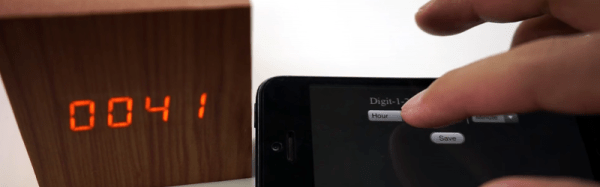
This good-looking clock appears to be made out of a block of wood with LED digits floating underneath. In reality, it is a block of PLA plastic covered with wood veneer (well, [androkavo] calls it veneer, but we think it might just be a contact paper or vinyl with a wood pattern). It makes for a striking effect, and we can think of other projects that might make use of the technique, especially since the wood surface looks much more finished than the usual 3D-printed part.

You can see a video of the clock in operation below. The clock circuit itself is nothing exceptional. Just a MAX7218 LED driver and a display along with an STM32 ARM processor. The clock has a DHT22 temperature and humidity sensor, as well as a speaker for an alarm.

Continue reading “Digital Clock Goes With The Grain”